Spain Francisco Goya Las Rinde el Sueno Los Caprichos 34 Sleep Heliogravure c1970
29,00 €
Francisco Goya – Las rinde el sueño – Los Caprichos Plate 34 – Heliogravure circa 1970
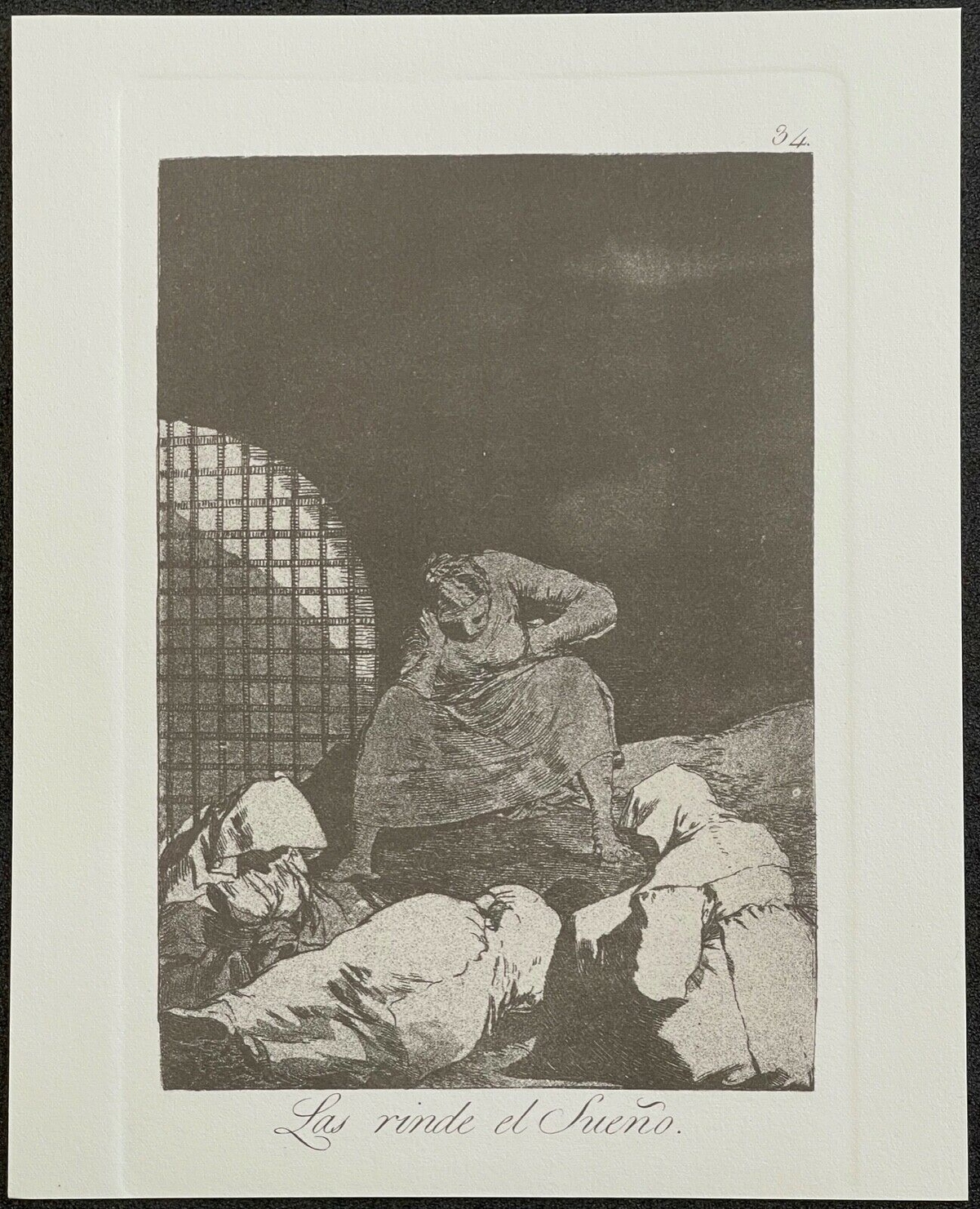
Fine twentieth-century heliogravure after Francisco de Goya (1746–1828), reproducing plate 34 of Los Caprichos, originally published in Madrid in 1799.
A dramatic scene showing four exhausted women overcome by sleep in a dark, confined interior with a barred window.
The composition is distinguished by powerful tonal contrasts and Goya’s characteristic social satire.
Technique: Heliogravure, circa 1970.
Sheet dimensions: 24.3 × 19.6 cm.
Image dimensions: 19.3 × 13.5 cm.
Reference: 4930-78R549.
Description
Francisco Goya Las Rinde el Sueno – Los Caprichos Plate 34 – Sleep Overcomes Them – Heliogravure circa 1970
Francisco Goya Las Rinde el Sueno – Fine twentieth-century heliogravure circa 1970 after plate 34 of the celebrated Spanish series Los Caprichos, originally published in Madrid in 1799.
Artculture6 presents this remarkable heliogravure after Francisco de Goya y Lucientes (1746–1828), one of the most important Spanish artists and printmakers.
The composition, entitled Las rinde el sueño (Sleep Overcomes Them), belongs to Goya’s celebrated series of eighty satirical prints known as Los Caprichos.
The scene depicts four exhausted women in a dark interior, apparently overcome by sleep and fatigue.
The dramatic contrasts between the illuminated figures, the barred opening and the surrounding darkness create an atmosphere of confinement, silence and melancholy.
LAS RINDE EL SUEÑO – SLEEP OVERCOMES THEM
The composition presents four women arranged within a confined interior.
At the centre, a woman sits upon a raised surface, her body bent forward and her head lowered in exhaustion.
Her posture conveys an overwhelming sense of physical and emotional fatigue.
Three other women occupy the foreground.
Their bodies are lying down or curled into uncomfortable positions, apparently overcome by sleep.
Their clothing forms large areas of pale drapery that contrast dramatically with the dark surroundings.
Goya gives particular importance to the position of their bodies, using gestures rather than elaborate facial expressions to communicate exhaustion.
A DARK INTERIOR AND A BARRED WINDOW
One of the most striking features of the composition is the large barred opening visible on the left.
The grid of vertical and horizontal bars suggests a prison cell or another enclosed institutional space.
Light enters through this opening, illuminating parts of the women’s clothing and establishing a strong contrast with the almost entirely black background.
The surrounding architecture is deliberately understated.
Goya concentrates attention on the sleeping women and their physical condition.
The absence of elaborate decorative detail contributes to the scene’s oppressive atmosphere.
THE SOCIAL SATIRE OF FRANCISCO GOYA
The meaning of Las rinde el sueño extends beyond a straightforward representation of sleeping figures.
Goya frequently employed ordinary human situations to expose moral contradictions, social injustice and the consequences of ignorance or oppression.
The confined setting has encouraged interpretations associated with imprisonment and the condition of women.
Contemporary commentaries on Los Caprichos offer different explanations, including moral and social readings of the women’s apparent exhaustion.
The composition deliberately leaves room for interpretation.
The figures may appear peaceful at first sight, but the uncomfortable postures, barred window and overwhelming darkness introduce a sense of unease.
This ambiguity is characteristic of Goya’s satirical vision.
FRANCISCO DE GOYA (1746–1828)
Francisco José de Goya y Lucientes was born in Fuendetodos, Spain, in 1746.
He became one of the most influential European artists of the late eighteenth and early nineteenth centuries.
His work encompasses royal portraiture, religious painting, historical compositions, drawings and some of the most innovative prints of his era.
Goya developed a distinctive artistic language combining realism, psychological observation, social criticism and imaginative expression.
His graphic works frequently explore the darker aspects of human behaviour and the contradictions of contemporary society.
His influence extended far beyond Spain, helping to shape the development of modern European art.
LOS CAPRICHOS – A MASTERPIECE OF SPANISH PRINTMAKING
Published in Madrid in 1799, Los Caprichos consists of eighty compositions examining the social and moral failings of Goya’s time.
The series addresses superstition, ignorance, hypocrisy, cruelty, social ambition and the abuse of authority.
Goya employed etching and aquatint, sometimes combined with other intaglio techniques, to create extraordinary variations of light, texture and atmosphere.
Many compositions use fantasy and grotesque imagery, while others derive their power from apparently ordinary scenes of human life.
Las rinde el sueño, plate 34, belongs to this second tradition.
Its dramatic contrasts and understated gestures demonstrate Goya’s ability to express complex ideas through a simple arrangement of figures.
THE ORIGINAL PRINT OF 1799
The original composition was developed in the late 1790s and published in 1799 as part of Los Caprichos.
The etching and burnished aquatint technique allowed Goya to create the characteristic dark background and subtle tonal modelling.
In the original print, the figures are represented in varying degrees of light, with the central woman seated above the others.
The barred opening on the left provides an important architectural clue to the setting.
The title Las rinde el sueño appears beneath the image.
The number 34 identifies the composition’s position within the original series.
The Metropolitan Museum of Art and other major museum collections preserve original impressions of this work.
TONAL CONTRASTS AND ARTISTIC EXPRESSION
The composition is distinguished by its strong contrast between light and darkness.
The women’s clothing is rendered through delicate graphic lines and broad illuminated surfaces.
The darker portions of the image create an enveloping atmosphere, suggesting the quiet of a confined nocturnal space.
The central figure becomes the focus of the composition through her slightly elevated position.
The surrounding women form a group whose bodies appear almost merged into the folds of their garments.
This careful arrangement gives the print a remarkable sense of unity and emotional intensity.
THE HELIOGRAVURE PROCESS
The present example is a twentieth-century heliogravure produced circa 1970 after Goya’s original composition.
Heliogravure is a photomechanical printing process capable of reproducing fine details and subtle tonal gradations.
It has been widely employed for reproducing historical engravings and drawings in high-quality art publications.
This example preserves the principal characteristics of Goya’s image, particularly the dark background, illuminated figures and original Spanish inscription.
This is a circa 1970 heliogravure reproduction, not an original etching or aquatint printed during Goya’s lifetime.
TECHNICAL DETAILS
Artist of the original composition: Francisco de Goya y Lucientes (1746–1828).
Original title: Las rinde el sueño.
English title: Sleep Overcomes Them.
French title: Le sommeil les vainc.
Series: Los Caprichos.
Plate number: 34.
Original publication: Madrid, Spain, 1799.
Original technique: Etching and burnished aquatint.
Technique of this example: Heliogravure.
Date of this example: Circa 1970.
Sheet dimensions: 24.3 × 19.6 cm.
Image dimensions: 19.3 × 13.5 cm.
Reference: 4930-78R549.
CONDITION
Vintage example displaying the natural patina of the paper.
The reproduced composition and original inscriptions remain well preserved.
COLLECTOR’S INTEREST
An appealing twentieth-century heliogravure after one of Francisco Goya’s most celebrated print series.
Particularly interesting for collectors of Spanish art, Los Caprichos, historical printmaking, social satire, female subjects and representations of sleep, confinement and melancholy.
The contrast between the sleeping figures and the surrounding darkness gives this composition a powerful visual presence.
An attractive addition to a collection devoted to Goya and the history of European graphic art.
Offered by Artculture6 – Antique Prints, Drawings and Works of Art.



Avis
Il n’y a pas encore d’avis.