Spain Francisco Goya No Grites Tonta Los Caprichos 74 Fantasy Heliogravure c1970
29,00 €
Francisco Goya No Grites Tonta – Los Caprichos Plate 74 – Heliogravure circa 1970
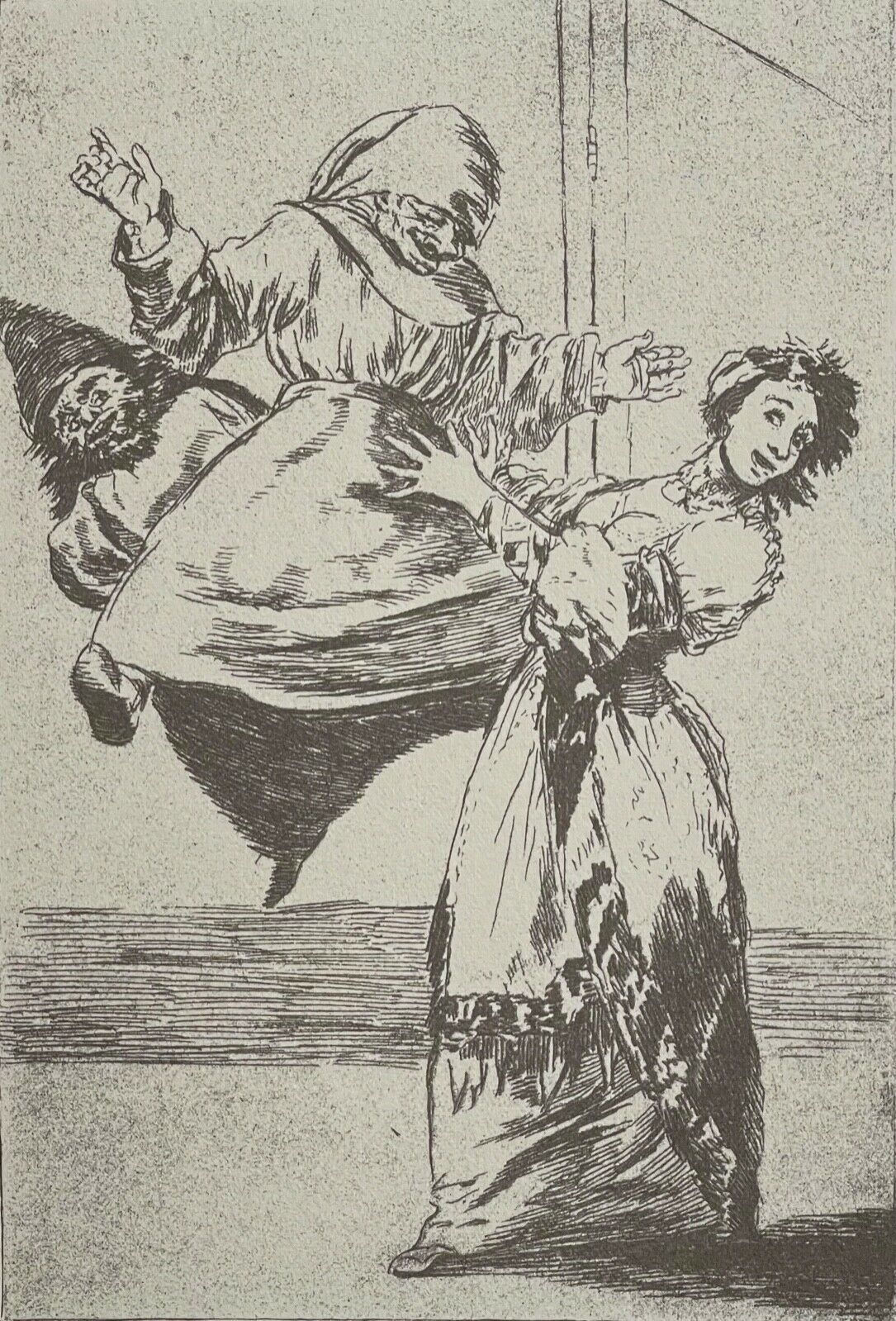
Fine twentieth-century heliogravure after Francisco de Goya (1746–1828), reproducing plate 74 of his celebrated series Los Caprichos, originally published in Madrid in 1799.
A mysterious satirical scene showing an elegantly dressed young woman approached by two hooded, goblin-like figures, combining fantasy, seduction and social criticism.
Technique: Heliogravure, circa 1970.
Sheet dimensions: 25 × 18.7 cm.
Image dimensions: 19 × 12.9 cm.
Reference: 4930-79R549.
Description
Francisco Goya No Grites Tonta – Los Caprichos Plate 74 – Spanish Satirical Heliogravure circa 1970
Francisco Goya No Grites Tonta – Fine twentieth-century heliogravure circa 1970 after plate 74 of the celebrated Spanish series Los Caprichos, originally published in Madrid in 1799.
Artculture6 presents this attractive heliogravure after Francisco de Goya y Lucientes (1746–1828), one of the most influential painters and printmakers in the history of Spanish art.
The composition, entitled No grites, tonta (Don’t Scream, Silly), belongs to Goya’s celebrated series of eighty satirical prints known as Los Caprichos.
This remarkable scene combines fantasy, social satire, seduction and the ambiguous appearance of supernatural figures.
The original composition dates from the late eighteenth century and was first published as part of Los Caprichos in 1799.
NO GRITES, TONTA – A MYSTERIOUS ENCOUNTER
The engraving depicts a richly dressed young woman suddenly confronted by two extraordinary figures.
The woman stands in the foreground, wearing an elegant long dress decorated with delicate lace and elaborate folds.
Her body leans backwards while her head turns towards the viewer.
Rather than displaying an expression of genuine terror, she appears to offer a subtle and knowing smile.
Behind her, a large hooded figure approaches with both arms extended.
The character wears a voluminous robe and seems to hover above the floor, creating an unsettling impression of supernatural movement.
A second, smaller figure appears behind the first.
This bearded character wears a pointed cap and emerges from beneath the folds of the larger figure’s clothing.
The composition creates an unusual encounter between an apparently respectable young woman and two mysterious visitors.
FANTASY, SEDUCTION AND SOCIAL SATIRE
The meaning of No grites, tonta has attracted considerable scholarly attention.
The title can be translated into English as Don’t Scream, Silly or Don’t Shout, Foolish Girl.
At first sight, the scene appears to illustrate a frightening encounter with supernatural creatures.
However, Goya introduces a more ambiguous interpretation through the expression and posture of the young woman.
Her smile suggests that the unexpected visitors may not be entirely unwelcome.
The figures have been interpreted as goblins or men disguised as supernatural beings.
Some interpretations also associate their clothing with religious garments, suggesting a satire of concealed romantic encounters and the hypocrisy of outward respectability.
The work combines humour and discomfort, inviting the viewer to question appearances and conventional morality.
THE PREPARATORY DRAWING
Goya produced a preparatory drawing for this composition, preserved in the Museo Nacional del Prado in Madrid.
In the preparatory study, the central female figure differs from her appearance in the final print.
The original drawing presents a more frightened reaction to the two approaching figures.
In the completed composition, Goya transformed her expression into a more ambiguous and subtly amused smile.
This change is particularly significant.
It shifts the interpretation of the scene from a straightforward supernatural encounter towards a more complex satire involving desire, false modesty and social convention.
The final composition demonstrates Goya’s extraordinary ability to convey meaning through small variations in facial expression and gesture.
FRANCISCO DE GOYA (1746–1828)
Francisco José de Goya y Lucientes was born in Fuendetodos, Spain, in 1746.
He became one of the most important European artists of the late eighteenth and early nineteenth centuries.
His career included royal portraiture, religious painting, historical compositions, drawings and innovative graphic works.
Goya developed a distinctive artistic language that combined realism, psychological observation, satire and a fascination with the darker aspects of human nature.
His prints frequently examined superstition, religious hypocrisy, ignorance, social inequality and the contradictions of contemporary society.
His graphic work profoundly influenced the development of modern European art.
LOS CAPRICHOS – EIGHTY SATIRICAL PRINTS
Published in Madrid in 1799, Los Caprichos consists of eighty compositions exploring the social and moral contradictions of Spanish society.
The series includes scenes of everyday life, grotesque characters, fantastic apparitions and symbolic representations of human folly.
Goya employed etching and aquatint, together with related intaglio techniques, to create a remarkable variety of tonal effects.
Many of the later plates are distinguished by the appearance of witches, goblins and strange creatures.
These supernatural subjects allowed Goya to explore human behaviour through the language of fantasy and satire.
No grites, tonta, plate 74, is a characteristic example of this imaginative and critical approach.
THE ORIGINAL COMPOSITION
The image is arranged vertically.
Three principal figures occupy the foreground against a restrained interior background.
The large hooded character dominates the centre of the composition, with its wide robe creating a strong contrast against the lighter dress of the young woman.
The smaller figure emerges from behind the drapery, contributing an element of grotesque humour.
Fine graphic lines define the costumes, faces and hands, while the darker tonal passages create depth and dramatic emphasis.
The title No grites, tonta appears beneath the composition.
The number 74 is visible in the upper-right corner, identifying the work’s position within the original series.
THE HELIOGRAVURE PROCESS
The present example is a twentieth-century heliogravure produced circa 1970 after Goya’s original composition.
Heliogravure is a photomechanical printing process used to reproduce the tonal qualities and fine details of drawings, engravings and other works of art.
It was particularly valued for reproducing historical graphic works with subtle gradations of tone.
This example faithfully reproduces the characteristic arrangement of the figures, the expressive gestures and the original Spanish title.
This is a circa 1970 heliogravure reproduction, not an original eighteenth-century etching or aquatint printed during Goya’s lifetime.
TECHNICAL DETAILS
Artist of the original composition: Francisco de Goya y Lucientes (1746–1828).
Original title: No grites, tonta.
English title: Don’t Scream, Silly.
Series: Los Caprichos.
Plate number: 74.
Original publication: Madrid, Spain, 1799.
Technique of this example: Heliogravure.
Date of this example: Circa 1970.
Sheet dimensions: 25 × 18.7 cm.
Image dimensions: 19 × 12.9 cm.
Reference: 4930-79R549.
CONDITION
Vintage example displaying the natural patina of the paper.
The reproduced composition and original inscriptions remain well preserved.
COLLECTOR’S INTEREST
An attractive twentieth-century heliogravure after one of Francisco Goya’s most celebrated graphic series.
Particularly interesting for collectors of Spanish art, Los Caprichos, fantasy imagery, social satire, historical printmaking and the representation of supernatural figures in European art.
The ambiguous expression of the young woman, the mysterious hooded visitors and the delicate tonal contrasts make this composition a memorable example of Goya’s imaginative world.
Offered by Artculture6 – Antique Prints, Drawings and Works of Art.



Avis
Il n’y a pas encore d’avis.