The Butter Churner – Jean-François Millet – French Antique Heliogravure on Wove Paper
29,00 €
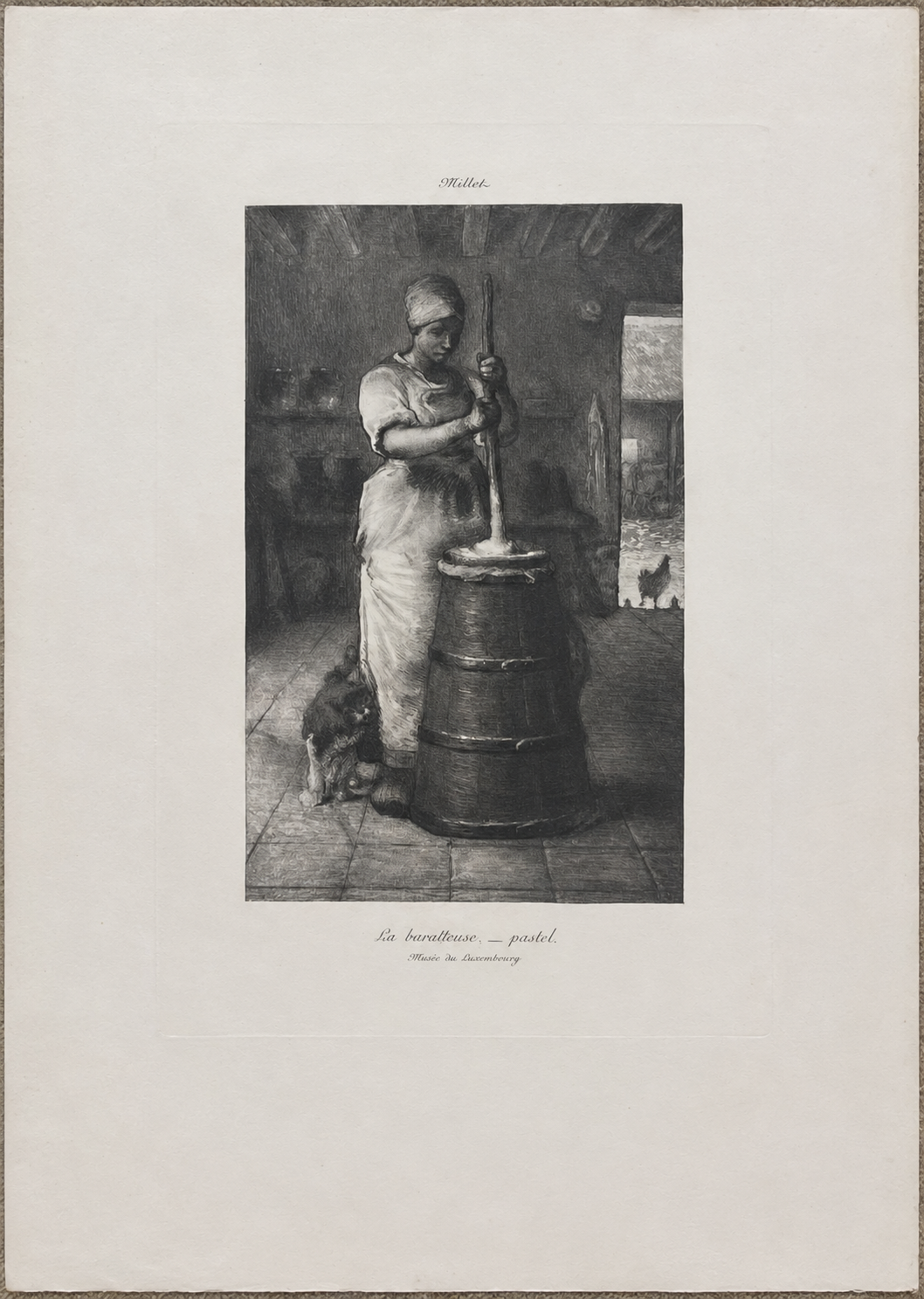
Antique French heliogravure circa 1910 after Jean-François Millet (1814–1875), entitled La Baratteuse (The Butter Churner).
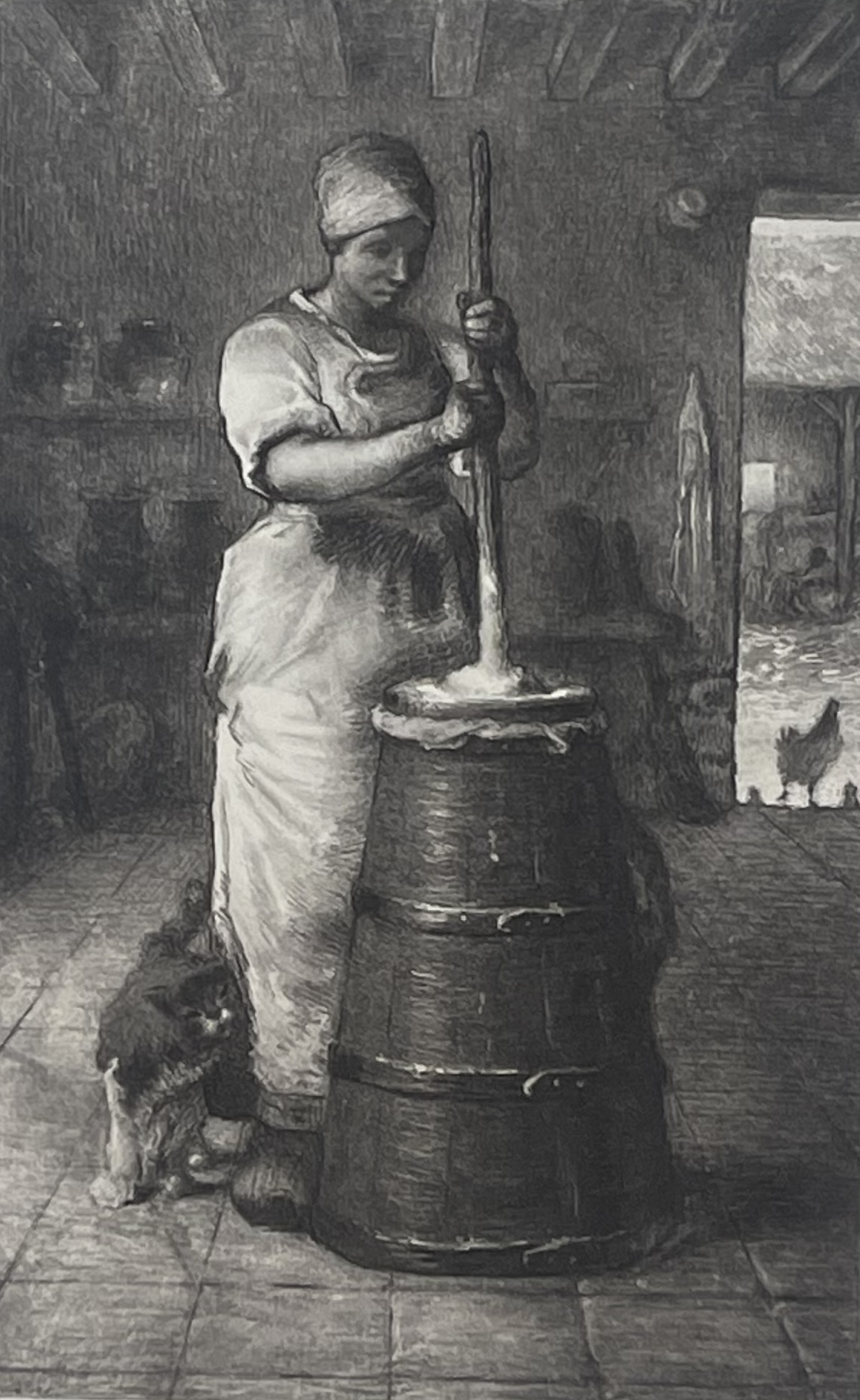
A beautifully detailed rural scene depicting a peasant woman making butter inside a farmhouse, with a cat beside her and chickens visible outside.
Printed on wove paper, with attractive tonal contrasts and generous margins.
Sheet: 32.3 × 22.8 cm.
Printed image: 17.6 × 10.9 cm.
Description
JEAN FRANCOIS MILLET HELIOGRAVURE – THE BUTTER CHURNER – CIRCA 1910
Antique French Heliogravure on Wove Paper – La Baratteuse
An attractive early twentieth-century French heliogravure after Jean-François Millet (1814–1875), entitled La Baratteuse(The Butter Churner).
Printed circa 1910 on fine wove paper, this elegant antique print reproduces one of Millet’s characteristic compositions devoted to rural life and traditional agricultural activities.
The scene depicts a peasant woman making butter inside a farmhouse, surrounded by the familiar objects and animals of everyday country life.
THE BUTTER CHURNER – A SCENE OF FRENCH RURAL LIFE
At the centre of the composition, a countrywoman stands beside a large wooden butter churn.
She holds the long vertical handle with both hands, concentrating on the repetitive movement required to transform cream into butter.
Her traditional working clothes consist of a simple dress, an apron and a headscarf.
Her strong posture and concentrated expression convey the physical effort involved in domestic work.
A cat stands beside her feet, while an open doorway reveals a farmhouse courtyard where chickens can be seen.
The rustic wooden interior, household utensils and atmospheric lighting create an intimate representation of nineteenth-century rural life.
Millet’s composition is distinguished by its naturalism, quiet dignity and careful observation of everyday human activity.
TRADITIONAL BUTTER MAKING IN THE COUNTRYSIDE
Before the mechanisation of agricultural production, butter making was an essential activity in many European farming households.
Cream was placed inside a wooden churn and repeatedly agitated until the butterfat separated from the liquid.
The process required physical effort, patience and practical experience.
In many rural households, this work was traditionally performed by women.
Millet’s depiction of a woman operating a butter churn provides an engaging historical representation of a once familiar agricultural activity.
The artist transforms an ordinary domestic task into a subject of considerable artistic significance.
JEAN-FRANÇOIS MILLET (1814–1875)
Jean-François Millet was one of the leading French painters associated with the Barbizon School.
Born in Normandy, he developed a profound interest in the lives of peasants and agricultural workers.
His paintings and drawings are distinguished by their sympathetic observation of rural labour and everyday human experience.
Among his most celebrated compositions are The Gleaners, The Angelus and The Sower.
Millet’s art combines realistic observation with a remarkable sense of human dignity.
His representations of rural workers had a lasting influence on the development of nineteenth-century European painting.
Vincent van Gogh was among the artists deeply influenced by Millet’s work.
AN ANTIQUE HELIOGRAVURE ON WOVE PAPER
Heliogravure is a photomechanical intaglio printing process valued for its ability to reproduce fine details and delicate tonal variations.
The technique was widely used for high-quality reproductions of paintings, drawings and photographic images.
The present antique impression dates from approximately 1910.
It is printed on wove paper, providing an even surface particularly suited to the subtle tonal effects of heliogravure.
The rich blacks and carefully reproduced details preserve the atmosphere of Millet’s original composition.
The sheet retains generous margins around the printed image.
The name of Millet and the original French title appear in the printed presentation.
THE BARBIZON SCHOOL AND FRENCH RURAL ART
The Barbizon School played an important role in the development of nineteenth-century landscape and genre painting.
Its artists moved away from idealised academic subjects and developed a more direct observation of nature and rural life.
Millet was particularly interested in the dignity of agricultural labour.
His representations of peasants working in fields, farmhouses and rural settings became some of the most influential images of nineteenth-century France.
The Butter Churner belongs to this artistic tradition, celebrating the everyday activities of rural workers.
AN ATTRACTIVE COLLECTOR’S PRINT
This early twentieth-century heliogravure is of interest to collectors of Jean-François Millet, the Barbizon School, French rural art and antique prints.
The intimate farmhouse scene, traditional butter churn and expressive central figure make it a charming example of French artistic imagery.
The print combines the historical interest of traditional agricultural practices with the artistic importance of Millet’s original composition.
DETAILS
Artist: After Jean-François Millet (1814–1875).
Original title: La Baratteuse.
English title: The Butter Churner.
Date of impression: Circa 1910.
Technique: Heliogravure.
Paper: Wove paper.
Sheet dimensions: 32.3 × 22.8 cm.
Printed image: 17.6 × 10.9 cm.
Period: Early 20th century.
Origin: France.
Subject: French rural life, butter making, farmhouse interior and peasant woman.
CONDITION
Antique impression showing the natural patina of aged wove paper.
The printed composition, tonal contrasts and original inscriptions remain well preserved.
The sheet retains generous margins around the image.
An attractive antique French heliogravure reproducing a celebrated composition by Jean-François Millet.
Reference: 4802-21R462



Avis
Il n’y a pas encore d’avis.