Spain Francisco Goya Por Que Fue Sensible Los Caprichos 32 Prison Woman Heliogravure c1970
29,00 €
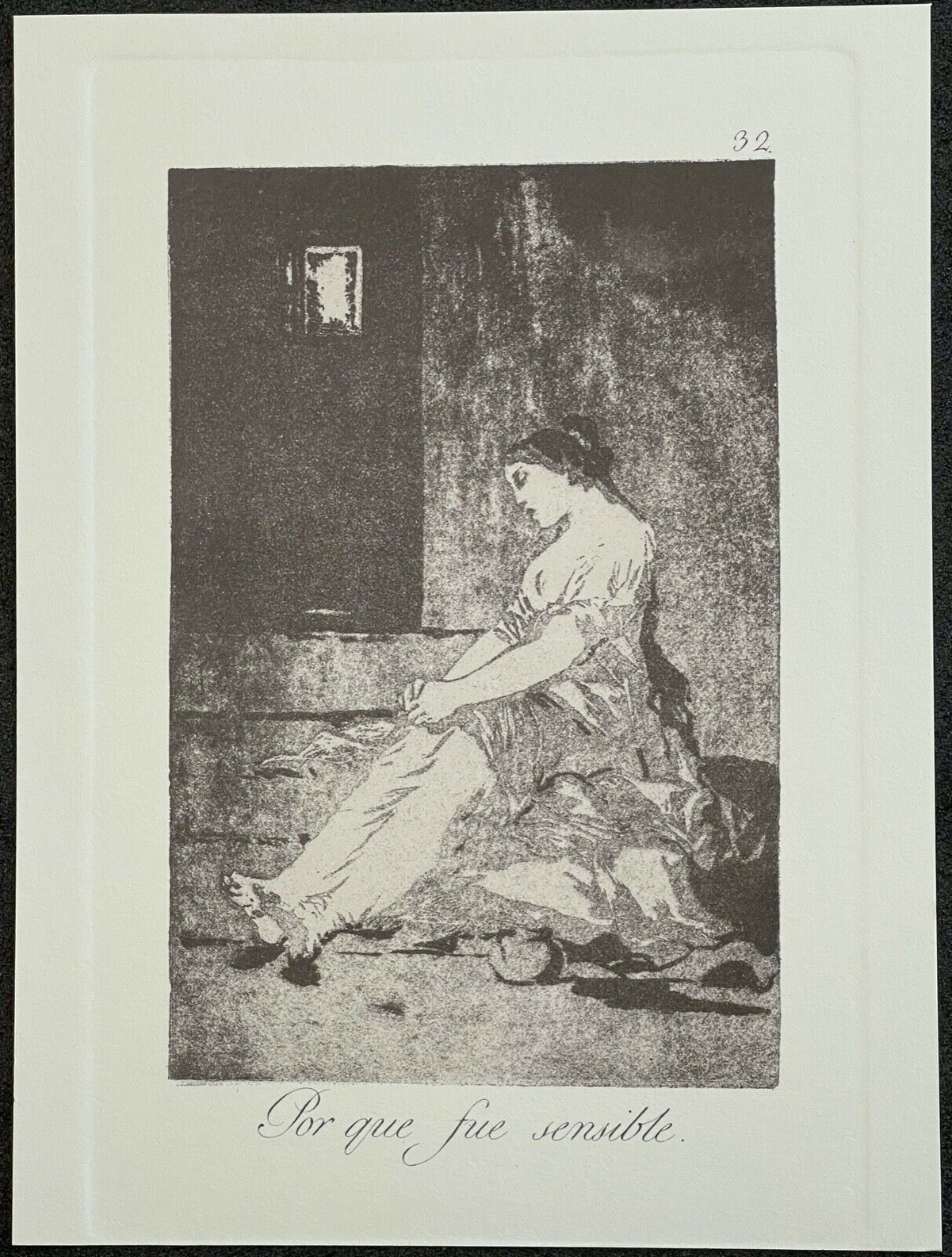
Francisco Goya – Por que fue sensible – Los Caprichos Plate 32 – Heliogravure circa 1970
Fine twentieth-century heliogravure after Francisco de Goya (1746–1828), reproducing plate 32 of Los Caprichos, originally published in Madrid in 1799.
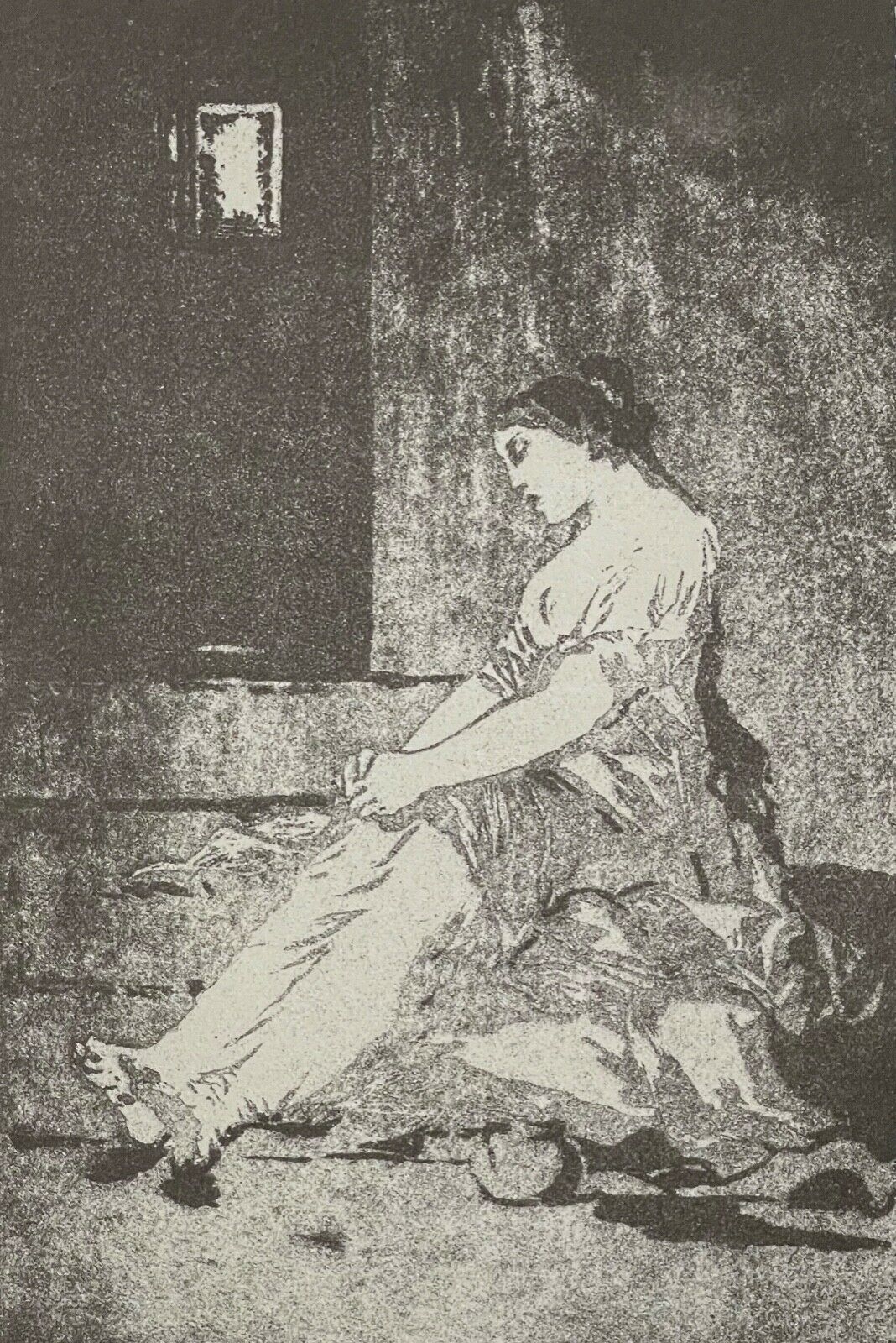
A moving composition showing a young woman seated alone inside a dark prison cell, her head bowed in sadness.
The scene reflects Goya’s interest in imprisonment, social injustice and the condition of women.
Technique: Heliogravure, circa 1970.
Sheet dimensions: 24 × 17.9 cm.
Image dimensions: 18 × 11.9 cm.
Reference: 4930-77R549.
Description
Francisco Goya Por Que Fue Sensible – Los Caprichos Plate 32 – Imprisoned Woman – Heliogravure circa 1970
Francisco Goya Por Que Fue Sensible – Fine twentieth-century heliogravure circa 1970 after plate 32 of the celebrated Spanish series Los Caprichos, originally published in Madrid in 1799.
Artculture6 presents this remarkable heliogravure after Francisco de Goya y Lucientes (1746–1828), one of the most influential painters and printmakers in European art history.
The composition, entitled Por que fue sensible (Because She Was Sensitive), portrays a solitary young woman seated inside a dark prison cell.
The dramatic contrast between the illuminated figure and the surrounding darkness creates a powerful image of confinement, melancholy and human suffering.
POR QUE FUE SENSIBLE – A WOMAN IN PRISON
The engraving depicts a young woman sitting alone upon the stone steps of a prison interior.
She wears a long dress with numerous carefully rendered folds.
Her head is bowed, her shoulders are slightly bent and her hands rest together upon her knees.
Her expression suggests deep sadness and resignation.
The woman occupies the central foreground, surrounded by an almost entirely dark architectural setting.
A small opening in the upper-left area allows a limited amount of light to enter the cell.
The surrounding walls and stone surfaces emphasise the isolation of the figure.
The composition is remarkable for its simplicity and emotional intensity.
AN ATMOSPHERE OF CONFINEMENT AND SOLITUDE
Goya has reduced the setting to a few essential elements.
The young woman is seated in a confined space with very little light.
The dark surroundings create an oppressive atmosphere, while the illuminated portions of her face and clothing immediately attract the viewer’s attention.
The absence of other figures reinforces her solitude.
The contrast between the pale dress and the surrounding darkness gives the composition its distinctive visual character.
Small objects on the floor, including a vessel, contribute to the impression of a harsh prison environment.
The scene is both intimate and unsettling.
SOCIAL CRITICISM IN LOS CAPRICHOS
The meaning of Por que fue sensible extends beyond a simple representation of imprisonment.
Goya frequently used his prints to criticise the moral conventions, social inequalities and injustices of contemporary Spanish society.
This composition has been associated with the situation of women exposed to punishment, poverty and social condemnation.
Some historical interpretations suggest that the imprisoned woman may be connected with the preceding plate, Ruega por ella, which examines the world of prostitution and its social consequences.
In this reading, the woman has been imprisoned following a life shaped by difficult circumstances and questionable social relationships.
The scene therefore becomes a commentary on the vulnerability of women and the severity of contemporary moral judgement.
A POSSIBLE REFERENCE TO A CRIMINAL CASE
Another interpretation associates the composition with María Vicenta Mendieta, a woman involved in a highly publicised murder case in Madrid.
Mendieta and her lover Santiago San Juan were convicted following the killing of her husband, Francisco del Castillo.
The case was tried in February 1798, and both defendants were executed in April of that year.
The affair attracted considerable public attention.
Scholars have suggested that Goya may have drawn inspiration from this case when creating images concerned with imprisonment, punishment and the condition of women.
The identification remains an interpretation rather than a definitive portrait of a particular historical person.
FRANCISCO DE GOYA (1746–1828)
Francisco José de Goya y Lucientes was born in Fuendetodos, Spain, in 1746.
He became one of the greatest Spanish painters, draughtsmen and printmakers.
His career included royal portraits, religious paintings, historical compositions and a remarkable body of graphic work.
Goya developed a deeply personal artistic language combining realism, satire, psychological observation and criticism of social institutions.
His prints often explore themes of cruelty, superstition, hypocrisy, punishment and human vulnerability.
His influence extended far beyond Spain and contributed to the development of modern European art.
LOS CAPRICHOS – A MASTERPIECE OF SPANISH PRINTMAKING
First published in Madrid in 1799, Los Caprichos consists of eighty compositions examining the customs, beliefs and contradictions of Spanish society.
The series addresses subjects such as ignorance, superstition, corruption, prostitution, social ambition and the abuse of authority.
Goya employed etching, aquatint and related intaglio techniques to create powerful variations of light and shadow.
Por que fue sensible, plate 32, is one of the compositions in which the emotional significance of the human figure is intensified by an almost entirely dark setting.
The original print is especially admired for its sophisticated use of aquatint.
THE ORIGINAL AQUATINT COMPOSITION
Goya developed the original composition between approximately 1797 and 1799.
The original copperplate was executed principally in aquatint, with delicate drypoint details.
The artist used contrasting tonal areas to establish the dark atmosphere of the prison cell.
The woman’s illuminated face, dress and hands stand out against the surrounding shadows.
A preparatory drawing for this composition is preserved in the Museo Nacional del Prado in Madrid.
The original print was published as plate 32 of Los Caprichos in 1799.
THE HELIOGRAVURE PROCESS
The present example is a twentieth-century heliogravure produced circa 1970 after Goya’s original composition.
Heliogravure is a photomechanical printing process capable of reproducing fine details and subtle tonal variations.
It has frequently been used to reproduce historical prints and works of art.
This example preserves the essential visual qualities of Goya’s composition, particularly the dramatic shadows, delicate modelling of the female figure and powerful contrast between light and darkness.
This is a circa 1970 heliogravure reproduction, not an original aquatint printed during Goya’s lifetime.
TECHNICAL DETAILS
Artist of the original composition: Francisco de Goya y Lucientes (1746–1828).
Original title: Por que fue sensible.
English title: Because She Was Sensitive.
Series: Los Caprichos.
Plate number: 32.
Original publication: Madrid, Spain, 1799.
Original technique: Aquatint and drypoint.
Technique of this example: Heliogravure.
Date of this example: Circa 1970.
Sheet dimensions: 24 × 17.9 cm.
Image dimensions: 18 × 11.9 cm.
Reference: 4930-77R549.
CONDITION
Vintage example displaying the natural patina of the paper.
The reproduced composition remains well preserved.
COLLECTOR’S INTEREST
An attractive twentieth-century heliogravure after one of Francisco Goya’s most important satirical print series.
Particularly interesting for collectors of Spanish art, Los Caprichos, historical printmaking, prison scenes, social criticism and representations of women in eighteenth-century society.
The intense contrast between the isolated female figure and the surrounding darkness gives this work a remarkable emotional presence.
An appealing addition to a collection devoted to Goya and the history of European graphic art.
Offered by Artculture6 – Antique Prints, Drawings and Works of Art.



Avis
Il n’y a pas encore d’avis.