

Description
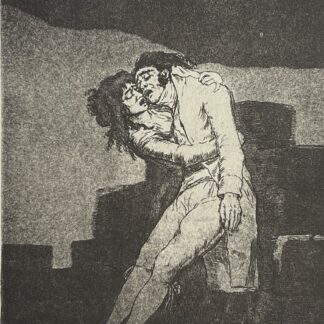
Francisco Goya Subir y Bajar – Los Caprichos Plate 56 – Rise and Fall of Power – Heliogravure circa 1970
Francisco Goya Subir y Bajar – Fine twentieth-century heliogravure circa 1970 after plate 56 of the celebrated Spanish series Los Caprichos, originally published in Madrid in 1799.
Artculture6 presents this remarkable heliogravure after Francisco de Goya y Lucientes (1746–1828), one of the most influential Spanish painters and printmakers in European art history.
The composition, entitled Subir y bajar (To Rise and to Fall), depicts a fantastic scene in which a powerful man is elevated by a monstrous satyr while two other figures fall towards the ground.
This extraordinary image belongs to Goya’s celebrated series of eighty satirical prints, combining grotesque fantasy with a penetrating commentary on ambition, political favour and the instability of worldly power.
SUBIR Y BAJAR – TO RISE AND TO FALL
The composition presents a striking arrangement of human and fantastic figures.
At the top of the group stands a man with his arms dramatically extended.
His head is surrounded by a mass of smoke or flames, creating an extraordinary impression of supernatural energy.
He appears to hold or project flashes of lightning, suggesting the temporary possession of exceptional power.
Beneath him, a large satyr-like creature supports the elevated figure.
The monstrous being possesses animal features and is seated upon a globe, reinforcing the allegorical meaning of the scene.
Two other human figures are represented falling away from the central group.
One tumbles downwards on the right, while another appears to collapse towards the left.
Their uncontrolled movements contrast with the triumphant posture of the elevated man.
AN ALLEGORY OF AMBITION AND FORTUNE
The Spanish title Subir y bajar means To Rise and to Fall.
The composition symbolises the unstable nature of worldly success.
Those who enjoy power, wealth and political favour may rise rapidly, only to lose their privileged position when circumstances change.
Goya transforms this familiar theme into a spectacular visual allegory.
The man at the top of the composition appears intoxicated by his elevation.
The smoke surrounding his head suggests vanity, illusion and the absence of sound judgement.
The figures falling below him represent those who have already lost their former importance.
The monstrous creature supporting the central figure introduces a disturbing and ironic dimension to the scene.
Rather than celebrating power, Goya exposes its instability and the absurdity of human ambition.
MANUEL GODOY – A POSSIBLE HISTORICAL ALLUSION
The composition has frequently been interpreted as an allusion to Manuel Godoy (1767–1851), one of the most influential political figures in Spain during the reign of King Charles IV.
Godoy enjoyed extraordinary royal favour and experienced a remarkably rapid rise to political prominence.
He was appointed to high office at a young age and received the title Prince of Peace in 1795.
His influence depended heavily upon the confidence of the Spanish monarchy.
His political career was marked by rivalries, changing alliances and periods of instability.
Historical commentaries on Goya’s print have associated the elevated central figure with Godoy’s exceptional rise and the precarious nature of his position.
The subject nevertheless possesses a broader significance, expressing the universal instability of power and fortune.
THE MONSTROUS SATYR
One of the most remarkable elements of the composition is the grotesque creature supporting the triumphant man.
The figure combines human and animal characteristics, including features associated with a satyr.
Its body appears powerful and heavy, contrasting with the dynamic movement of the elevated figure.
The satyr is seated upon a globe, introducing a symbolic reference to worldly power.
Goya frequently employed such hybrid creatures to represent irrational behaviour, corruption, superstition and the weaknesses of human society.
Here, the monstrous figure becomes an essential component of the satire.
The powerful individual is not elevated by wisdom or merit, but by an unstable and grotesque supporting force.
FRANCISCO DE GOYA (1746–1828)
Francisco José de Goya y Lucientes was born in Fuendetodos, Spain, in 1746.
He became one of the greatest European artists of the late eighteenth and early nineteenth centuries.
His career included royal portraits, religious paintings, historical compositions, drawings and an extraordinary body of graphic works.
Goya developed a distinctive artistic language combining realism, fantasy, psychological observation and social criticism.
His prints frequently examine ignorance, superstition, corruption, social ambition and abuses of authority.
His influence extended far beyond Spain and contributed significantly to the development of modern European art.
LOS CAPRICHOS – EIGHTY SATIRICAL PRINTS
Published in Madrid in 1799, Los Caprichos consists of eighty compositions exploring the contradictions and moral failings of Spanish society.
The series examines superstition, hypocrisy, ignorance, corruption, social ambition and the abuse of authority.
Goya employed etching, aquatint and related intaglio techniques to create remarkable contrasts of light and darkness.
Many compositions introduce fantastic creatures, distorted human figures and symbolic transformations.
These images allow Goya to explore real social problems through the language of imagination and satire.
Subir y bajar, plate 56, is a memorable example of this approach.
THE ORIGINAL COMPOSITION
The original work was created during the late 1790s and published as plate 56 of Los Caprichos in 1799.
The composition is organised around a dramatic vertical movement.
At the centre, the satyr supports the rising figure, while other characters fall away from the group.
The different postures create a visual contrast between elevation and downfall.
The light falling upon the principal figure highlights his momentary triumph.
The darker passages surrounding the monstrous creature and the falling bodies reinforce the atmosphere of uncertainty and instability.
A preparatory drawing by Goya is preserved in the Museo Nacional del Prado in Madrid.
ETCHING AND AQUATINT
The original print was executed using etching and burnished aquatint.
These techniques allowed Goya to combine finely engraved outlines with atmospheric tonal effects.
The bodies of the figures are rendered through expressive lines, while the darker surfaces create depth and dramatic contrast.
The unusual arrangement of the figures gives the image a strong sense of movement.
The original plate is catalogued as Harris 91.
The composition remains one of the best-known examples of Goya’s criticism of the instability of power.
THE HELIOGRAVURE PROCESS
The present example is a twentieth-century heliogravure produced circa 1970 after Goya’s original composition.
Heliogravure is a photomechanical printing process capable of reproducing fine graphic details and tonal variations.
It has frequently been employed in high-quality reproductions of historical engravings, drawings and important works of art.
This example reproduces the fantastic composition and the dramatic contrasts of Goya’s original image.
This is a circa 1970 heliogravure reproduction, not an original eighteenth-century etching or aquatint printed during Goya’s lifetime.
TECHNICAL DETAILS
Artist of the original composition: Francisco de Goya y Lucientes (1746–1828).
Original title: Subir y bajar.
English title: To Rise and to Fall.
Series: Los Caprichos.
Plate number: 56.
Original publication: Madrid, Spain, 1799.
Original technique: Etching and burnished aquatint.
Technique of this example: Heliogravure.
Date of this example: Circa 1970.
Sheet dimensions: 24.9 × 18.8 cm.
Image dimensions: 18.8 × 12.9 cm.
Reference: 4930-65R550.



Avis
Il n’y a pas encore d’avis.