Dante’s Dream of Leah – Gustave Doré Purgatorio Canto XXVII – c.1890 Wood Engraving
39,00 €
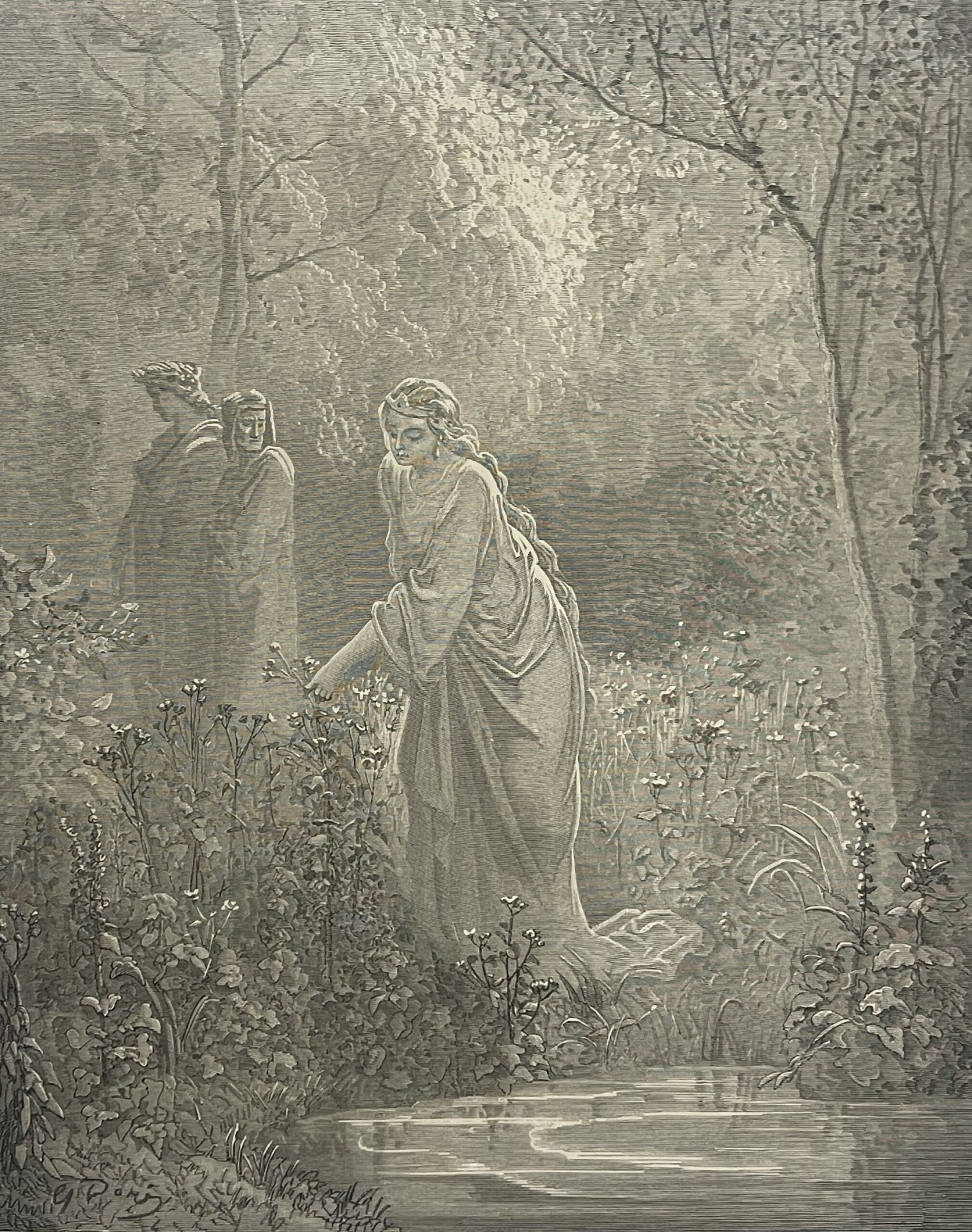
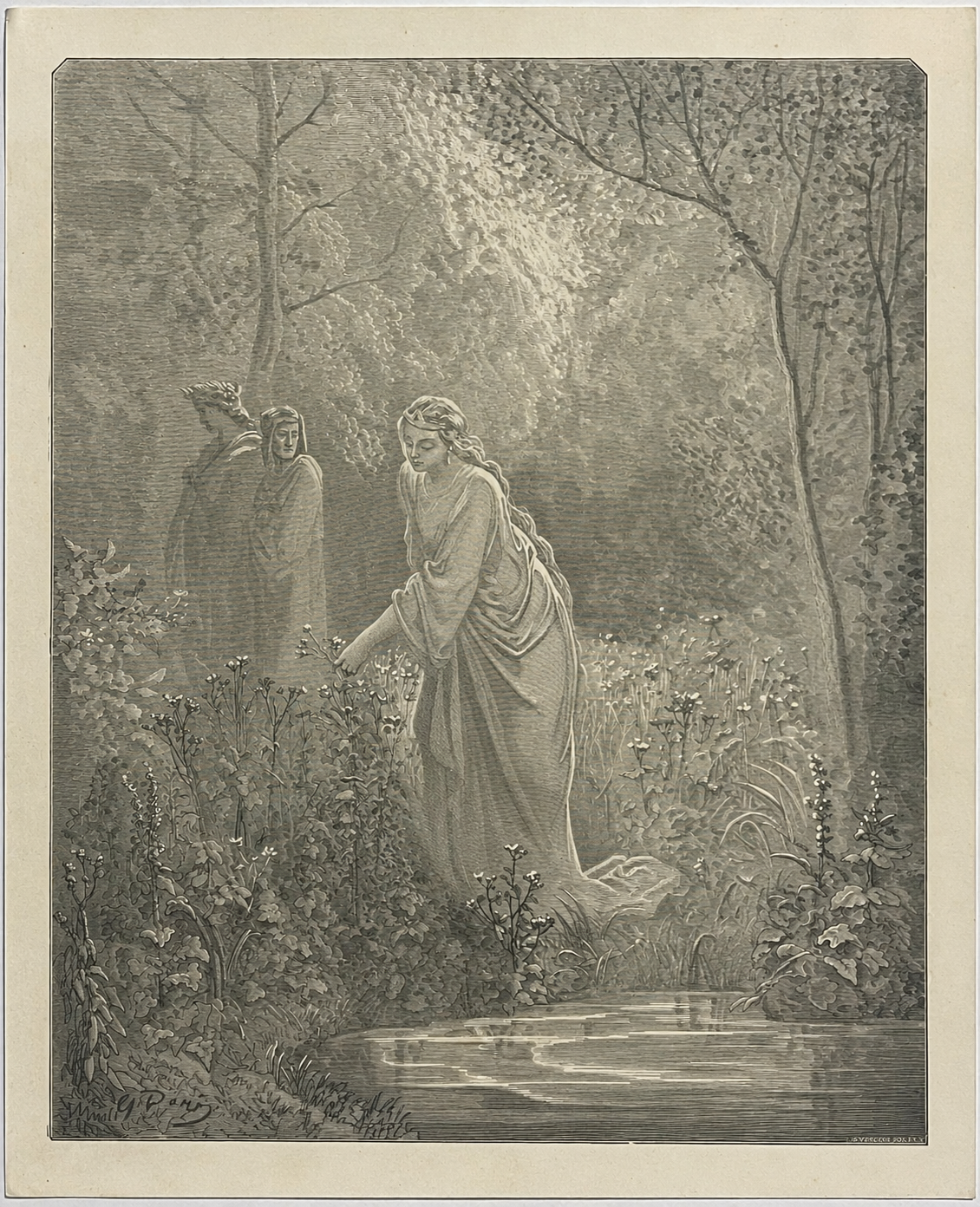
Original nineteenth-century wood engraving, circa 1890, depicting Dante’s Dream of Leah, after Gustave Doré.
A poetic illustration from Canto XXVII of Dante Alighieri’s Divine Comedy, Purgatorio.
Leah gathers flowers beside a stream while Dante and Virgil appear among the trees.
Sheet: 26.7 × 21.7 cm.
Engraved image: 24.5 × 19.7 cm.
Description
GUSTAVE DORE – DANTE’S DREAM OF LEAH – PURGATORIO CANTO XXVII
Original 19th-Century Wood Engraving – The Divine Comedy – Circa 1890
A beautiful antique wood engraving depicting Dante’s Dream of Leah, after Gustave Doré (1832–1883), illustrating Canto XXVII of Purgatorio, the second part of Dante Alighieri’s celebrated Divine Comedy.
This poetic composition shows the biblical figure Leah gathering flowers in a peaceful meadow, while Dante and Virgil appear in the background.
The delicate atmosphere and luminous landscape make this illustration one of the gentler and more contemplative scenes in Doré’s interpretation of Dante’s masterpiece.
DANTE’S DREAM OF LEAH
Near the end of his journey through Purgatory, Dante falls asleep on the mountain before reaching the Earthly Paradise.
In his dream, he encounters a beautiful young woman walking through a meadow and gathering flowers to make a garland.
The woman introduces herself as Leah, a biblical figure from the Old Testament.
In Dante’s symbolic vision, Leah represents the active life, expressed through good deeds and virtuous actions.
Her sister Rachel represents the contemplative life, dedicated to reflection and spiritual understanding.
The dream marks an important transition in Dante’s spiritual journey, preparing him for his entrance into the Earthly Paradise and his eventual reunion with Beatrice.
A POETIC COMPOSITION BY GUSTAVE DORÉ
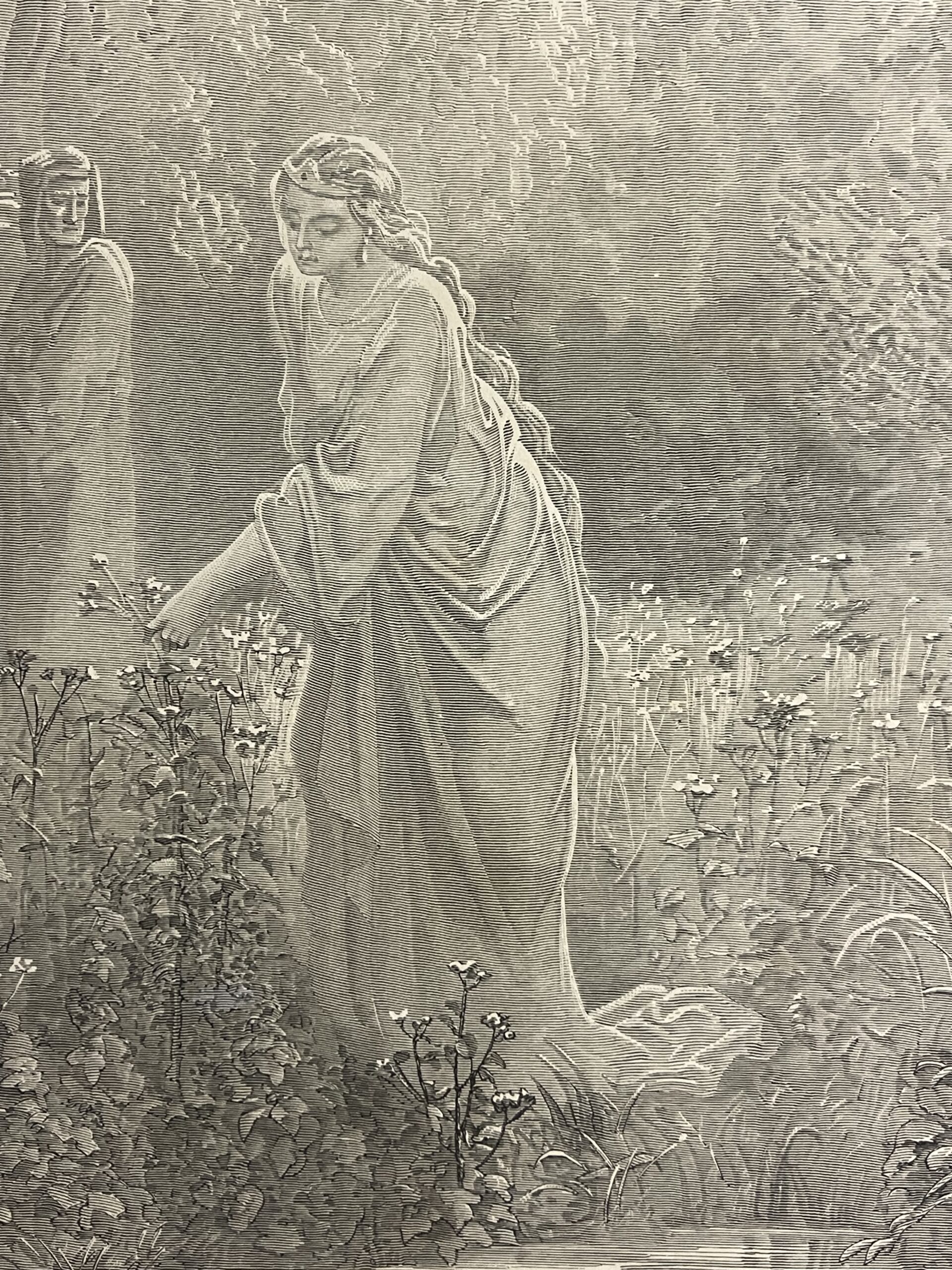
The engraving depicts Leah bending gracefully to gather flowers beside a quiet stream.
She wears a long flowing gown, while her hair falls softly over her shoulders.
Behind her, Dante and Virgil appear among the trees, observing the peaceful landscape.
The woodland setting is rendered with exceptional delicacy.
Fine engraved lines create subtle variations of light across the foliage, flowers, flowing fabric and reflective water.
Unlike Doré’s terrifying visions of the Inferno, this image conveys tranquillity, spiritual renewal and the beauty of nature.
GUSTAVE DORÉ AND THE DIVINE COMEDY
Gustave Doré was one of the most celebrated French illustrators of the nineteenth century.
His monumental illustrations for Dante’s Divine Comedy remain among the greatest achievements of European literary illustration.
The illustrations for the Inferno first appeared in 1861, followed by those for Purgatorio and Paradiso in 1868.
Doré’s extraordinary imagination, precise drawing and dramatic treatment of light transformed Dante’s poetry into unforgettable visual images.
His engravings became internationally celebrated and were reproduced in numerous nineteenth-century editions.
A NINETEENTH-CENTURY LITERARY ENGRAVING
This antique impression, dated circa 1890, reproduces Doré’s celebrated composition from Purgatorio.
The carefully engraved vegetation, luminous atmosphere and elegant central figure make it an attractive example of nineteenth-century French book illustration.
It will appeal to collectors of Gustave Doré, Dante Alighieri, antique literary prints, romantic landscapes and symbolic religious art.
DETAILS
Artist: After Gustave Doré (1832–1883).
Author: Dante Alighieri (1265–1321).
Title: Dante’s Dream of Leah.
Literary work: The Divine Comedy.
Section: Purgatorio.
Canto: XXVII.
Original illustration published: 1868.
Impression: Circa 1890.
Technique: Wood engraving.
Sheet dimensions: 26.7 × 21.7 cm.
Engraved image: 24.5 × 19.7 cm.
Period: 19th century.
Subject: Leah, Dante, Virgil, poetry, biblical symbolism and the Earthly Paradise.
CONDITION
Antique impression showing the natural patina of aged paper. The engraved composition and fine details are well preserved.
A charming nineteenth-century literary engraving combining the poetic imagination of Dante with Gustave Doré’s exceptional artistic talent.


Avis
Il n’y a pas encore d’avis.