
Description
GUSTAVE DORE – FAITH, HOPE AND CHARITY – DANTE’S PURGATORIO
Original 19th-Century Wood Engraving – Circa 1890
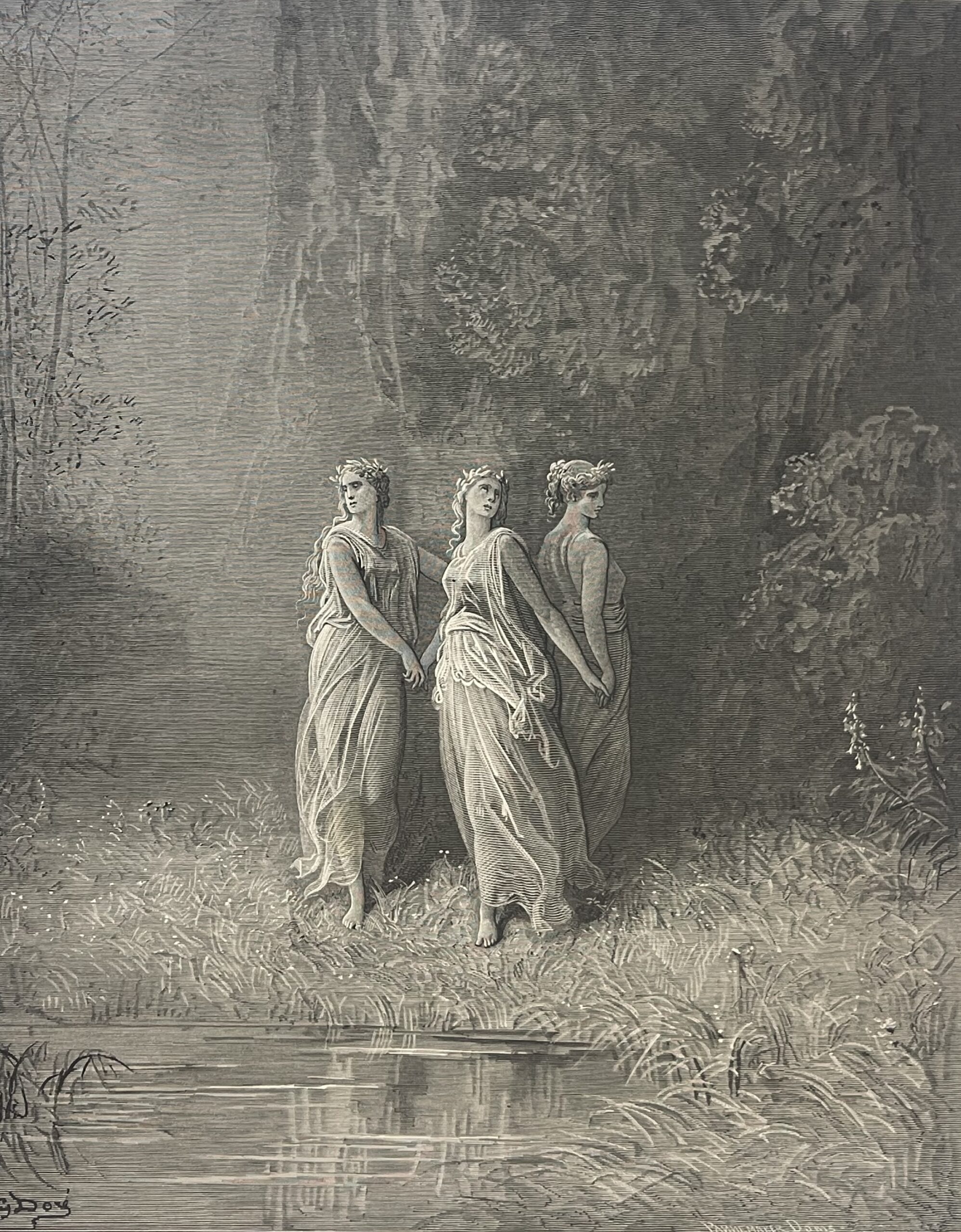
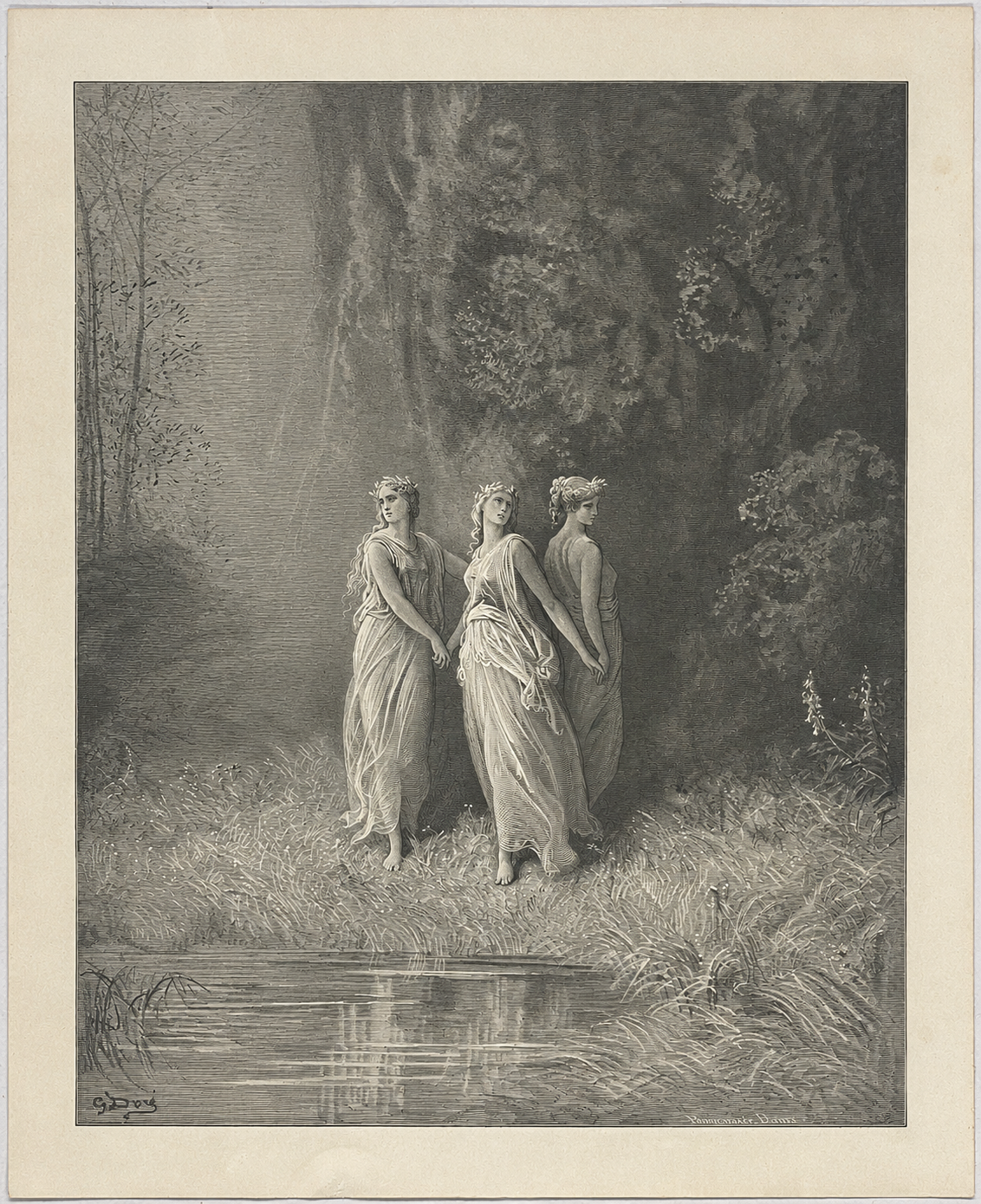
A beautiful nineteenth-century wood engraving depicting the Three Theological Virtues — Faith, Hope and Charity — after Gustave Doré (1832–1883), engraved by François Pannemaker.
This elegant composition illustrates Canto XXIX of Purgatorio, the second part of Dante Alighieri’s celebrated Divine Comedy.
The three virtues are represented as graceful young women standing together in a mysterious woodland landscape.
THE THREE THEOLOGICAL VIRTUES
Near the conclusion of his journey through Purgatory, Dante reaches the Earthly Paradise, where he witnesses an extraordinary symbolic procession.
Among the allegorical figures appearing in the procession are three women representing the Christian theological virtues.
Faith symbolises trust in God and the acceptance of divine truth.
Hope represents spiritual confidence and the expectation of eternal salvation.
Charity expresses divine love and love for humanity.
In Dante’s poem, the three figures are associated with the colours white, green and red, each carrying a particular theological meaning.
Their appearance marks an important stage in Dante’s spiritual transformation and preparation for his encounter with Beatrice.
A POETIC WOODLAND COMPOSITION
Gustave Doré presents the three women in a richly detailed forest.
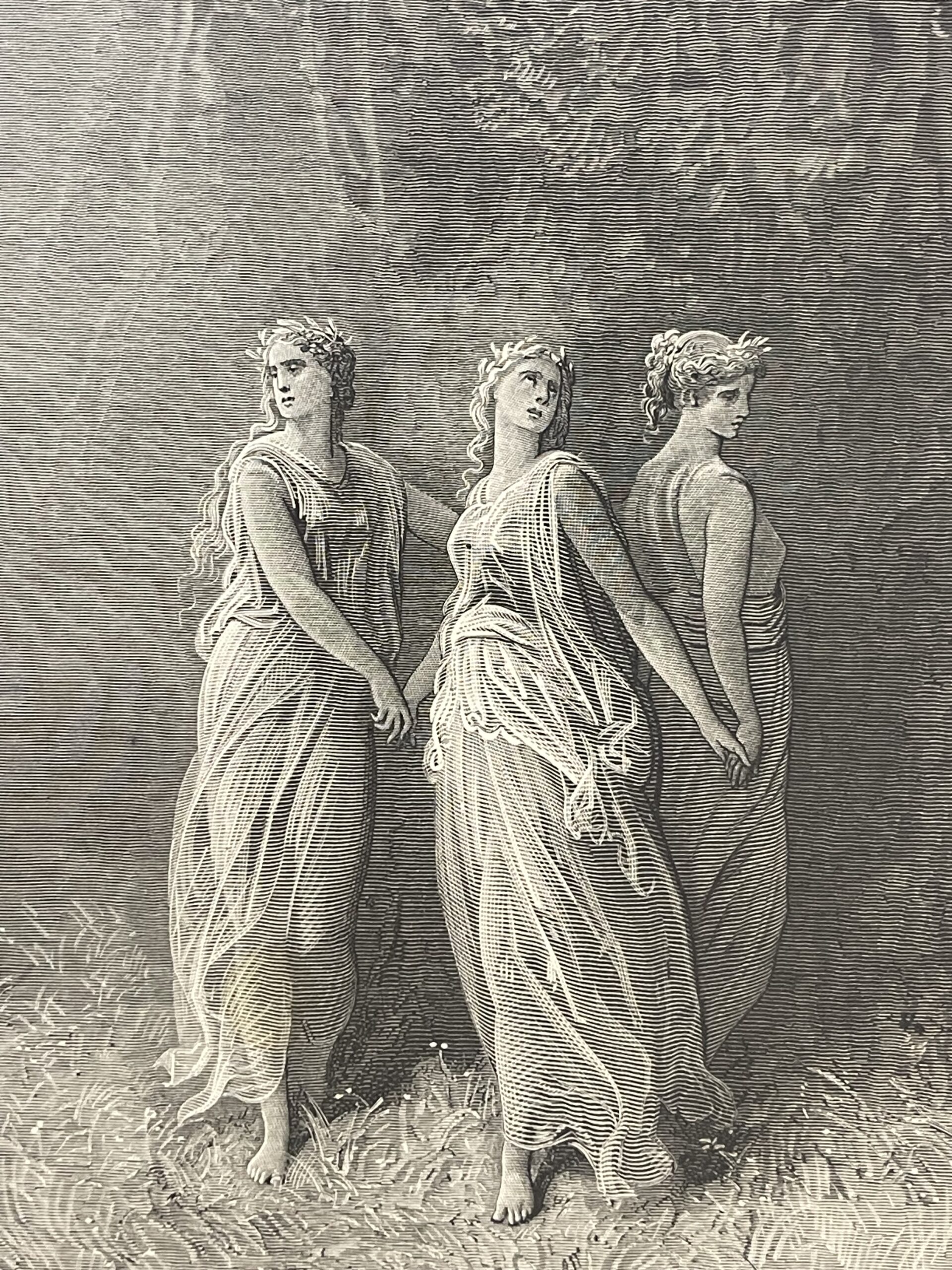
Their flowing classical robes and delicately arranged hair create an atmosphere of elegance and tranquillity.
The figures stand close together, turning in different directions as if participating in a graceful dance.
Behind them, tall trees rise into the shadows, while delicate foliage and woodland plants cover the surrounding ground.
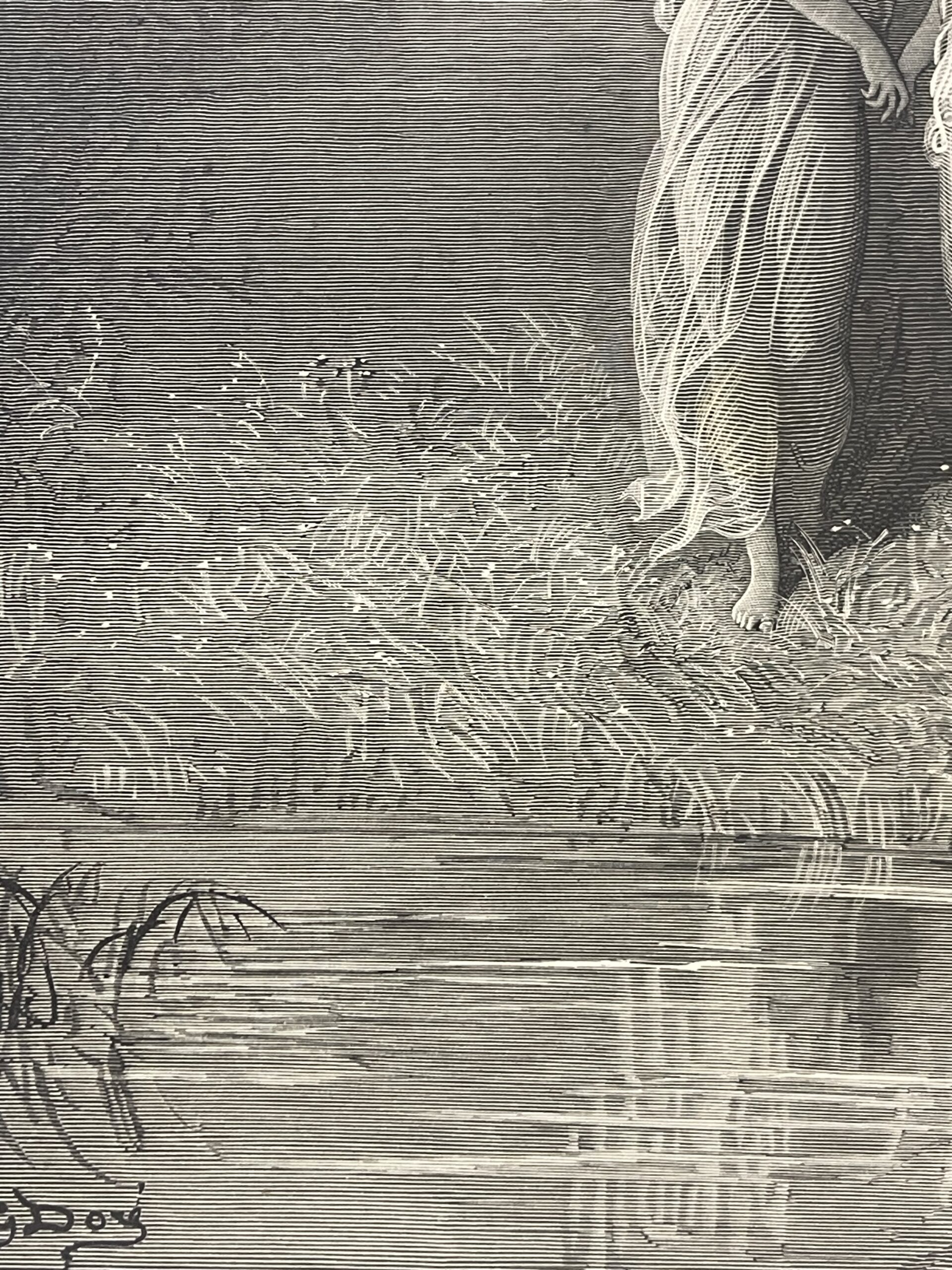
In the foreground, a quiet stream reflects the light filtering through the forest.
The subtle contrasts between the illuminated figures and the shadowy woodland demonstrate Doré’s exceptional ability to create atmosphere through engraved lines.
Unlike his dramatic illustrations of Dante’s Inferno, this composition expresses serenity, spiritual beauty and contemplation.
GUSTAVE DORÉ AND THE DIVINE COMEDY
Gustave Doré was one of the most influential French illustrators of the nineteenth century.
His interpretation of Dante’s Divine Comedy became one of the great achievements of European literary illustration.
The illustrations for the Inferno appeared in 1861, followed by those for Purgatorio and Paradiso in 1868.
Doré’s extraordinary imagination and dramatic treatment of light brought Dante’s poetry to life for generations of readers.
His engravings were widely reproduced in numerous editions throughout the nineteenth century.
ENGRAVED BY FRANÇOIS PANNEMAKER
François Pannemaker was an accomplished wood engraver who collaborated with Gustave Doré on important illustrated publications.
His detailed technique faithfully reproduces the elaborate folds of the garments, the texture of the vegetation and the delicate variations of light within Doré’s composition.
The printed signatures of Gustave Doré and Pannemaker appear in the lower corners.
AN ATTRACTIVE ANTIQUE LITERARY PRINT
This nineteenth-century impression, dated circa 1890, preserves the poetic beauty of Doré’s original composition.
An appealing subject for collectors of Gustave Doré, Dante Alighieri, antique religious engravings, literary illustrations and symbolic art.
DETAILS
Artist: After Gustave Doré (1832–1883).
Engraver: François Pannemaker.
Title: Faith, Hope and Charity.
Literary work: The Divine Comedy.
Section: Purgatorio.
Canto: XXIX.
Original illustration published: 1868.
Impression: Circa 1890.
Technique: Wood engraving.
Sheet dimensions: 26.9 × 21.8 cm.
Engraved image: 23.6 × 18.7 cm.
Period: 19th century.
Subject: Theological virtues, Dante, Christian allegory and the Earthly Paradise.

Avis
Il n’y a pas encore d’avis.