Dutch School c1700–1730 Original Ink Wash Drawing Horses at Watering Trough and Stone Fountain
119,00 €
Dutch School Horses Drawing – Original Ink and Grey Wash Landscape, Attributed to the Early 18th Century, circa 1700–1730.
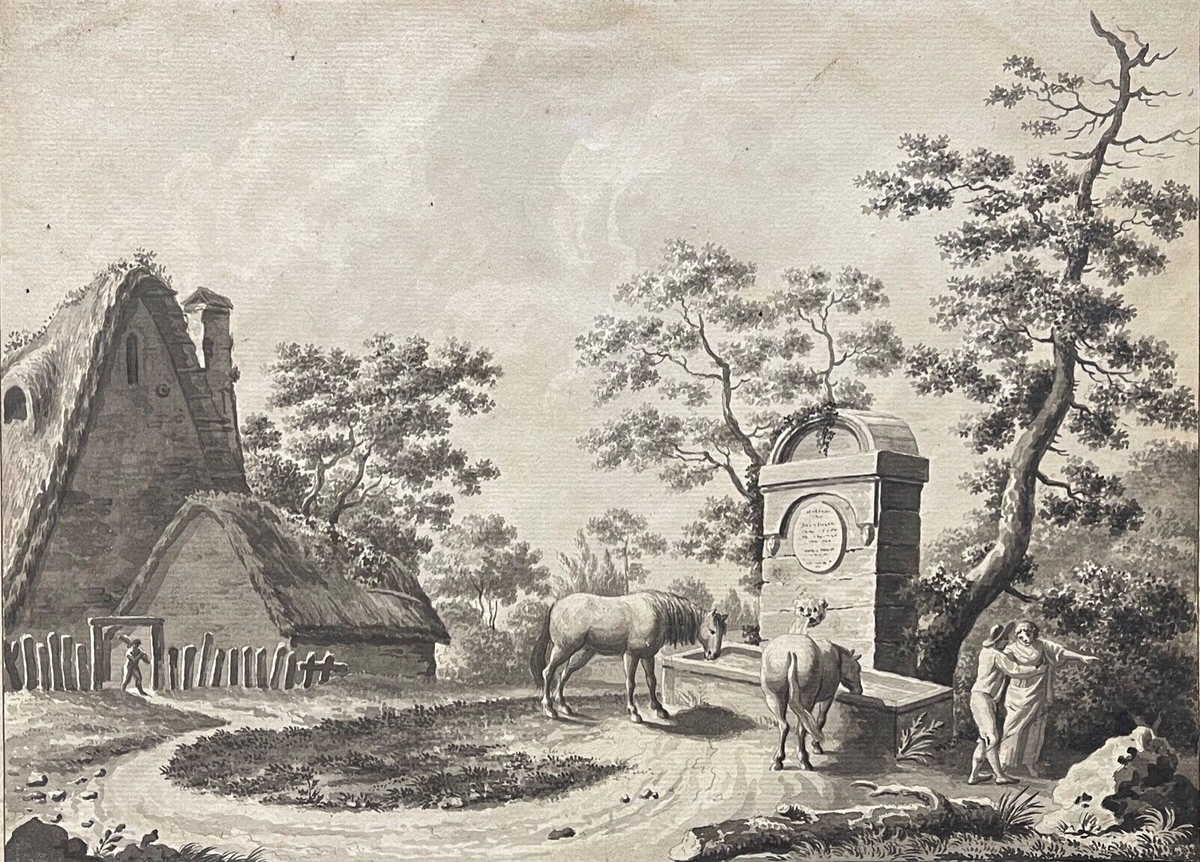
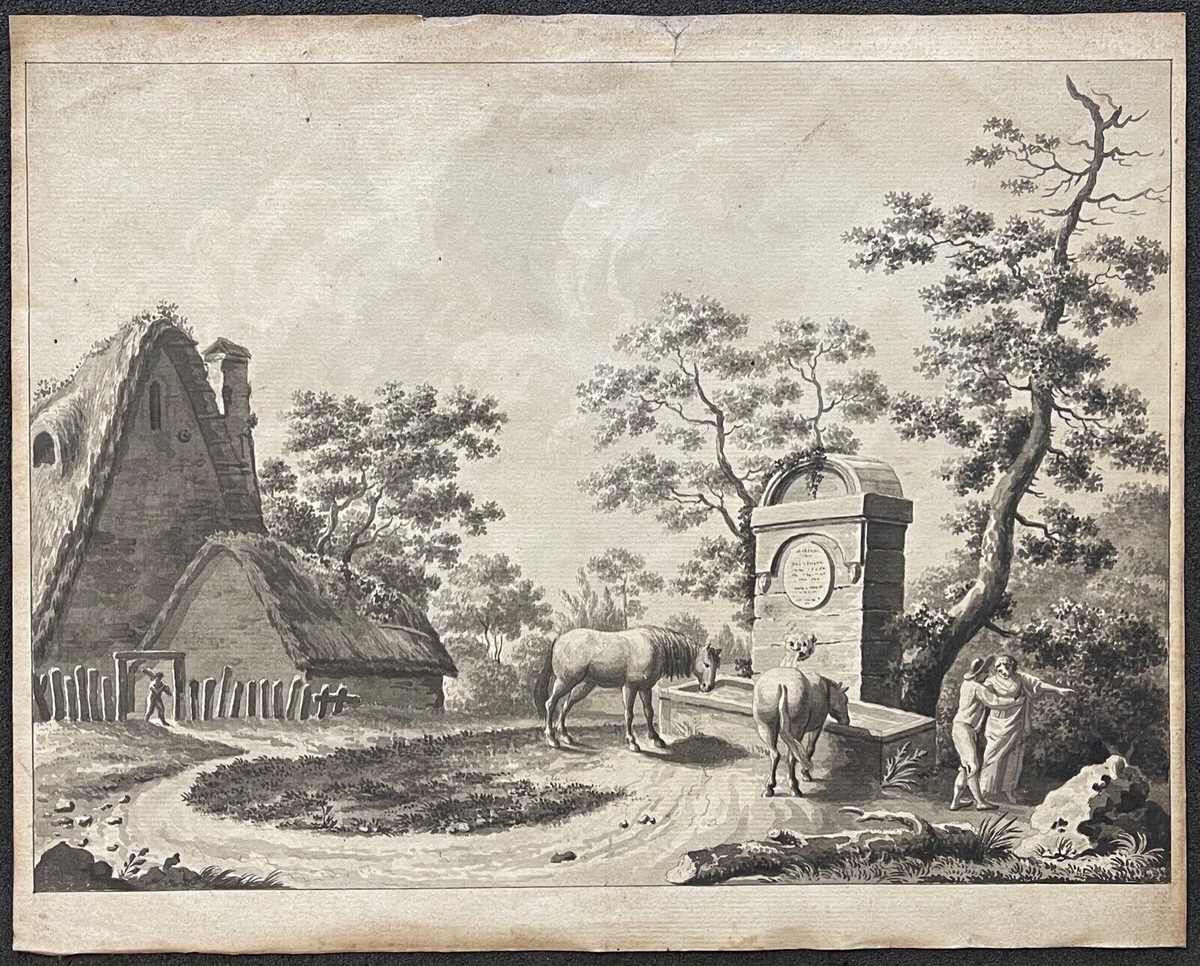
Beautiful original hand-executed drawing depicting two horses beside a monumental stone watering trough, surrounded by picturesque thatched cottages, mature trees and two rural figures.
The composition features an unusual stone fountain with an oval inscription panel, carefully rendered architecture and delicate grey washes.
Traditionally attributed to the Dutch School of the early eighteenth century.
Technique: Original ink and grey wash drawing, entirely executed by hand.
Support: Antique shaded laid paper (papier vergé ombré).
Sheet dimensions: 32 × 25.5 cm.
Drawing dimensions: 31 × 22.5 cm.
Condition: Natural paper patina, scattered foxing and a very small beginning of a tear along the upper edge.
Reference: 5132-4R620.
Description
Dutch School Horses Drawing – Original hand-executed ink and grey wash landscape, traditionally attributed to the early eighteenth-century Dutch School, circa 1700–1730, depicting two horses beside a monumental stone watering trough, thatched cottages, mature trees and rural figures.
Artculture6 presents this beautiful original antique drawing, executed entirely by hand in ink and grey wash on old shaded laid paper.
The composition represents a peaceful country landscape featuring two horses drinking at a monumental stone fountain.
Traditional thatched buildings, a rustic wooden fence, elegant trees and small human figures contribute to the picturesque atmosphere.
The work is traditionally attributed to the Dutch School of the early eighteenth century, although the artist has not been identified.
Its carefully arranged landscape, architectural details and subtle tonal variations make it particularly attractive to collectors of original European drawings.
HORSES AT THE WATERING TROUGH
Two horses occupy the centre of this elegant rural composition.
The first animal stands in profile beside a large rectangular stone basin.
Its head is lowered towards the water, and its pale body contrasts with the surrounding foliage.
The second horse is depicted from behind, standing close to the fountain.
The natural postures of the animals contribute to the tranquil atmosphere of the landscape.
Their arrangement creates a harmonious relationship between the foreground and the architectural setting.
Scenes featuring horses at watering places were popular subjects in traditional European landscape art.
They provided artists with an opportunity to combine animal studies, rural architecture and observations of everyday life.
THE MONUMENTAL STONE FOUNTAIN
One of the most remarkable features of the drawing is the substantial stone fountain.
The monument consists of a rectangular water basin surmounted by a tall architectural structure.
Its upper section has a curved architectural crown.
An oval inscription panel occupies the centre of the monument.
Several lines of lettering are visible within this panel, although they cannot currently be deciphered with sufficient certainty.
Beneath the inscription appears a sculpted decorative element resembling a mask or animal head.
The fountain has the appearance of a public or commemorative monument.
Its exact location has not been established.
The carefully rendered stonework gives the composition additional architectural interest.
TRADITIONAL THATCHED COTTAGES
On the left stands an imposing rural building covered by a steeply pitched thatched roof.
The structure features a tall gable, a chimney and several small openings.
A smaller thatched cottage occupies the foreground.
A simple wooden fence formed from irregular stakes surrounds part of the property.
A small figure appears near the entrance.
The buildings evoke traditional rural architecture of northern Europe.
Their picturesque appearance is compatible with the established landscape traditions of the Netherlands and neighbouring regions.
The darker washes applied to the roofs contrast effectively with the lighter tones of the surrounding landscape.
RURAL FIGURES AND HISTORICAL COSTUMES
Two small figures stand beneath a large tree on the right.
One appears to be wearing a flowing garment and extends an arm in a gesture of conversation or indication.
The other figure wears a hat and stands close by.
Their clothing and general appearance evoke the visual traditions of the late seventeenth and early eighteenth centuries.
The figures introduce a discreet narrative element into the composition.
Their presence gives the scene a human dimension without disturbing its peaceful rural character.
The precise identities of the figures and the location represented remain unknown.
A HARMONIOUS LANDSCAPE COMPOSITION
The drawing is carefully organised around a winding country path.
The road curves through the foreground before leading towards the fountain and cottages.
Large trees frame the composition.
On the right, an elegant tree with a curved trunk rises above the figures.
Smaller trees and foliage occupy the background.
The carefully controlled distribution of light and shade creates a sense of atmospheric depth.
The relatively open sky balances the darker architectural elements and vegetation.
The combination of horses, buildings, figures and mature trees gives the landscape a harmonious and decorative appearance.
THE DUTCH LANDSCAPE TRADITION
Landscape drawing became one of the most important artistic disciplines in the Netherlands during the seventeenth century.
Dutch artists developed a particular interest in familiar rural subjects, including farmhouses, country roads, livestock, trees, cottages and village scenes.
This artistic tradition continued into the eighteenth century.
Drawings executed with pen, ink and grey wash were admired for their delicacy, atmospheric qualities and precise observation of everyday life.
The present composition belongs stylistically to this broader Netherlandish landscape tradition.
Its traditional attribution to the early eighteenth-century Dutch School, circa 1700–1730, is based on stylistic and material considerations.
The attribution and dating should be understood as scholarly proposals rather than documented certainties.
AN ORIGINAL HAND-DRAWN WORK OF ART
This is an original drawing executed entirely by hand, not an engraving, lithograph or printed reproduction.
The artist combined carefully drawn ink lines with subtle passages of grey wash.
The different tonal values create volume, depth and atmospheric perspective.
The thatched roofs, tree trunks and foliage are rendered in stronger shades.
The horses, fountain and distant landscape are modelled through lighter tonal passages.
Particular attention has been given to the architectural forms of the fountain and the delicate representation of the trees.
The work demonstrates the expressive possibilities of ink and wash drawing.
ANTIQUE SHADED LAID PAPER
The drawing is executed on old shaded laid paper, described in French as papier vergé ombré.
This historic paper type is compatible with the proposed early eighteenth-century attribution.
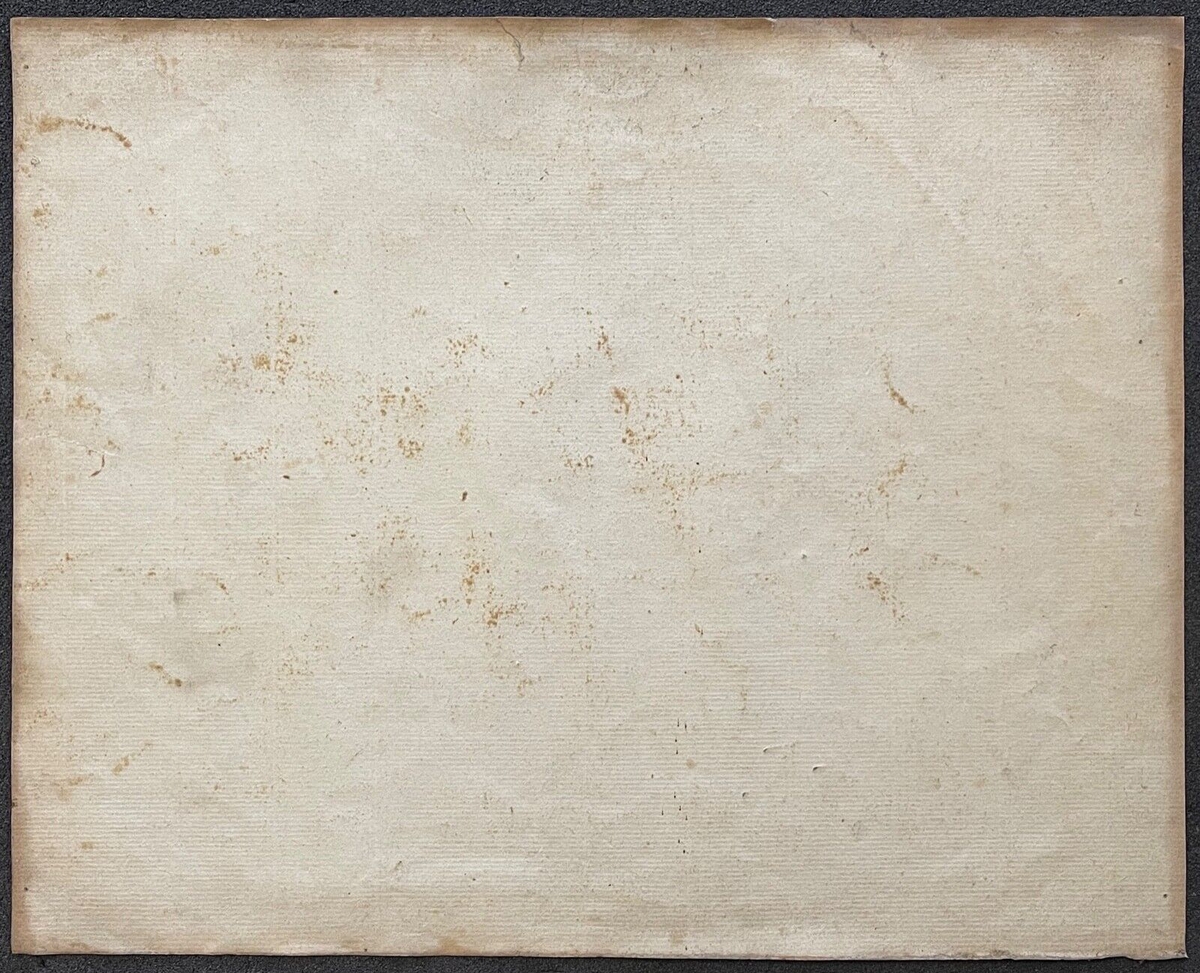
The reverse shows the natural structure of the paper together with scattered foxing and signs of age.
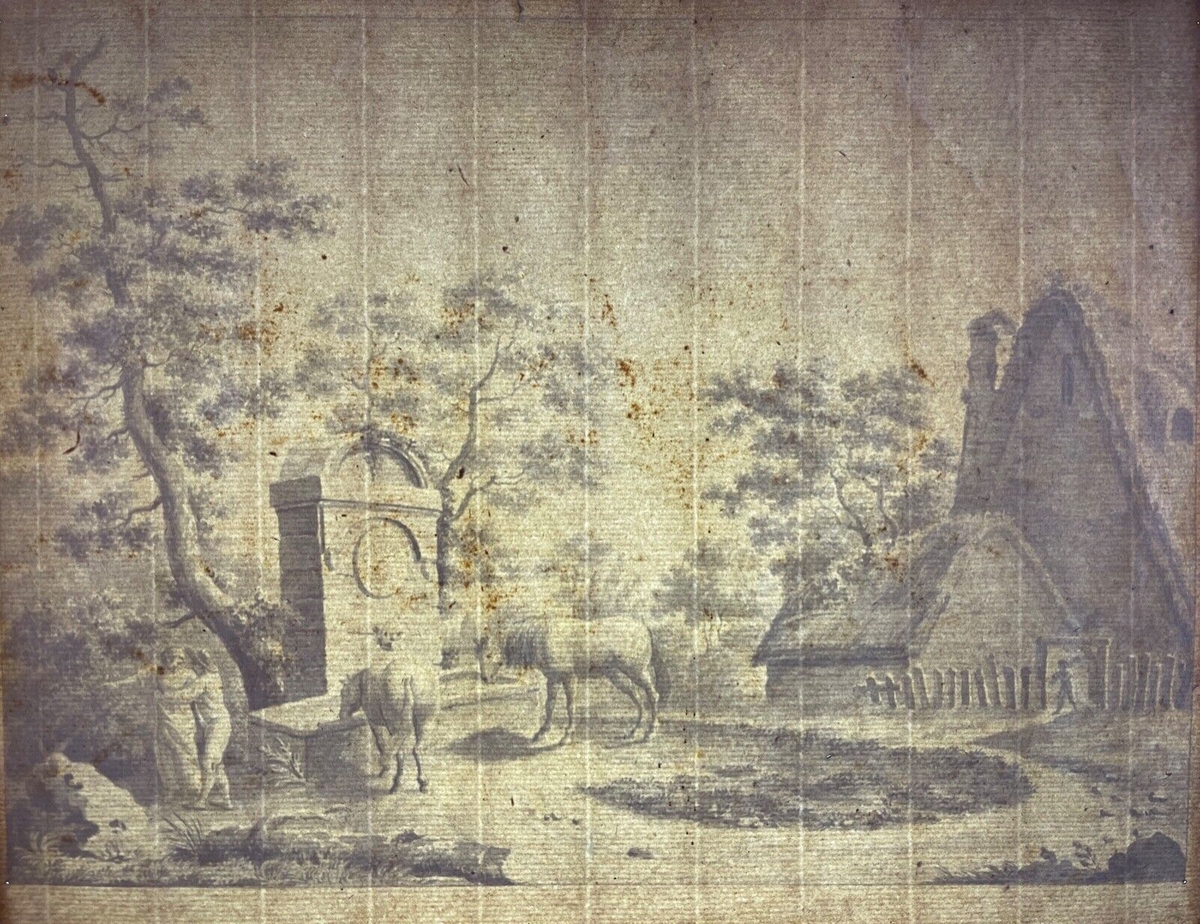
The composition can also be distinguished in reverse through the sheet.
The material characteristics contribute to the historical interest of the work, although they do not independently establish an exact production date.
AN ATTRACTIVE EQUESTRIAN SUBJECT
Horses occupy an important position in European rural and equestrian art.
Before modern mechanisation, they were essential to agriculture, transport, commerce and travel.
Watering places were common features of the countryside.
Their representation allowed artists to combine the study of animals with picturesque architectural settings.
The two horses in this composition are represented in complementary positions.
One is shown in profile, the other from behind.
Their natural attitudes add a distinctive charm to the landscape.
ARCHITECTURAL AND HISTORICAL INTEREST
The unusual stone fountain gives this drawing an architectural interest beyond its equestrian subject.
Its curved upper structure, oval inscription panel and sculpted decorative feature distinguish it from ordinary rural watering troughs.
The nearby thatched cottages and wooden fencing provide a contrasting example of vernacular architecture.
The composition therefore brings together two different aspects of historic rural life: a formal public monument and traditional domestic buildings.
The inscription may eventually provide a clue to the geographical identification of the scene, but no exact location can currently be assigned.
TECHNICAL DETAILS
Artist: Anonymous.
Traditional attribution: Dutch School.
Attributed period: Early eighteenth century, circa 1700–1730.
Nature: Original hand-executed drawing.
Technique: Ink and grey wash.
Support: Antique shaded laid paper (papier vergé ombré).
Subject: Two horses at a watering trough, monumental stone fountain, thatched cottages and rural figures.
Location depicted: Unidentified.
Sheet dimensions: 32 × 25.5 cm.
Drawing dimensions: 31 × 22.5 cm.
Reference: 5132-4R620.
CONDITION
Original antique drawing displaying a natural aged-paper patina.
Some scattered foxing and signs of age are visible, particularly on the reverse.
A very small beginning of a tear is present along the upper edge of the sheet.
The drawn composition remains well preserved and clearly legible, including the horses, buildings, fountain and landscape details.
COLLECTOR’S INTEREST
A beautiful original ink and grey wash landscape, traditionally attributed to the early eighteenth-century Dutch School.
Particularly interesting for collectors of original antique drawings, Netherlandish landscapes, equestrian subjects, monumental fountains, rural architecture and historic European paper.
The combination of two horses, an unusual architectural fountain, traditional thatched cottages and carefully drawn trees makes this work especially appealing.
Its generous format and delicate tonal execution enhance its decorative qualities.
An individually hand-executed work of art, not a printed engraving or reproduction.
Offered by Artculture6 – Antique Prints, Drawings and Works of Art.

Avis
Il n’y a pas encore d’avis.