Samson Blinded by Philistines 1728 Netherlands Gerard Hoet Abraham de Blois Biblical Engraving
79,00 €
Samson Blinded by the Philistines – Original Dutch Biblical Copper Engraving, 1728.
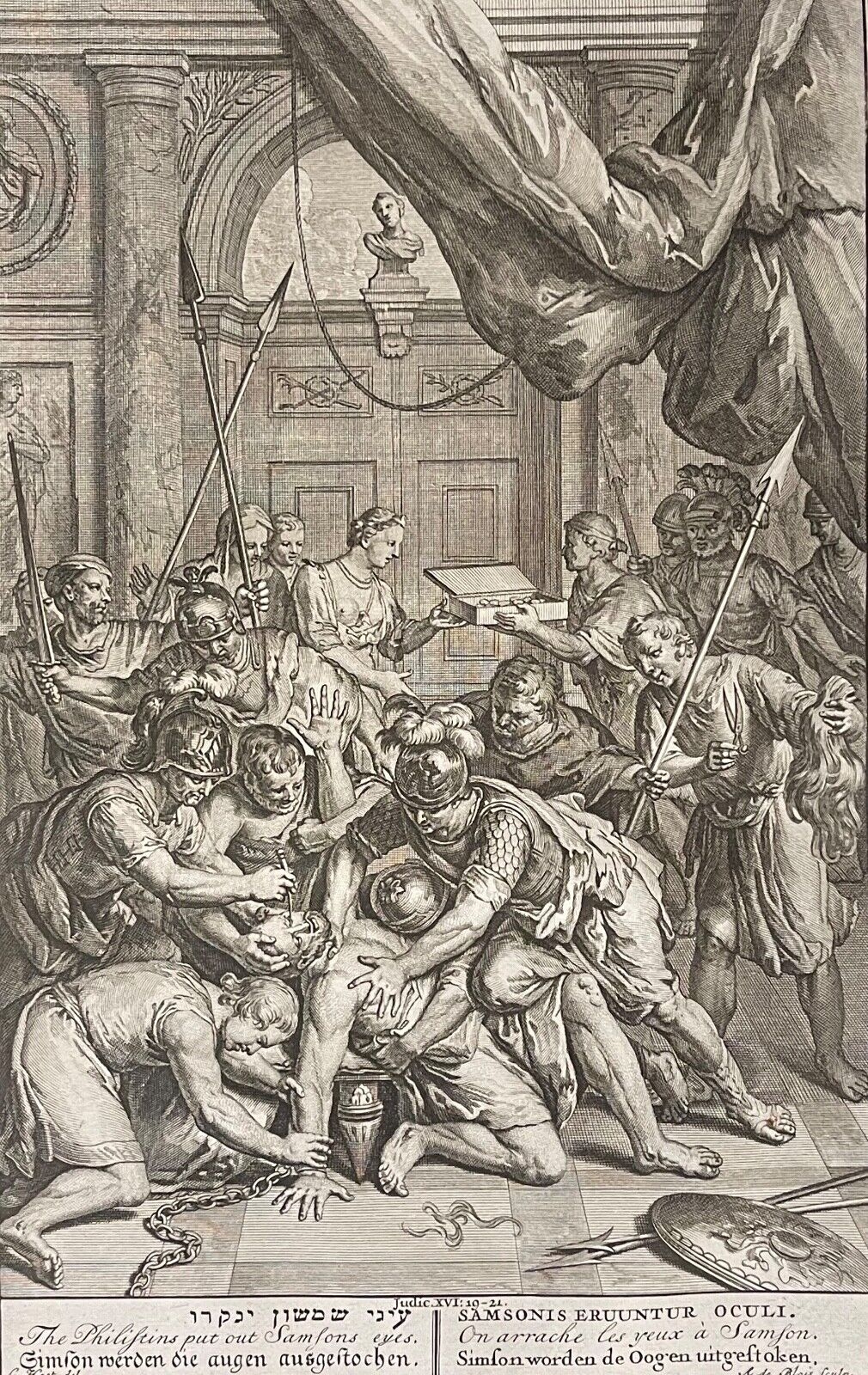
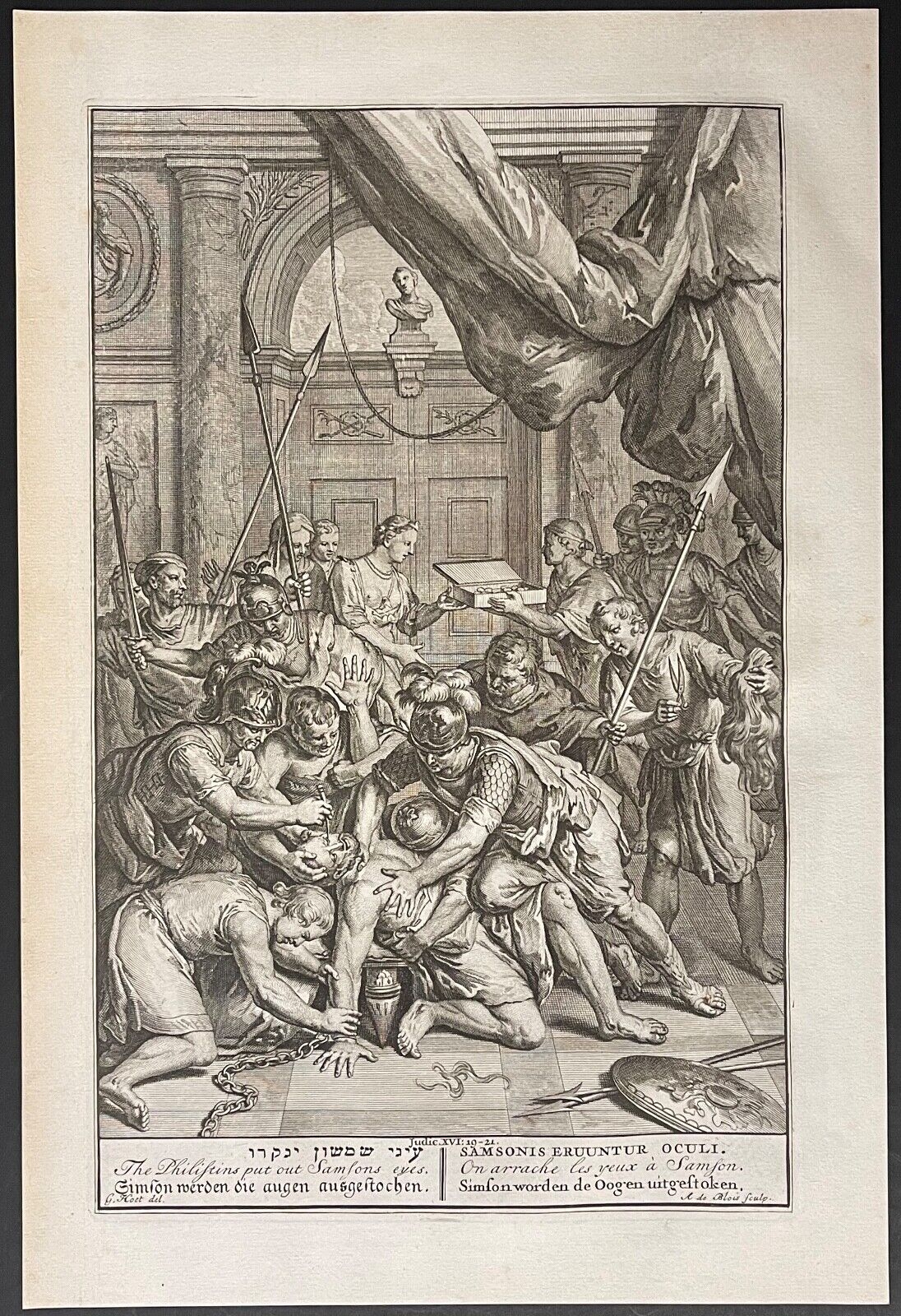
Impressive eighteenth-century biblical engraving after Gerard Hoet the Elder (1648–1733), engraved by Abraham de Blois, depicting Samson’s capture and blinding by the Philistines, as narrated in Judges 16:19–21.
A dramatic composition featuring armed soldiers restraining Samson, Delilah receiving her reward, classical architecture and monumental draperies.
The original signatures and biblical captions appear in six languages, including Hebrew, Latin, English, French, German and Dutch.
Technique: Copper engraving, etching and burin.
Date: 1728.
Paper: Antique shaded laid paper.
Sheet: 40 × 26.7 cm.
Engraved composition including captions: 34.2 × 21.5 cm.
Reference: 5215-176R669.
Description
Samson Blinded by the Philistines – Original eighteenth-century Dutch biblical copper engraving dated 1728, after Gerard Hoet the Elder (1648–1733), engraved by Abraham de Blois, depicting one of the most dramatic episodes from the Old Testament, Judges 16:19–21.
Artculture6 presents this impressive antique biblical engraving illustrating the capture, humiliation and blinding of Samson by the Philistines following his betrayal by Delilah.
The composition was designed by the celebrated Dutch painter and draughtsman Gerard Hoet the Elder and engraved by Abraham de Blois.
Printed on antique shaded laid paper, this large eighteenth-century print is distinguished by its dramatic figures, elaborate classical architecture, monumental draperies and original inscriptions in six different languages.
SAMSON BLINDED BY THE PHILISTINES
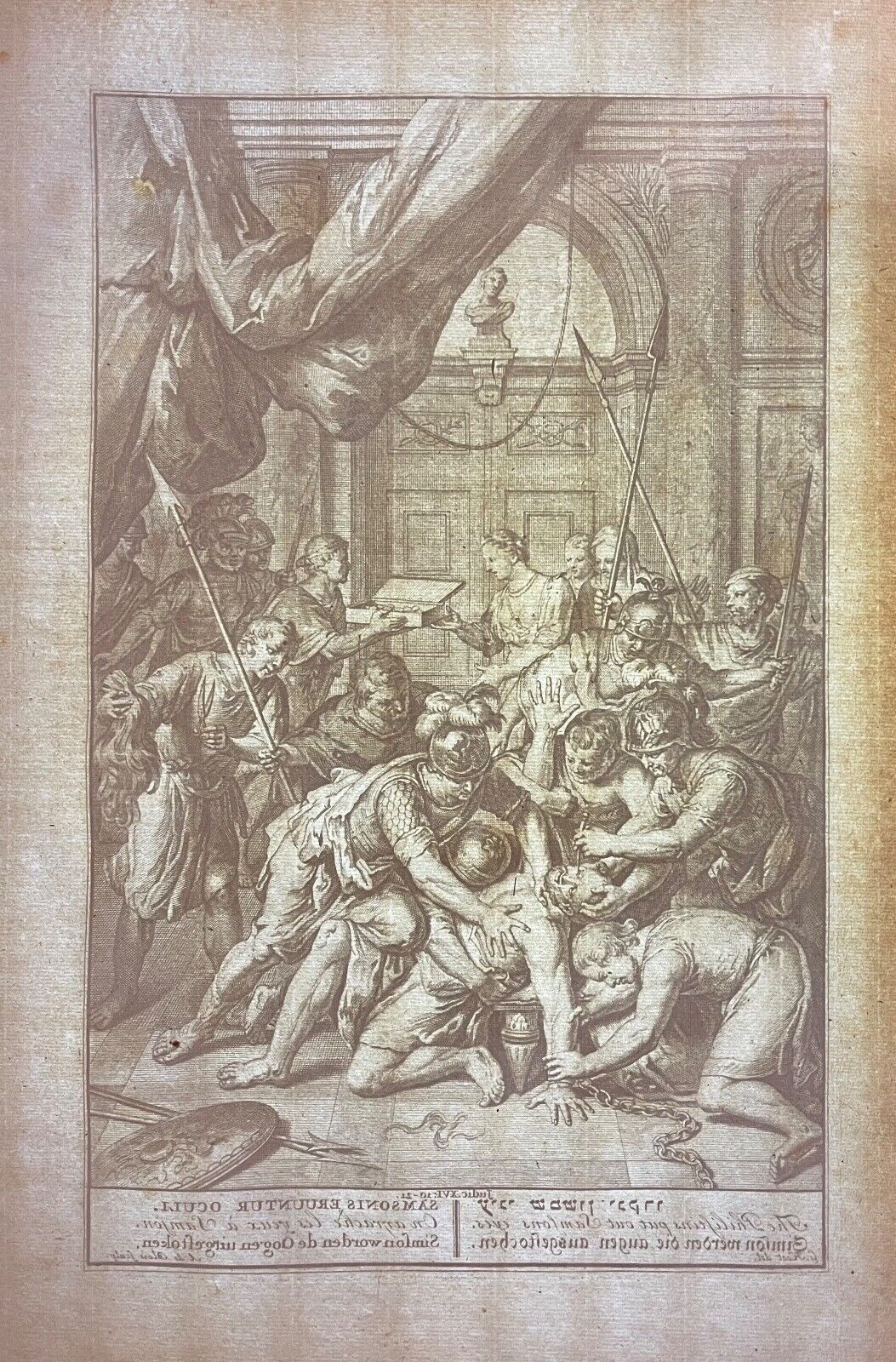
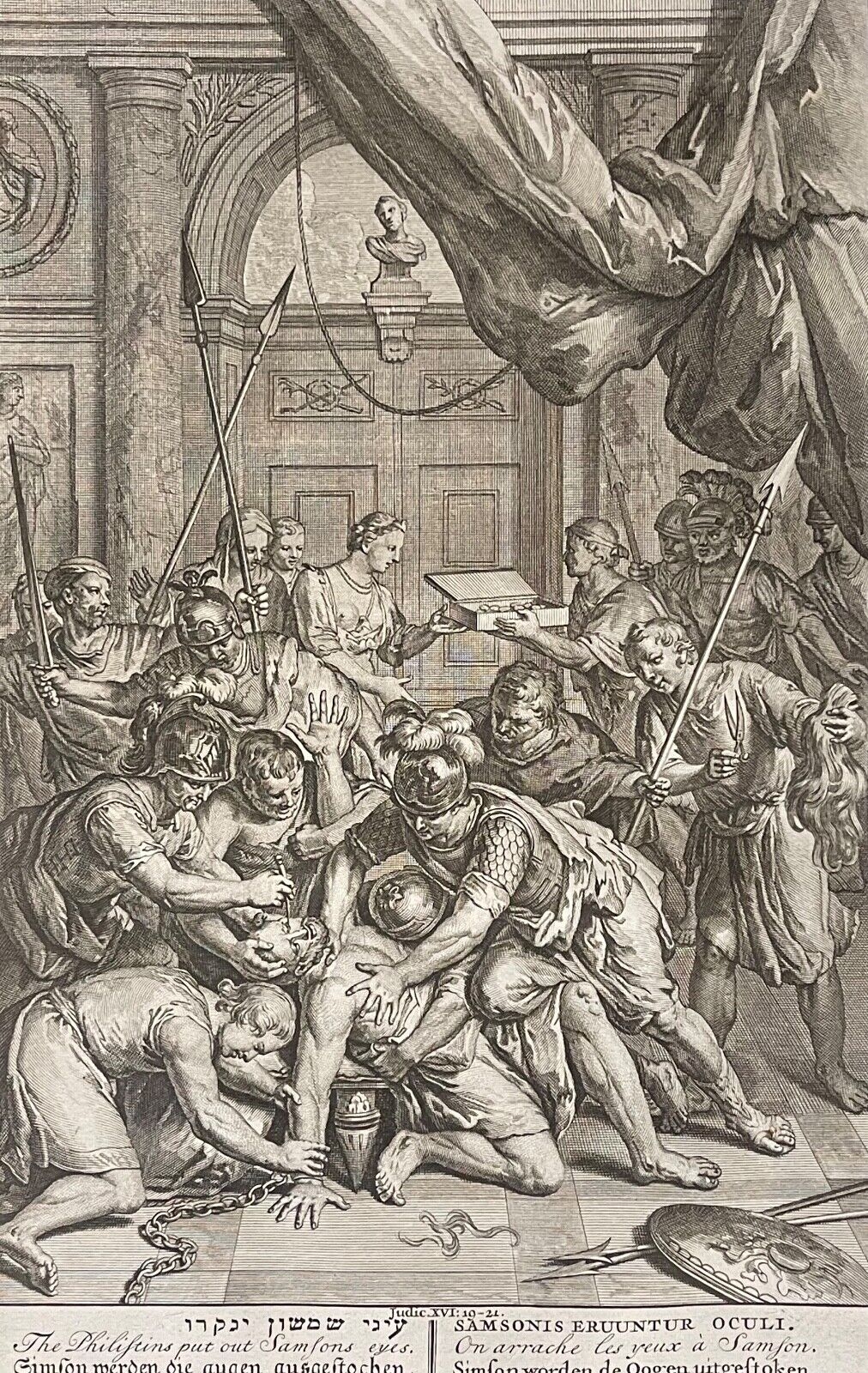
The engraving illustrates the dramatic moment when Samson, deprived of his extraordinary strength, is overpowered and blinded by the Philistines.
The principal action takes place in the foreground.
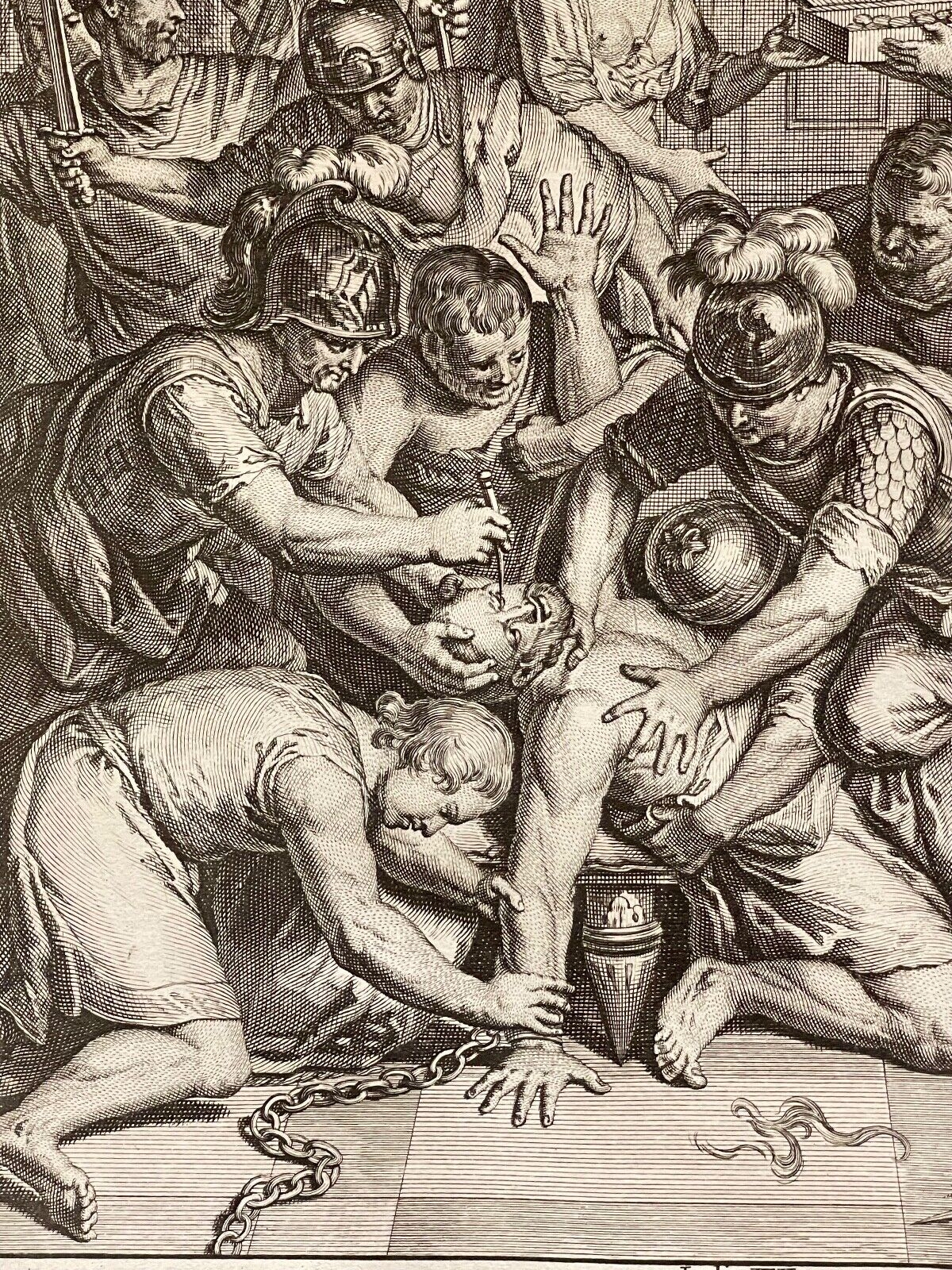
Samson lies on the ground, surrounded by armed soldiers who restrain his body and prevent him from escaping.
One figure holds his head while another prepares to pierce his eyes with a sharp instrument.
Several men seize his limbs, while other soldiers observe the punishment.
Their expressive gestures create a powerful impression of violence and confusion.
Samson’s body, formerly associated with superhuman strength, is now helpless beneath his captors.
The scene represents one of the most tragic moments in his biblical history.
DELILAH AND THE BETRAYAL OF SAMSON
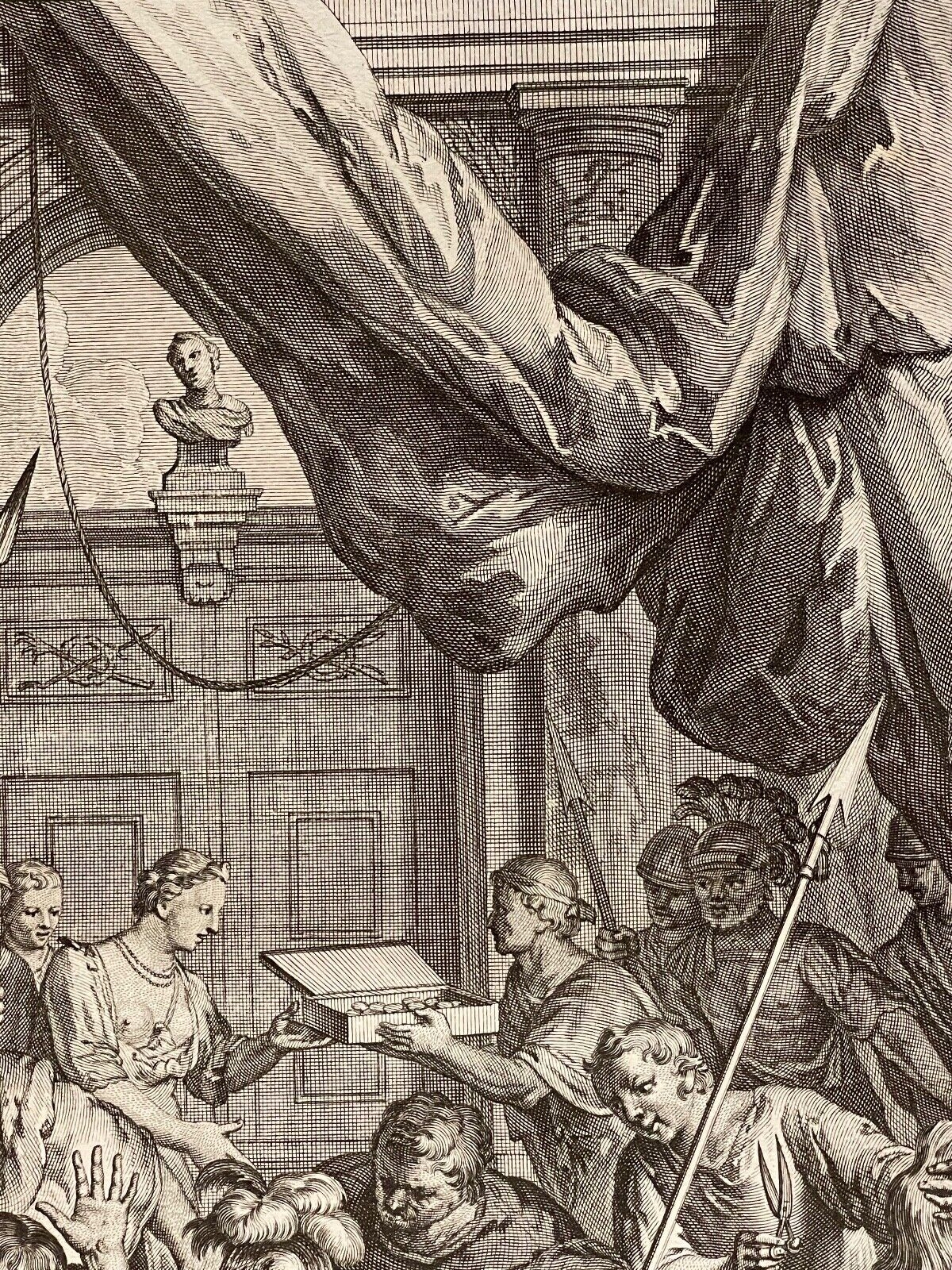
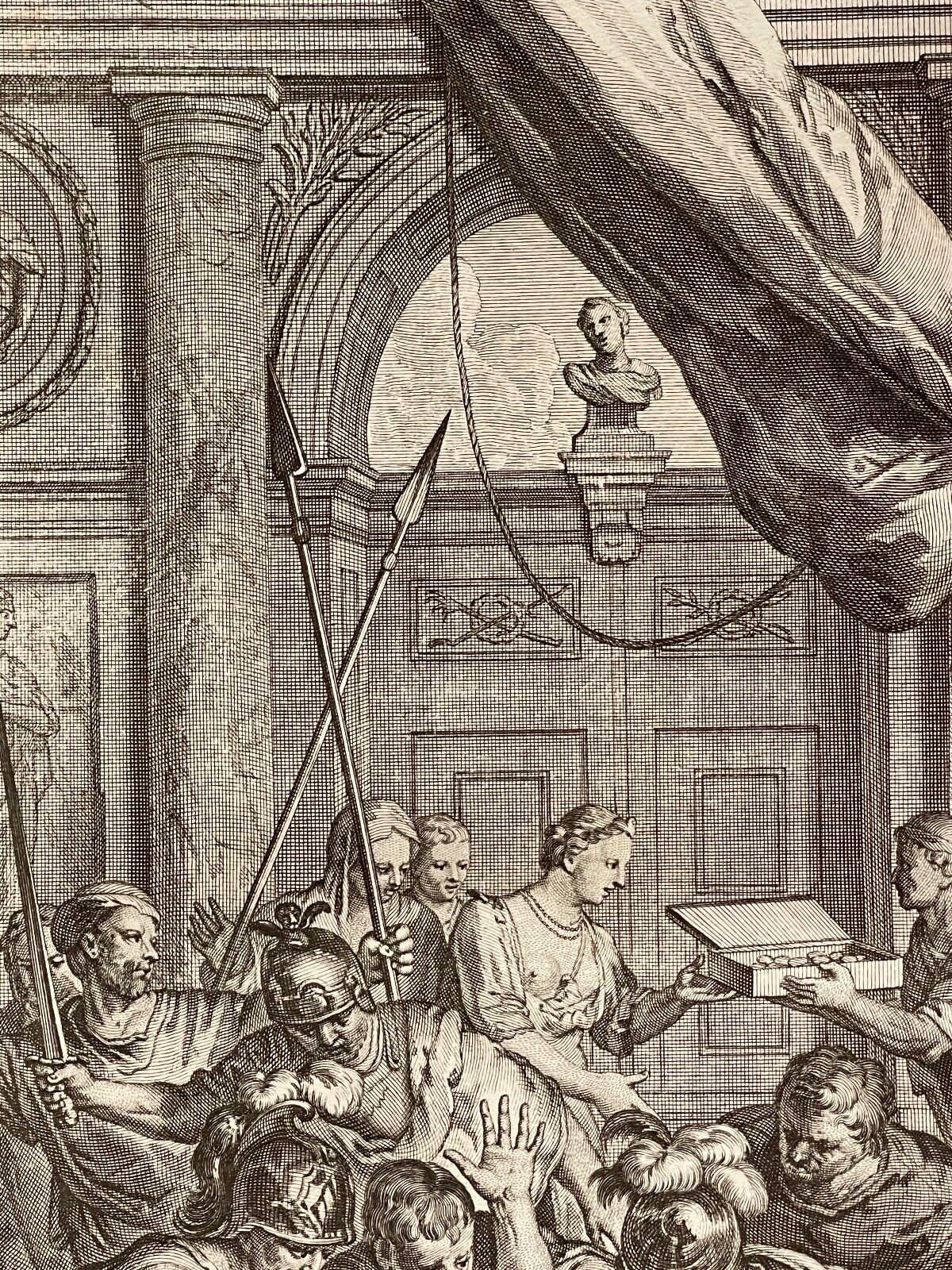
In the background, a richly dressed woman is shown receiving a small chest or casket from another figure.
This scene recalls the betrayal of Samson by Delilah.
According to the Book of Judges, Samson possessed extraordinary strength because of his special dedication to God.
The Philistine rulers offered Delilah a reward if she could discover the secret of his power.
After several unsuccessful attempts, Samson eventually revealed that his hair had never been cut.
Delilah arranged for his hair to be shaved while he slept.
When the Philistines arrived, Samson discovered that his former strength had disappeared.
He was captured, blinded and taken away as a prisoner.
The background scene of the woman receiving the casket introduces an important narrative reference to the betrayal that preceded Samson’s punishment.
THE BIBLICAL STORY OF SAMSON
Samson was one of the judges of ancient Israel.
His extraordinary strength was associated with his status as a Nazirite, dedicated to God from birth.
The biblical narrative describes several remarkable exploits, including his victory over a lion and his conflicts with the Philistines.
His relationship with Delilah ultimately led to his downfall.
Following his capture, Samson was taken to Gaza, bound with bronze chains and forced to work as a prisoner.
Over time, his hair began to grow again.
During a great gathering in the temple of the Philistine god Dagon, Samson prayed for the return of his strength.
He pushed against the supporting pillars of the temple, causing the building to collapse.
His story became one of the most frequently illustrated subjects in European biblical art.
AN EXTRAORDINARY DRAMATIC COMPOSITION
The design is distinguished by the extraordinary number of figures gathered around Samson.
The principal characters form a compact group of soldiers, servants and spectators.
Their bodies are arranged in different directions, creating a strong sense of movement.
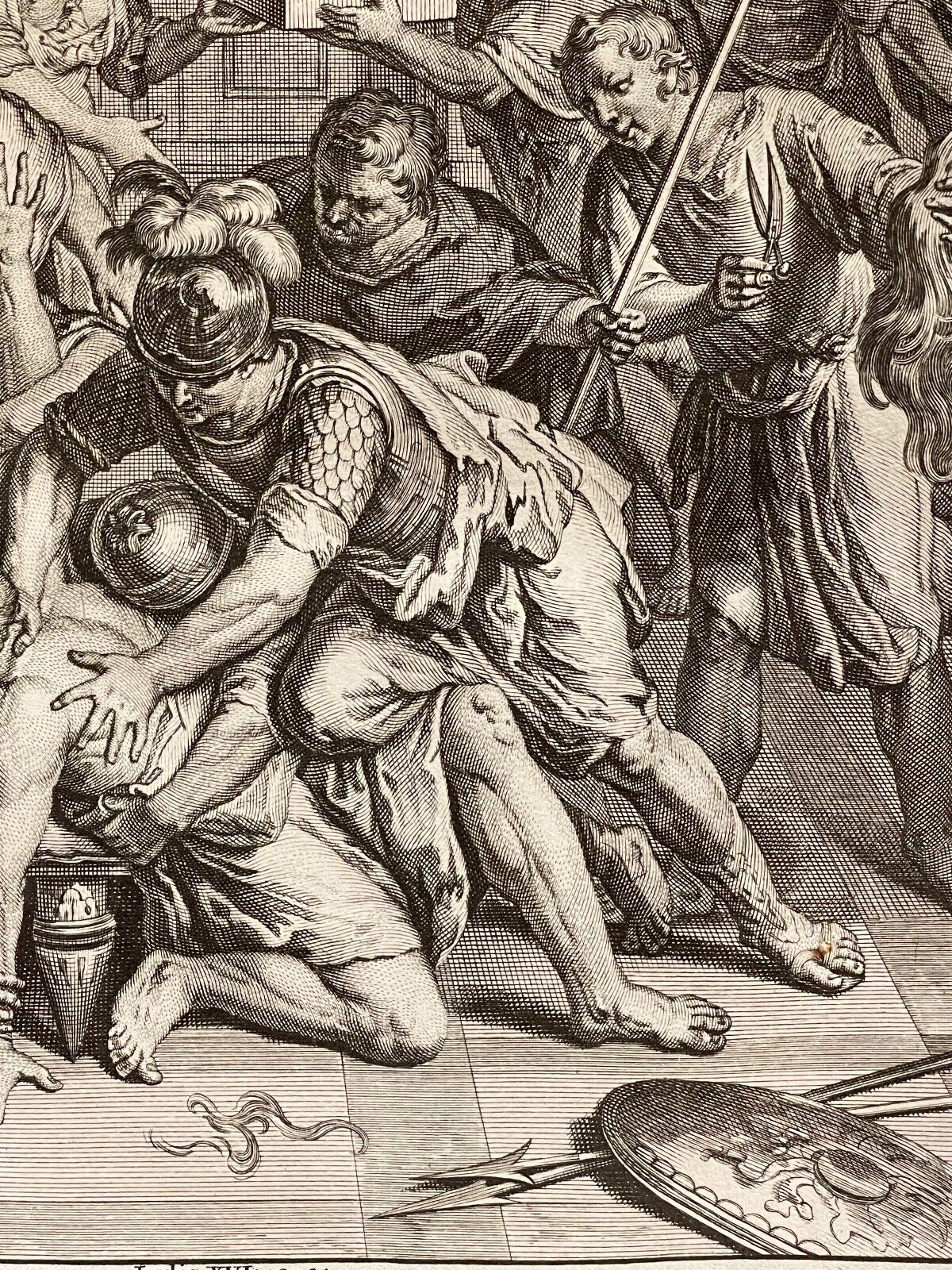
Military helmets, shields, spears and chains are distributed throughout the foreground.
The soldiers wear classical-style armour and draped garments.
Their expressions vary from aggression and determination to fear and astonishment.
The entire scene is organised to direct attention towards the suffering figure of Samson.
The complexity of the composition demonstrates Gerard Hoet’s ability to represent dramatic historical and religious narratives.
CLASSICAL ARCHITECTURE AND MONUMENTAL DRAPERIES
The background contains an elaborate architectural setting inspired by classical antiquity.
Large columns support an imposing interior decorated with relief panels and architectural mouldings.
An arched opening frames a sculpted bust.
The architectural elements provide a grand theatrical setting for the biblical narrative.
Above the characters, enormous draperies hang from the upper part of the composition.
Their heavy folds occupy much of the upper right section of the engraving.
The contrast between the monumental fabric, rigid architecture and agitated human figures contributes to the dramatic power of the image.
GERARD HOET THE ELDER (1648–1733)
Gerard Hoet the Elder was born in Zaltbommel, the Netherlands, on 22 August 1648.
He became a distinguished Dutch painter, draughtsman and designer of historical, mythological and biblical compositions.
His early training included instruction from his father and from the painter Warnard van Rijsen.
During his career, he worked in several Dutch cities and travelled abroad.
Hoet developed a particular interest in complex narrative scenes containing numerous figures, architectural backgrounds and expressive gestures.
In 1697, he participated with Hendrik Schoock in establishing a drawing academy in Utrecht.
His biblical compositions were subsequently translated into copper engravings by several accomplished printmakers.
These prints circulated widely throughout Europe during the eighteenth century.
Gerard Hoet died in The Hague in 1733.
ABRAHAM DE BLOIS – DUTCH ENGRAVER
Abraham de Blois was an engraver active in the Netherlands during the late seventeenth and early eighteenth centuries.
He produced copper engravings after designs by established artists, including Gerard Hoet.
His work demonstrates careful attention to line, texture and the rendering of dramatic figures.
In the present engraving, de Blois reproduces the complex arrangement of soldiers restraining Samson.
The facial expressions, armour, architectural decoration and large folds of drapery are rendered through precise engraved lines.
The artist’s signature is visible beneath the composition:
A. de Blois sculp.
The original designer is identified by the corresponding inscription:
G. Hoet del.
These signatures provide valuable documentation of the artists responsible for the work.
INSCRIPTIONS IN SIX LANGUAGES
One of the most distinctive features of this eighteenth-century print is its multilingual caption.
The biblical episode is identified in six languages:
Hebrew: An inscription referring to the blinding of Samson.
Latin: SAMSONIS ERUUNTUR OCULI.
English: The Philistins put out Samsons eyes.
French: On arrache les yeux à Samson.
German: Simson werden die augen ausgestochen.
Dutch: Simson worden de Oogen uitgestoken.
The biblical reference is also printed beneath the image:
Judic. XVI:19–21.
These original inscriptions reflect the international circulation of biblical engravings during the early eighteenth century.
Their presence adds considerable historical, linguistic and decorative interest to the sheet.
ORIGINAL EIGHTEENTH-CENTURY COPPER ENGRAVING
The present print belongs to the tradition of Dutch biblical copper engraving of the early eighteenth century.
The composition was engraved using intaglio techniques, combining etched passages with finely controlled burin work.
The architecture is represented through precise parallel lines, while the figures display more varied and expressive engraved marks.
The folds of the enormous draperies demonstrate particularly skilful shading.
The detailed helmets, weapons and chains contribute to the richness of the foreground.
The lighter architectural background provides contrast with the densely occupied central scene.
The result is a powerful example of eighteenth-century biblical printmaking.
ANTIQUE SHADED LAID PAPER
The engraving is printed on old shaded laid paper, described in French as papier vergé ombré.
The paper retains its natural aged appearance.
Its warm tone complements the finely engraved composition and the original inscriptions.
The relatively generous margins help preserve the complete image and multilingual legends.
ARTISTIC AND HISTORICAL INTEREST
The blinding of Samson has been represented by many important European artists.
The subject combines betrayal, human suffering, divine strength and the consequences of moral weakness.
Gerard Hoet developed the episode as a dramatic historical composition, with monumental architecture and an extensive group of figures.
Abraham de Blois transformed this design into a detailed copper engraving.
The combination of the artists’ signatures, the biblical reference and the six-language caption makes this a particularly interesting example of early eighteenth-century religious art.
TECHNICAL DETAILS
Subject: Samson Blinded by the Philistines.
Biblical reference: Judges 16:19–21.
Original designer: Gerard Hoet the Elder (1648–1733).
Engraver: Abraham de Blois.
Country of artistic origin: Netherlands.
Period: Eighteenth century.
Edition date: 1728, as catalogued.
Technique: Antique copper engraving, etching and burin.
Support: Antique shaded laid paper.
Sheet dimensions: 40 × 26.7 cm.
Engraved composition including captions: 34.2 × 21.5 cm.
Original inscriptions: Hebrew, Latin, English, French, German and Dutch.
Artist’s signatures: G. Hoet del. and A. de Blois sculp.
Reference: 5215-176R669.
CONDITION
Antique example displaying the natural patina of aged paper.
The engraved composition and original inscriptions remain well preserved.
The numerous figures, architectural details and multilingual captions retain good clarity.
COLLECTOR’S INTEREST
An attractive original eighteenth-century Dutch biblical copper engraving after Gerard Hoet the Elder, engraved by Abraham de Blois.
Particularly interesting for collectors of Old Testament illustrations, the Book of Judges, Samson and Delilah, Dutch Baroque art, antique religious engravings and historical copper prints.
The dramatic blinding of Samson, the richly decorated architectural setting and the unusual six-language inscription make this a distinctive historical work.
An appealing addition to a collection devoted to early European printmaking and biblical iconography.
Offered by Artculture6 – Antique Prints, Drawings and Works of Art.

Avis
Il n’y a pas encore d’avis.