Eglon King of Moab Killed Netherlands 1728 Gerard Hoet Haelwegh Biblical Engraving
79,00 €
Eglon King of Moab Killed – Original Dutch Biblical Copper Engraving, 1728.
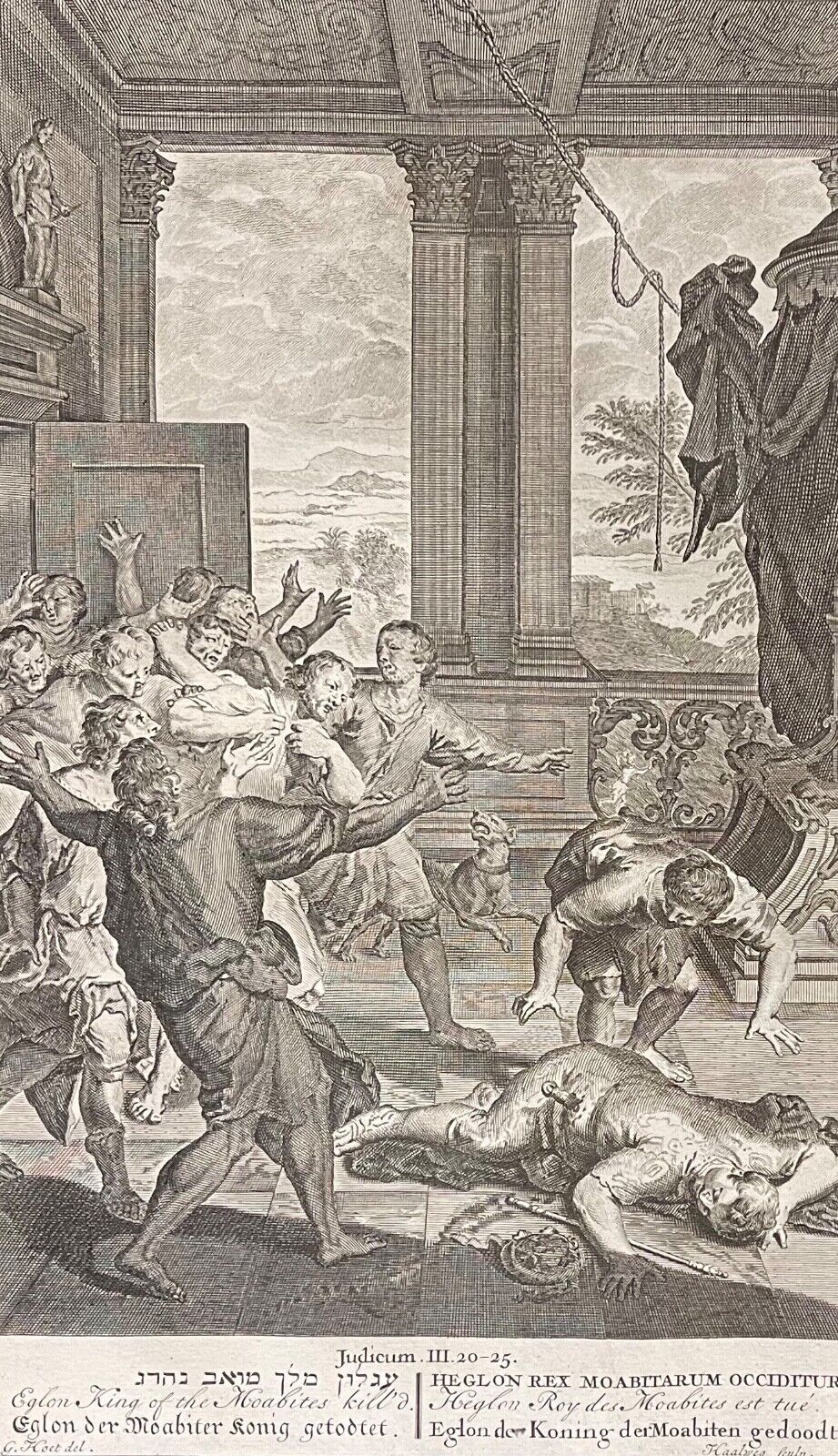
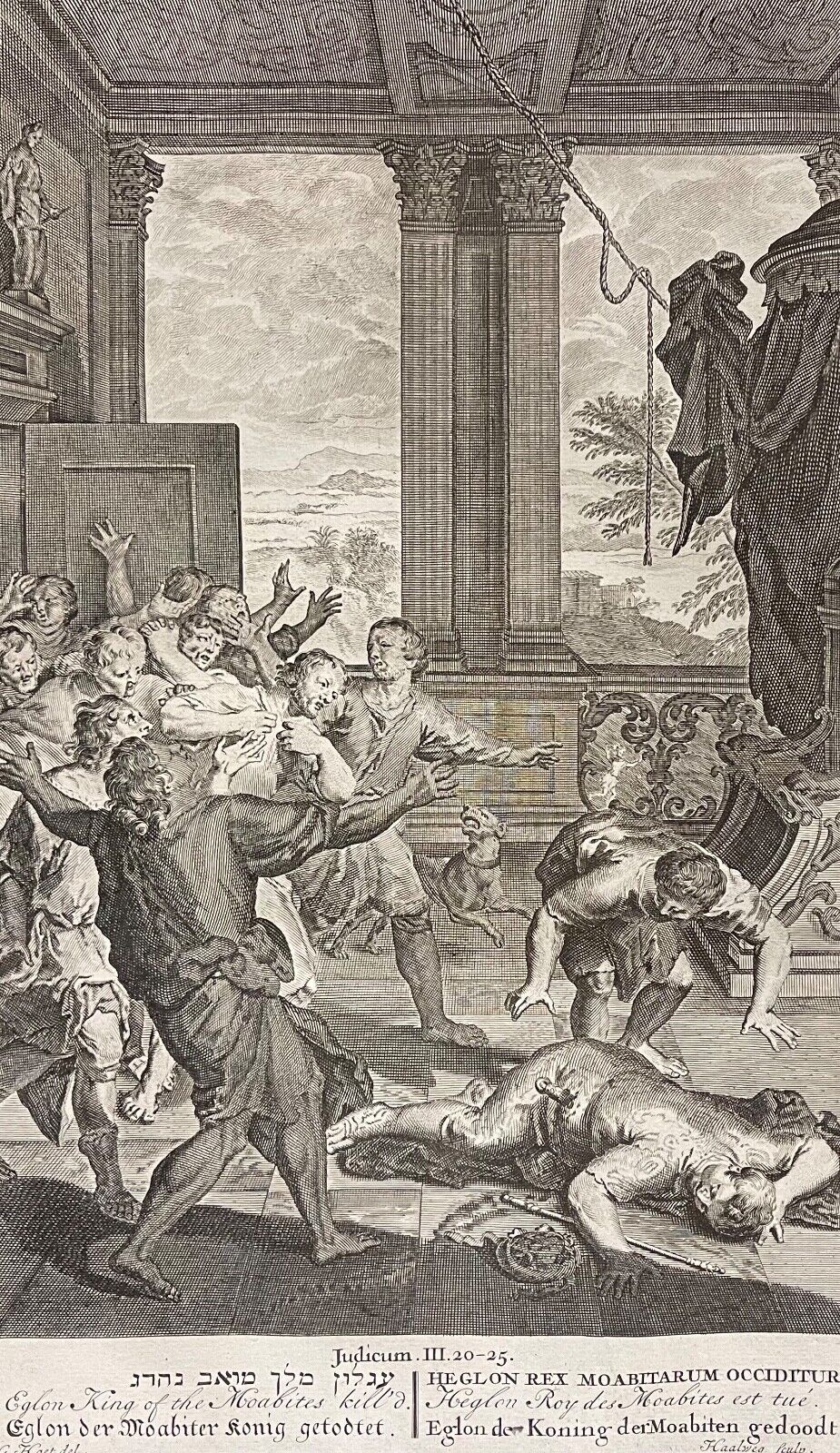
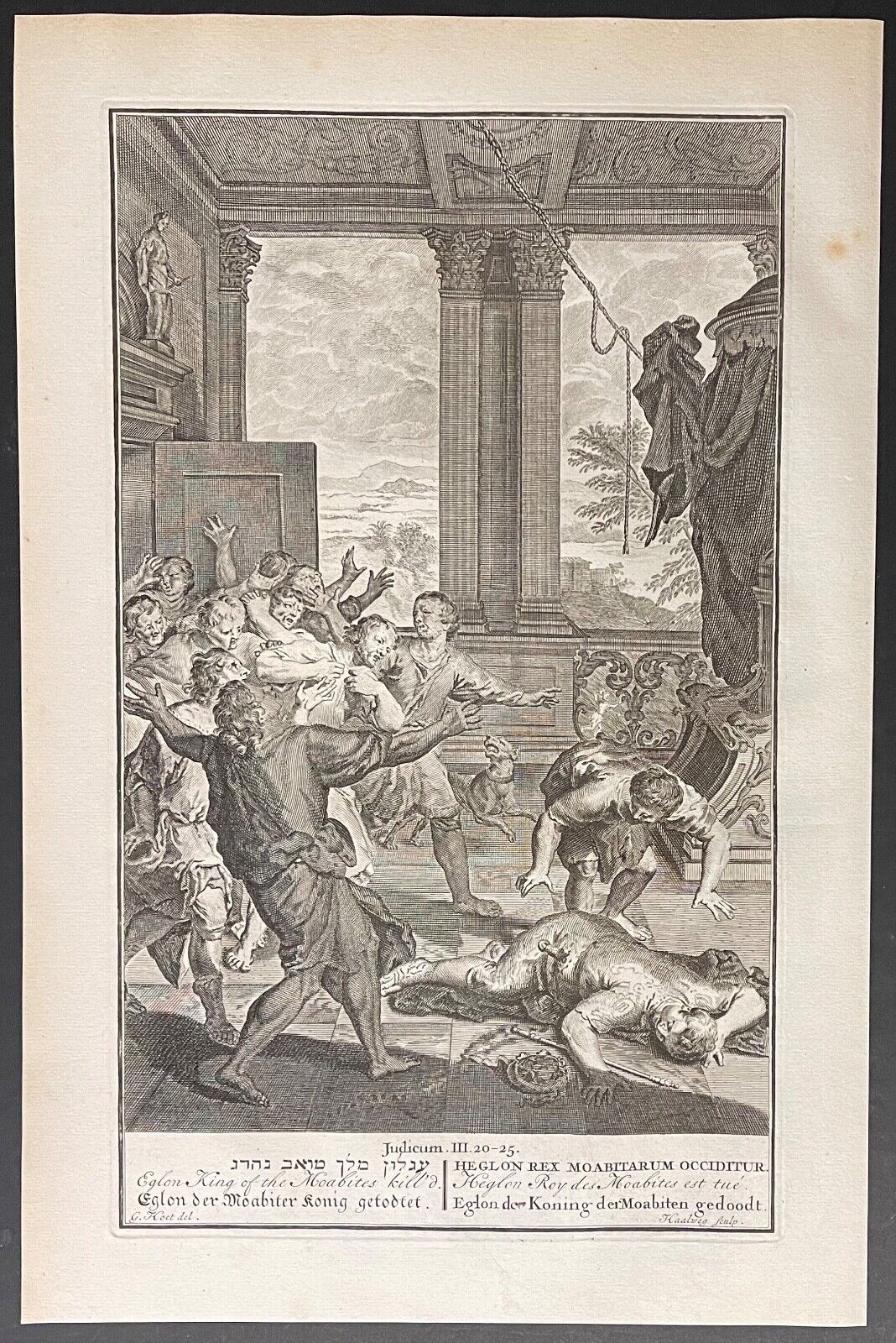
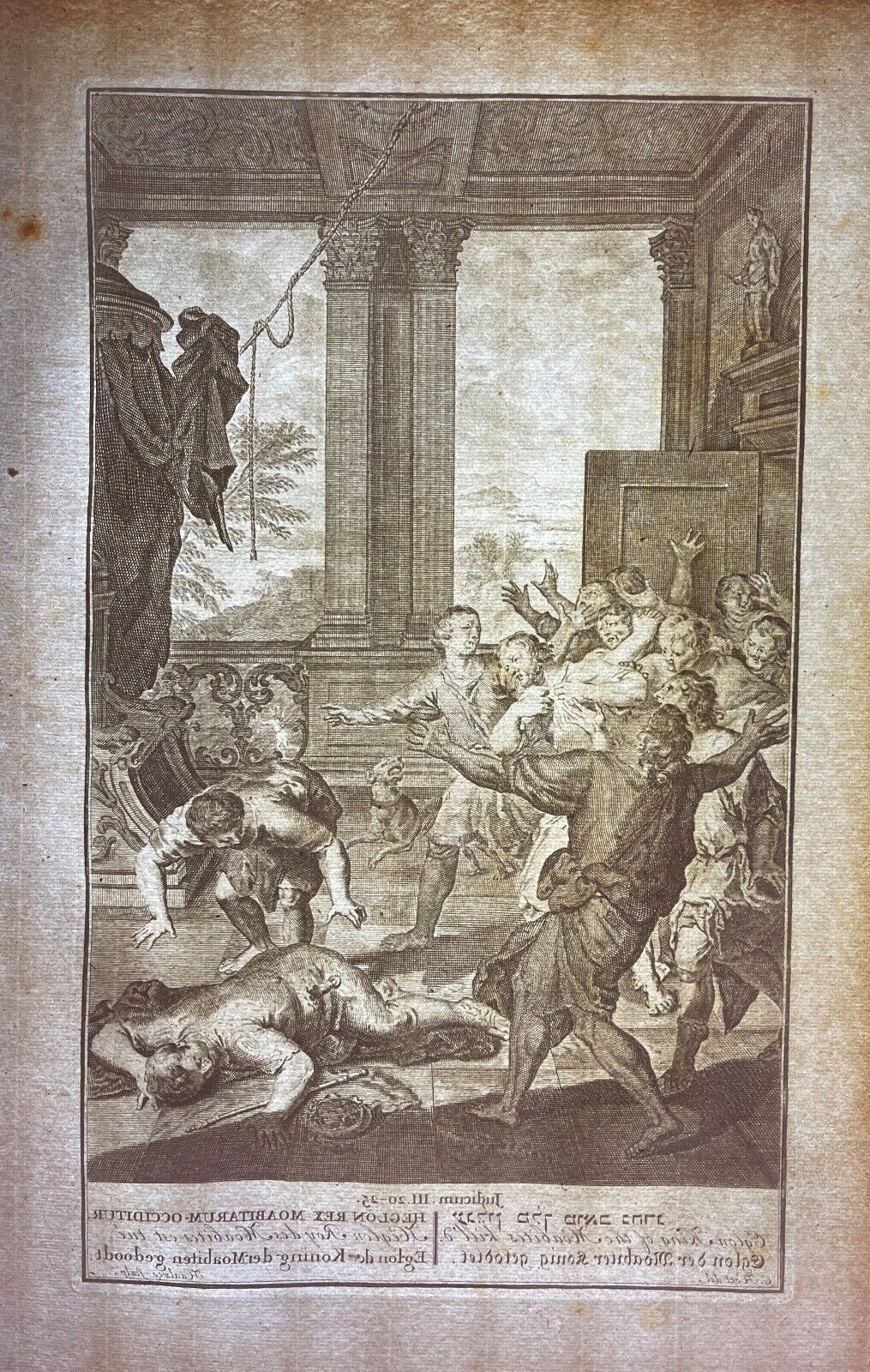
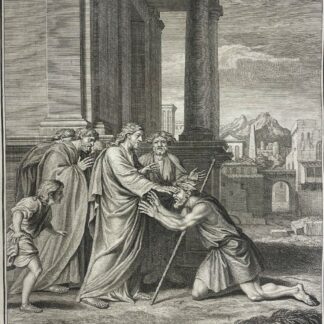
Impressive eighteenth-century biblical engraving after Gerard Hoet the Elder (1648–1733), engraved by Adriaen Haelwegh, depicting the discovery of King Eglon’s body following his assassination by Ehud, as narrated in Judges 3:20–25.
A dramatic composition featuring the murdered king beside his elaborate throne, terrified servants, monumental Corinthian columns and classical architectural decoration.
The original captions appear in six languages, including Hebrew, Latin, English, French, German and Dutch.
Technique: Copper engraving and etching.
Edition: 1728.
Paper: Antique shaded laid paper.
Sheet dimensions: 40.8 × 27 cm.
Engraved composition including captions: 35 × 20.8 cm.
Reference: 5215-179R669.
Description
Eglon King of Moab Killed – Original eighteenth-century Dutch biblical copper engraving from 1728, after Gerard Hoet the Elder (1648–1733), engraved by Adriaen Haelwegh, illustrating the discovery of King Eglon’s body following his assassination by Ehud, as narrated in the Book of Judges, chapter 3.
Artculture6 presents this impressive antique biblical engraving depicting one of the most dramatic episodes from the Old Testament.
The composition was designed by the celebrated Dutch painter and draughtsman Gerard Hoet the Elder and engraved by Adriaen Haelwegh.
Printed on antique shaded laid paper, this large historical print is distinguished by its expressive figures, imposing classical architecture, elaborate throne and original biblical inscriptions in six languages.
EGLON KING OF MOAB – THE DISCOVERY OF HIS BODY
The engraving illustrates the discovery of King Eglon after his assassination by Ehud, one of the judges of ancient Israel.
The principal action takes place within a grand royal chamber.
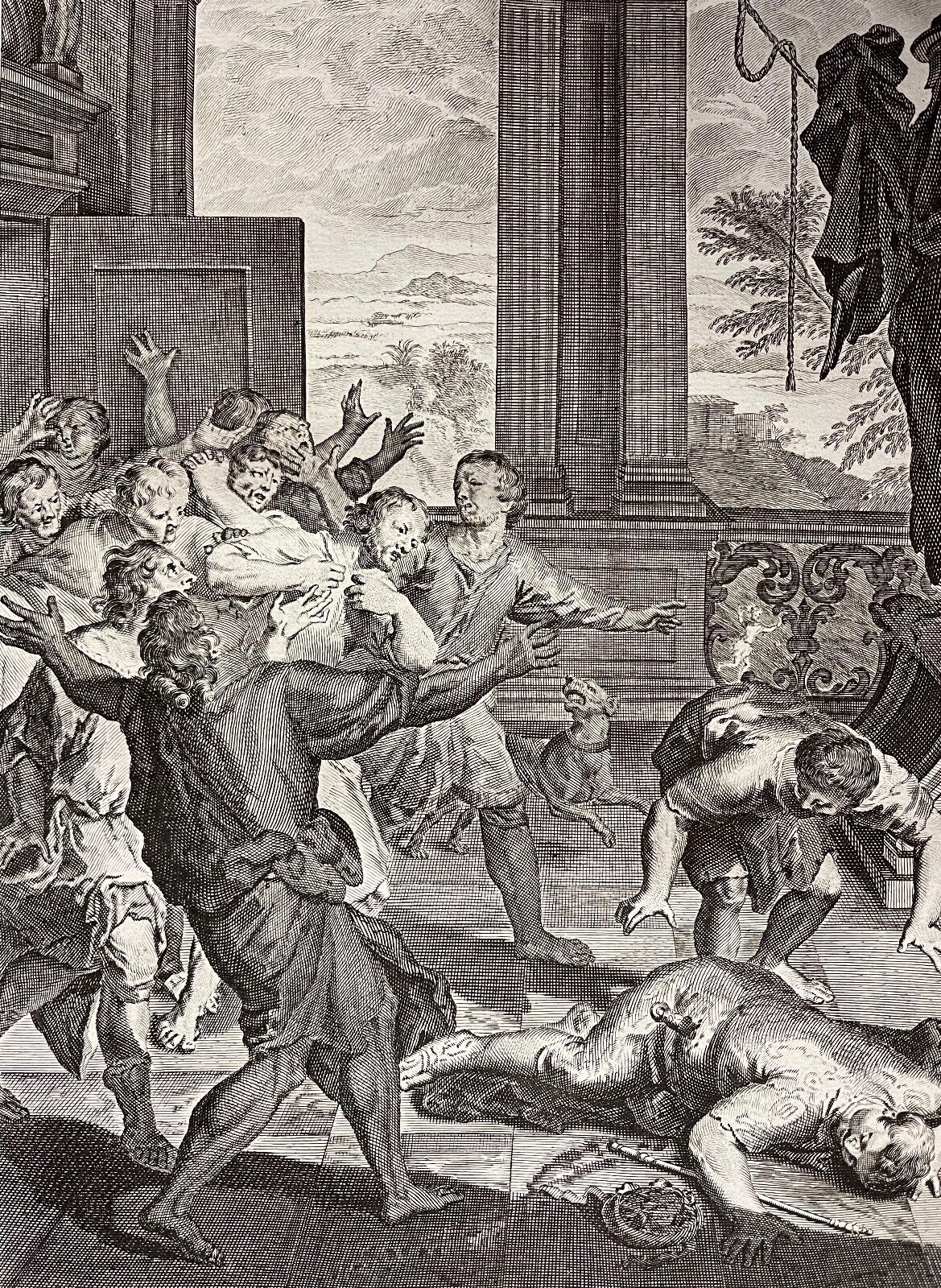
In the foreground, the body of Eglon lies on the floor beside his elaborately decorated throne.
The king is surrounded by servants who have entered the chamber and discovered the tragedy.
Several men raise their arms in astonishment.
Others lean towards the body, apparently attempting to understand what has happened.
One figure in the foreground turns away in a dramatic gesture of alarm.
The different expressions of fear, surprise and confusion create a remarkable sense of movement.
Rather than depicting the moment of the assassination itself, Gerard Hoet has chosen to represent its dramatic aftermath.
EHUD AND THE ASSASSINATION OF EGLON
The biblical narrative appears in the Book of Judges, chapter 3.
Eglon was king of Moab and had established his authority over the Israelites.
According to the biblical account, the Israelites remained under his domination for eighteen years.
Ehud, son of Gera, was chosen to deliver tribute to the Moabite king.
He prepared a double-edged dagger and concealed it beneath his clothing, attached to his right thigh.
After presenting the tribute, Ehud returned to the king, claiming that he had a secret message for him.
Eglon dismissed his attendants, leaving himself alone with Ehud.
Ehud then drew his concealed weapon and stabbed the king.
Afterwards, he left the royal chamber and secured its doors.
THE SERVANTS DISCOVER THE DEAD KING
The king’s attendants initially assumed that Eglon wished to remain undisturbed.
They waited outside the locked chamber.
When the king failed to appear, they eventually opened the doors.
They discovered their sovereign lying dead upon the floor.
This moment provides the subject of the present engraving.
The attendants react with extraordinary gestures of distress and disbelief.
Their movements are carefully arranged around the fallen king.
The composition transforms the biblical narrative into a spectacular historical scene.
THE STORY OF EHUD IN THE OLD TESTAMENT
Ehud occupies an important place among the judges of ancient Israel.
According to the Book of Judges, his actions ended the domination of Eglon and the Moabites.
After escaping from the royal residence, Ehud returned to the Israelites and summoned them to revolt.
The narrative describes the defeat of the Moabite forces and a subsequent period of peace.
The episode has been represented in European biblical art for centuries.
It combines political conflict, deception, personal courage and the dramatic death of a ruler.
Gerard Hoet’s interpretation focuses upon the emotional consequences of the event rather than the act of violence itself.
A MONUMENTAL CLASSICAL INTERIOR
One of the most attractive features of this engraving is the elaborate architectural setting.
The scene takes place inside a grand palace decorated with classical columns and sculptural ornaments.
Tall Corinthian columns dominate the centre of the composition.
To the left, a sculpted figure stands within an architectural niche.
Beyond the columns appears an extensive landscape with distant mountains, trees and buildings.
The architectural perspective creates a remarkable impression of depth.
The classical interior reflects the artistic conventions of European biblical illustration during the Baroque period.
THE ROYAL THRONE AND DRAPERIES
On the right stands an elaborate royal throne decorated with scrollwork and carved ornaments.
Its imposing structure emphasises the elevated position of King Eglon.
Large draperies hang above the throne.
The folds of the fabric are rendered through carefully controlled engraved lines.
The contrast between the luxurious royal setting and the fallen body of the king adds to the dramatic character of the composition.
These architectural and decorative elements make the print especially attractive to collectors of historical European engraving.
GERARD HOET THE ELDER (1648–1733)
Gerard Hoet the Elder was born in Zaltbommel, the Netherlands, on 22 August 1648.
He became a distinguished Dutch painter and draughtsman, particularly celebrated for historical, mythological and biblical compositions.
His artistic training included instruction from his father and the painter Warnard van Rijsen.
During his career, Hoet worked in several Dutch cities and travelled abroad.
He developed a particular interest in complex narrative scenes containing numerous figures, monumental architectural backgrounds and expressive gestures.
In 1697, he participated with Hendrik Schoock in establishing a drawing academy in Utrecht.
His biblical compositions were translated into copper engravings by several accomplished Dutch printmakers.
These engravings circulated widely throughout Europe during the eighteenth century.
Gerard Hoet died in The Hague in 1733.
ADRIAEN HAELWEGH – DUTCH ENGRAVER
Adriaen Haelwegh was an engraver active in the Northern Netherlands during the seventeenth century.
His engraved works include historical and religious compositions after Dutch artists.
He translated Gerard Hoet’s dramatic biblical design into a detailed copper engraving.
Particular attention was given to the expressions of the servants, the folds of their garments and the architectural elements of the palace.
The engraved lines create fine contrasts between illuminated figures and darker passages.
The original inscriptions identify the artists:
G. Hoet del.
Haelwegh sculp.
The composition provides an attractive example of the collaboration between a Dutch history painter and a professional copper engraver.
A DRAWING PRESERVED AT THE ALBERTINA
An important preparatory composition by Gerard Hoet representing the same biblical scene is preserved in the Albertina collection in Vienna.
The drawing depicts King Eglon discovered dead beside his throne.
This museum reference provides valuable documentation of the original artistic design.
The drawing is executed in grey wash with white highlights over graphite and measures approximately 32.4 × 21.1 cm.
The existence of this preparatory work contributes to the historical and artistic interest of the engraved composition.
AN ORIGINAL EIGHTEENTH-CENTURY EDITION
The present example belongs to a series of Dutch biblical engravings circulated during the early eighteenth century.
The composition is documented in a publication of 1720 and was used again in a Dutch edition published in The Hague in 1728.
The present impression is catalogued as belonging to the 1728 edition.
The engravings were intended to illustrate important episodes from the Old and New Testaments.
Their detailed compositions and multilingual inscriptions demonstrate the international audience for biblical imagery during the period.
INSCRIPTIONS IN SIX LANGUAGES
One of the distinctive features of this engraving is the series of captions beneath the image.
The subject is identified in six languages:
Hebrew: Biblical inscription concerning Eglon, king of Moab.
Latin: HEGLON REX MOABITARUM OCCIDITUR.
English: Eglon King of the Moabites kill’d.
French: Heglon Roy des Moabites est tué.
German: Eglon der Moabiter König getödtet.
Dutch: Eglon der Koning der Moabiten gedoodt.
The biblical reference appears above the captions:
Judicum III. 20–25.
These inscriptions contribute to the historical, linguistic and decorative character of the print.
COPPER ENGRAVING TECHNIQUE
The composition was produced using traditional copper engraving and etching techniques.
The classical columns and architectural mouldings are rendered through closely spaced parallel lines.
The garments and expressive faces display more varied engraved marks.
The ornamental details of the royal throne are treated with particular care.
The open landscape beyond the palace is engraved in lighter tones, providing a sense of atmospheric depth.
The overall composition combines dramatic movement with architectural precision.
ANTIQUE SHADED LAID PAPER
The engraving is printed on old shaded laid paper, described in French as papier vergé ombré.
The sheet retains its natural antique appearance.
The relatively generous margins preserve the complete composition and the multilingual legends.
The historic paper contributes to the material interest of this eighteenth-century impression.
TECHNICAL DETAILS
Subject: Eglon, King of Moab, discovered dead after his assassination by Ehud.
Biblical reference: Judges 3:20–25.
Original designer: Gerard Hoet the Elder (1648–1733).
Engraver: Adriaen Haelwegh.
Country of origin: Netherlands.
Period: Eighteenth century.
Edition: 1728, as catalogued.
Technique: Antique copper engraving and etching.
Support: Antique shaded laid paper.
Sheet dimensions: 40.8 × 27 cm.
Engraved composition including captions: 35 × 20.8 cm.
Original inscriptions: Hebrew, Latin, English, French, German and Dutch.
Reference: 5215-179R669.
CONDITION
Antique example displaying the natural patina of aged paper.
The engraved composition and original inscriptions remain well preserved.
The figures, architectural details and multilingual captions retain good clarity.
COLLECTOR’S INTEREST
An impressive original eighteenth-century Dutch biblical engraving after Gerard Hoet the Elder, engraved by Adriaen Haelwegh.
Particularly interesting for collectors of Old Testament illustrations, the Book of Judges, Dutch Baroque art, historical copper engravings, biblical kings and religious iconography.
The discovery of the murdered king, the expressive servants, monumental classical architecture and original six-language captions make this a distinctive historical composition.
An appealing addition to a collection devoted to early European printmaking and biblical history.
Offered by Artculture6 – Antique Prints, Drawings and Works of Art.

Avis
Il n’y a pas encore d’avis.