Berlin Germany Napoleon Entry 1806 Brandenburg Gate Swebach Bovinet French Engraving c1850
59,00 €
Berlin Germany Napoleon Entry 1806 – Brandenburg Gate – Large French Historical Engraving after Swebach, circa 1850.
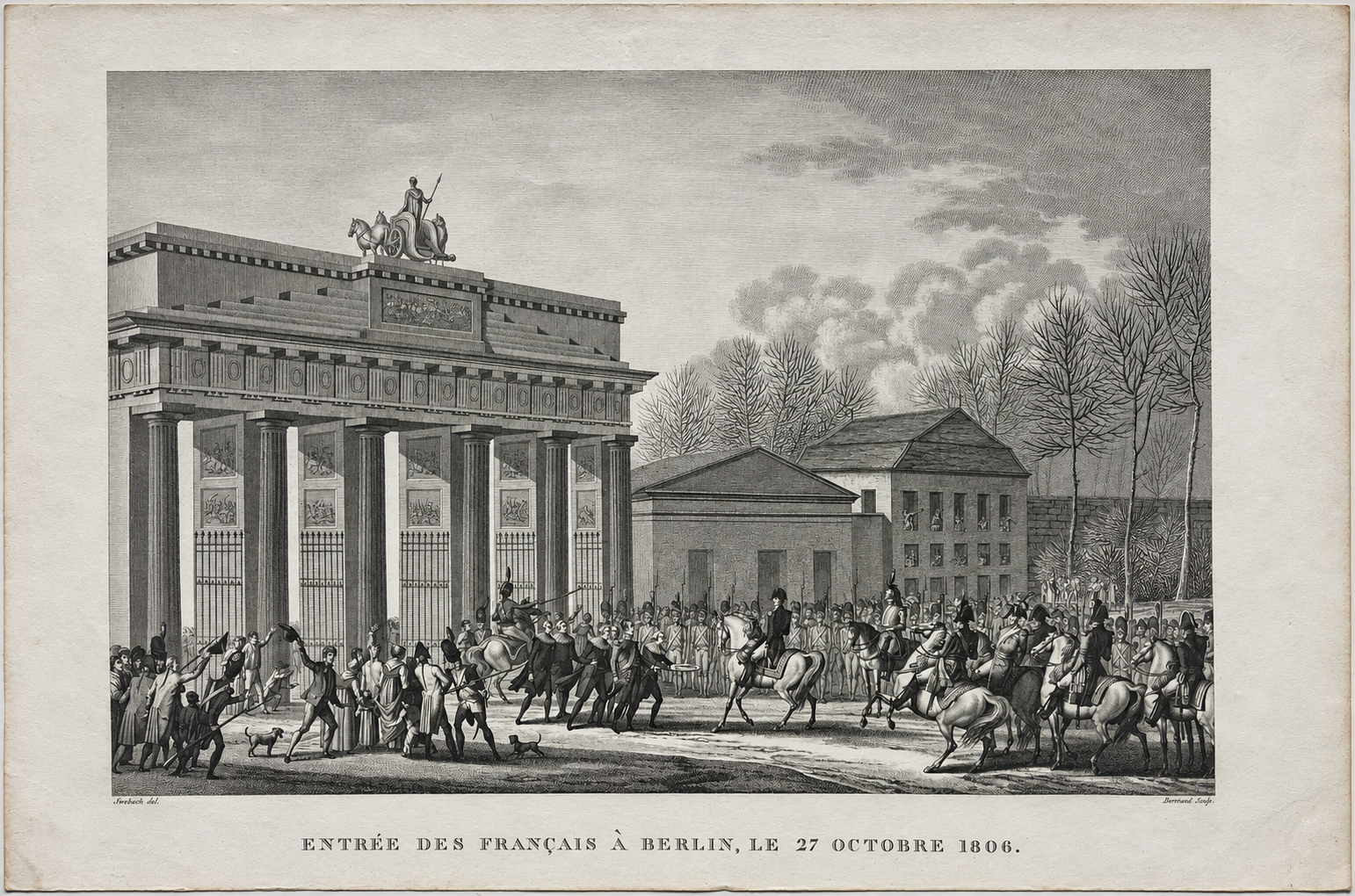
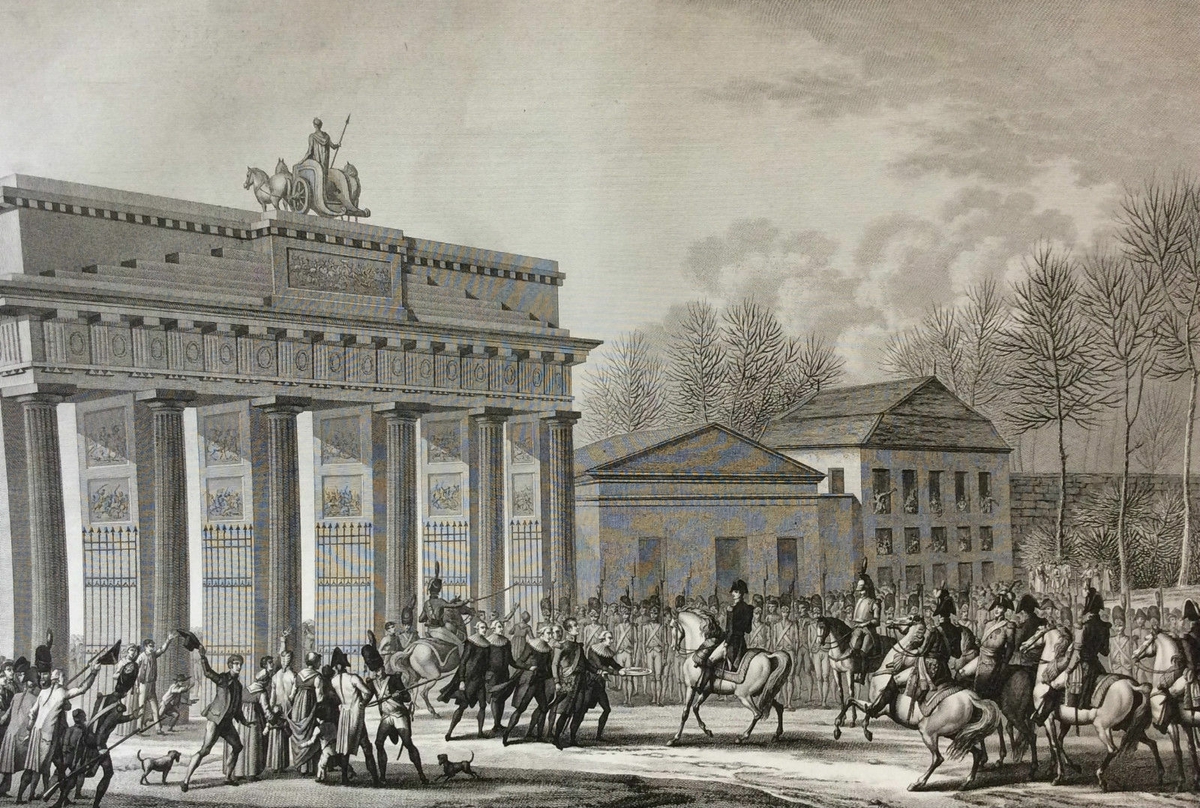
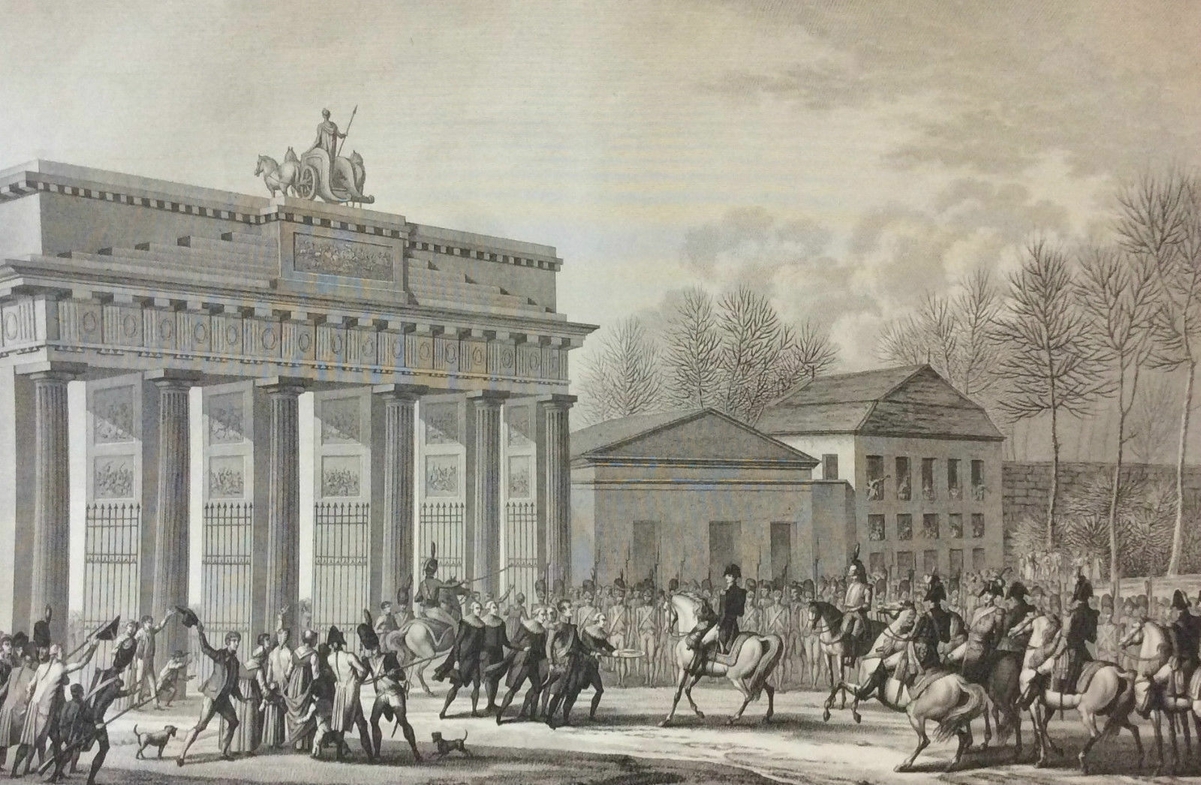
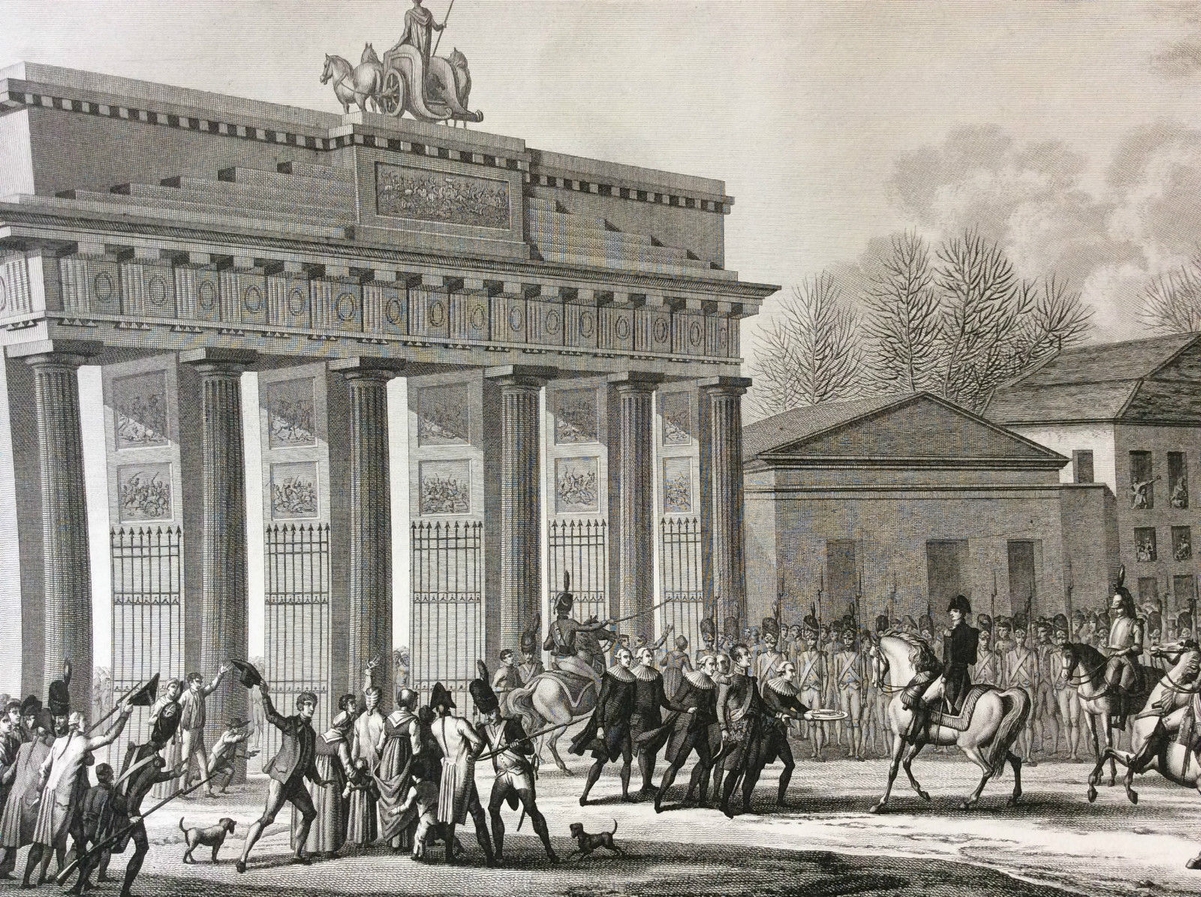
Impressive nineteenth-century French engraving depicting Napoleon Bonaparte entering Berlin through the famous Brandenburg Gate on 27 October 1806, following the French victories at Jena and Auerstedt.
A richly detailed panoramic composition with Napoleon on horseback, French cavalry officers, infantry, civilian spectators, military uniforms and the monumental Brandenburg Gate crowned by its quadriga.
Artist: After Jacques François Joseph Swebach-Desfontaines (1769–1823).
Engraver: Edme Bovinet.
Technique: Antique French etching, nineteenth century.
Sheet dimensions: 46.3 × 30.2 cm.
Engraved image: 37.9 × 25.3 cm.
Reference: 4401-91R324D25.
Description
Berlin Germany Napoleon Entry 1806 – Brandenburg Gate – Antique French Engraving after Swebach circa 1850
Berlin Germany Napoleon Entry 1806 – Large nineteenth-century French historical engraving after Jacques François Joseph Swebach-Desfontaines (1769–1823), depicting Emperor Napoleon Bonaparte entering the Prussian capital through the Brandenburg Gate on 27 October 1806.
Artculture6 presents this impressive antique French engraving, traditionally dated circa 1850, illustrating one of the most celebrated events of Napoleon’s military campaigns.
The original composition was designed by Swebach-Desfontaines and engraved by Edme Bovinet.
The scene represents Napoleon’s triumphant entry into Berlin following the decisive French victories at Jena and Auerstedt on 14 October 1806.
The engraving is distinguished by its monumental architecture, numerous military figures, mounted cavalry officers, horses, civilians and the famous Brandenburg Gate.
NAPOLEON ENTERS BERLIN – 27 OCTOBER 1806
On 27 October 1806, Emperor Napoleon I entered Berlin following the defeat of the Prussian armies.
The French victory at the twin battles of Jena and Auerstedt, fought on 14 October, had destroyed much of Prussia’s military strength.
The French army advanced rapidly towards the Prussian capital.
Napoleon entered Berlin through the monumental Brandenburg Gate, accompanied by his officers and cavalry.
His arrival marked a decisive moment in the War of the Fourth Coalition and demonstrated the military supremacy of the French Empire.
The scene became an important subject for nineteenth-century historical painters and engravers.
THE BRANDENBURG GATE
The Brandenburg Gate dominates the left side of this remarkable composition.
Built between 1788 and 1791, the monument was designed by the Prussian architect Carl Gotthard Langhans.
Its monumental Neoclassical architecture was inspired by the Propylaea of the Acropolis in Athens.
The structure consists of imposing Doric columns supporting an elaborate entablature.
Above the building stands the famous quadriga, a four-horse chariot driven by the goddess of Victory.
The gate was one of the most important ceremonial entrances to Berlin.
Napoleon’s passage beneath the monument became a powerful symbol of French military success and Prussian defeat.
A SPECTACULAR HISTORICAL COMPOSITION
The engraving depicts the French army entering Berlin through a broad ceremonial avenue.
Napoleon appears mounted on horseback, surrounded by officers and members of his military escort.
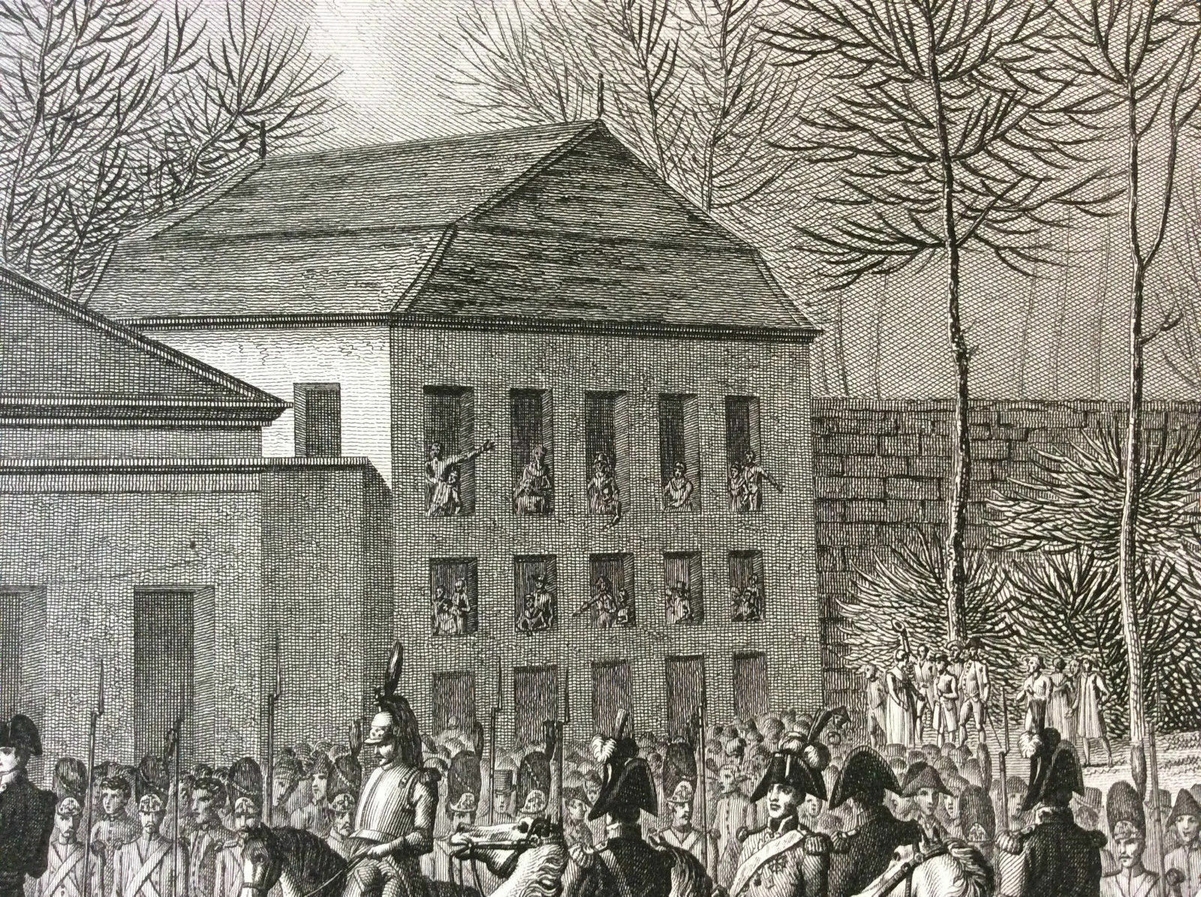
Numerous civilians gather along the street to observe the arrival of the French troops.
Several spectators raise their hats or gesture towards the passing soldiers.
Women and children are represented among the crowd, creating a lively scene of urban life.
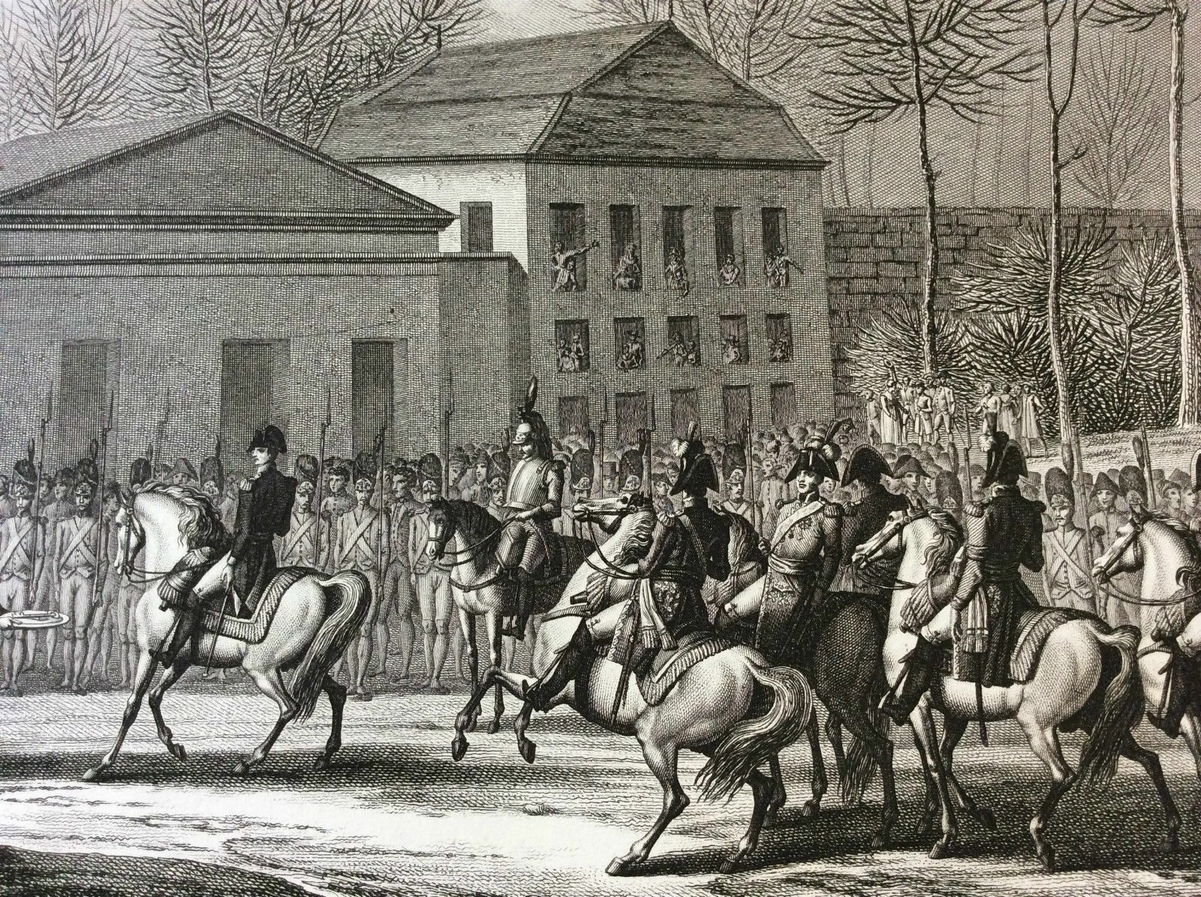
On the right, groups of mounted cavalry officers occupy the foreground.
Their elaborate uniforms, feathered headgear and military equipment are carefully engraved.
Behind the principal figures, numerous infantrymen and mounted soldiers form a procession extending towards the Brandenburg Gate.
The scale of the composition emphasises the importance of this historic event.
FRENCH CAVALRY AND MILITARY UNIFORMS
The representation of military horses is one of the most attractive elements of the engraving.
Swebach-Desfontaines was particularly celebrated for his equestrian subjects.
The horses are shown in varied movements and positions, contributing to the impression of a procession in motion.
The saddles, harnesses, military uniforms and equipment are rendered with considerable attention to detail.
Mounted officers wear the distinctive clothing and headgear associated with the Napoleonic period.
The contrast between the disciplined military figures and the animated civilian crowd adds to the narrative richness of the image.
THE PRUSSIAN CAMPAIGN OF 1806
The campaign against Prussia formed part of the War of the Fourth Coalition.
Prussia entered the conflict amid growing concern over Napoleon’s influence in the German states.
The French army achieved decisive victories at Jena and Auerstedt on 14 October 1806.
These defeats caused the rapid collapse of Prussian resistance across much of the kingdom.
French forces subsequently occupied Berlin.
Napoleon continued his operations eastwards, leading to further campaigns against Russian and Prussian forces during 1807.
His entry into Berlin became one of the defining images of the First French Empire.
THE QUADRIGA AND NAPOLEON
The famous quadriga crowning the Brandenburg Gate became directly associated with Napoleon’s occupation of Berlin.
Designed by the sculptor Johann Gottfried Schadow, the monument represented Victory driving a chariot pulled by four horses.
Following the French occupation, the quadriga was removed and transported to Paris.
It remained in France until Napoleon’s defeat in 1814, when it was returned to Berlin.
This episode contributed to the monument’s enduring importance as a symbol of Prussian and German history.
JACQUES FRANÇOIS JOSEPH SWEBACH-DESFONTAINES
Jacques François Joseph Swebach-Desfontaines was born in Metz, France, in 1769 and died in Paris in 1823.
He was a French painter, draughtsman and printmaker particularly admired for his representations of horses, cavalry and historical military events.
He studied with his father and subsequently with Michel Hamon-Duplessis.
His artistic career developed during the French Revolution, and he exhibited at the Paris Salon.
From 1802 to 1813, he served as principal painter at the Sèvres porcelain manufactory.
After the Napoleonic period, he also worked in Russia in connection with the Imperial Porcelain Manufactory.
His works are especially appreciated for their dynamic equestrian compositions, detailed military costumes and carefully organised historical scenes.
The present engraving reproduces a composition after Swebach, combining military history with monumental architecture.
EDME BOVINET – FRENCH ENGRAVER
Edme Bovinet was born in 1767 and worked as a French engraver during the late eighteenth and early nineteenth centuries.
He produced numerous historical prints and reproductions after contemporary artists.
His engraving of Napoleon’s entry into Berlin demonstrates careful treatment of architectural elements, military uniforms and equestrian figures.
The numerous closely spaced engraved lines create contrasts of light and shadow throughout the composition.
The Brandenburg Gate, mounted officers and surrounding crowd are all represented with considerable precision.
AN IMPORTANT HISTORICAL EVENT
Napoleon’s occupation of Berlin was more than a ceremonial military entry.
It represented the defeat of one of France’s principal continental opponents.
During his stay in Berlin, Napoleon continued to reorganise the territories under French influence.
On 21 November 1806, he issued the Berlin Decree, a major step in establishing the Continental System against British trade.
The occupation therefore had important diplomatic, economic and military consequences.
The engraving preserves the memory of this decisive moment through a monumental historical composition.
NINETEENTH-CENTURY FRENCH PRINTMAKING
The nineteenth century saw the publication of numerous engravings commemorating Napoleon’s victories and military campaigns.
Historical images of Berlin, Jena, Auerstedt, Friedland and Tilsit were particularly popular.
These prints documented the principal events of the Napoleonic era while also serving as decorative works of art.
The present example belongs to this tradition of large French historical engravings.
Its combination of monumental architecture, numerous figures and carefully engraved horses makes it especially attractive.
TECHNICAL DETAILS
Subject: Napoleon I entering Berlin through the Brandenburg Gate.
Historical event: 27 October 1806.
Location: Berlin, Prussia, now Germany.
Monument: Brandenburg Gate.
Original draughtsman: Jacques François Joseph Swebach-Desfontaines (1769–1823).
Engraver: Edme Bovinet (1767–circa 1832–1837).
Period: Nineteenth century.
Date of this impression: Circa 1850, as catalogued.
Technique: Antique French etching.
Sheet dimensions: 46.3 × 30.2 cm.
Engraved image dimensions: 37.9 × 25.3 cm.
Reference: 4401-91R324D25.
CONDITION
Antique example displaying the natural patina of aged paper. The engraved composition and original inscriptions remain well preserved.
COLLECTOR’S INTEREST
An attractive large nineteenth-century French historical engraving depicting Napoleon Bonaparte’s triumphant entry into Berlin on 27 October 1806.
Particularly interesting for collectors of Napoleonic history, the First French Empire, Prussian history, the Brandenburg Gate, French military engravings, cavalry and European historical architecture.
The monumental gate, numerous soldiers, animated civilian crowd and finely engraved horses make this a decorative and historically significant composition.
The print also complements historical engravings depicting Napoleon’s later campaigns in Poland, the Siege of Danzig and the meeting with Tsar Alexander I at Tilsit in 1807.
Offered by Artculture6 – Antique Prints, Drawings and Works of Art.


Avis
Il n’y a pas encore d’avis.