Tilsit Prussia 1807 Napoleon Bonaparte Tsar Alexander I Russia Swebach Engraving c1850
59,00 €
Tilsit 1807 Napoleon and Alexander I of Russia – Large French Historical Engraving after Swebach, circa 1850.
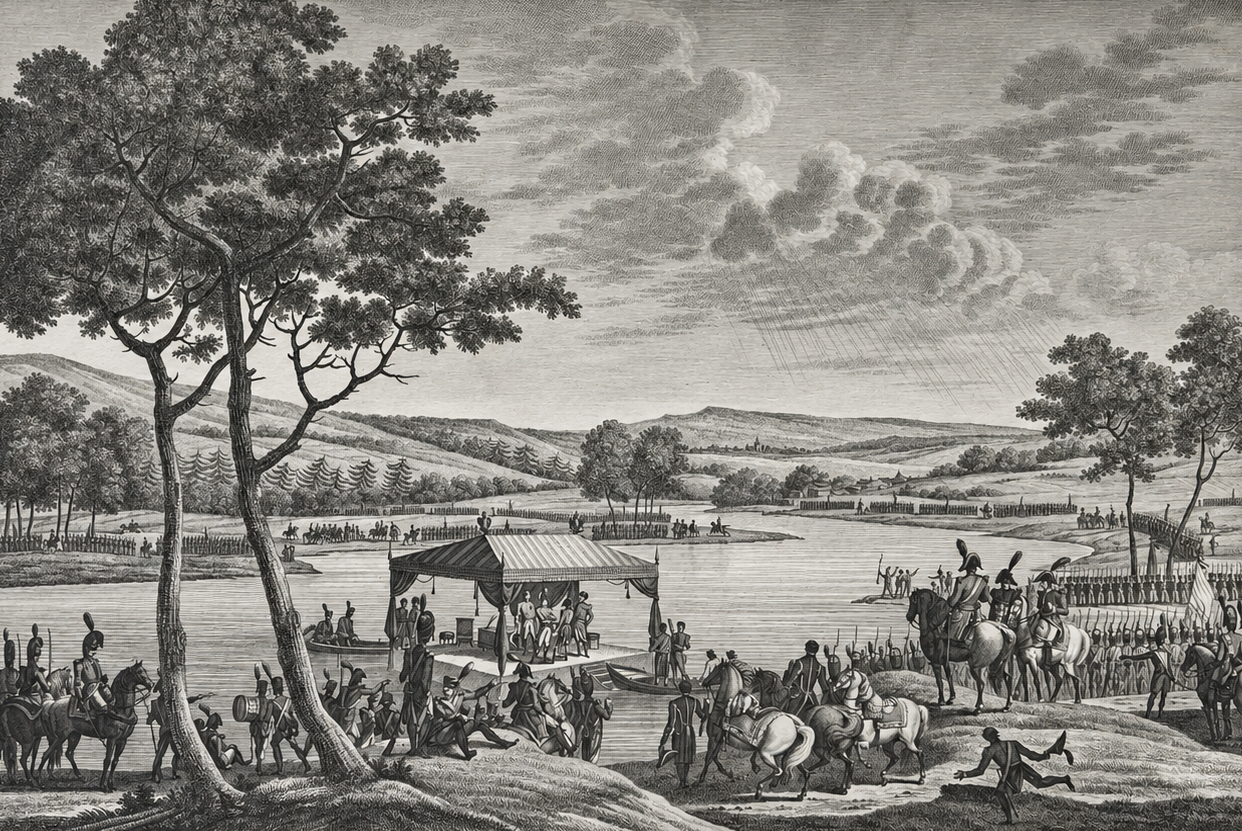
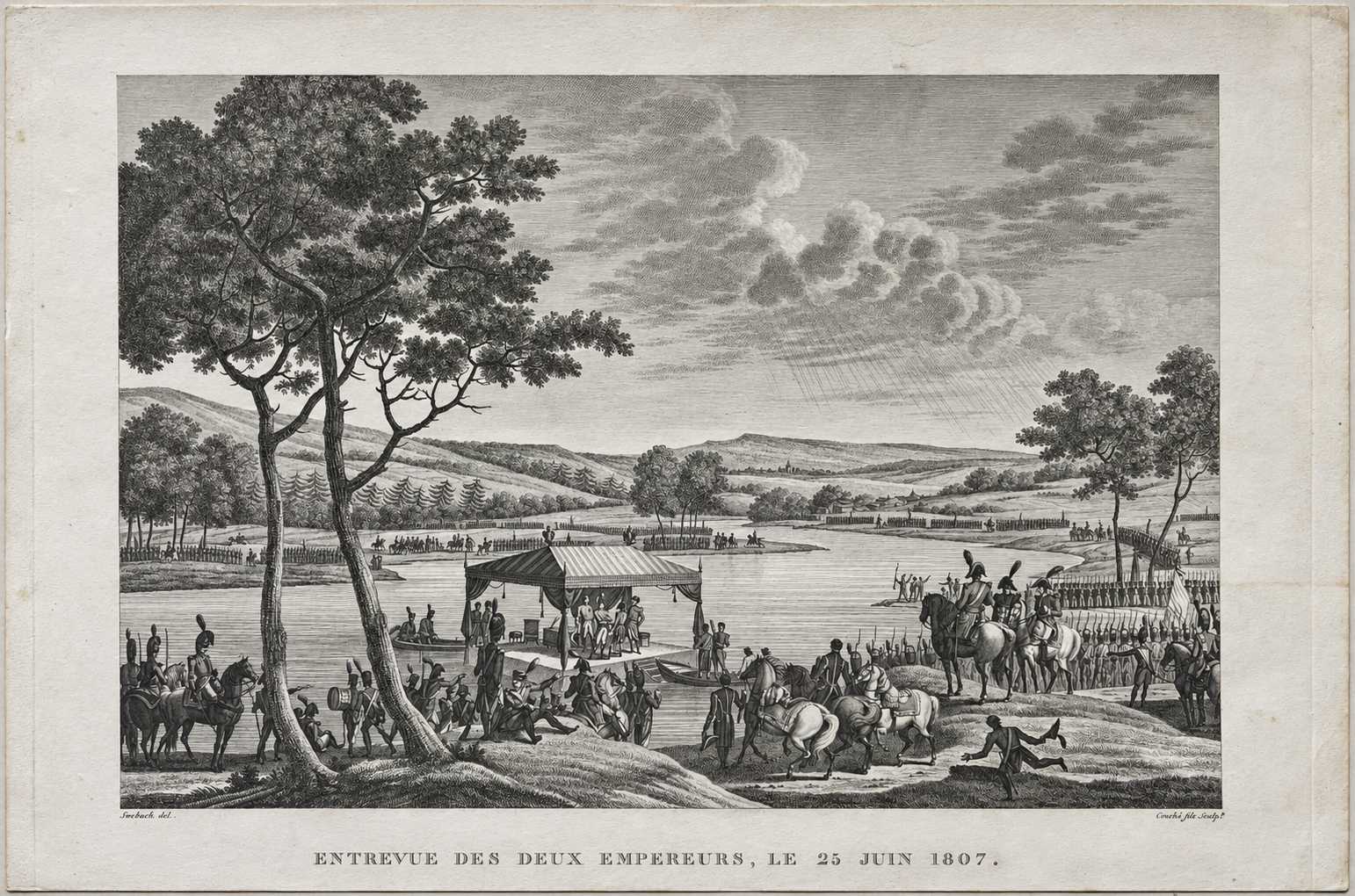
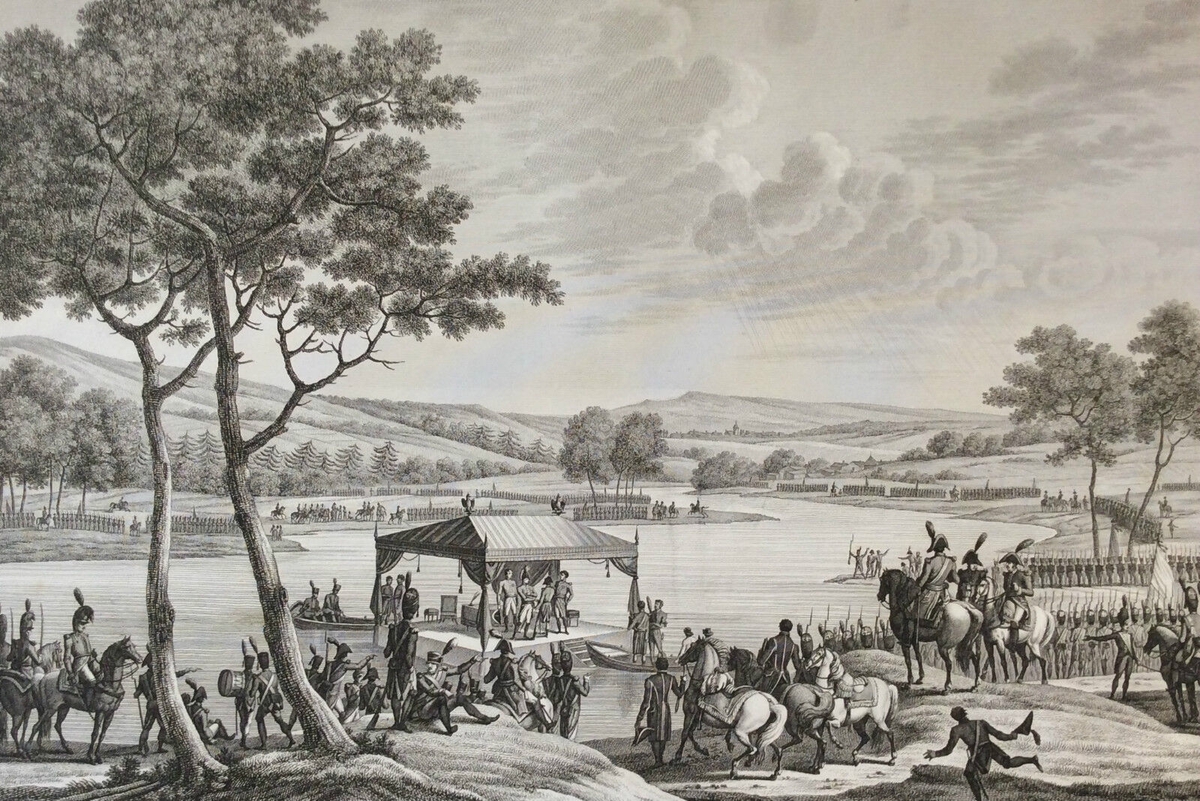
Impressive nineteenth-century etching depicting the historic meeting of Emperor Napoleon Bonaparte and Tsar Alexander I of Russia on 25 June 1807, aboard a floating pavilion on the Niemen River at Tilsit.
A richly detailed panoramic composition featuring French and Russian soldiers, cavalry officers, horses, military formations, boats, trees and a beautiful landscape.
The meeting preceded the Treaties of Tilsit, signed in July 1807.
Artist: After Jacques François Joseph Swebach-Desfontaines (1769–1823).
Technique: Antique etching, circa 1850.
Sheet dimensions: 46.5 × 30.2 cm.
Engraved composition: 38.2 × 25.5 cm.
Reference: 4401-94R324D25.
Description
Tilsit 1807 Napoleon and Alexander I of Russia – Historic Meeting on the Niemen River – Antique French Engraving circa 1850
Tilsit 1807 Napoleon and Alexander I of Russia – Large original nineteenth-century French historical engraving after Jacques François Joseph Swebach-Desfontaines (1769–1823), depicting the famous meeting of the two emperors on 25 June 1807.
Artculture6 presents this impressive antique French etching, traditionally dated circa 1850, illustrating one of the most celebrated diplomatic events of the Napoleonic era.
The composition depicts Emperor Napoleon I of France meeting Tsar Alexander I of Russia in a specially constructed floating pavilion on the Niemen River, at Tilsit in East Prussia.
The encounter marked the beginning of negotiations that resulted in the historic Treaties of Tilsit in July 1807.
The engraving is distinguished by its extensive panoramic landscape, numerous military figures, mounted officers, horses, soldiers, flags and the floating pavilion occupied by the two sovereigns.
THE MEETING OF THE TWO EMPERORS – 25 JUNE 1807
On 25 June 1807, Napoleon Bonaparte met Tsar Alexander I of Russia in the middle of the Niemen River.
The meeting took place following Napoleon’s decisive victory over the Russian army at the Battle of Friedland on 14 June 1807.
After several months of military operations in Poland and East Prussia, both rulers sought to negotiate an end to the conflict.
A floating platform was specially constructed on the river to receive the two sovereigns.
An elegant pavilion was erected upon the raft, providing a neutral location between the opposing armies.
Napoleon approached from the French-controlled bank, while Alexander arrived from the Russian side.
The two emperors met upon the platform and entered the pavilion for their discussions.
This remarkable encounter became one of the most famous diplomatic scenes of the First French Empire.
THE FLOATING PAVILION
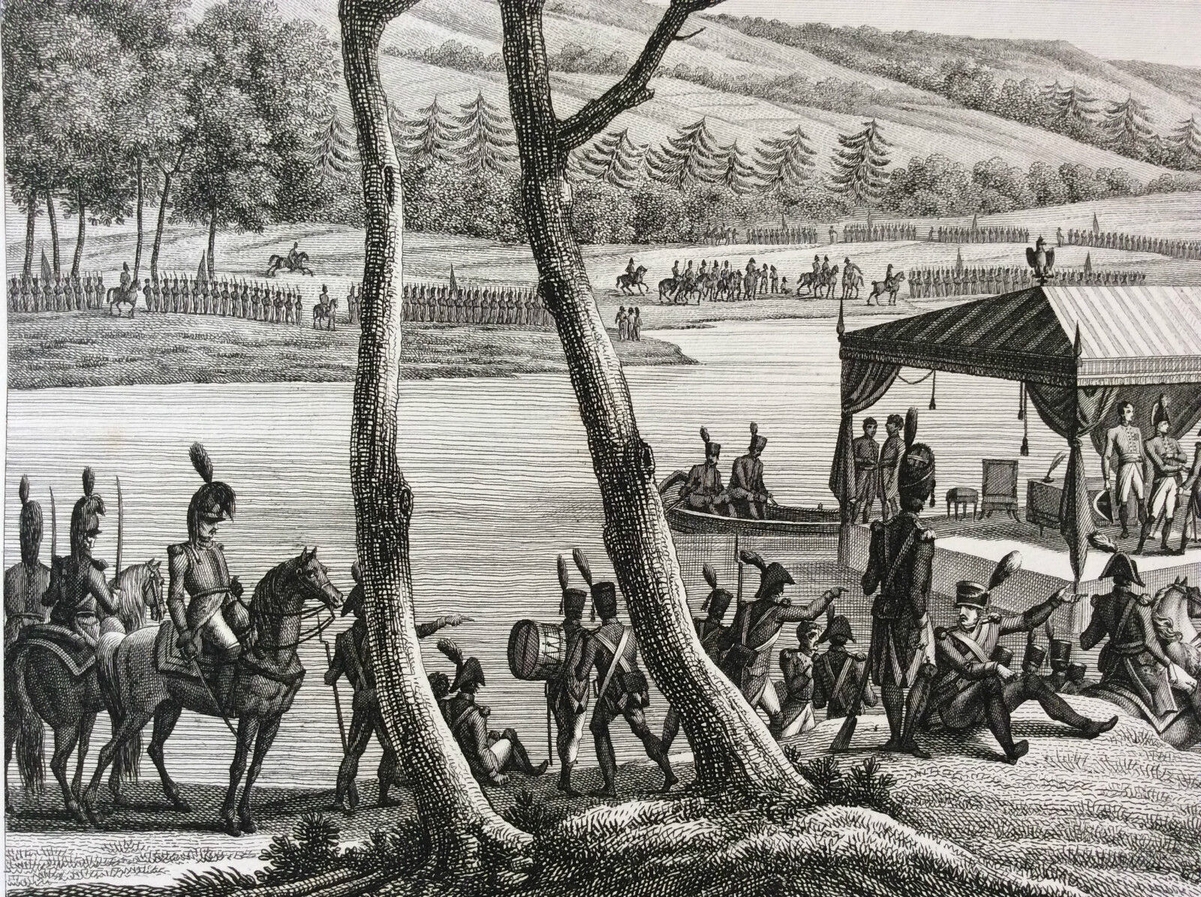
The pavilion occupies the centre of this elaborate engraving.
It stands upon a floating platform anchored in the river and is protected by a large striped roof.
The sides are decorated with curtains and draperies, creating the appearance of a ceremonial structure.
Inside and around the pavilion, the two emperors and their accompanying dignitaries can be distinguished.
Several small boats are positioned beside the raft, while other vessels carry officers and attendants across the water.
The central pavilion provides the focal point of the composition, emphasising the meeting between the two sovereigns.
The surrounding landscape and military formations establish the scale and solemnity of the event.
FRENCH AND RUSSIAN MILITARY FORCES
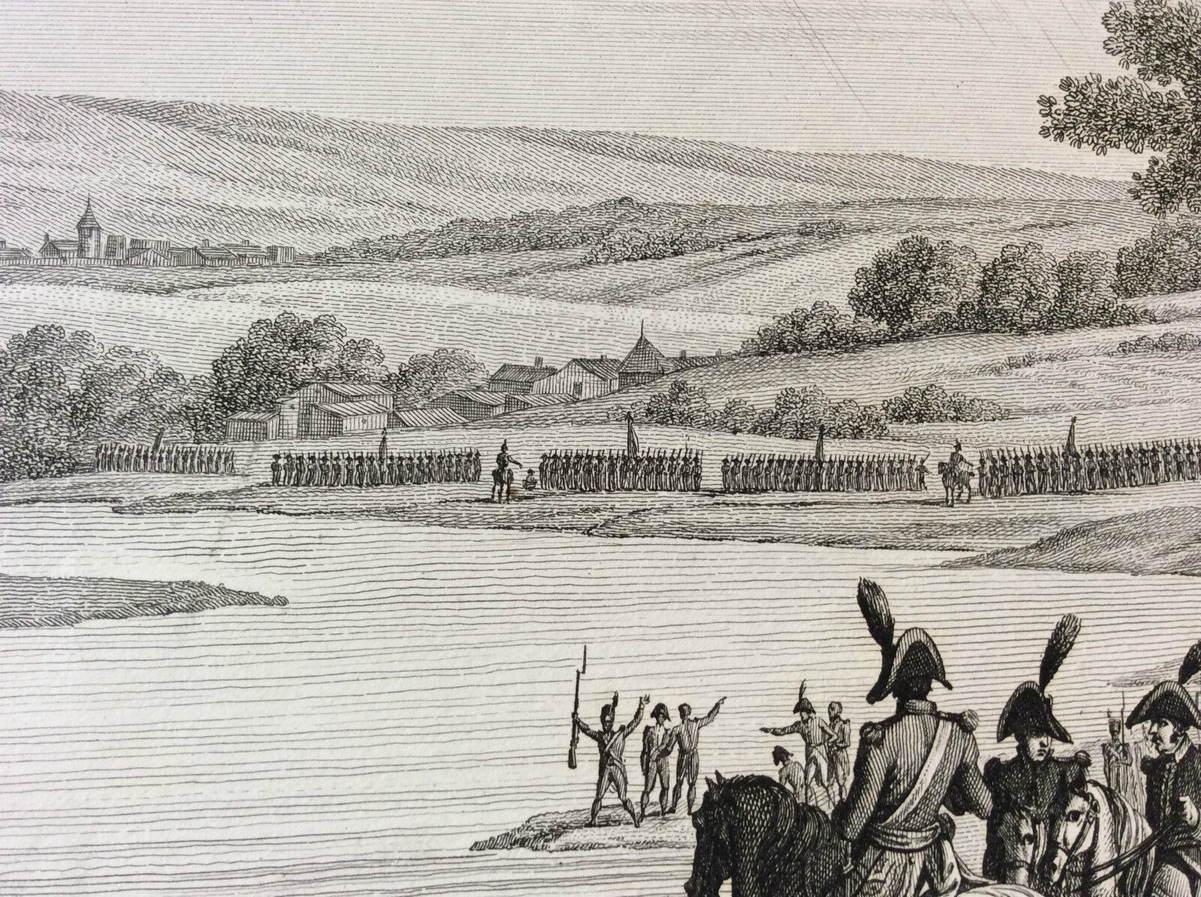
The banks of the river are occupied by numerous soldiers and military officers.
In the foreground, mounted cavalrymen, infantrymen, musicians and standard-bearers gather around the river crossing.
Their elaborate uniforms and equipment are carefully engraved.
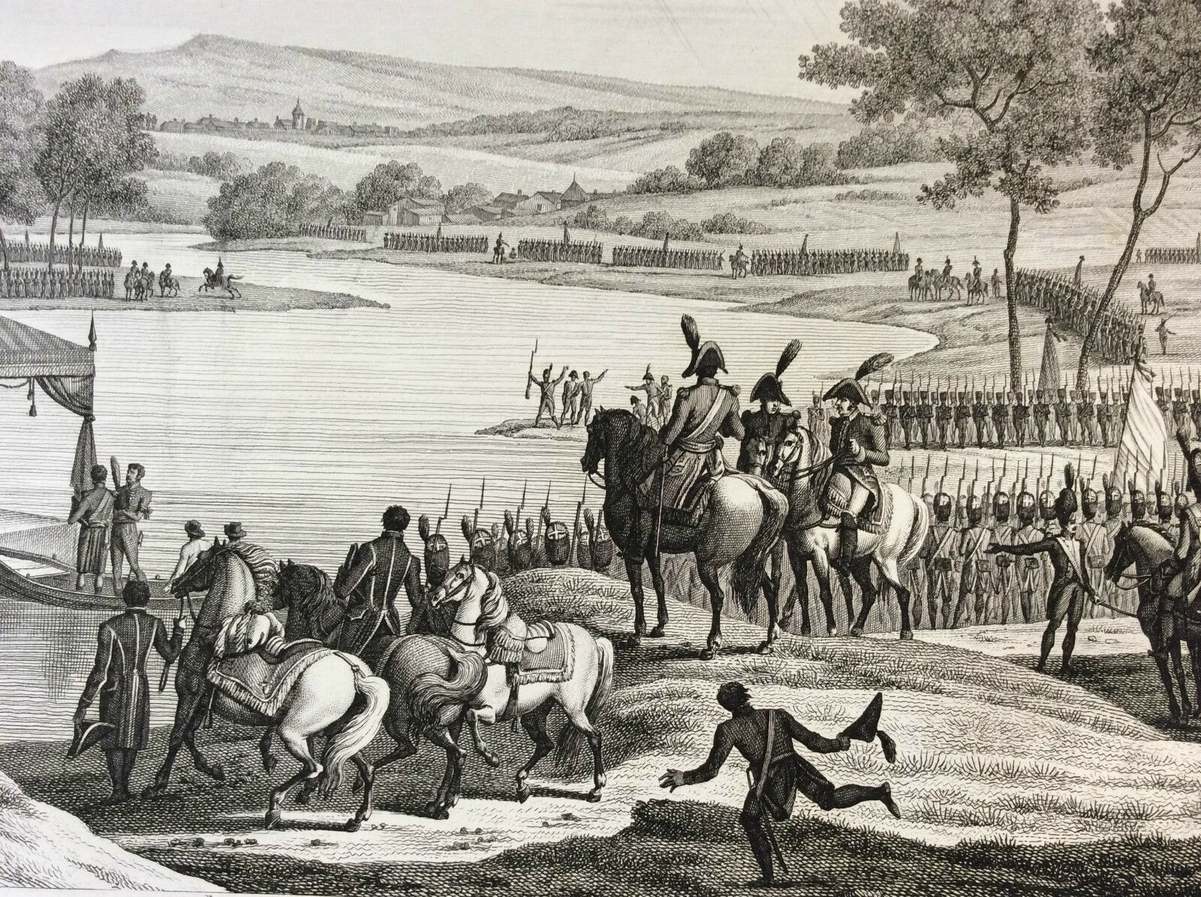
On the right, groups of soldiers stand in formation, while officers on horseback observe the diplomatic ceremony.
Several horses are represented in lively poses, displaying the artistic skill for which Swebach-Desfontaines was particularly well known.
On the opposite bank, additional groups of troops and spectators extend into the distance.
The scene combines a major diplomatic event with the visual grandeur of Napoleonic military ceremonial.
A MAGNIFICENT PANORAMIC LANDSCAPE
The historical event takes place within an extensive landscape.
Tall trees dominate the left foreground, their branches framing the scene.
Beyond the military groups, the broad Niemen River winds through fields and wooded countryside.
In the distance, small villages, buildings, rolling hills and scattered figures contribute to the panoramic effect.
The sky is filled with beautifully engraved clouds and rays of light.
The large trees, detailed military formations and carefully arranged landscape give the composition remarkable depth.
The result is both an important historical illustration and an attractive decorative engraving.
THE BATTLE OF FRIEDLAND AND THE ROAD TO TILSIT
The meeting followed Napoleon’s victory at the Battle of Friedland on 14 June 1807.
French forces defeated the Russian army commanded by General Levin August von Bennigsen.
The victory placed Napoleon in a strong position during the subsequent peace negotiations.
An armistice was arranged later in June, opening the way for direct discussions between Napoleon and Alexander.
Their encounter on the Niemen on 25 June marked an important moment in the political history of Europe.
The negotiations culminated in the Treaties of Tilsit, signed on 7 and 9 July 1807.
THE TREATIES OF TILSIT
The peace agreements dramatically altered the balance of power in Europe.
France and Russia entered a period of diplomatic cooperation.
Prussia suffered substantial territorial losses, while territories in Central and Eastern Europe were reorganised.
The agreements strengthened French influence across much of continental Europe.
The Duchy of Warsaw was established from former Prussian-controlled Polish territories.
Although the Franco-Russian partnership eventually deteriorated, the meeting at Tilsit remained one of the most celebrated moments of Napoleon’s diplomatic career.
JACQUES FRANÇOIS JOSEPH SWEBACH-DESFONTAINES
Jacques François Joseph Swebach-Desfontaines was born in Metz, France, in 1769 and died in Paris in 1823.
He was a distinguished painter, draughtsman and printmaker, particularly celebrated for his depictions of horses, cavalry, military campaigns and historical subjects.
His career developed during the French Revolution and the First Empire.
He exhibited at the Paris Salon and received recognition for his skill in military and equestrian painting.
From 1802 to 1813, he served as principal painter at the Sèvres porcelain manufactory.
After the Napoleonic period, he also worked in Russia in connection with the Imperial Porcelain Manufactory.
His military compositions are especially admired for their animated horses, precise uniforms and elaborate narrative detail.
The present engraving reproduces a historical composition after Swebach.
FRENCH NAPOLEONIC PRINTMAKING
During the nineteenth century, French publishers produced numerous engravings celebrating the campaigns, battles and diplomatic achievements of Napoleon I.
These prints preserved the memory of major events from the Revolutionary and Imperial periods.
The meeting of Napoleon and Alexander at Tilsit became a particularly popular subject.
The ceremonial pavilion on the Niemen provided a powerful symbol of diplomacy between former enemies.
This engraving belongs to that rich historical tradition.
Its detailed representation of the soldiers, military horses, landscape and floating pavilion makes it a particularly attractive example of Napoleonic iconography.
ENGRAVING TECHNIQUE AND ARTISTIC DETAILS
The print displays careful linear engraving throughout the composition.
The foliage of the trees is rendered through numerous closely spaced lines.
The military uniforms, weapons and horses are treated with considerable precision.
The distant landscape is developed through lighter engraved passages, creating atmospheric depth.
The sky combines delicate horizontal lines with finely modelled clouds.
The original French title appears beneath the composition:
ENTREVUE DES DEUX EMPEREURS, LE 25 JUIN 1807.
The original artist’s inscription identifies the design as the work of Swebach.
AN IMPORTANT HISTORICAL SUBJECT
The meeting between Napoleon and Alexander I took place at a critical moment in European history.
It brought together two of the most powerful rulers of their time, following one of the major military campaigns of the Napoleonic Wars.
The floating pavilion, surrounded by the armies of both empires, became an enduring symbol of the diplomatic negotiations of 1807.
The engraving preserves the ceremony in a monumental panoramic composition, combining political history, military detail and landscape art.
TECHNICAL DETAILS
Subject: Meeting of Napoleon I and Tsar Alexander I of Russia.
Original French title: Entrevue des deux Empereurs, le 25 juin 1807.
Historical event: 25 June 1807.
Location: Tilsit, East Prussia, now Sovetsk, Kaliningrad region, Russia.
River: Niemen / Neman.
Artist of the original design: Jacques François Joseph Swebach-Desfontaines (1769–1823).
Period: Nineteenth century.
Date of this impression: Circa 1850, as catalogued.
Technique: Antique black-and-white etching.
Sheet dimensions: 46.5 × 30.2 cm.
Engraved composition: 38.2 × 25.5 cm.
Reference: 4401-94R324D25.
CONDITION
Antique example displaying the natural patina of aged paper. The engraved composition and original inscriptions remain well preserved.
COLLECTOR’S INTEREST
An attractive large nineteenth-century French historical engraving depicting the famous meeting between Napoleon Bonaparte and Tsar Alexander I of Russia at Tilsit.
Particularly interesting for collectors of Napoleonic history, the First French Empire, Russian imperial history, military engravings, equestrian art and European diplomatic history.
The numerous military figures, carefully rendered horses, extensive landscape and floating pavilion make this a decorative and historically significant composition.
An appealing addition to a collection devoted to Napoleon I and the military history of nineteenth-century Europe.
Offered by Artculture6 – Antique Prints, Drawings and Works of Art.



Avis
Il n’y a pas encore d’avis.