Rome Italy Essedarii Gladiators Roman War Chariots Horses Engraving 1704
39,00 €
Essedarii Gladiators – Rome, Italy – Original Dutch Engraving 1704
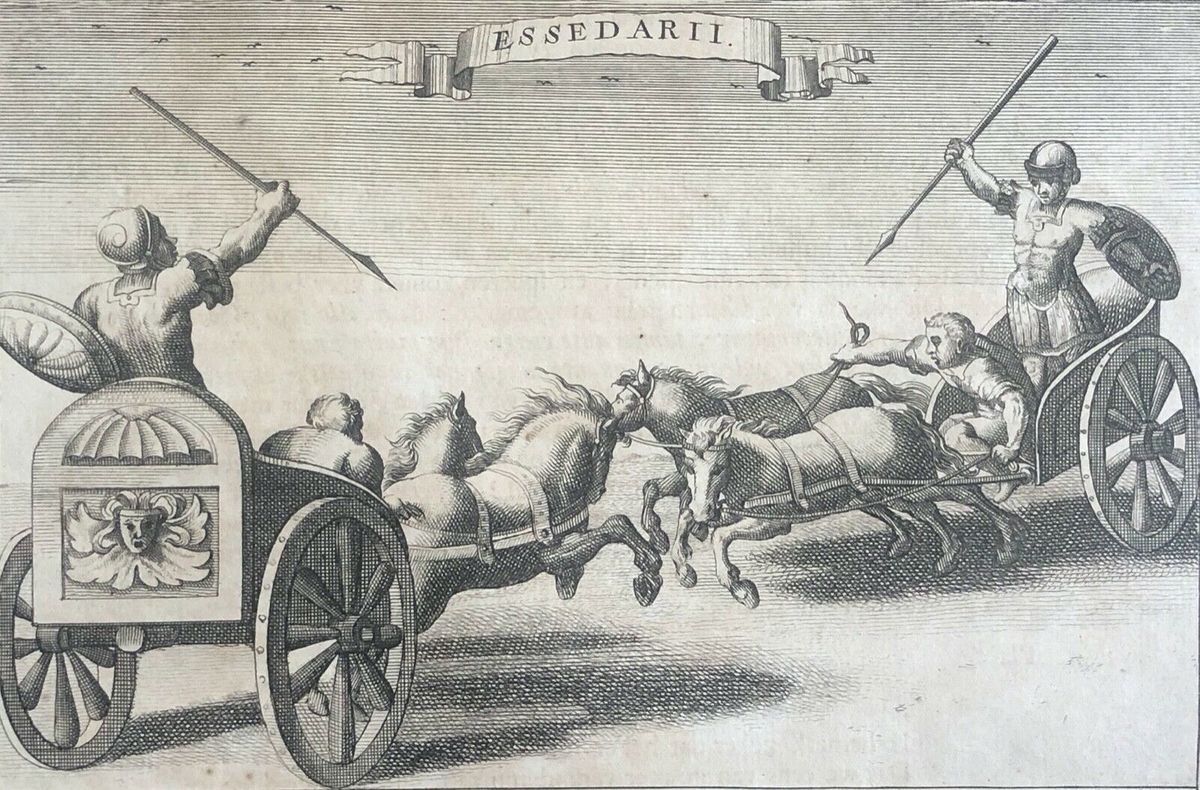
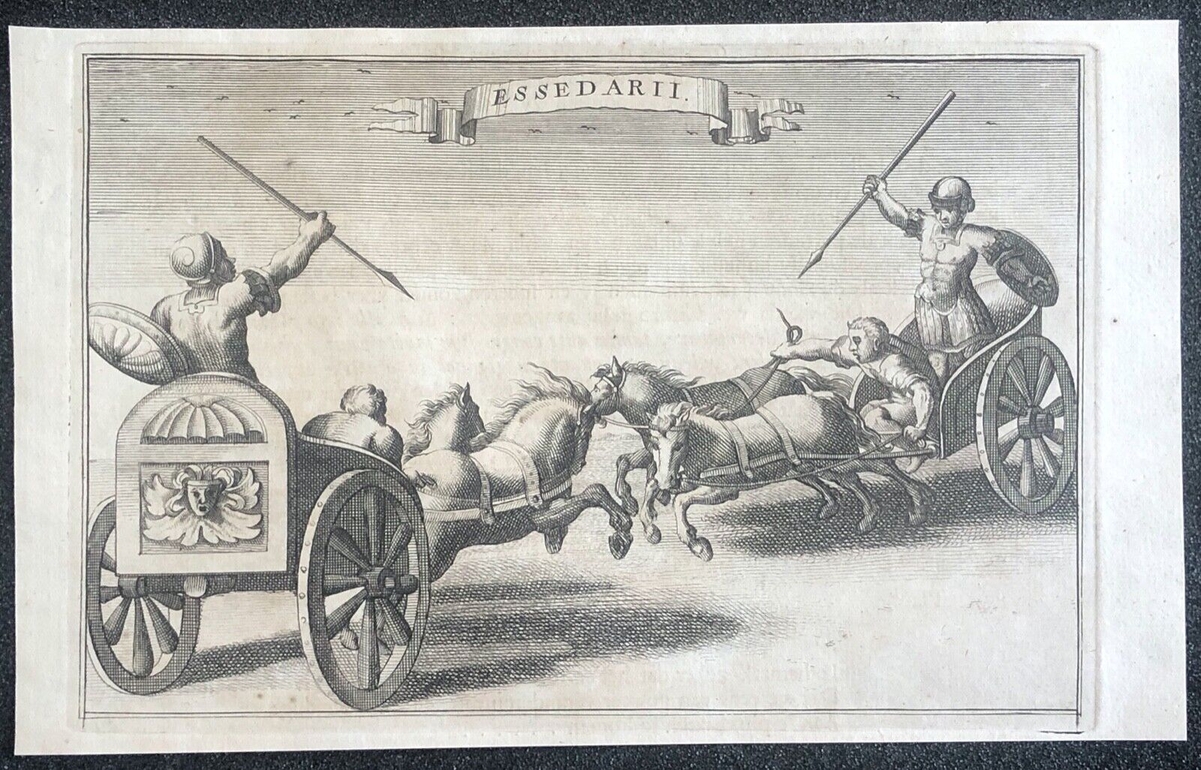
Remarkable early eighteenth-century engraving entitled ESSEDARII, depicting two opposing horse-drawn war chariots carrying armed Roman gladiators.
The combatants brandish long spears and circular shields while their horses gallop towards one another.
An unusual historical subject inspired by Celtic chariot warfare and the gladiatorial spectacles of ancient Rome.
Publication: Netherlands, 1704.
Sheet dimensions: 22 × 12.5 cm.
Engraved image: 19 × 12.3 cm.
Paper: Laid vellum paper.
Reference: 4899-72R488.
Description
Rome Essedarii Gladiators – Roman War Chariots and Horses – Original Dutch Engraving 1704
Essedarii Gladiators in Ancient Rome – Original early eighteenth-century Dutch engraving published in 1704, depicting two horse-drawn war chariots engaged in a dramatic armed confrontation.
Artculture6 presents this remarkable antique historical engraving entitled ESSEDARII, illustrating a distinctive category of gladiators associated with chariot warfare in ancient Rome.
The composition depicts two elaborate chariots advancing towards each other at high speed, each carrying armed combatants equipped with long spears and circular shields.
Published in the Netherlands in 1704, this print provides an impressive example of early eighteenth-century historical illustration devoted to Roman gladiatorial spectacles and ancient military traditions.
ESSEDARII – THE CHARIOT GLADIATORS
The Latin word ESSEDARII appears within a decorative scroll at the upper centre of the composition.
The term refers to a class of gladiators associated with the essedum, a type of war chariot used by Celtic peoples, particularly the ancient Britons and Gauls.
The Romans encountered these vehicles during their military campaigns and were impressed by the mobility and fighting methods of the chariot warriors.
The essedarius subsequently became a recognised category within the world of Roman gladiatorial combat.
This engraving offers a dramatic eighteenth-century interpretation of these remarkable fighters.
TWO WAR CHARIOTS IN FULL COMBAT
The composition is dominated by two opposing horse-drawn chariots.
On the left, a richly decorated chariot advances towards its opponent.
The vehicle features large spoked wheels and an ornamental body decorated with a prominent grotesque mask surrounded by elaborate foliage.
A helmeted warrior stands within the chariot, raising a long spear while holding a circular shield.
The horses are represented in powerful movement, their legs extended as they gallop towards the opposing team.
The flowing manes and carefully engraved muscles emphasise their speed and strength.
THE OPPOSING CHARIOT
On the right, another chariot approaches from the opposite direction.
A muscular helmeted gladiator stands prominently within the vehicle, brandishing a long spear above his head.
He carries a circular shield decorated with an ornamental motif.
The driver holds the reins and directs the horses towards the approaching chariot.
The two teams appear to be entering a dramatic confrontation, with their horses almost meeting at the centre of the engraving.
The closely spaced engraved lines beneath the horses create deep shadows and a strong impression of rapid movement.
THE ORIGINS OF CHARIOT WARFARE
The essedarii were associated with the chariot-fighting traditions of Celtic peoples.
Julius Caesar described the use of war chariots by the ancient Britons during his expeditions to Britain in 55 and 54 BC.
According to his account, these warriors combined the mobility of horse-drawn vehicles with the fighting methods of infantry.
They could move rapidly across the battlefield, throw missiles and then dismount to engage their opponents.
Their skill in controlling the chariots and moving between the vehicle and the battlefield impressed Roman observers.
The Latin term essedum became associated with these Celtic war vehicles, while essedarii referred to the men who fought using them.
ESSEDARII IN ROMAN GLADIATORIAL SPECTACLES
Roman gladiatorial spectacles featured several categories of fighters distinguished by their equipment and methods of combat.
Among these were the murmillo, retiarius, thraex, hoplomachus and essedarius.
The essedarius was associated with chariot fighting, a tradition adapted from the military practices of Rome’s northern neighbours.
Ancient literary and epigraphic sources confirm the existence of essedarii as gladiators.
The precise equipment and fighting techniques employed by these performers are not completely documented, but the association with war chariots is firmly established.
The engraving illustrates this tradition through a theatrical confrontation between two armed chariot teams.
HORSES AND CHARIOT CONSTRUCTION
The engraved details of the horses and vehicles are particularly attractive.
The horses are shown with finely engraved manes, expressive heads and carefully modelled bodies.
The large wheels are constructed with numerous spokes, while the chariot bodies feature decorative panels and raised structures.
The warrior on the left stands behind an elaborate shielded panel, while the opposing vehicle has a lighter, more open construction.
The combination of moving horses, raised weapons and large wheels gives the scene a striking visual rhythm.
ENGRAVING TECHNIQUE AND ARTISTIC DETAIL
The print demonstrates the precision of early eighteenth-century line engraving.
The horses are modelled through fine hatching, particularly around their necks, shoulders and legs.
The clothing and armour of the gladiators are carefully rendered, with strong contrasts between illuminated surfaces and shaded areas.
The wheels, shields, weapons and harnesses are represented with considerable attention to detail.
The background is deliberately restrained, allowing the dynamic action of the chariots to dominate the composition.
A fine engraved border surrounds the image, while the title ESSEDARII is presented within an elegant decorative scroll.
ROMAN HISTORY AND EIGHTEENTH-CENTURY PRINTMAKING
The history of the Roman Empire provided European artists and publishers with numerous subjects for illustrated books during the seventeenth and eighteenth centuries.
Gladiatorial combat was especially popular because it combined military history, dramatic action and the distinctive customs of ancient civilisation.
The essedarii formed one of the more unusual categories of gladiators represented in historical illustrations.
This Dutch engraving of 1704 reflects that fascination with the variety of fighting methods associated with Roman public spectacles.
Its dynamic composition is also closely related in subject to contemporary engravings representing female gladiators, dwarf gladiators and other specialised types of Roman combatants.
TECHNICAL DETAILS
Subject: Essedarii gladiators fighting from horse-drawn war chariots.
Original inscription: ESSEDARII.
Historical setting: Ancient Rome, Italy.
Historical background: Celtic chariot warfare and Roman gladiatorial spectacles.
Publication: Netherlands, 1704.
Period: Early eighteenth century.
Technique: Antique black-and-white engraving.
Paper: Laid vellum paper.
Sheet dimensions: 22 × 12.5 cm.
Engraved image dimensions: 19 × 12.3 cm.
Reference: 4899-72R488.
CONDITION
Antique example displaying the natural patina of aged paper. The engraved composition and original inscriptions remain beautifully preserved.
COLLECTOR’S INTEREST
An attractive and unusual early eighteenth-century engraving depicting essedarii, the chariot gladiators associated with ancient Roman spectacles.
The print is particularly interesting for collectors of Roman history, gladiatorial combat, Celtic warfare, ancient horses and chariots, historical engravings and Baroque-era illustrations.
The dynamic arrangement of the opposing vehicles, expressive horses and finely engraved weapons makes this an appealing example of Dutch historical printmaking from 1704.

Avis
Il n’y a pas encore d’avis.