Rome Italy Postulaticii Gladiators Roman Sword Shield Combat Original Engraving 1704
39,00 €
Postulaticii Gladiators – Rome, Italy – Original Dutch Engraving 1704
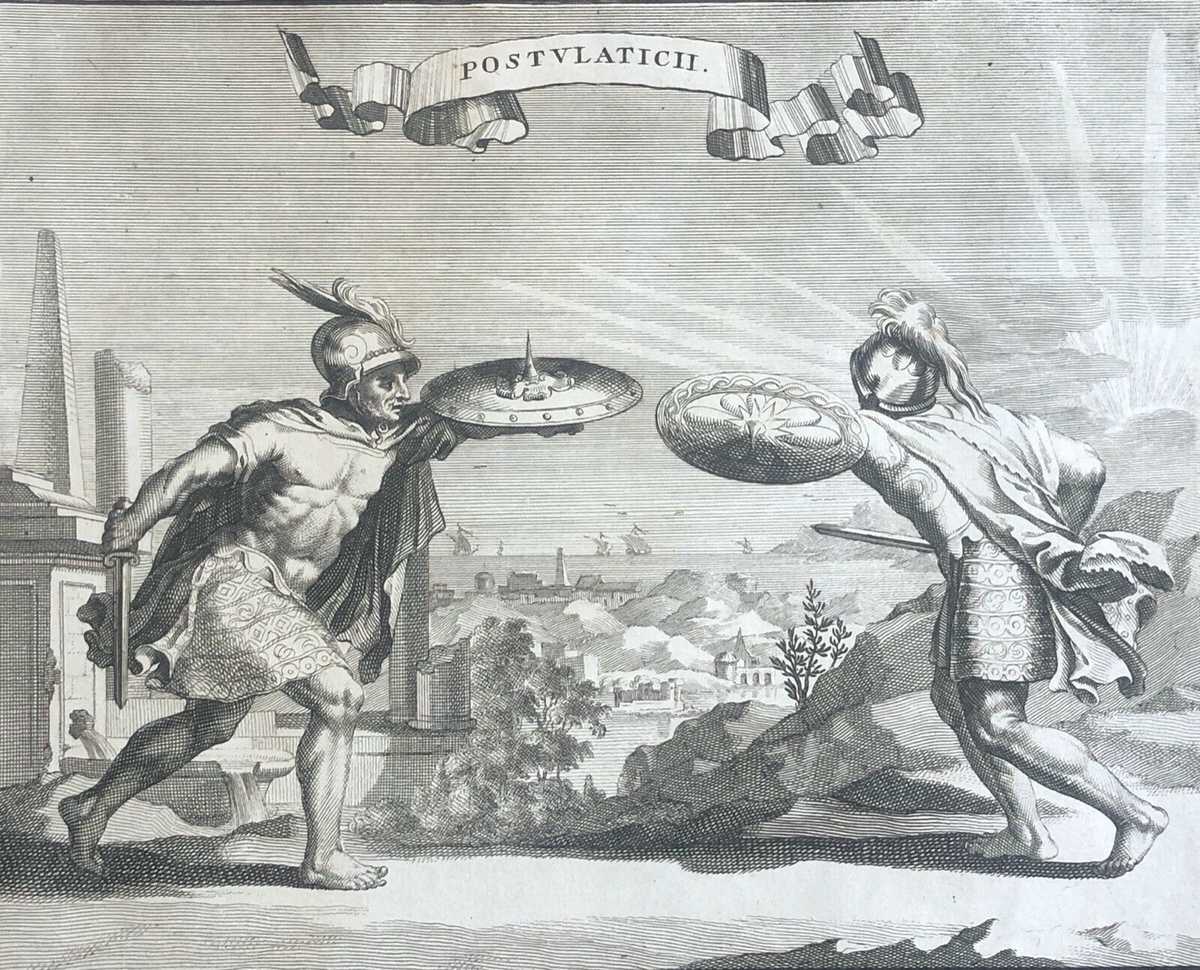
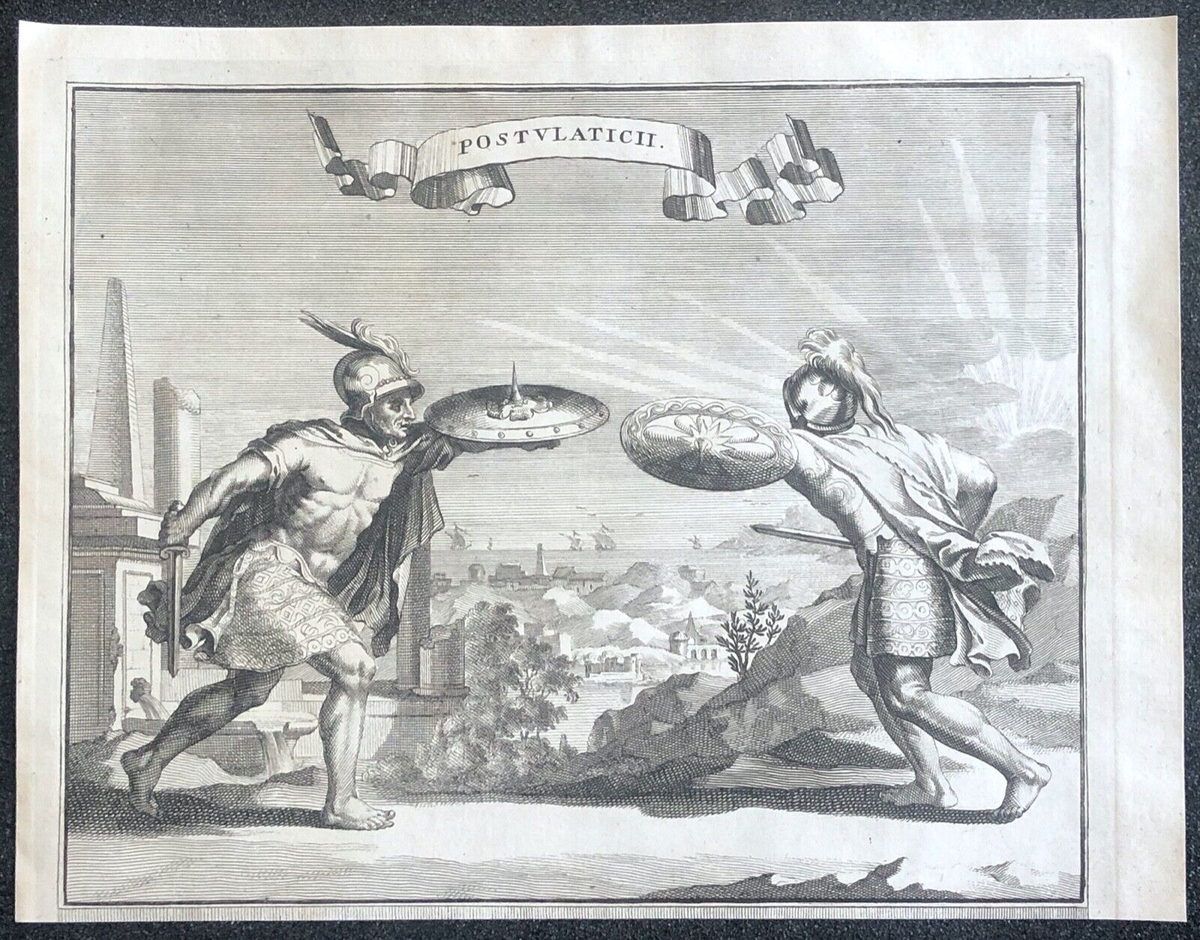
Remarkable early eighteenth-century engraving entitled POSTVLATICII, depicting two Roman gladiators engaged in sword and shield combat before classical monuments and a distant ancient city.
The Postulaticii were gladiators presented in additional contests specifically requested by Roman spectators, a practice mentioned by the philosopher Seneca.
Publication: Netherlands, 1704.
Sheet dimensions: 21.7 × 17.5 cm.
Engraved image: 19.8 × 16 cm.
Paper: Laid vellum paper.
Reference: 4899-74R488.
Description
Rome Postulaticii Gladiators – Roman Sword and Shield Combat – Original Dutch Engraving 1704
Postulaticii Gladiators in Ancient Rome – Original early eighteenth-century Dutch engraving published in 1704, depicting two armed Roman gladiators engaged in a dramatic confrontation with swords and circular shields.
Artculture6 presents this beautiful antique historical engraving entitled POSTVLATICII, illustrating a distinctive category of gladiators who appeared in additional contests specifically requested by spectators during the public spectacles of ancient Rome.
The composition portrays two richly equipped fighters wearing elaborate helmets, decorated armour and flowing garments, confronting one another against an impressive background of classical architecture and a distant Roman-style city.
Published in the Netherlands in 1704, this engraving is an attractive example of Baroque historical printmaking devoted to the traditions and spectacles of Roman antiquity.
POSTULATICII – GLADIATORS REQUESTED BY THE SPECTATORS
The Latin inscription POSTVLATICII appears within a decorative scroll at the upper centre of the engraving.
The historical term Postulaticii refers to gladiators whose appearance was specifically requested by the audience, generally in addition to the regularly scheduled combats.
Roman gladiatorial spectacles were carefully organised public entertainments.
The fighters included in the ordinary programme were known as Ordinarii.
When spectators demanded further entertainment, the organiser could provide additional contests featuring gladiators who had not appeared in the original programme.
These requested fighters were called Postulaticii.
The Roman philosopher Seneca refers to them in his seventh letter to Lucilius, a famous discussion of the violence and moral consequences of public spectacles.
Unlike categories defined primarily by particular weapons or armour, the designation Postulaticii referred to the circumstances in which these gladiators were presented.
TWO GLADIATORS IN ARMED COMBAT
The foreground is dominated by two gladiators confronting each other.
The fighter on the left advances towards his opponent.
He wears an elaborate crested helmet, a short decorated garment and a flowing cloak draped across his shoulders.
His right hand holds a short sword, while his opposite arm carries a circular shield with a projecting central boss.
His powerful stance and carefully modelled body convey strength and determination.
The second gladiator, positioned on the right, is represented in a dynamic turning movement.
He wears a plumed helmet, a decorated cuirass and a flowing cloak.
His shield is ornamented with an elegant floral design, while his other hand carries a sword.
The artist has carefully balanced the positions of the two figures, creating an expressive scene of armed confrontation.
ARMOUR, WEAPONS AND COSTUME
The details of the gladiators’ equipment contribute significantly to the decorative character of the composition.
Both warriors wear helmets embellished with prominent plumes.
Their circular shields differ in design.
The left shield includes a raised central point, while the right shield features a finely engraved ornamental pattern.
The clothing and protective equipment are rendered through delicate parallel and crossed lines.
The artist has paid particular attention to the movement of the flowing cloaks, the muscular forms of the combatants and the contrasting surfaces of their armour.
The figures are presented according to the artistic conventions of eighteenth-century representations of classical antiquity.
ANCIENT ARCHITECTURE AND A DISTANT CITY
The engraving is distinguished by its elaborate architectural and landscape background.
On the left stand ancient columns and fragments of monumental buildings.
Behind the gladiators, the landscape opens towards a distant city with numerous buildings, towers and architectural structures.
Several sailing vessels can be distinguished on the horizon.
To the right, an elevated rocky landscape rises behind the second warrior.
Bright rays of light cross the sky, creating a theatrical effect that contrasts with the darker engraved foreground.
The combination of monumental architecture, distant urban scenery and dramatic illumination gives the composition a richly decorative character.
GLADIATORIAL SPECTACLES IN ANCIENT ROME
Gladiatorial games formed an important element of public life in ancient Rome.
Such spectacles were organised by magistrates, wealthy individuals and emperors, attracting large audiences.
The combats could feature several different types of gladiators, distinguished by their weapons, armour and methods of fighting.
The programme was arranged by the organiser, known in Latin as the editor.
Additional fighters could be presented in response to public demand.
The Postulaticii illustrate this relationship between spectators and organisers, demonstrating the influence that the audience could exert over the development of a gladiatorial spectacle.
The term is therefore particularly interesting for understanding the organisation of Roman public entertainment.
SENECA AND THE POSTULATICII
The philosopher Seneca discussed Roman public spectacles in his Epistulae Morales ad Lucilium.
In Letter VII, he described the disturbing effects of violent public entertainment.
He distinguished between regularly scheduled gladiatorial pairs and those specifically requested by the spectators.
This passage provides important historical evidence for the term Postulaticii.
The engraving of 1704 belongs to the tradition of European illustrated historical works that sought to represent and explain the customs of the ancient world.
AN EARLY EIGHTEENTH-CENTURY DUTCH ENGRAVING
Published in the Netherlands in 1704, this antique print reflects the widespread European fascination with Roman history, military equipment and gladiatorial combat.
The engraver has chosen a theatrical composition that emphasises the gestures and appearance of the two armed fighters.
The finely detailed costumes and shields contrast with the more delicate engraved treatment of the distant landscape.
The architectural monuments, dramatic sky and carefully arranged figures give the image an elegant Baroque character.
ENGRAVING TECHNIQUE AND ARTISTIC DETAIL
The composition displays precise linear engraving throughout.
Close parallel strokes model the bodies of the gladiators, while cross-hatching creates shadows beneath their garments and armour.
The engraved ornaments of the shields are particularly attractive.
The helmets, cloaks, architectural columns and distant buildings are all carefully differentiated through the use of fine lines and contrasting tonal values.
The shadows cast across the ground enhance the impression of movement.
The upper part of the composition is dominated by the decorative title scroll bearing the inscription POSTVLATICII.
A fine engraved border surrounds the image.
TECHNICAL DETAILS
Subject: Postulaticii gladiators, additional fighters requested during Roman public spectacles.
Original inscription: POSTVLATICII.
Historical setting: Ancient Rome, Italy.
Historical reference: Seneca, Epistulae Morales, VII, 4.
Publication: Netherlands, 1704.
Period: Early eighteenth century.
Technique: Antique black-and-white engraving.
Paper: Laid vellum paper.
Sheet dimensions: 21.7 × 17.5 cm.
Engraved image dimensions: 19.8 × 16 cm.
Reference: 4899-74R488.
CONDITION
Antique example displaying the natural patina of aged paper. The engraved composition and original inscriptions remain beautifully preserved.
COLLECTOR’S INTEREST
An attractive early eighteenth-century historical engraving illustrating the Postulaticii, a distinctive category of gladiators requested by Roman spectators.
The print is particularly appealing to collectors of Roman history, gladiatorial combat, classical antiquity, antique armour, historical costume and Dutch engravings.
Its dramatic composition, richly decorated shields and elaborate classical architectural setting make it an interesting example of early eighteenth-century historical illustration.
The print also complements other engraved representations of specialised gladiatorial categories, including female gladiators, dwarf gladiators and chariot fighters.
Offered by Artculture6 – Antique Prints, Drawings and Works of Art.

Avis
Il n’y a pas encore d’avis.