Rome Italy Dwarf Gladiators Nani Ancient Roman Sword Fighting Engraving 1704
39,00 €
Dwarf Gladiators – NANI – Ancient Rome – Original Dutch Engraving 1704
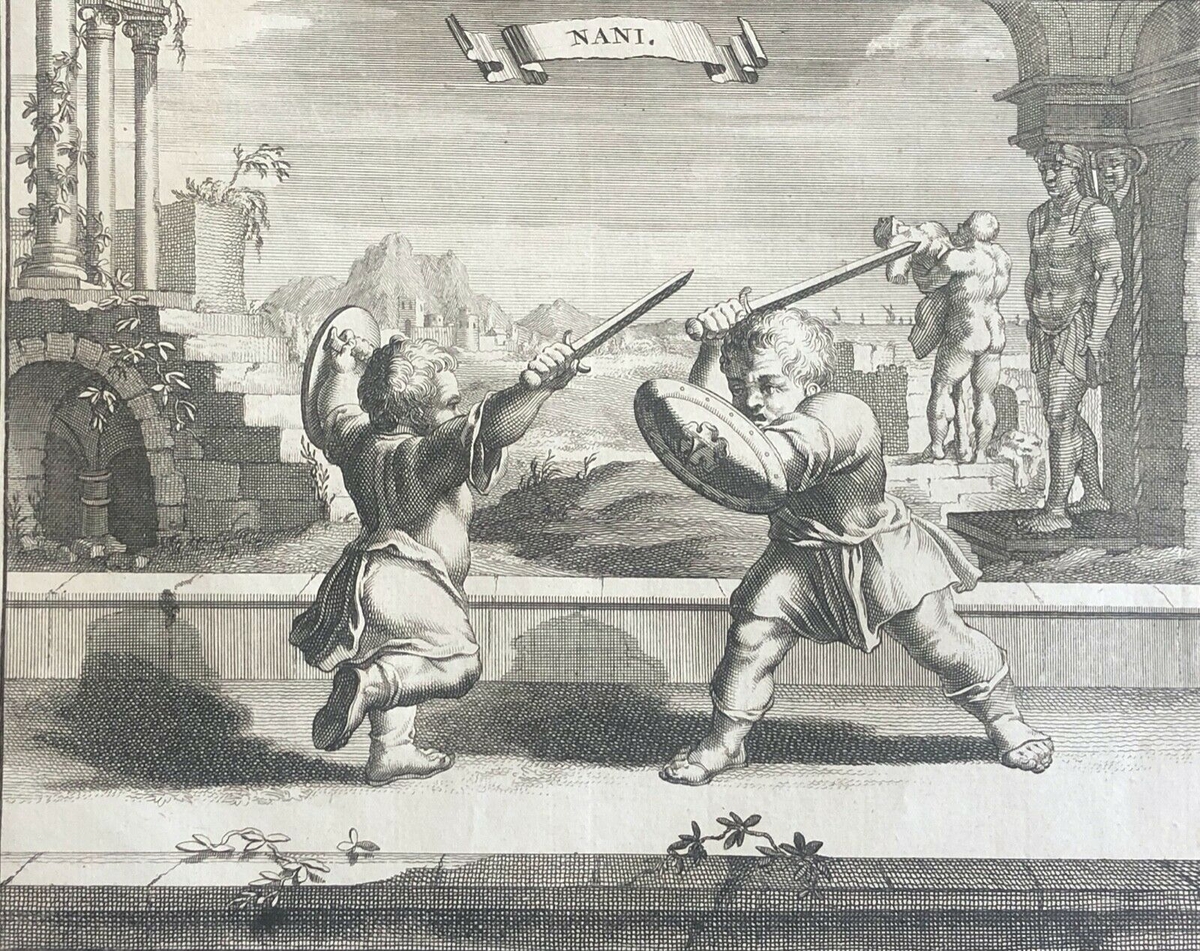
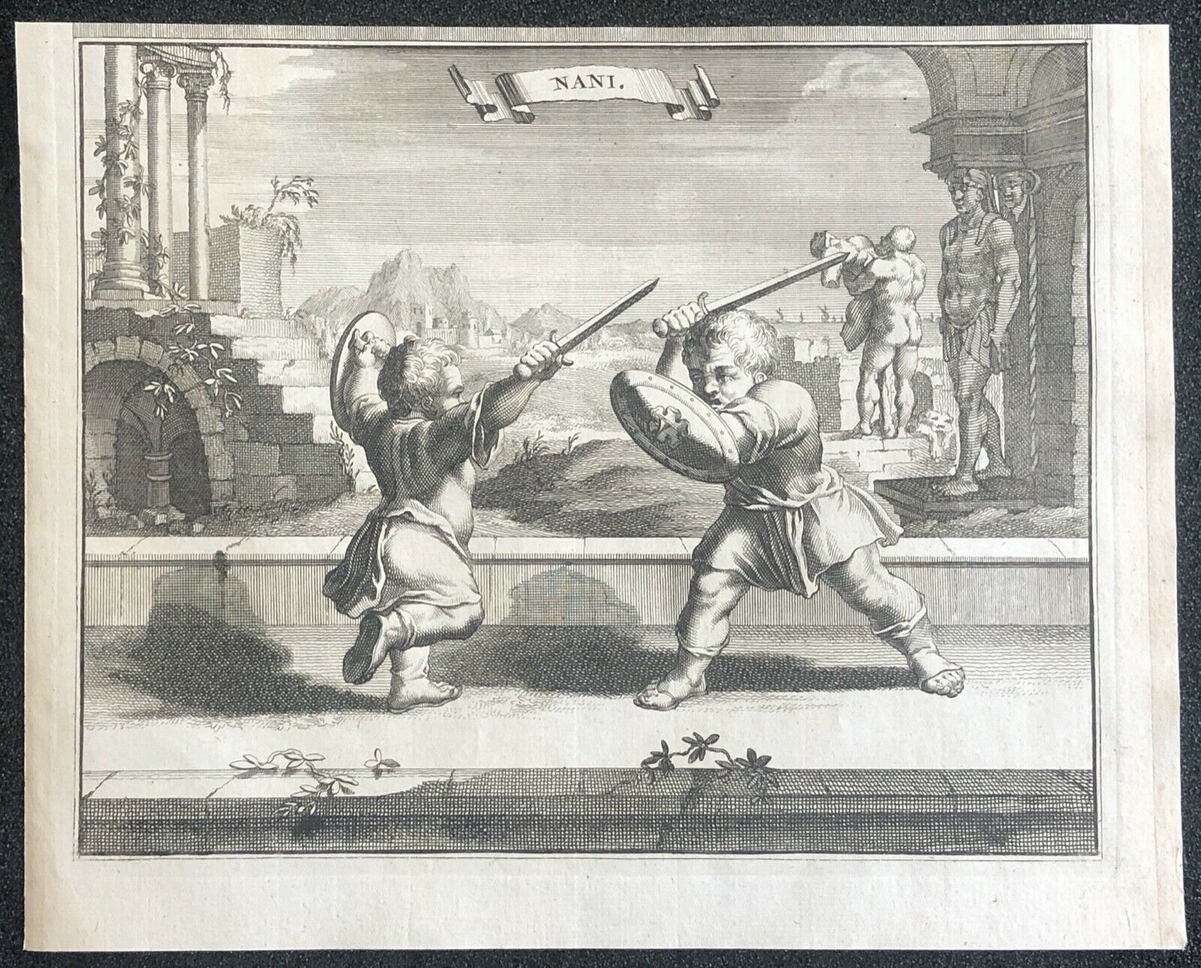
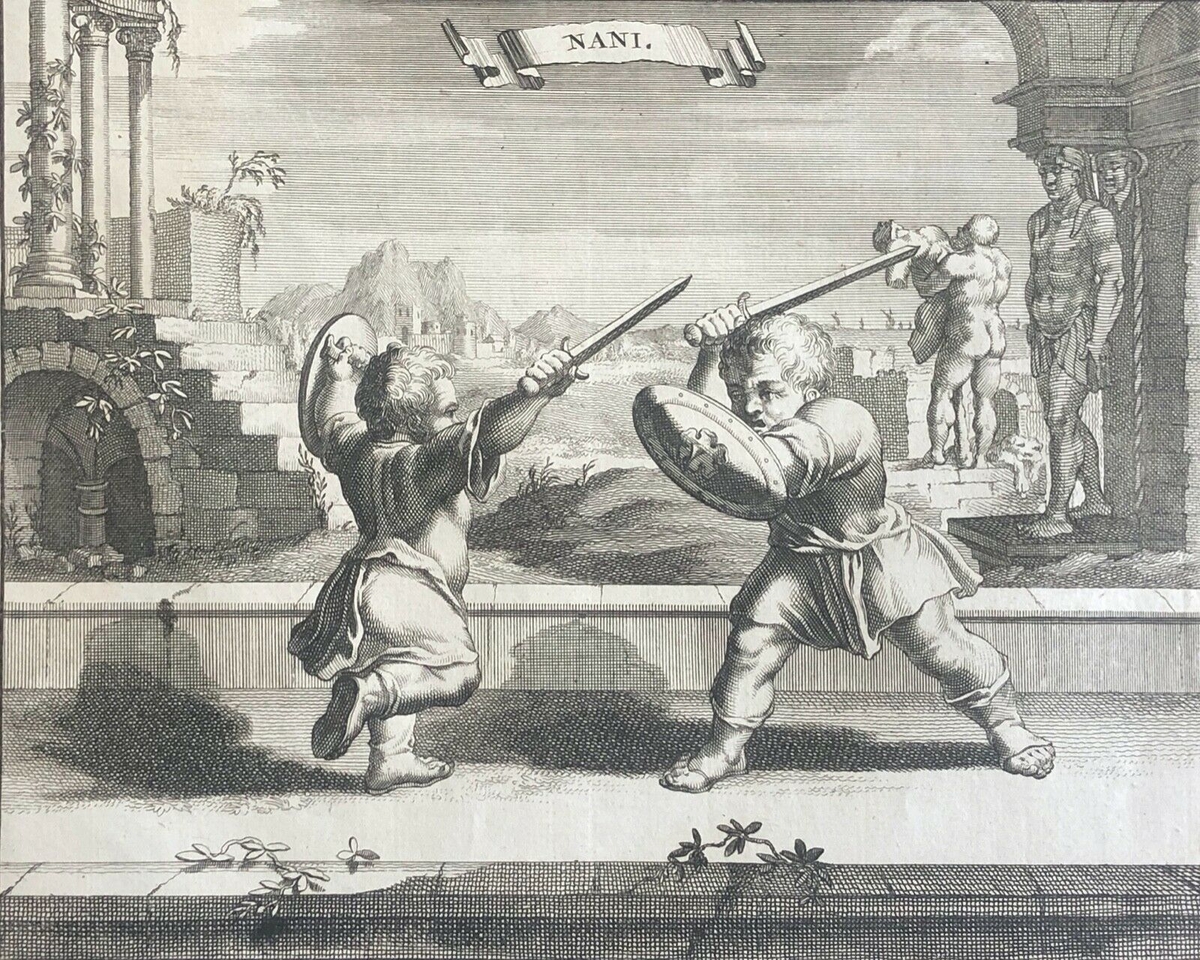
Remarkable early eighteenth-century engraving depicting two short-statured Roman gladiators fighting with swords and circular shields.
Entitled NANI, the composition places the combatants before classical architectural ruins, monumental statues and a distant mountainous landscape.
An unusual historical subject associated with the public spectacles of ancient Rome.
Publication: Netherlands, 1704.
Sheet dimensions: 22.7 × 18.2 cm.
Engraved image: 20 × 16 cm.
Paper: Laid vellum paper.
Reference: 4899-71R488.
Description
Rome Dwarf Gladiators – NANI – Ancient Roman Sword Combat – Original Dutch Engraving 1704
Dwarf Gladiators in Ancient Rome – Original early eighteenth-century Dutch engraving published in 1704, depicting two short-statured gladiators engaged in armed combat with swords and circular shields before an elaborate classical architectural setting.
Artculture6 presents this remarkable antique historical engraving entitled NANI, the Latin term for dwarfs or people of short stature.
The composition illustrates an unusual aspect of the public spectacles of ancient Rome: armed contests involving fighters of small stature.
Published in the Netherlands in 1704, this beautifully executed engraving combines dramatic figures, classical ruins, monumental statues and a picturesque landscape.
NANI – DWARF GLADIATORS IN ANCIENT ROME
The word NANI appears on an engraved scroll in the upper centre of the image.
The Latin inscription identifies the subject of this unusual historical composition.
Two short-statured fighters stand opposite one another, armed with swords and circular shields.
Both figures are represented in energetic combat poses.
The scene reflects the fascination of early eighteenth-century European artists with the unusual entertainments and public spectacles of the Roman Empire.
THE TWO COMBATANTS
The fighter on the left wears a short tunic with loose sleeves and a flowing lower garment.
His right arm extends upwards, raising a sword towards his opponent.
A circular shield is held beside his head, while his body leans forward in an energetic attacking movement.
The combatant on the right adopts a broad defensive stance.
His legs are spread apart, his circular shield protects his upper body, and his sword is raised in readiness to strike.
His short costume is fastened around the waist, and the folds of the fabric are carefully rendered through fine engraved lines.
Both figures display animated expressions.
The artist has emphasised their movement through the strong positions of their arms, their contrasting postures and the shadows cast across the ground.
DWARF GLADIATORS AND ROMAN PUBLIC SPECTACLES
The Roman Empire was famous for its elaborate public spectacles, including gladiatorial combat, animal hunts and theatrical displays.
Ancient literary sources also describe contests involving people of short stature.
These performances were particularly associated with the extraordinary entertainments presented by certain Roman emperors.
During the reign of Emperor Domitian, from AD 81 to 96, public spectacles included unusual types of combat.
The Roman historian Cassius Dio described exhibitions involving women and dwarfs.
The poet Statius also referred to short-statured fighters participating in violent contests, emphasising the surprising intensity of their movements.
Such events formed part of the diversity of Roman arena entertainments.
The present engraving offers an eighteenth-century artistic interpretation of this unusual historical subject.
EMPEROR DOMITIAN AND THE ROMAN ARENA
Domitian, the last emperor of the Flavian dynasty, ruled Rome from AD 81 until AD 96.
His reign was marked by elaborate public entertainments and spectacles.
Historical authors describe gladiatorial contests, night-time performances and unusual displays involving different categories of participants.
The presence of dwarf fighters at some of these events is supported by ancient literary testimony.
However, the engraving does not identify a particular emperor, amphitheatre or historical contest.
Its composition should therefore be understood as a general representation of this aspect of Roman spectacle rather than the documentary portrayal of one specific event.
CLASSICAL ARCHITECTURE AND ROMAN STATUARY
The architectural setting contributes significantly to the appeal of this engraving.
On the left stands a group of ancient columns, decorated architectural fragments and a stone archway partly surrounded by vegetation.
On the right, a monumental portico contains classical sculptures.
One statue represents a standing armed figure, while another sculptural group appears further back.
The figures stand upon an elevated architectural terrace, separated from the landscape by a low stone wall.
In the distance, a valley opens towards mountains and ancient buildings.
The combination of monumental architecture, sculptural details and picturesque ruins creates a theatrical classical setting characteristic of early eighteenth-century historical illustration.
ENGRAVING TECHNIQUE AND ARTISTIC DETAIL
The engraving is distinguished by its careful linear execution.
Numerous closely spaced lines model the muscular forms, clothing and facial expressions of the combatants.
The circular shields are decorated with ornamental details, while the swords are represented with clear, precise outlines.
The architectural elements display refined shading, particularly around the columns, arches and sculptural figures.
A distant landscape is rendered through delicate horizontal and diagonal engraved strokes.
The shadows beneath the fighters reinforce the impression of a dramatic encounter taking place upon a stone terrace.
An engraved border surrounds the composition, and the title NANI appears in a decorative scroll above the scene.
AN UNUSUAL SUBJECT IN EIGHTEENTH-CENTURY PRINTMAKING
Antique engravings depicting Roman gladiators are relatively familiar subjects in collections of historical prints.
Representations specifically devoted to dwarf gladiators are more unusual.
The subject reflects both the diversity of Roman public spectacles and the interest of eighteenth-century European publishers in the customs of classical civilisation.
This engraving is particularly attractive for its unusual iconography, lively composition and detailed classical setting.
It also forms an interesting thematic counterpart to antique engravings representing female gladiators and other special categories of combatants.
TECHNICAL DETAILS
Subject: Dwarf gladiators engaged in sword combat.
Original inscription: NANI.
Historical setting: Ancient Rome, Italy.
Historical context: Roman public spectacles, particularly those recorded during the reign of Domitian.
Publication: Netherlands, 1704.
Period: Early eighteenth century.
Technique: Antique black-and-white engraving.
Paper: Laid vellum paper.
Sheet dimensions: 22.7 × 18.2 cm.
Engraved image dimensions: 20 × 16 cm.
Reference: 4899-71R488.
CONDITION
Antique example displaying the natural patina of aged paper. The engraved composition and original inscriptions remain beautifully preserved.
COLLECTOR’S INTEREST
An attractive and unusual early eighteenth-century historical engraving depicting dwarf gladiators in ancient Rome.
The print is particularly interesting for collectors of Roman history, gladiatorial combat, classical antiquity, historical costume, antique engravings and the history of public entertainment.
Its distinctive subject, expressive figures and finely detailed architectural background make it an appealing example of Dutch historical printmaking from 1704.

Avis
Il n’y a pas encore d’avis.