
Description
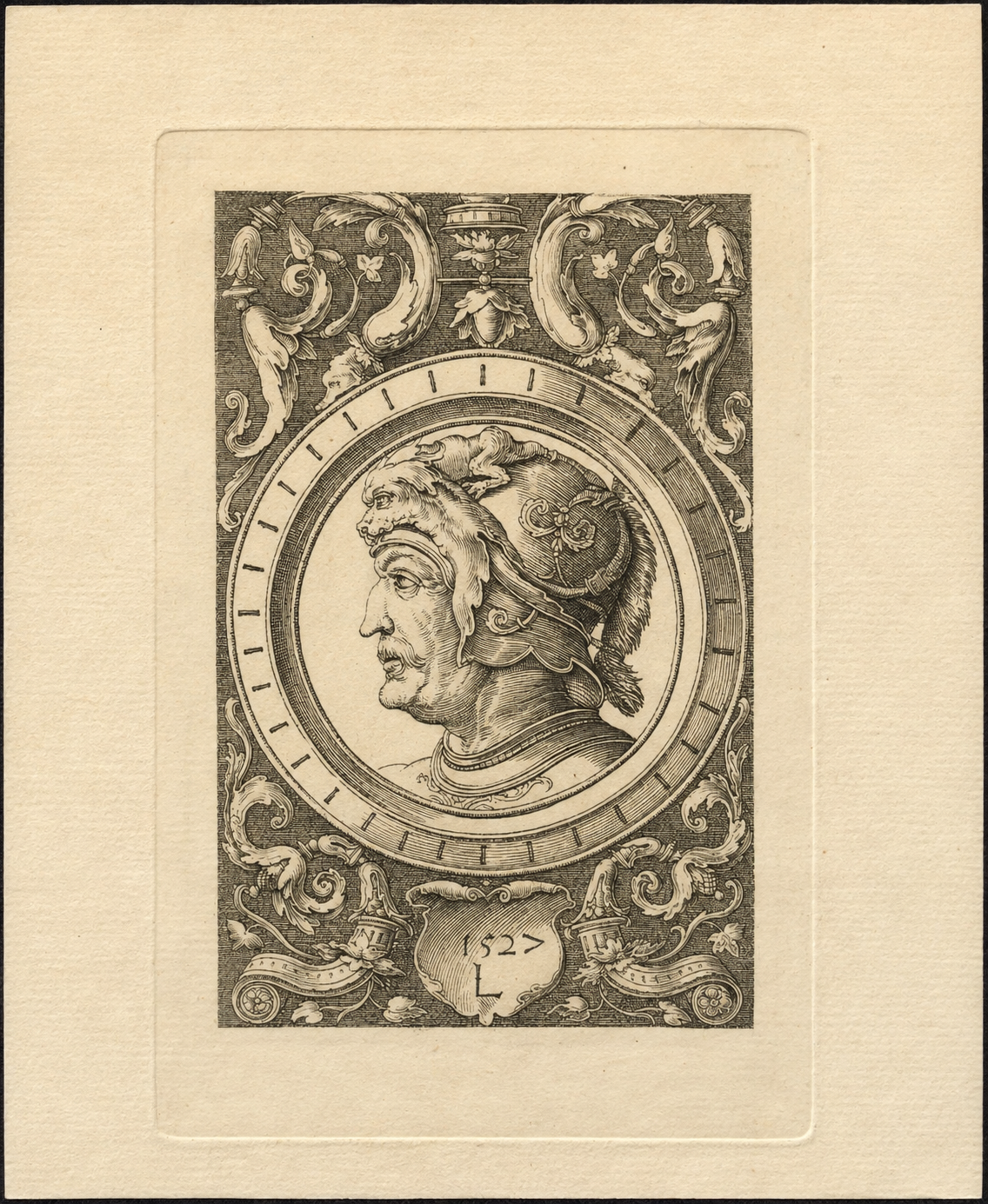
Netherlands 1527 Lucas van Leyden – Remarkable antique Amand-Durand heliogravure circa 1880, reproducing a magnificent Renaissance engraving of a soldier’s head in profile within an elaborate ornamental medallion.
Artculture6 presents this beautiful nineteenth-century French heliogravure after Lucas van Leyden (circa 1494–1533), one of the greatest Dutch engravers of the Northern Renaissance.
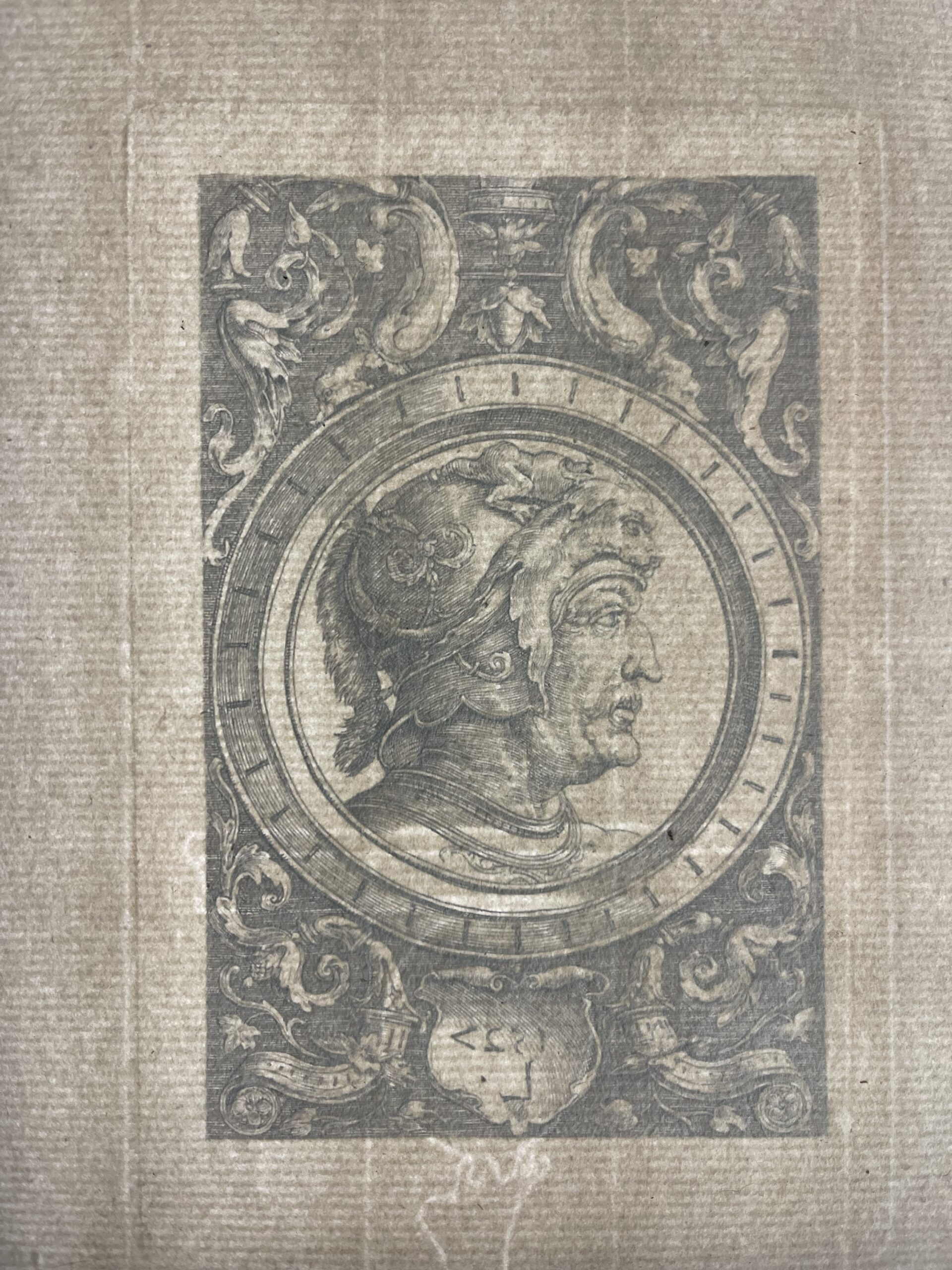
The composition depicts the profile of a soldier wearing an elaborately decorated helmet, enclosed within a large circular medallion surrounded by intricate Renaissance foliage, scrollwork and ornamental motifs.
Originally engraved in 1527, this remarkable design illustrates the exceptional artistic refinement of Northern European Renaissance printmaking.
The present antique impression was produced around 1880 using the celebrated Amand-Durand heliogravure process.
The lower ornamental cartouche bears the reproduced date and artist’s monogram:
« 1527 / L »
ORNAMENT WITH THE HEAD OF A SOLDIER – A RENAISSANCE MASTERPIECE
The composition is dominated by an impressive circular medallion containing the profile portrait of a soldier.
The figure faces left and wears a magnificent ceremonial helmet.
His powerful facial features are carefully rendered, including his prominent nose, expressive eye, pronounced cheekbones and slightly open mouth.
The helmet is particularly remarkable.
Its upper section incorporates an elaborate animal-head ornament, while the rear displays decorative spiral elements and a flowing crest.
The arrangement of the helmet combines classical military imagery with the imaginative decorative vocabulary of the Renaissance.
The soldier’s neck and shoulders are protected by carefully designed armour.
Fine engraved lines and closely arranged hatching reproduce the different surfaces of the metal and the contours of the face.
The result is a powerful and highly accomplished Renaissance portrait study.
A MAGNIFICENT ORNAMENTAL MEDALLION
The soldier’s profile is enclosed within a substantial circular frame.
This frame consists of several concentric borders, including a broad outer ring decorated with regularly spaced divisions.
The medallion is surrounded by an exceptionally rich arrangement of Renaissance ornaments.
Large acanthus scrolls occupy the upper corners, their curling leaves and flowing forms creating a balanced symmetrical composition.
Small floral motifs and stylised foliage complete the decorative arrangement.
At the top, a central ornamental element establishes the vertical axis of the composition.
The lower corners contain additional decorative scrolls, stylised architectural elements and ornamental forms.
At the bottom centre, an elegant shield-shaped cartouche bears the date and monogram.
The dark engraved background provides a striking contrast with the lighter ornamental motifs.
The combination of precise geometry, elaborate decoration and expressive portraiture creates a particularly harmonious design.
LUCAS VAN LEYDEN – MASTER OF THE NORTHERN RENAISSANCE
Lucas van Leyden, also known as Lucas de Leyde, was born in Leiden in the Netherlands around 1494.
He became one of the most important painters, draughtsmen and engravers of the Northern Renaissance.
His extraordinary artistic talent developed at an early age.
By the beginning of the sixteenth century, he had already established a reputation for his technical abilities and the sophistication of his engraved compositions.
His work includes religious subjects, historical scenes, portraits, mythological compositions and ornamental designs.
Lucas van Leyden was particularly celebrated for his exceptional mastery of copper engraving.
His precise burin work allowed him to produce delicate tonal variations, convincing anatomical forms and remarkably intricate decorative details.
He was a contemporary of Albrecht Dürer, whom he met in Antwerp in 1521.
The artistic relationship between these two great Northern European printmakers illustrates the importance of engraving in the cultural exchanges of the Renaissance.
Lucas van Leyden died in 1533.
His works are represented in many of the world’s most important collections of Renaissance prints.
THE INFLUENCE OF ITALIAN RENAISSANCE ORNAMENT
The present composition demonstrates the growing influence of classical antiquity and Italian Renaissance ornament upon Northern European artists.
The profile portrait enclosed within a circular medallion recalls ancient Roman coins and sculptural portrait reliefs.
The elaborate helmet evokes classical military imagery.
The surrounding acanthus leaves, scrolls and floral ornaments reflect decorative forms popularised during the Italian Renaissance.
Lucas van Leyden combines these classical influences with the exceptional precision characteristic of Northern European engraving.
The composition represents an important stage in the development of Renaissance ornamental design.
Its decorative vocabulary would remain influential in European engraving, architecture and the applied arts.
A REMARKABLE EXAMPLE OF COPPER ENGRAVING
The original design of 1527 was executed using the burin, a technique requiring the artist to cut lines directly into a copperplate.
The engraved lines vary in depth, thickness and spacing to produce different tonal effects.
In the soldier’s face, delicate parallel strokes create subtle transitions between light and shadow.
The helmet is rendered through a combination of curved outlines, dense hatching and fine ornamental details.
The surrounding foliage demonstrates an exceptional mastery of flowing decorative forms.
The background is composed of numerous closely spaced horizontal lines.
This dark setting allows the medallion and its ornaments to stand out with remarkable clarity.
The precision and complexity of the design demonstrate why Lucas van Leyden is regarded as one of the finest engravers of the Northern Renaissance.
CHARLES AMAND-DURAND (1831–1904)
Charles Amand-Durand was an important nineteenth-century French specialist in the art of heliogravure.
He developed advanced methods for reproducing historical engravings with exceptional accuracy.
His process combined photographic techniques with the preparation of metal printing plates.
This allowed the intricate lines, delicate shading and subtle details of old master engravings to be faithfully reproduced.
Amand-Durand devoted much of his career to the reproduction of important European prints from the Renaissance and Baroque periods.
His work contributed significantly to the nineteenth-century appreciation of historical engraving.
Today, antique Amand-Durand impressions are valued for their technical quality, artistic refinement and historical interest.
AN ANTIQUE AMAND-DURAND HELIOGRAVURE CIRCA 1880
The present work is an antique nineteenth-century heliogravure dating from approximately 1880.
It reproduces the original engraved composition created by Lucas van Leyden in 1527.
This is a nineteenth-century reproduction, not a sixteenth-century lifetime impression.
The heliogravure process preserves the extraordinary detail of the soldier’s face, the decorated helmet and the surrounding Renaissance ornaments.
The fine engraved lines and subtle tonal variations are particularly well reproduced.
The impression is printed on antique laid paper.
PRINTED DATE AND MONOGRAM – 1527 / L
The lower part of the composition contains an ornamental cartouche bearing:
« 1527 / L »
The letter L is the historical monogram of Lucas van Leyden.
The date identifies the year in which the original composition was created.
This is a printed reproduction of the original engraved date and artist’s signature, not a handwritten autograph signature.
The monogram and date contribute to the historical and decorative appeal of the composition.
DIMENSIONS AND TECHNICAL DETAILS
Country: Netherlands
Original artist: Lucas van Leyden (circa 1494–1533)
Artistic school: Northern Renaissance, Dutch
Subject: Ornament with the Head of a Soldier
Original composition date: 1527
Original technique: Copper engraving with burin
Reproduction technique: Amand-Durand heliogravure
Date of this impression: Circa 1880
Paper: Antique laid paper
Sheet dimensions: 16.3 × 13.3 cm
Printed image dimensions: 11.5 × 7.5 cm
Printed date and monogram: 1527 / L
Reproduction period: Nineteenth century


Avis
Il n’y a pas encore d’avis.