


Description
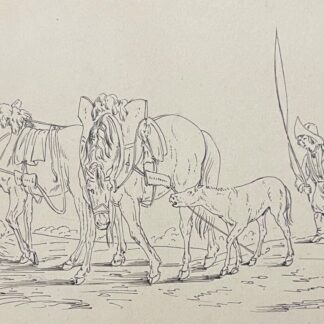
Netherlands 1620 Visscher – Remarkable antique Dutch landscape etching by Claes Jansz Visscher II, known as Piscator (1586/1587–1652), depicting a rustic wooden shelter, cattle, goats, a resting shepherd and magnificent old trees.
Artculture6 presents this beautiful and uncommon antique Netherlandish etching associated with Claes Jansz Visscher II, an important draughtsman, printmaker and publisher of the Dutch Golden Age.
The composition represents a peaceful pastoral landscape dominated by an old wooden shed surrounded by imposing trees, grazing animals and dense vegetation.
A shepherd rests on the ground beside the rustic building, while cattle and goats occupy the surrounding countryside.
In the distance, small sailing vessels appear on an open stretch of water.
The original composition dates from approximately 1620 and is documented in the collections of the Rijksmuseum in Amsterdam.
A PICTURESQUE LANDSCAPE OF THE DUTCH GOLDEN AGE
The Netherlands experienced an extraordinary artistic development during the seventeenth century.
Landscape painting and engraving became particularly important, reflecting a growing interest in the countryside, rural architecture and everyday life.
Artists increasingly represented modest subjects such as old barns, farm buildings, winding paths, trees, animals and agricultural activities.
These landscapes celebrated the beauty of ordinary surroundings rather than monumental architecture or grand historical events.
The present composition belongs to this tradition of naturalistic Dutch landscape engraving.
Its combination of pastoral animals, a humble wooden shelter, old trees and a resting figure creates an intimate representation of rural life.
A RUSTIC WOODEN SHED SURROUNDED BY TREES
The centre of the composition is occupied by a modest wooden agricultural shelter.
The structure is formed by several irregular vertical planks, carefully represented through numerous parallel engraved lines.
Its simple construction and weathered appearance suggest a utilitarian building associated with livestock or agricultural activity.
The shed stands upon slightly elevated ground and is surrounded by substantial trees.
One particularly impressive tree extends its twisting branches across the upper part of the composition.
Its trunk is represented with an elaborate network of curved lines and closely arranged hatching.
The foliage is rendered through numerous delicate strokes, giving the tree a lively and natural appearance.
On the opposite side, further trees and branches contribute to the richness of the landscape.
The combination of rustic architecture and natural vegetation gives the scene a particularly picturesque character.
CATTLE AND GOATS IN A PEACEFUL PASTORAL SETTING
Several animals occupy the open ground beside the wooden shelter.
A substantial cow stands in the landscape, its back turned towards the viewer.
Nearby, goats are represented in natural poses, resting or standing among the uneven grassy terrain.
Another animal lies in the foreground.
The artist has carefully observed the proportions and characteristic features of the different animals.
Fine etched lines describe their bodies, legs, horns and coats.
The stronger shadows beneath the animals give them convincing volume and presence.
These carefully rendered details reflect the importance of animal subjects in seventeenth-century Dutch landscape art.
THE RESTING SHEPHERD
A small human figure appears near the rustic building.
The shepherd is reclining upon the ground, apparently enjoying a moment of rest beside the animals.
His relaxed posture contributes to the peaceful atmosphere of the composition.
Although the figure occupies a relatively modest position, it introduces a human element into the rural landscape.
The scene evokes the relationship between agricultural life, domestic animals and the natural environment.
The shepherd’s presence also creates an appealing contrast with the imposing old trees surrounding the wooden shelter.
A DISTANT COASTAL LANDSCAPE
Beyond the foreground animals and rustic buildings, the landscape opens towards a distant horizon.
Small sailing vessels can be distinguished upon an expanse of water.
The gently undulating terrain, sparse vegetation and distant water suggest the coastal and dune landscapes associated with the Dutch countryside.
The artist has created an effective sense of depth through the contrast between the detailed foreground and the lighter treatment of the distant scenery.
This atmospheric perspective gives the composition particular visual appeal.
CLAES JANSZ VISSCHER II – PISCATOR (1586/1587–1652)
Claes Jansz Visscher II was born in Amsterdam around 1586 or 1587.
He became one of the most influential Dutch printmakers, draughtsmen, cartographers and publishers of the first half of the seventeenth century.
He is frequently associated with the Latinised name Piscator, derived from the Dutch word Visscher, meaning fisherman.
Working in Amsterdam during the Dutch Golden Age, Visscher developed an extensive artistic and commercial activity.
He produced and published numerous engravings, etchings, landscapes, city views and geographical maps.
His work contributed significantly to the development and distribution of printed images throughout Europe.
Visscher was particularly interested in landscapes, rural buildings and scenes of everyday life.
His compositions are admired for their detailed observation of nature and their delicate graphic execution.
He died in Amsterdam in 1652.
His works are represented in important international museum collections, including the Rijksmuseum.
THE ART OF DUTCH LANDSCAPE ETCHING
The present composition demonstrates the remarkable expressive possibilities of early seventeenth-century etching.
The trees are described through a network of fine lines and curved strokes.
The wooden shelter is rendered with closely spaced vertical hatching, emphasising the rough texture of the planks.
The animals are carefully modelled through subtle tonal contrasts.
The grass, stones and uneven ground are represented using short, spontaneous engraved lines.
Particular attention has been devoted to the powerful old trees, whose twisted branches create an impressive natural framework.
The dense shadows of the foreground contrast with the delicate treatment of the distant landscape.
The resulting composition combines technical precision with the spontaneous character of an intimate rural study.
AN IMPORTANT NETHERLANDISH COMPOSITION FROM AROUND 1620
The original composition is associated with Claes Jansz Visscher II and dated to approximately 1620.
A corresponding etching is preserved in the Rijksmuseum in Amsterdam.
The present impression is unsigned and its individual printing date has not been established.
Its artistic interest lies in the carefully engraved pastoral subject, the rustic shelter, the animals and the atmospheric representation of the Dutch countryside.
DIMENSIONS AND TECHNICAL DETAILS
Country: Netherlands
Artistic school: Dutch Golden Age
Artist: Claes Jansz Visscher II, known as Piscator
Artist’s dates: 1586/1587–1652
Original composition: Circa 1620
Subject: Pastoral landscape with cattle, goats, a resting shepherd and a wooden shed
Technique: Etching, intaglio print
Sheet dimensions: 16.5 × 11 cm
Engraved image dimensions: 15.6 × 10.1 cm
Signature: No visible artist’s signature
Printing date of this impression: Undetermined



Avis
Il n’y a pas encore d’avis.