
Description
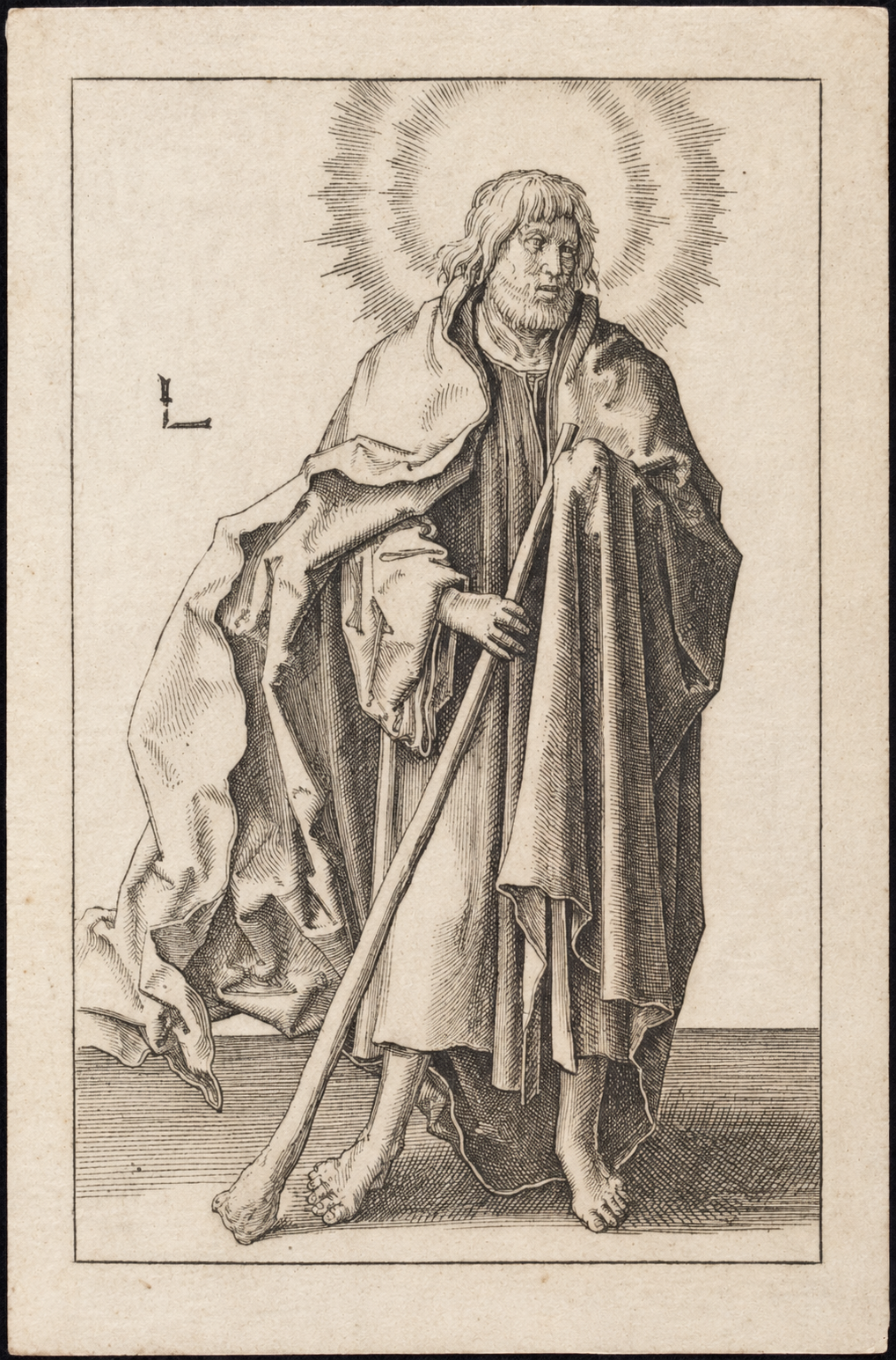
Lucas van Leyden Saint Jude Thaddeus – Antique Amand-Durand heliogravure circa 1880, reproducing a magnificent Northern Renaissance engraving created around 1510 by the Dutch master Lucas van Leyden (circa 1494–1533).
Artculture6 presents this beautiful nineteenth-century French heliogravure after Lucas van Leyden, one of the most important European engravers of the early sixteenth century.
The composition depicts Saint Jude Thaddeus, one of the Twelve Apostles of Jesus Christ, standing barefoot with a long staff or club, his head surrounded by a radiant halo.
This remarkable religious image is distinguished by the expressive face of the saint, the exceptional treatment of his flowing garments and the delicate engraved lines characteristic of the Northern Renaissance.
The original composition was executed around 1510.
The present antique impression was produced around 1880 using the celebrated Amand-Durand heliogravure process.
SAINT JUDE THADDEUS – ONE OF THE TWELVE APOSTLES
Saint Jude Thaddeus occupies an important place in Christian tradition.
He was one of the Twelve Apostles chosen by Jesus Christ to spread his teachings.
He should not be confused with Judas Iscariot.
In Western Christian iconography, Saint Jude is frequently represented carrying a staff or club, traditionally associated with accounts of his martyrdom.
He is also widely venerated in the Catholic Church as the patron saint of difficult and seemingly hopeless causes.
His image has appeared in religious painting, sculpture and engraving since the Middle Ages.
During the Renaissance, artists developed increasingly refined representations of the Apostles, combining traditional religious attributes with new approaches to human anatomy, expression and drapery.
The present composition is a remarkable example of this artistic tradition.
A MAGNIFICENT RENAISSANCE FIGURE OF AN APOSTLE
The engraving represents Saint Jude Thaddeus standing in a dignified and contemplative pose.
His body faces almost directly towards the viewer, while his head is turned slightly to the right.
The saint has shoulder-length hair and a short beard.
His face is carefully modelled through fine engraved lines, creating subtle variations of light and shadow.
A large radiant halo surrounds his head.
The rays extend outward in a regular circular arrangement, emphasising the spiritual significance of the figure.
The Apostle wears a long tunic covered by an exceptionally elaborate mantle.
The folds of this garment fall in sweeping curves, creating dramatic contrasts between illuminated fabric and deep shadow.
One arm extends beneath the flowing cloak, while the other hand rests against the garments near the centre of the composition.
A long staff or club is placed diagonally across the lower part of the image.
The saint stands barefoot upon a simple horizontal ground.
The absence of architectural decoration in the background allows the figure and its magnificent drapery to dominate the composition.
THE EXTRAORDINARY ART OF RENAISSANCE DRAPERY
One of the most remarkable features of this engraving is the treatment of the Apostle’s mantle.
The flowing fabric forms numerous deep and complex folds.
On the left, the mantle falls in broad, expressive curves, creating a strong impression of movement.
On the right, the cloth hangs in substantial vertical folds carefully defined by delicate parallel lines.
The artist uses closely arranged hatching to create dark areas and subtle gradations of tone.
These variations give the garments a remarkable sense of weight and volume.
The contrast between the intricate drapery and the relatively simple background creates an elegant and powerful composition.
The careful treatment of the hands, feet and facial expression demonstrates the extraordinary technical skill of the original engraver.
LUCAS VAN LEYDEN (CIRCA 1494–1533) – MASTER OF THE NORTHERN RENAISSANCE
Lucas van Leyden, also known as Lucas de Leyde, was born in Leiden in the Netherlands around 1494.
He became one of the most celebrated painters, draughtsmen and engravers of the Northern Renaissance.
His artistic talent emerged at an exceptionally early age.
By the beginning of the sixteenth century, he was already producing engravings displaying remarkable technical sophistication.
His work encompasses religious subjects, biblical narratives, portraits, mythological scenes and representations of everyday life.
Lucas van Leyden was particularly admired for his mastery of copper engraving with the burin.
His fine, precise linework allowed him to create subtle tonal variations, complex drapery and expressive human figures.
He developed a highly individual artistic style that combined the traditions of Netherlandish art with the growing influence of the Renaissance.
Lucas was a contemporary of the great German artist Albrecht Dürer.
The two artists met in Antwerp in 1521, an important encounter in the history of Northern European printmaking.
Lucas van Leyden died in 1533.
His original prints are preserved in many of the world’s leading museums and collections of Renaissance art.
RELIGIOUS ENGRAVING IN THE EARLY SIXTEENTH CENTURY
Religious imagery played a fundamental role in European art during the Renaissance.
Engraving made it possible to distribute sophisticated representations of biblical figures to a much wider audience.
The development of copper engraving allowed artists to introduce extraordinary detail into relatively small compositions.
The burin was particularly effective in reproducing the delicate features of the human face, complex garments and carefully modelled anatomical forms.
Lucas van Leyden became one of the leading masters of this technique.
In the present composition, the delicate engraved hatching creates convincing volume throughout the figure.
The face is treated with exceptional sensitivity.
The mantle displays a magnificent variety of folds and tonal contrasts.
The radiant halo, staff and barefoot appearance provide the essential religious attributes of the Apostle.
The engraved image combines artistic refinement with a strong spiritual presence.
CHARLES AMAND-DURAND (1831–1904) AND HELIOGRAVURE
Charles Amand-Durand was a distinguished French specialist in nineteenth-century heliogravure.
He developed a sophisticated process for reproducing the engraved works of earlier European masters.
This technique combined photographic methods with the preparation of metal printing plates.
It enabled the delicate lines, hatching and tonal effects of historical engravings to be reproduced with remarkable precision.
Amand-Durand devoted an important part of his career to the reproduction of Renaissance and Baroque prints.
His work helped preserve and disseminate the artistic achievements of the great European engravers.
Antique Amand-Durand impressions remain appreciated for their technical quality and their historical interest as nineteenth-century reproductions of old master compositions.
AN ANTIQUE AMAND-DURAND HELIOGRAVURE CIRCA 1880
The present work is an antique French heliogravure dating from approximately 1880.
It reproduces an original engraving created by Lucas van Leyden around 1510.
This is a nineteenth-century impression produced through the Amand-Durand process, not an original sixteenth-century engraving.
The reproduction preserves the intricate details of the saint’s face, radiant halo, long staff and magnificent flowing mantle.
Particular attention has been given to the delicate engraved shading and complex arrangement of the drapery.
The impression is printed on antique laid paper.
PRINTED MONOGRAM – THE LETTER L
To the left of the Apostle appears the characteristic monogram:
« L »
This is the historical engraved mark associated with Lucas van Leyden.
On the present Amand-Durand impression, the mark has been reproduced as part of the printed composition.
It is therefore a printed reproduction of the artist’s original engraved signature, not an original handwritten autograph.
The presence of the monogram is an attractive historical feature of the image.
DIMENSIONS AND TECHNICAL DETAILS
Country of original composition: Netherlands
Original artist: Lucas van Leyden (circa 1494–1533)
Artistic school: Northern Renaissance, Dutch
Subject: Saint Jude Thaddeus
Original composition date: Circa 1510
Original technique: Copper engraving with burin
Reproduction technique: Amand-Durand heliogravure
Date of the present impression: Circa 1880
Paper: Antique laid paper
Sheet dimensions: 13.5 × 8.5 cm
Printed image dimensions: 11.8 × 7.2 cm
Printed artist’s monogram: L
Period of reproduction: Nineteenth century

Avis
Il n’y a pas encore d’avis.