Nicolaes Berchem Three Sheep Antique Amand Durand Heliogravure c1875 with Printed Signature
29,00 €
Nicolaes Berchem Three Sheep – Antique Amand-Durand heliogravure circa 1875.
Beautiful nineteenth-century French photogravure reproducing an original animal composition by the Dutch Golden Age master Nicolaes Berchem (1620–1683).
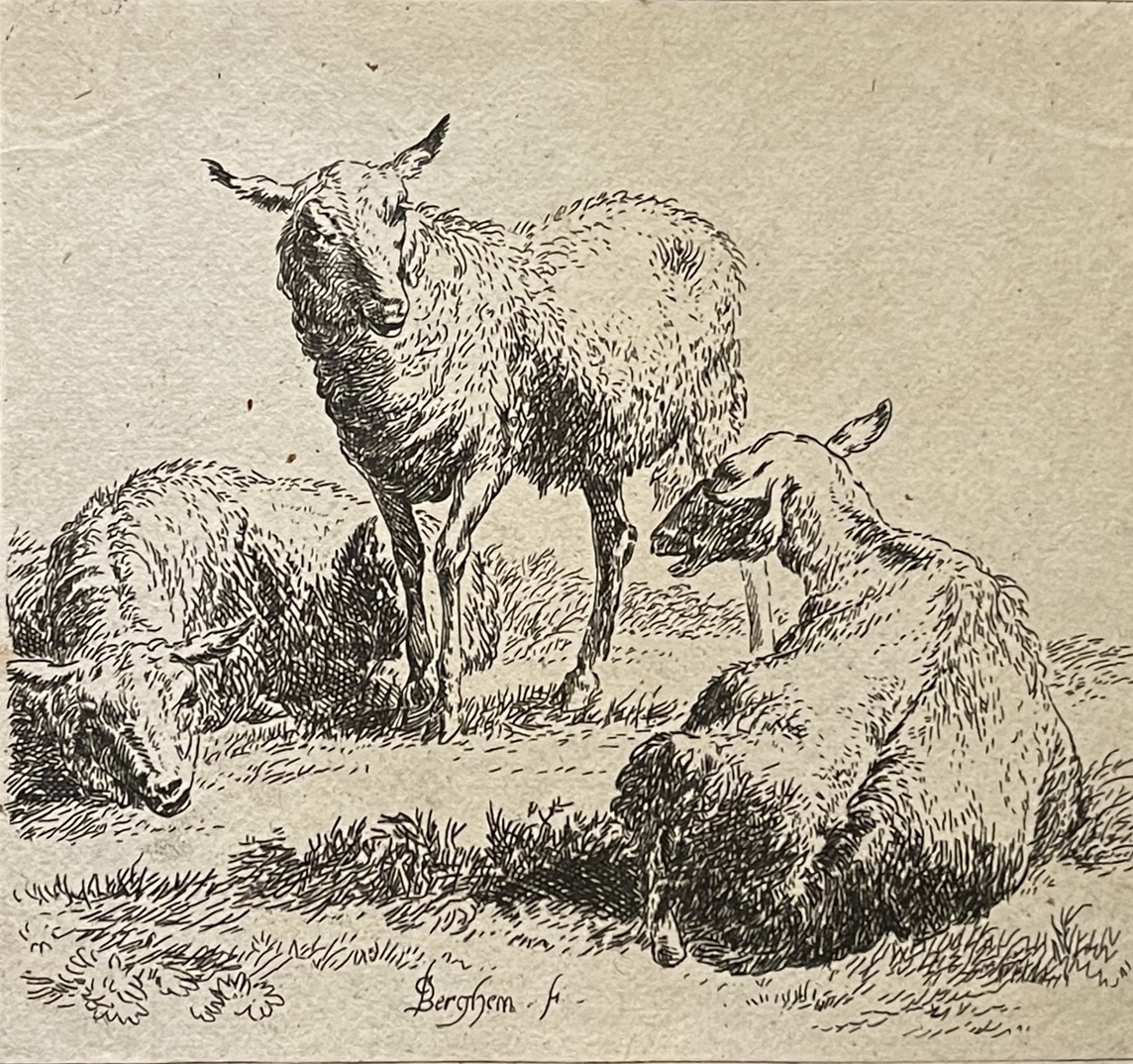
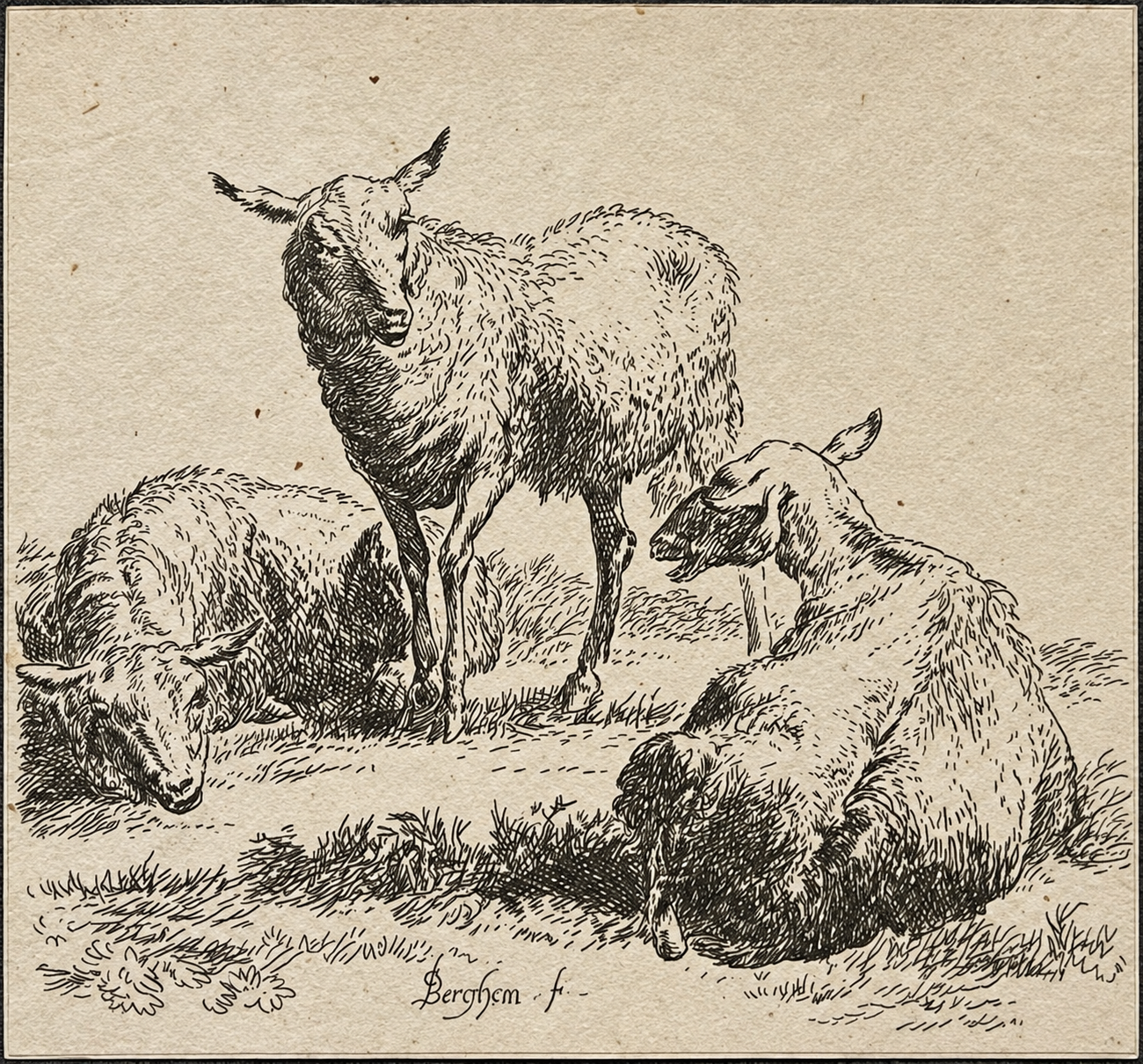
The scene depicts three sheep in a peaceful pastoral setting, one standing at the centre and two resting in the grass.
Exceptional detail in the animals’ wool, natural poses and delicate engraved shading.
The composition bears the reproduced engraved signature « Berghem f. », printed from the heliogravure plate and not an original handwritten autograph.
Sheet dimensions: 10.3 × 11.2 cm.
Antique impression with natural paper patina.
ARTCULTURE6 Reference: 4436-83R312.
Description
Nicolaes Berchem Three Sheep – Antique Amand-Durand heliogravure circa 1875, reproducing a beautiful seventeenth-century animal etching by the Dutch Golden Age master Nicolaes Berchem (1620–1683).
Artculture6 presents this charming nineteenth-century French heliogravure after Nicolaes Berchem, depicting three sheep resting in a peaceful pastoral setting.
The composition features one standing sheep in the centre, accompanied by two reclining animals, beautifully rendered through delicate engraved lines and expressive shading.
Produced using the celebrated Amand-Durand process around 1875, this antique reproduction preserves the intricate graphic qualities of the original Dutch animal composition.
The lower part of the image bears the reproduced engraved inscription « Berghem f. », identifying the original artist.
THREE SHEEP – A BEAUTIFUL DUTCH ANIMAL STUDY
The composition presents three sheep arranged in a carefully balanced pastoral scene.
At the centre stands a large sheep whose body is turned slightly towards the right.
Its head is turned towards the viewer, creating a particularly engaging and natural expression.
The animal’s abundant fleece is represented through numerous fine lines and small engraved strokes.
These carefully arranged marks describe the different textures of the wool and create subtle variations of light and shadow.
On the left, a second sheep rests upon the ground, its head lowered and its thick woolly body extending across the grass.
The third sheep is reclining on the right, with its head raised towards the standing animal.
The contrast between the three different poses brings life and movement to the composition.
Their peaceful attitudes evoke the quiet atmosphere of a traditional pastoral landscape.
THE ART OF NATURAL OBSERVATION
One of the most attractive qualities of this composition is the precision with which the animals have been observed.
Each sheep is represented with carefully considered proportions and individual characteristics.
The artist has paid particular attention to the shapes of the heads, ears, legs and bodies.
The thick wool is rendered through an intricate arrangement of curved strokes and delicate hatching.
The animals occupy almost the entire composition, while the surrounding landscape is reduced to scattered grass and small plants.
This restrained setting allows the viewer to concentrate on the animals themselves.
The standing sheep provides a strong vertical element, while the reclining animals establish a harmonious balance across the lower section.
The resulting composition is both naturalistic and elegant.
NICOLAES BERCHEM (1620–1683) – DUTCH GOLDEN AGE MASTER
Nicolaes Pietersz Berchem was born in Haarlem in 1620.
He became one of the most important Dutch landscape painters and printmakers of the seventeenth century.
His father was the celebrated still-life painter Pieter Claesz, under whom he received his early artistic training.
Berchem developed a particular interest in pastoral landscapes and the representation of domestic animals.
His paintings and engravings frequently depict sheep, goats, cattle, horses and shepherds in peaceful rural settings.
He is especially associated with the Dutch Italianate school, whose artists admired the landscapes, architecture and warm atmosphere of Italy.
His works combine careful natural observation with an elegant sense of composition.
Alongside his extensive painted production, Berchem created numerous original etchings.
These engravings demonstrate his remarkable ability to represent animals through delicate lines and expressive tonal contrasts.
His animal studies are particularly admired for their vitality, convincing anatomy and detailed rendering of fur and wool.
Berchem died in Amsterdam in 1683.
His works are represented in many important European and international museum collections.
ANIMAL ENGRAVING IN THE DUTCH GOLDEN AGE
Animal subjects occupied an important position in Dutch art during the seventeenth century.
Artists devoted considerable attention to the study of domestic livestock, rural landscapes and scenes of agricultural life.
Sheep were especially attractive subjects for printmakers because their thick fleece offered numerous opportunities for delicate linework.
The technique of etching allowed artists to describe the texture of wool through short, curved strokes and closely arranged hatching.
In the present composition, the different areas of shading give volume to the animals and emphasise their natural forms.
The dark sections beneath their bodies contrast with the lighter treatment of their fleece.
The simplicity of the surrounding landscape reinforces the carefully observed details of the three sheep.
This intimate animal study illustrates the importance of naturalism in Dutch Golden Age art.
CHARLES AMAND-DURAND (1831–1904)
Charles Amand-Durand was a celebrated nineteenth-century French specialist in heliogravure.
He developed an advanced photomechanical reproduction process that allowed historic engravings to be reproduced with remarkable accuracy.
His work was particularly associated with the reproduction of important European old master prints.
The heliogravure process combined photographic techniques with the preparation of metal printing plates.
It allowed subtle variations in engraved lines, hatching and tonal shading to be transferred to a new printing matrix.
Amand-Durand’s reproductions helped preserve and disseminate the graphic achievements of earlier European artists.
His nineteenth-century impressions remain appreciated for their technical quality and their historical connection with the revival of interest in old master prints.
AN ANTIQUE AMAND-DURAND HELIOGRAVURE CIRCA 1875
The present work was produced around 1875 using the Amand-Durand heliogravure process.
It reproduces a seventeenth-century composition by Nicolaes Berchem.
This is an antique nineteenth-century photogravure, not a lifetime impression printed from Berchem’s original copperplate.
The impression faithfully reproduces the fine graphic details of the original animal study.
The delicate textures of the fleece, the natural forms of the three sheep and the small areas of vegetation remain clearly visible.
The careful treatment of light and shadow creates an attractive sense of volume.
PRINTED SIGNATURE – BERGHEM F.
The lower part of the composition bears the inscription:
« Berghem f. »
The name Berghem is a historical spelling associated with Nicolaes Berchem.
The abbreviation f. derives from the Latin fecit, meaning « made it ».
This is a printed reproduction of the engraved signature appearing in the original composition, not an original handwritten autograph signature.
The inscription is an attractive feature of the image and contributes to its historical character.
DIMENSIONS AND TECHNICAL DETAILS
Original artist: Nicolaes Berchem (1620–1683)
Artistic school: Dutch Golden Age
Subject: Three Sheep
Original composition: Seventeenth century
Reproduction process: Amand-Durand heliogravure
Date of this impression: Circa 1875
Country of reproduction: France
Technique: Antique photogravure / heliogravure
Sheet dimensions: 10.3 × 11.2 cm
Printed inscription: Berghem f.
Period: Nineteenth century
CONDITION
Antique heliogravure displaying the natural patina of aged paper.
The composition and fine details of the three sheep remain well preserved.
Minor age-related marks are visible in the photograph.
COLLECTOR’S INTEREST
An attractive nineteenth-century heliogravure for collectors interested in Nicolaes Berchem, Dutch Golden Age art, animal studies and the celebrated Amand-Durand reproduction process.
The composition is particularly appealing for its naturalistic representation of three sheep, its delicate engraved textures and its peaceful pastoral atmosphere.
The reproduced engraved signature adds further interest to this charming antique work.
An attractive addition to a collection of historic animal prints, old master reproductions and European works on paper.
ARTCULTURE6 REFERENCE: 4436-83R312



Avis
Il n’y a pas encore d’avis.