
Description
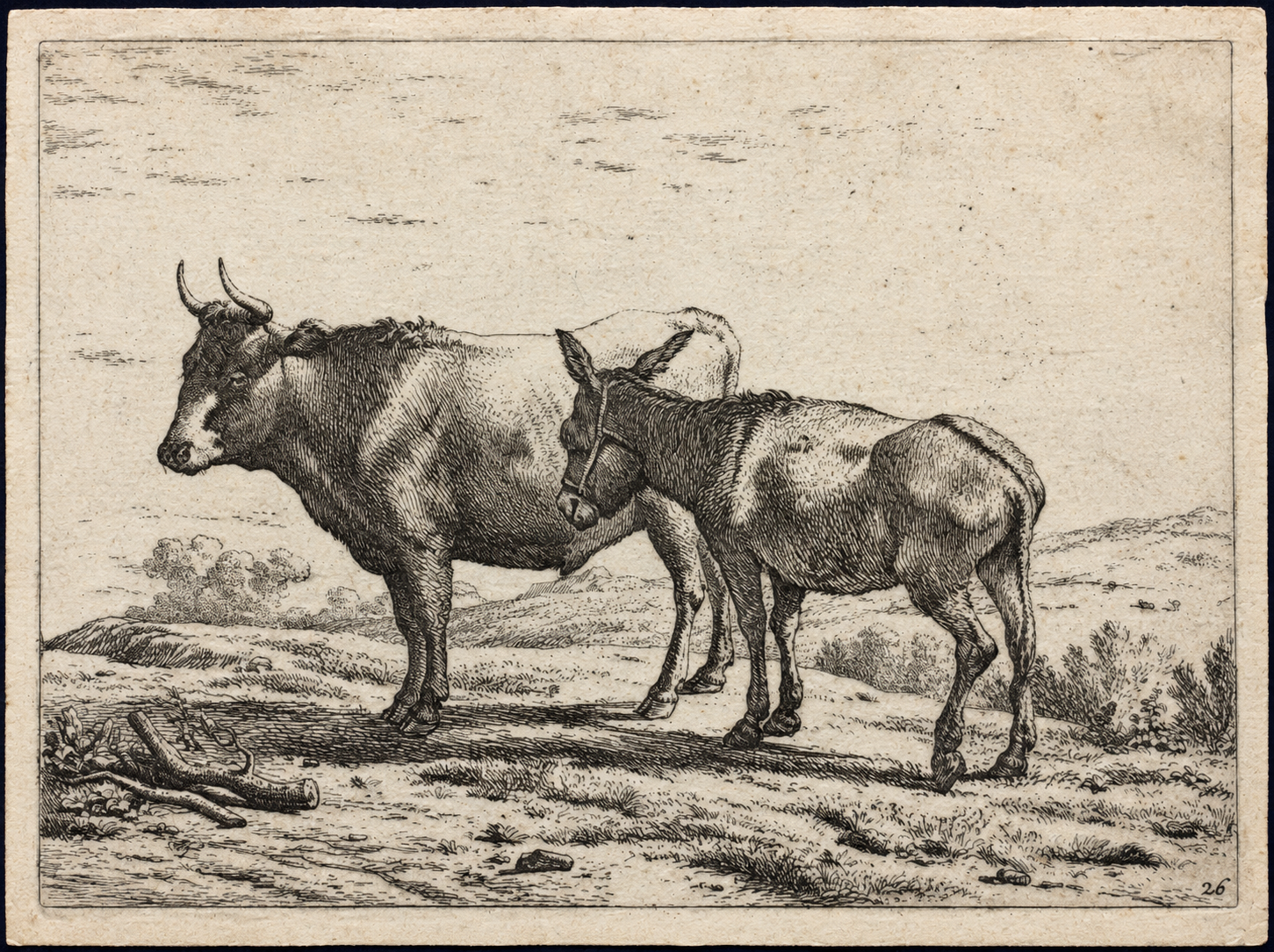
Karel Dujardin Ox and Donkey – Beautiful nineteenth-century Amand-Durand heliogravure, circa 1880, reproducing a celebrated animal etching by the Dutch Golden Age master Karel Dujardin (1626–1678).
Artculture6 presents this attractive antique French photogravure after Karel Dujardin, depicting an ox and a donkey standing together in a peaceful rural landscape.
Executed using the celebrated Amand-Durand heliogravure process, this fine nineteenth-century impression faithfully reproduces the delicate engraved lines, subtle shading and carefully observed animal anatomy of the original seventeenth-century composition.
Printed on antique laid linen paper, the work is particularly appealing for its finely detailed animals and atmospheric countryside setting.
THE OX AND THE DONKEY – A BEAUTIFUL ANIMAL COMPOSITION
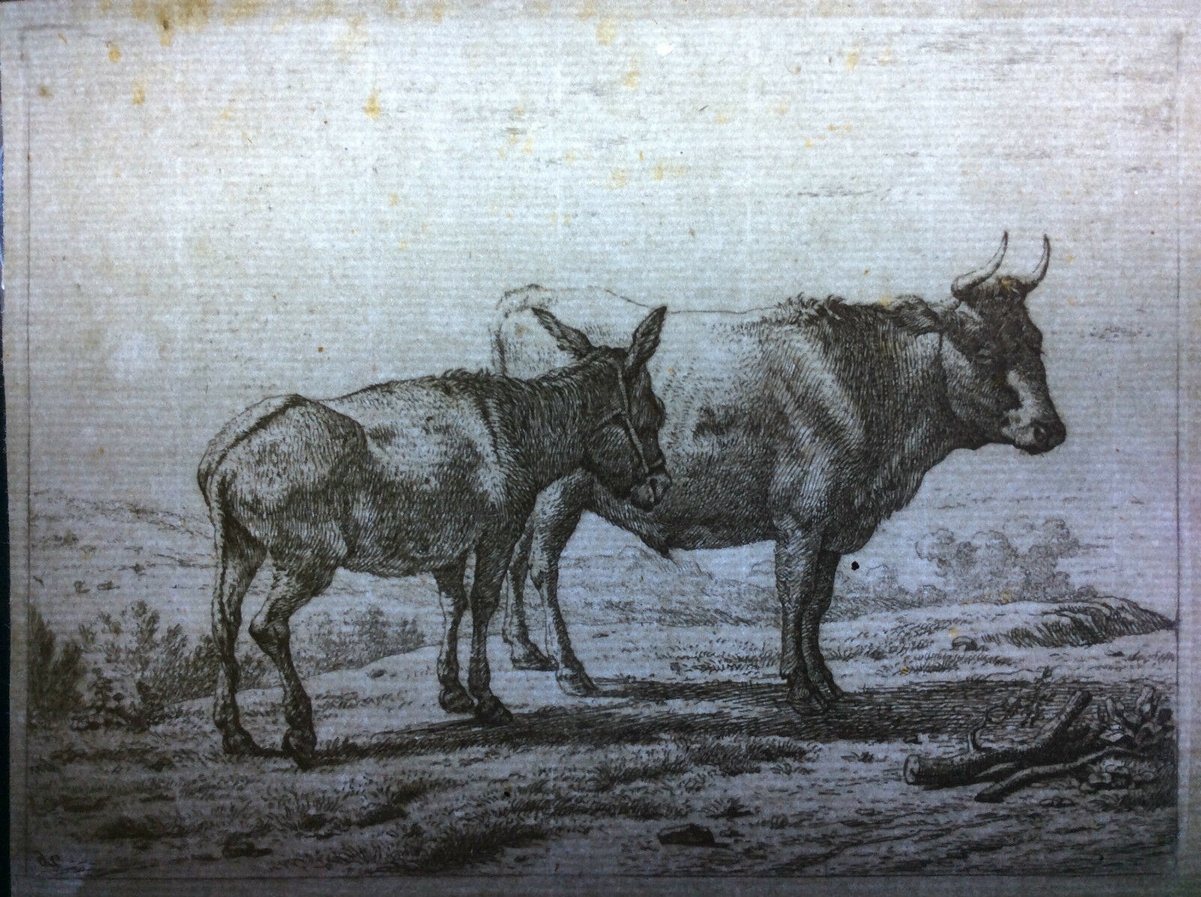
The engraving depicts two animals standing quietly together in an open landscape.
On the left, a powerful ox occupies an important position in the composition.
Its imposing body is represented in profile, with the head turned slightly towards the viewer.
The horns, broad neck, muscular shoulders and carefully observed legs demonstrate the remarkable naturalism of Karel Dujardin’s original design.
The animal’s coat is rendered through numerous delicate engraved lines and closely arranged hatching.
The variations in shading describe the shape and volume of the body, creating an attractive impression of depth.
Standing beside the ox is a donkey, its head inclined and its body shown in three-quarter view.
Its distinctive ears, slender legs and textured coat contrast with the imposing physical presence of the larger animal.
The two figures are represented with a remarkable sense of observation and tranquillity.
Their natural poses give the composition its particular charm.
A PEACEFUL DUTCH GOLDEN AGE LANDSCAPE
The animals stand within a gently undulating rural landscape.
In the foreground, small stones, grasses, branches and scattered vegetation are carefully represented.
The ground is described through delicate lines, with darker engraved areas indicating shadows beneath the animals.
In the background, low hills extend towards the horizon.
Small groups of trees and bushes introduce additional details into the landscape.
The relatively open sky contrasts with the detailed treatment of the animals.
This careful balance between natural observation and landscape composition is characteristic of the pastoral subjects appreciated by Dutch Golden Age artists.
The composition evokes a peaceful moment in the countryside, free from human activity.
KAREL DUJARDIN (1626–1678) – DUTCH GOLDEN AGE MASTER
Karel Dujardin, also known as Carel du Jardin, was born in Amsterdam in 1626.
He became an important Dutch painter, draughtsman and printmaker, particularly celebrated for his landscapes, pastoral scenes and representations of animals.
His artistic production includes paintings, drawings and etchings depicting cattle, donkeys, sheep, horses and rural subjects.
Dujardin was associated with the artistic tradition of the Bamboccianti, a group of predominantly northern European artists whose works depicted everyday life and picturesque subjects, often in Italian settings.
His work combines the detailed observation characteristic of Dutch painting with an appreciation of the warm light and atmospheric landscapes of southern Europe.
Animals occupy a central place in many of his compositions.
Rather than treating them as secondary accessories, Dujardin frequently made them the principal subjects of his works.
His ability to capture their anatomy, movement and natural behaviour established his reputation as an accomplished animal painter and printmaker.
Dujardin spent part of his career in Italy and died in Venice in 1678.
His works are represented in numerous international museum collections.
THE ART OF ANIMAL ETCHING IN THE SEVENTEENTH CENTURY
Animal studies formed an important part of Dutch artistic production during the seventeenth century.
Painters and engravers devoted considerable attention to the representation of domestic animals, rural landscapes and scenes of everyday life.
The technique of etching was particularly well suited to these subjects.
Fine engraved lines allowed artists to describe animal anatomy, the texture of fur and the subtle transitions between light and shadow.
In the present composition, the ox and donkey are rendered with exceptional precision.
The musculature of the ox is emphasised through strong tonal contrasts, while the donkey is described with lighter and more delicate strokes.
The surrounding landscape is treated with greater freedom, allowing the animals to dominate the scene.
The resulting composition combines scientific observation of nature with the artistic sensitivity of Dutch Golden Age printmaking.
CHARLES AMAND-DURAND AND NINETEENTH-CENTURY HELIOGRAVURE
Charles Amand-Durand (1831–1904) was a celebrated French engraver and specialist in heliogravure.
During the nineteenth century, he developed an advanced photomechanical process capable of reproducing historical engravings with remarkable accuracy.
His technique combined photographic methods with the preparation and refinement of metal printing plates.
This allowed the delicate lines and tonal effects of earlier engravings to be reproduced in great detail.
Amand-Durand became particularly well known for his reproductions of works by the great European printmakers.
His heliogravures provided collectors and art enthusiasts with carefully executed impressions of celebrated old master compositions.
The process was especially effective in reproducing the subtle engraved textures found in seventeenth-century Dutch etchings.
AN ANTIQUE AMAND-DURAND IMPRESSION CIRCA 1880
The present heliogravure dates from approximately 1880.
It reproduces the original seventeenth-century composition by Karel Dujardin.
This is a nineteenth-century Amand-Durand reproduction, not an original lifetime impression by Dujardin.
The impression displays the qualities associated with the heliogravure process, including the faithful rendering of fine lines, delicate shading and subtle tonal variations.
The detailed treatment of the ox and donkey is particularly attractive.
Individual strokes describing the animals’ coats, muscles and contours remain clearly visible.
The surrounding countryside, scattered vegetation and distant hills contribute to the harmonious appearance of the work.
Printed on laid linen paper, the impression possesses the character of an antique nineteenth-century print.
DIMENSIONS AND TECHNICAL DETAILS
Original artist: Karel Dujardin (1626–1678)
Artistic school: Dutch Golden Age
Subject: The Ox and the Donkey
Original composition: Seventeenth century
Heliogravure: Charles Amand-Durand process
Date of this impression: Circa 1880
Technique: Antique photogravure / heliogravure
Paper: Antique laid linen paper
Sheet dimensions: 19.5 × 14.8 cm
Plate mark dimensions: 18.8 × 14 cm
Country of reproduction: France
Period: Nineteenth century

Avis
Il n’y a pas encore d’avis.