Gersfeld Germany 1913 Original Graphite Drawing of a Historic Rural Village Street and Traditional Farmhouses in Hesse
89,00 €
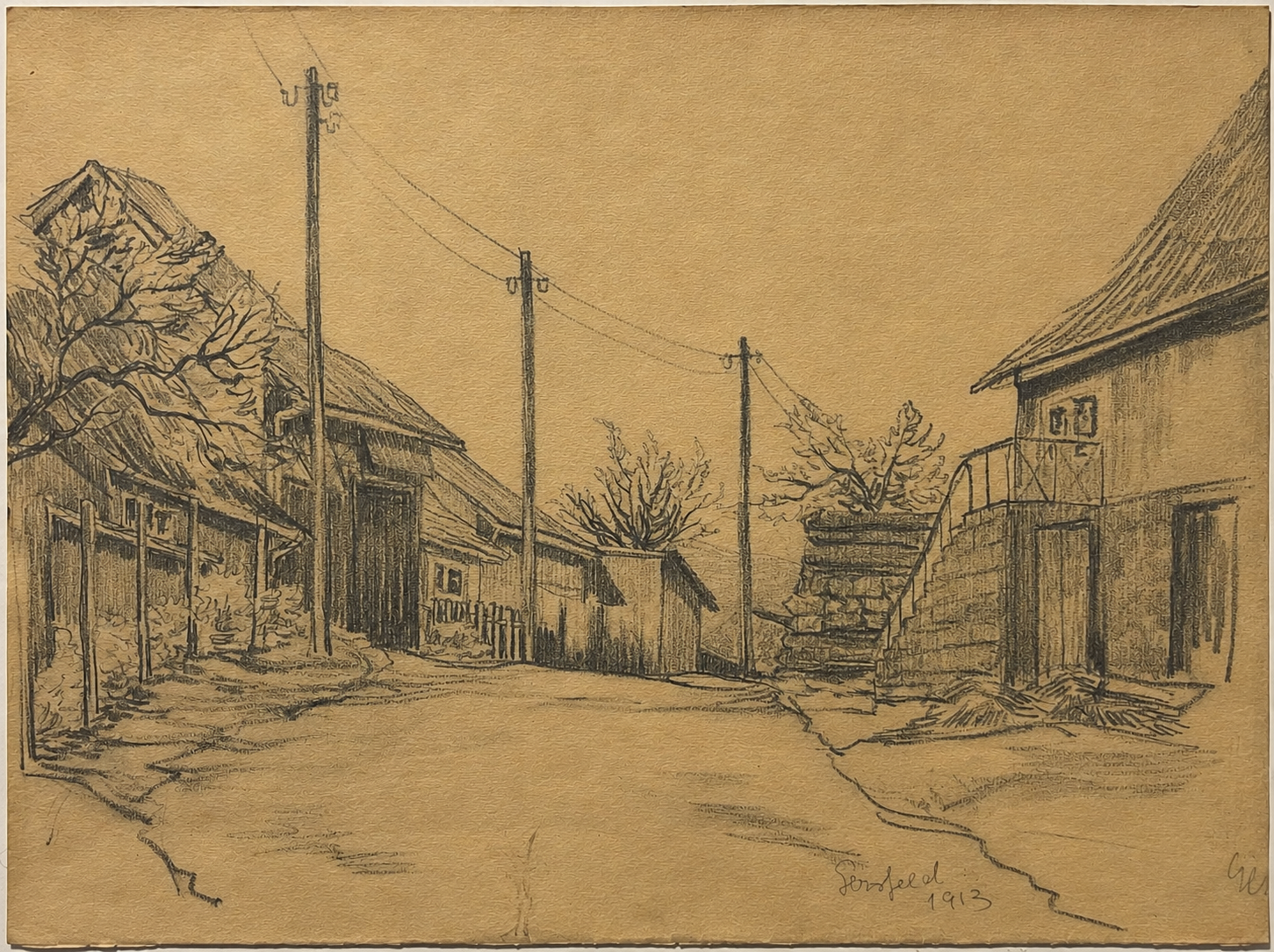
Gersfeld Germany 1913 – Original graphite drawing of a rural village street in the Rhön region of Hesse.
Beautiful early twentieth-century composition depicting traditional German farmhouses, old agricultural buildings, wooden utility poles and overhead lines.
The gently rising village road passes between historic rural buildings with substantial pitched roofs, wooden doors and traditional timber framing.
An interesting original architectural and landscape drawing from the years immediately preceding the First World War.
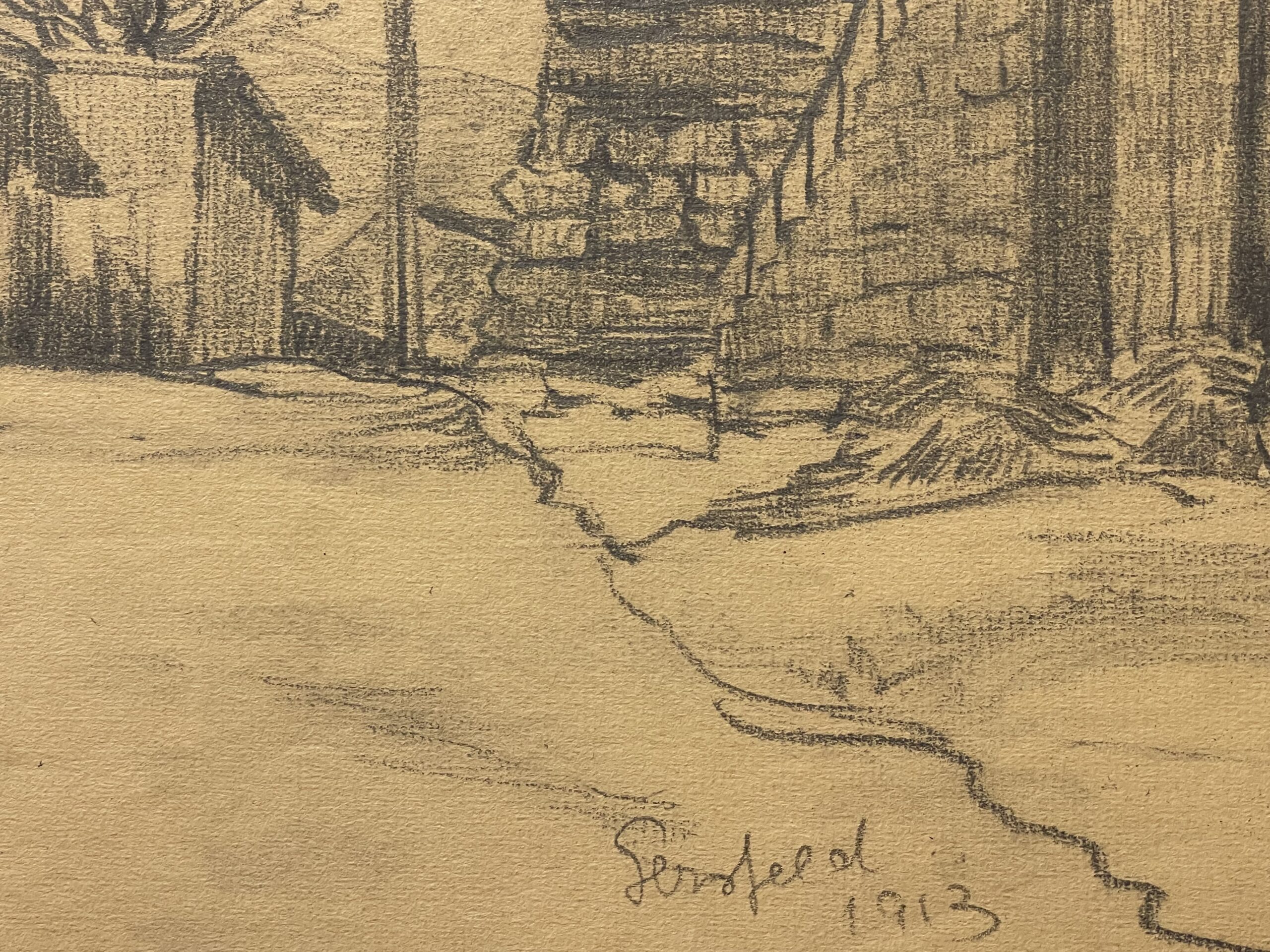
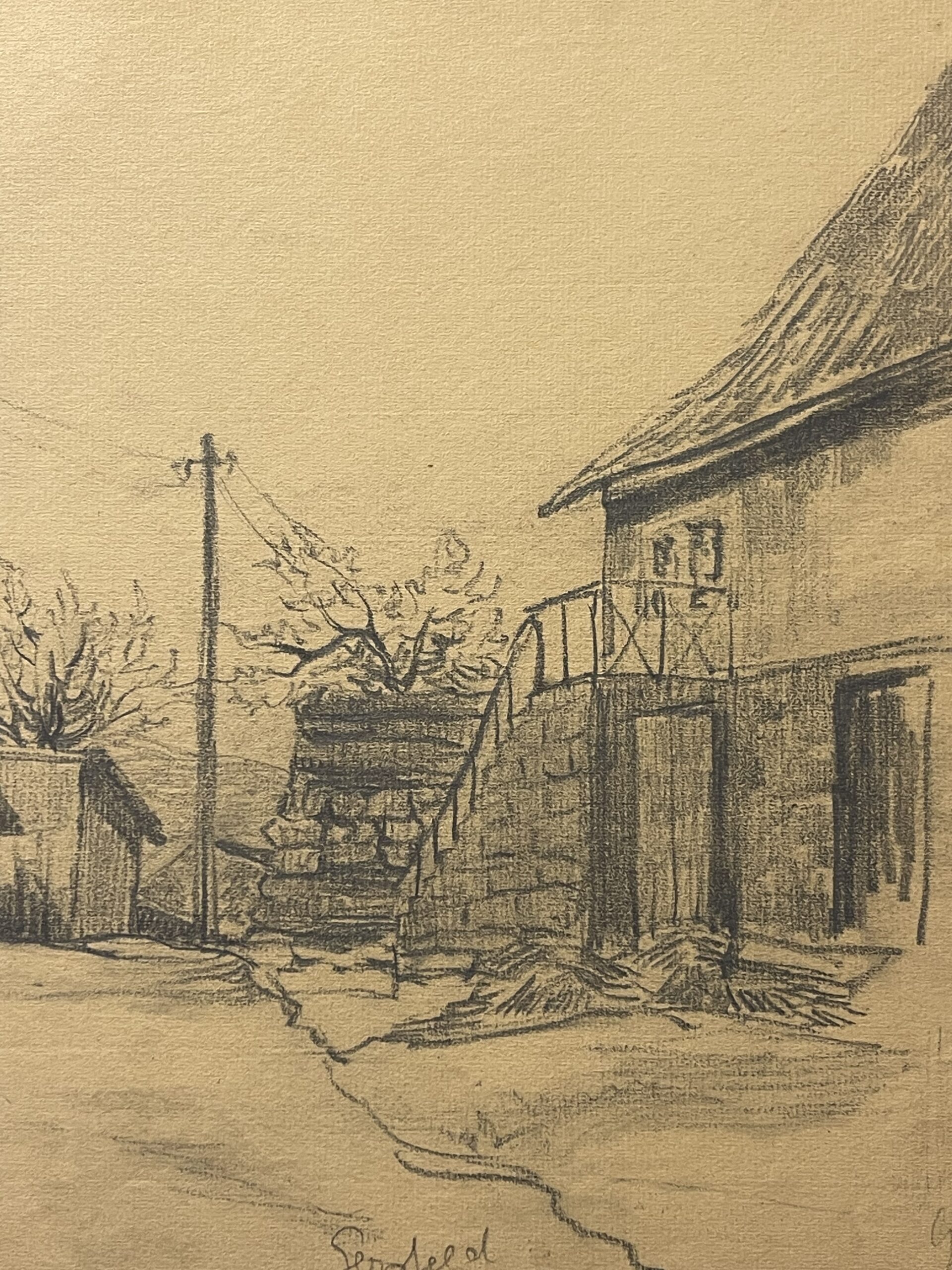
Handwritten inscription: Apparently « Gersfeld 1913 ».
Sheet dimensions: 40 × 29.8 cm.
Original drawing on naturally aged paper. Anonymous artist.
ARTCULTURE6 Reference: 4937-15R500.
Description
Gersfeld Germany 1913 – Original graphite drawing depicting a traditional rural village street with historic farmhouses, agricultural buildings and wooden utility poles in the Rhön region of Hesse.
Artculture6 presents this remarkable original German landscape drawing dated 1913, representing a picturesque rural street believed to be located in Gersfeld (Rhön), a historic town in the Fulda district of Hesse, Germany.
Executed in graphite on paper, this atmospheric composition captures the traditional architecture and quiet surroundings of a German rural settlement in the years immediately preceding the First World War.
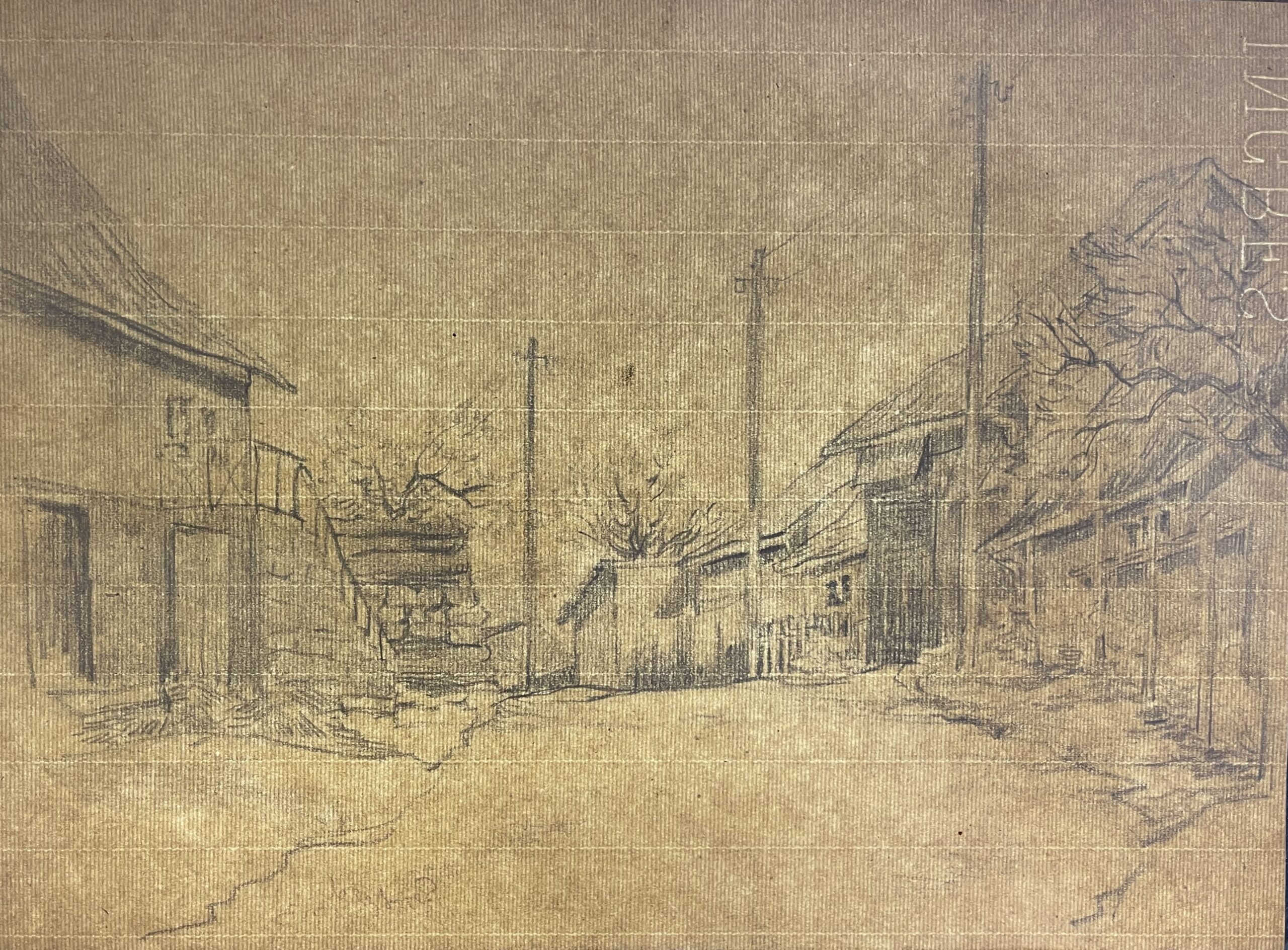
The drawing is distinguished by its carefully observed farm buildings, traditional wooden structures, gently rising village road and three tall utility poles carrying overhead lines.
A handwritten inscription appears to read « Gersfeld 1913 ».
GERSFELD – A HISTORIC TOWN IN THE RHÖN MOUNTAINS
Gersfeld is situated in the eastern part of Hesse, within the mountainous Rhön region of central Germany.
The town belongs to the Fulda district and has a history extending back to the early Middle Ages.
The surrounding region is distinguished by its wooded hills, agricultural landscapes, traditional villages and historic rural architecture.
The development of Gersfeld was closely connected with the history of the Rhön and its surrounding settlements.
Traditional buildings, including substantial farmhouses, barns and timber-framed structures, form an important part of the region’s architectural heritage.
The present drawing offers an attractive representation of this rural environment as it appeared at the beginning of the twentieth century.
A PICTURESQUE GERMAN VILLAGE STREET
The composition is organised around a gently rising road extending from the foreground towards a small group of traditional buildings.
The street curves slightly as it passes between the farmhouses, creating a convincing impression of perspective and depth.
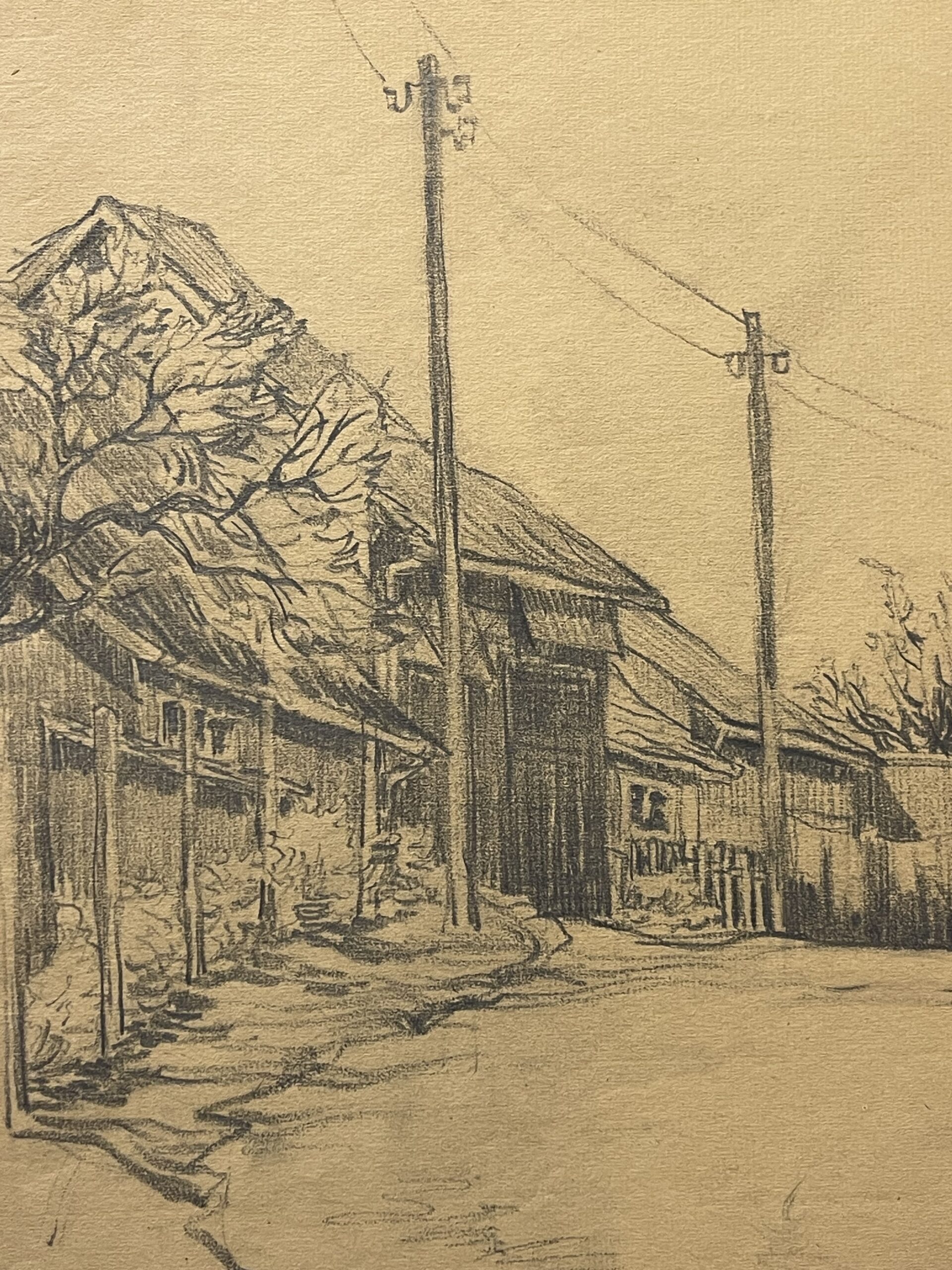
On the left, a succession of old rural buildings occupies much of the composition.
Their steep roofs, small windows and substantial wooden doors are carefully described through precise graphite strokes.
One particularly prominent building features a large timber entrance, characteristic of traditional barns and agricultural storage buildings.
Further along the street, smaller houses and farm buildings gradually recede into the distance.
The roadway is bordered by uneven ground, fences, low vegetation and trees.
These details contribute to the authenticity and atmosphere of the rural scene.
TRADITIONAL FARMHOUSES AND AGRICULTURAL ARCHITECTURE
The buildings depicted in this original drawing illustrate characteristic features of traditional German rural construction.
Their architecture combines timber framing, masonry walls, substantial pitched roofs and large wooden doors.
On the right, an imposing agricultural building occupies the foreground.
Its upper section displays exposed timber members supporting the traditional roof structure.
The lower façade includes a large wooden entrance and carefully rendered wall surfaces.
Several pieces of wood or agricultural materials appear near the base of the building.
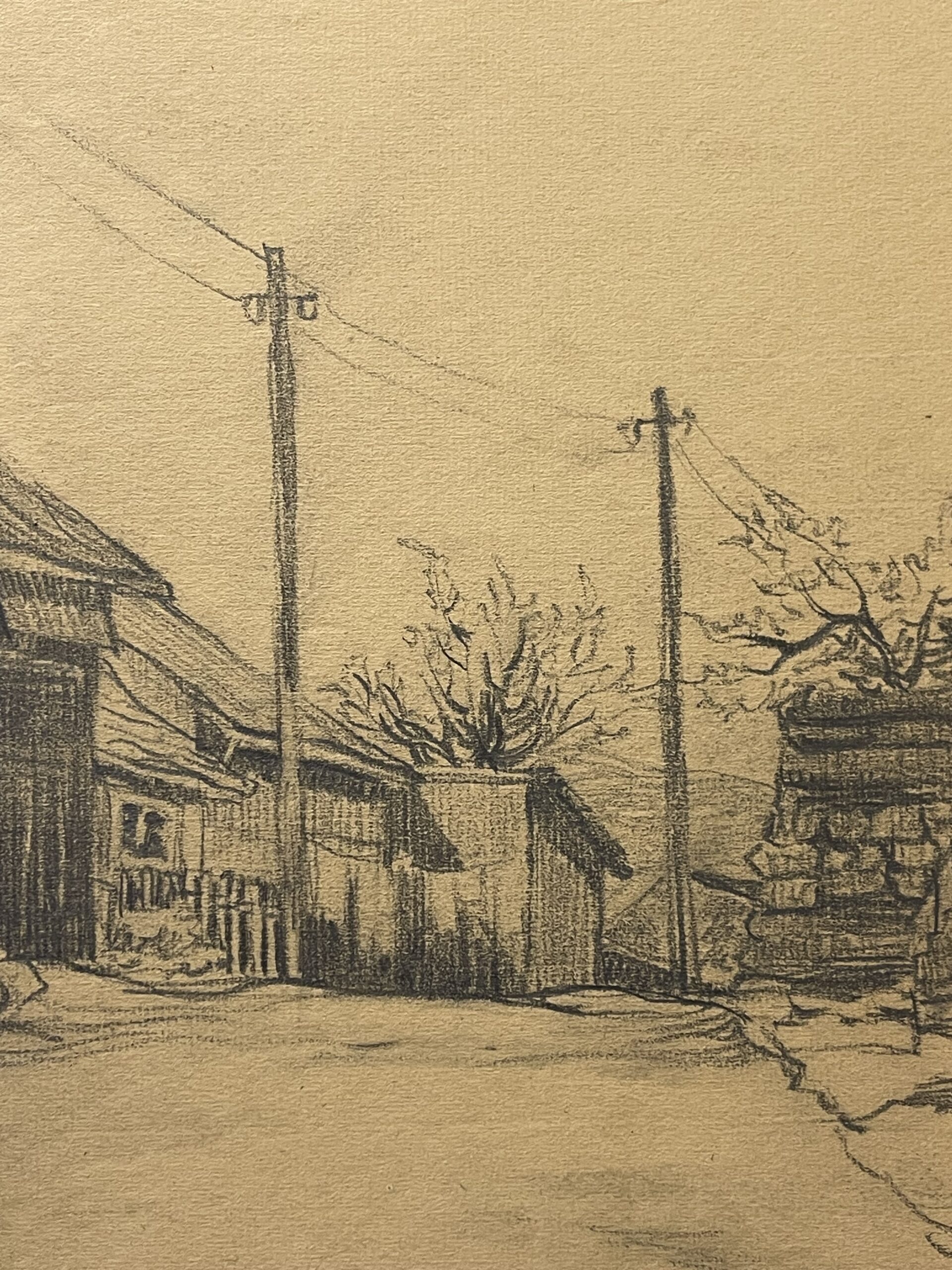
Beyond this farmhouse, an old stone wall marks the boundary of another property.
Trees rise above the wall, their branches creating an expressive contrast with the geometric structure of the architecture.
The artist has carefully observed the relationship between the buildings, their construction materials and the surrounding landscape.
WOODEN UTILITY POLES AND OVERHEAD LINES IN 1913
One of the most interesting details of this drawing is the presence of three tall wooden utility poles extending along the village street.
The poles are equipped with insulators and connected by overhead lines.
Their inclusion illustrates the changing appearance of rural settlements during the early twentieth century.
While the traditional farmhouses and agricultural buildings reflect established forms of village architecture, the overhead lines represent the growing presence of technical infrastructure.
The exact function of the lines is not established from the drawing alone.
Nevertheless, their careful representation provides an interesting historical detail and contributes to the documentary character of the composition.
From an artistic perspective, the three poles create a strong vertical rhythm against the open sky, reinforcing the perspective of the road.
ARTISTIC TECHNIQUE AND GRAPHITE EXECUTION
The drawing reveals a confident understanding of perspective, rural architecture and landscape composition.
The artist uses fine graphite lines and carefully controlled hatching to represent the buildings, wooden structures and roof surfaces.
The darker areas of the agricultural buildings are rendered with closely arranged pencil strokes.
Traditional timber frameworks are described through precise linear construction, while the stone walls and uneven ground receive a freer treatment.
The foliage of the trees is particularly expressive.
Short, energetic strokes describe the branches and irregular outlines of the vegetation.
The street is rendered through subtle variations of tone, with darker shading in the foreground and near the buildings.
These contrasts create an attractive sense of depth without diminishing the spontaneous character of the original drawing.
The warm natural patina of the paper complements the historical atmosphere of the composition.
GERMANY IN 1913 – BEFORE THE FIRST WORLD WAR
This drawing is dated 1913, one year before the outbreak of the First World War.
It therefore records a rural setting during the final years of the pre-war period.
The composition belongs to an interesting series of German architectural and landscape drawings executed between 1913 and 1916.
Other works from this group represent historic towns, castles, towers and traditional houses.
The present example is particularly distinctive because it concentrates on everyday rural architecture rather than monumental buildings.
The farmhouses, village street and overhead lines provide an evocative visual record of a changing agricultural environment at the beginning of the twentieth century.
HANDWRITTEN LOCATION AND DATE
A handwritten inscription in the lower part of the drawing appears to read:
« Gersfeld 1913 »
The date is clearly legible.
The place name is interpreted as Gersfeld (Rhön), a historic town in Hesse, Germany.
This identification is consistent with the geographical context of the series, although the exact buildings shown have not been independently matched to a historical photograph.
The artist remains anonymous.
DIMENSIONS AND TECHNICAL DETAILS
Country: Germany
Region: Hesse
District: Fulda
Probable location: Gersfeld (Rhön)
Date: 1913
Technique: Original graphite drawing on paper
Subject: Rural village street with traditional farmhouses, agricultural buildings and wooden utility poles
Sheet dimensions: 40 × 29.8 cm
Artist: Anonymous
Period: Early twentieth century, pre-First World War
Handwritten inscription: Apparently « Gersfeld 1913 »
CONDITION
Original antique drawing on naturally aged paper, displaying the characteristic patina of an early twentieth-century work.
The architectural composition, graphite shading and handwritten inscription remain well preserved.
COLLECTOR’S INTEREST
A particularly attractive original work for collectors interested in historic German villages, traditional farmhouses, rural architecture and early twentieth-century European drawings.
The carefully observed buildings, wooden utility poles and dated handwritten inscription give this drawing both artistic and documentary interest.
The work offers an appealing representation of the traditional rural landscape of the Rhön region before the First World War.
An interesting addition to a collection of original German landscapes, architectural studies and antique works on paper.
ARTCULTURE6 REFERENCE: 4937-15R500


Avis
Il n’y a pas encore d’avis.