Saalfeld Germany 1806 Death of Prince Louis Ferdinand Prussia Swebach Engraving c1850
59,00 €
Saalfeld Germany 1806 – Death of Prince Louis Ferdinand of Prussia – Large French Historical Engraving after Swebach, circa 1850.
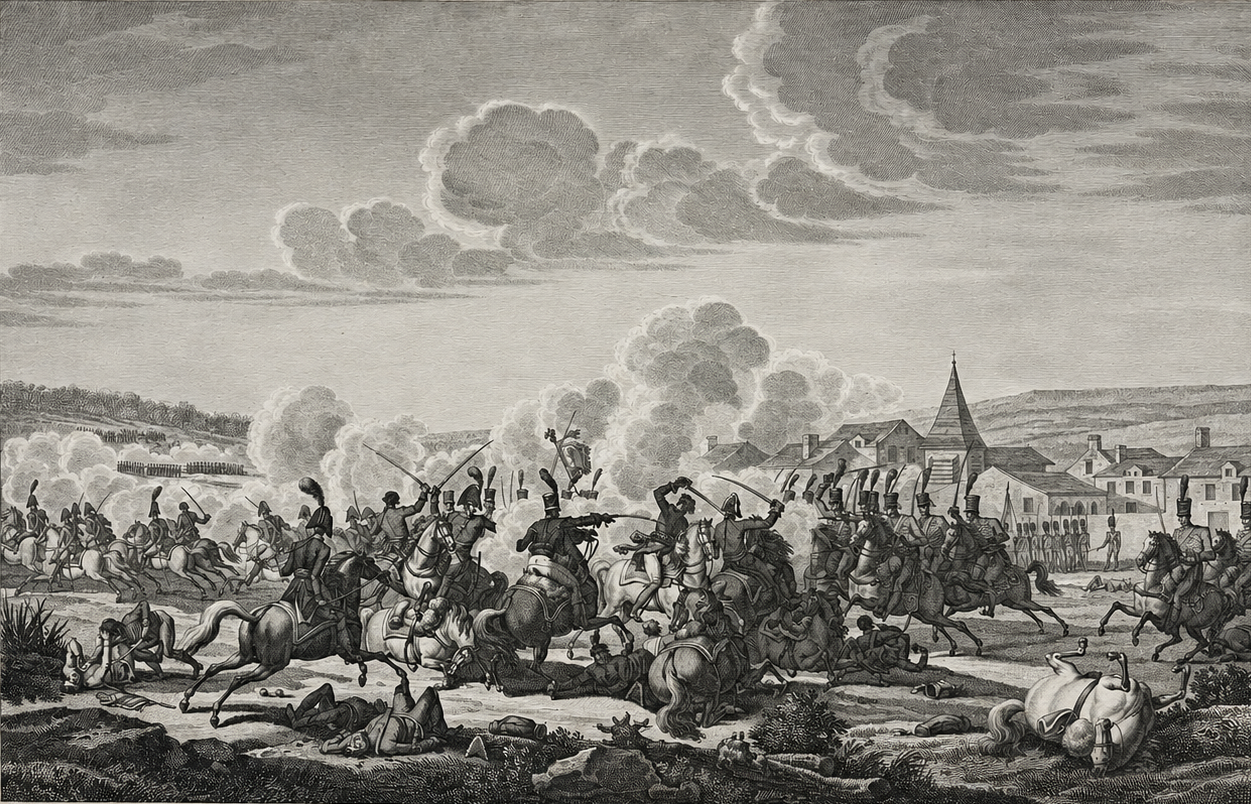
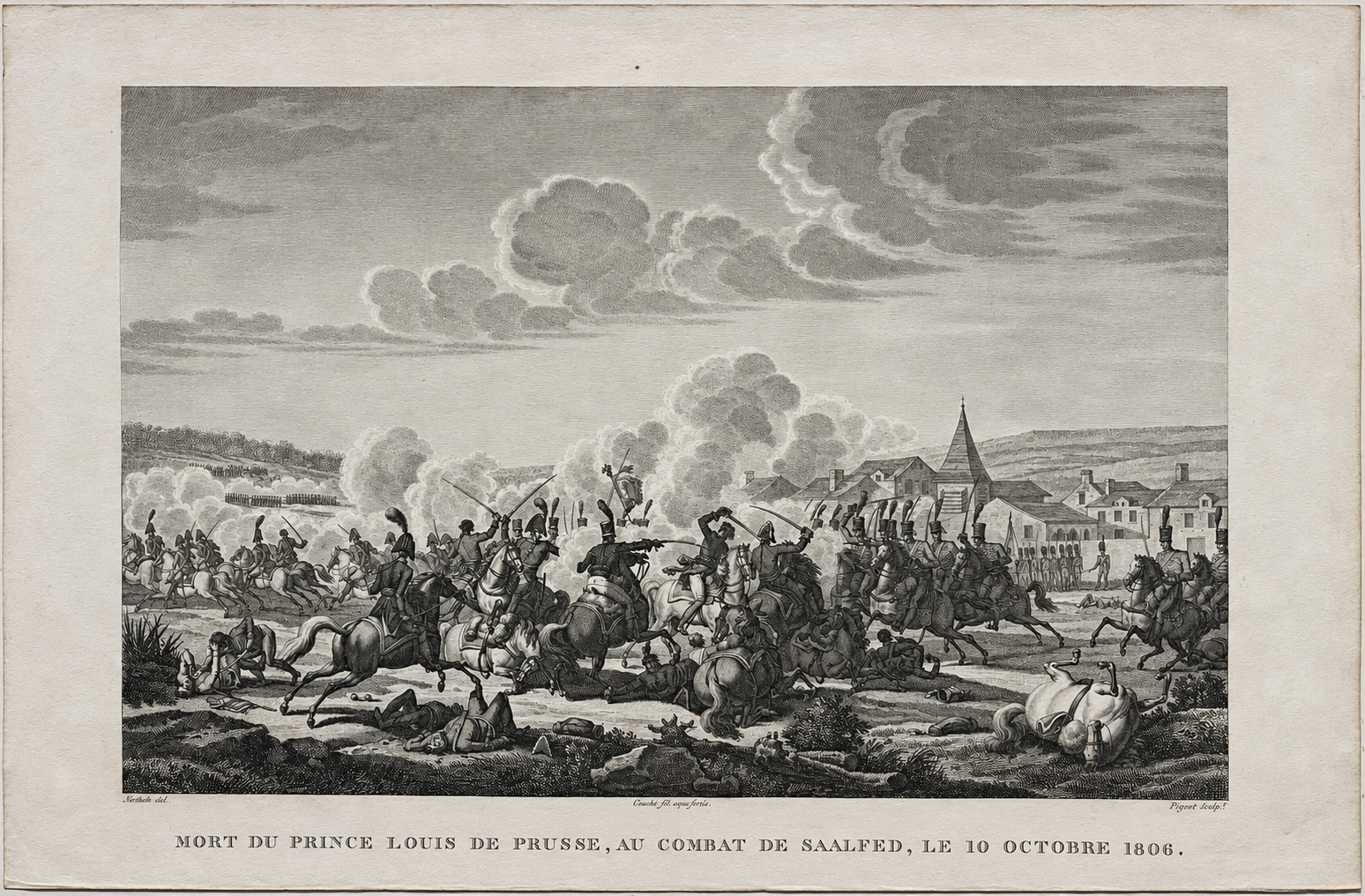
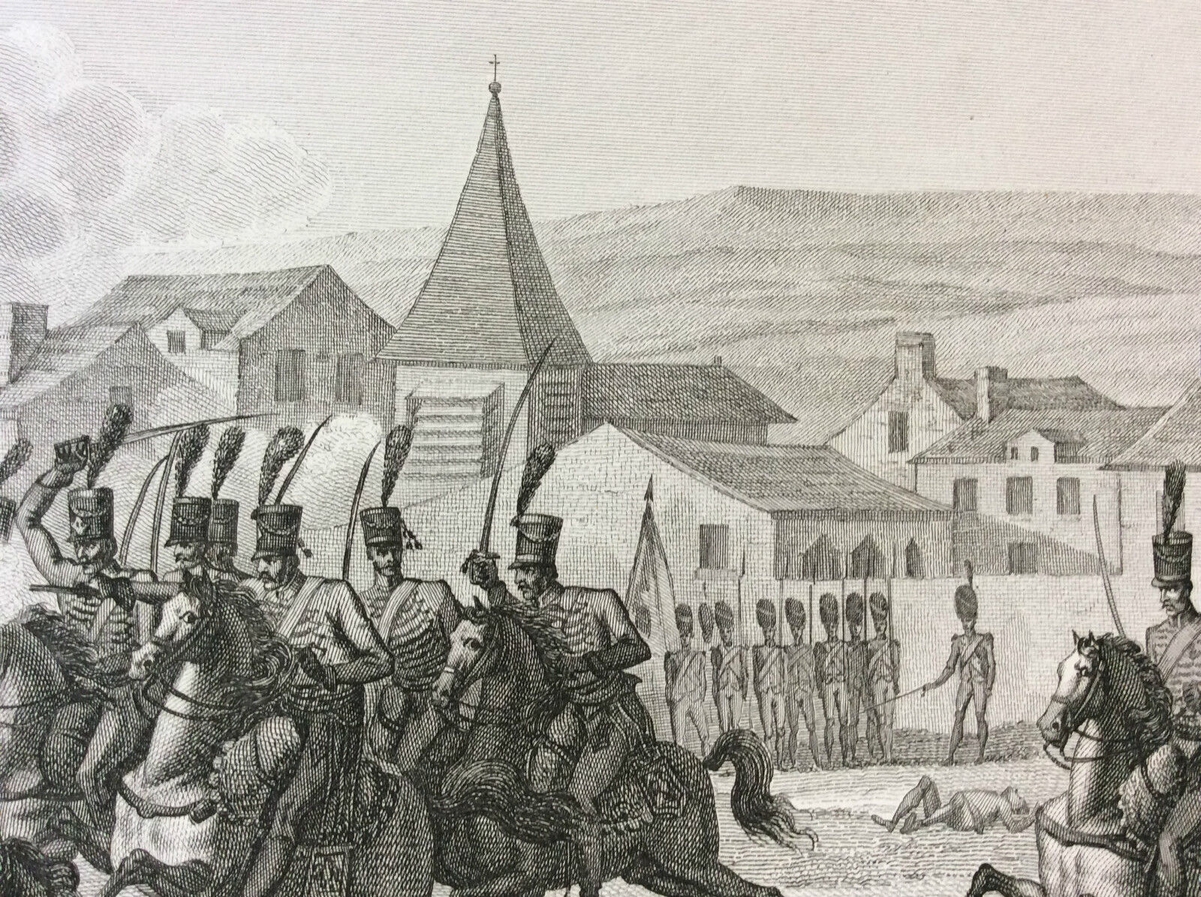
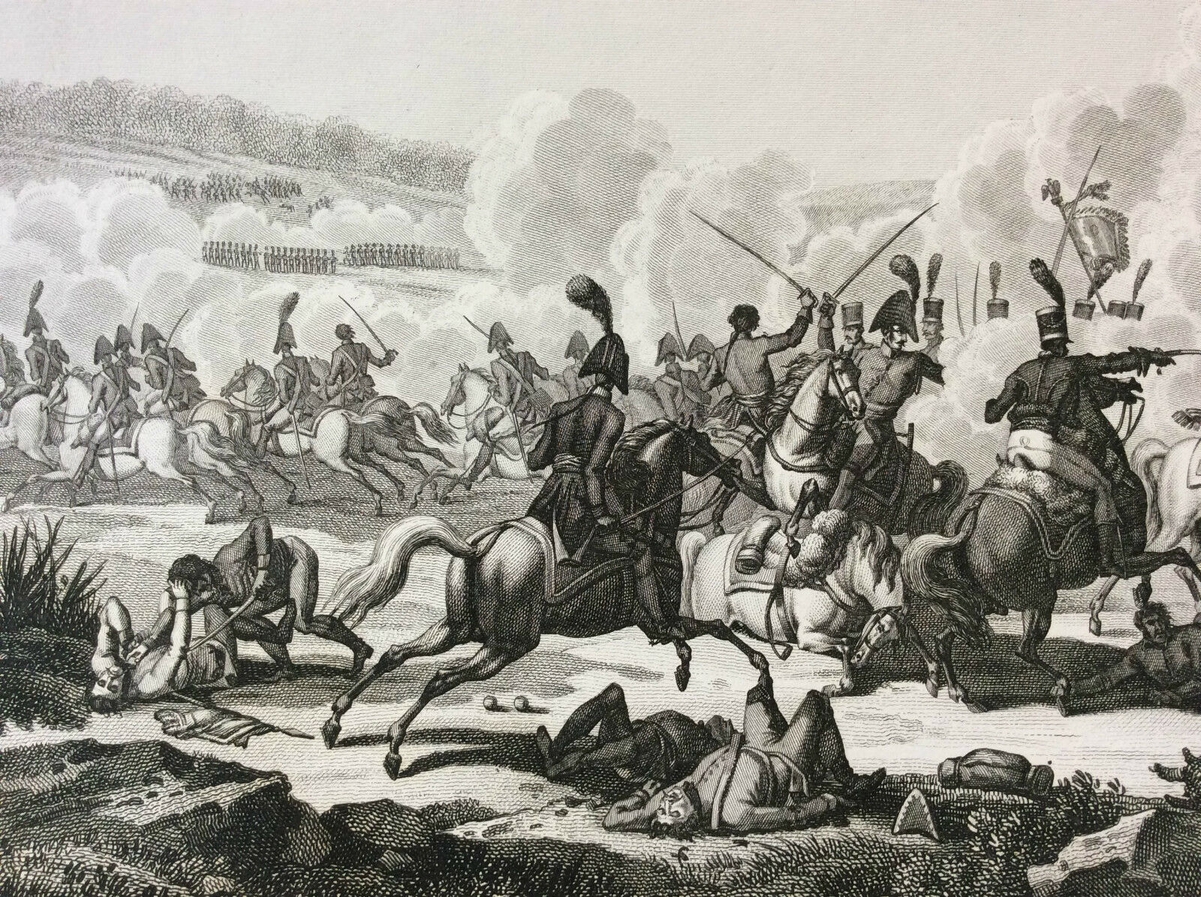
Impressive nineteenth-century French etching and burin engraving depicting the death of Prince Louis Ferdinand of Prussia during the Battle of Saalfeld on 10 October 1806.
A spectacular Napoleonic cavalry battle featuring galloping horses, mounted soldiers, drawn sabres, fallen combatants and military formations against a panoramic landscape.
The battle was fought between Prussian and Saxon troops and the French Fifth Corps commanded by Marshal Jean Lannes.
Artist: Jacques François Joseph Swebach-Desfontaines (1769–1823).
Engravers: Couché fils and Pigeot.
Date: Circa 1850.
Sheet dimensions: 46.4 × 30.1 cm.
Engraved image: 37.8 × 24.5 cm.
Reference: 4401-89R324D25.
Description
Saalfeld Germany 1806 – Death of Prince Louis Ferdinand of Prussia – Napoleonic Cavalry Battle – Antique French Engraving circa 1850
Saalfeld Germany 1806 – Large nineteenth-century French historical engraving after Jacques François Joseph Swebach-Desfontaines (1769–1823), depicting the death of Prince Louis Ferdinand of Prussia during the Battle of Saalfeld on 10 October 1806.
Artculture6 presents this impressive antique French military engraving, traditionally dated circa 1850, illustrating one of the most dramatic events of the opening campaign of the War of the Fourth Coalition.
The original composition was designed by Swebach-Desfontaines, etched by Louis-François Couché, known as Couché fils, and finished in burin by Pigeot.
The engraving depicts an extensive cavalry engagement involving French and Prussian soldiers, galloping horses, drawn sabres, fallen combatants and military formations near the town of Saalfeld in Thuringia, Germany.
The death of Prince Louis Ferdinand was a major event in the opening days of Napoleon’s campaign against Prussia.
SAALFELD GERMANY – THE BATTLE OF 10 OCTOBER 1806
The Battle of Saalfeld took place on 10 October 1806, at the beginning of the war between Napoleon’s French Empire and the Kingdom of Prussia.
The engagement occurred in Thuringia, near the River Saale.
Prince Louis Ferdinand of Prussia commanded an advanced force composed of Prussian and Saxon troops.
His soldiers encountered the French Fifth Corps under Marshal Jean Lannes.
The French forces launched a series of attacks, combining infantry, artillery and cavalry.
The Prussian troops were gradually overwhelmed and forced to retreat.
During the withdrawal, Prince Louis Ferdinand was killed in a violent cavalry encounter.
His death marked one of the first major losses suffered by Prussia during the campaign.
THE DEATH OF PRINCE LOUIS FERDINAND
The prince attempted to rally his troops as the Prussian lines collapsed.
He became separated from his soldiers and was pursued by French cavalrymen from the 10th Hussars.
According to historical accounts, his horse became entangled in a hedge, allowing Sergeant-Major Jean-Baptiste Guindey to approach him.
Guindey demanded that the prince surrender.
Louis Ferdinand refused and attempted to defend himself with his sword.
In the ensuing confrontation, the prince received fatal wounds and fell from his horse.
His death created considerable consternation among the Prussian forces.
Louis Ferdinand was a member of the Prussian royal family and one of the most outspoken opponents of Napoleon’s growing influence in Germany.
AN EXTRAORDINARY PANORAMIC CAVALRY BATTLE
The engraving presents a spectacular cavalry engagement extending across a broad landscape.
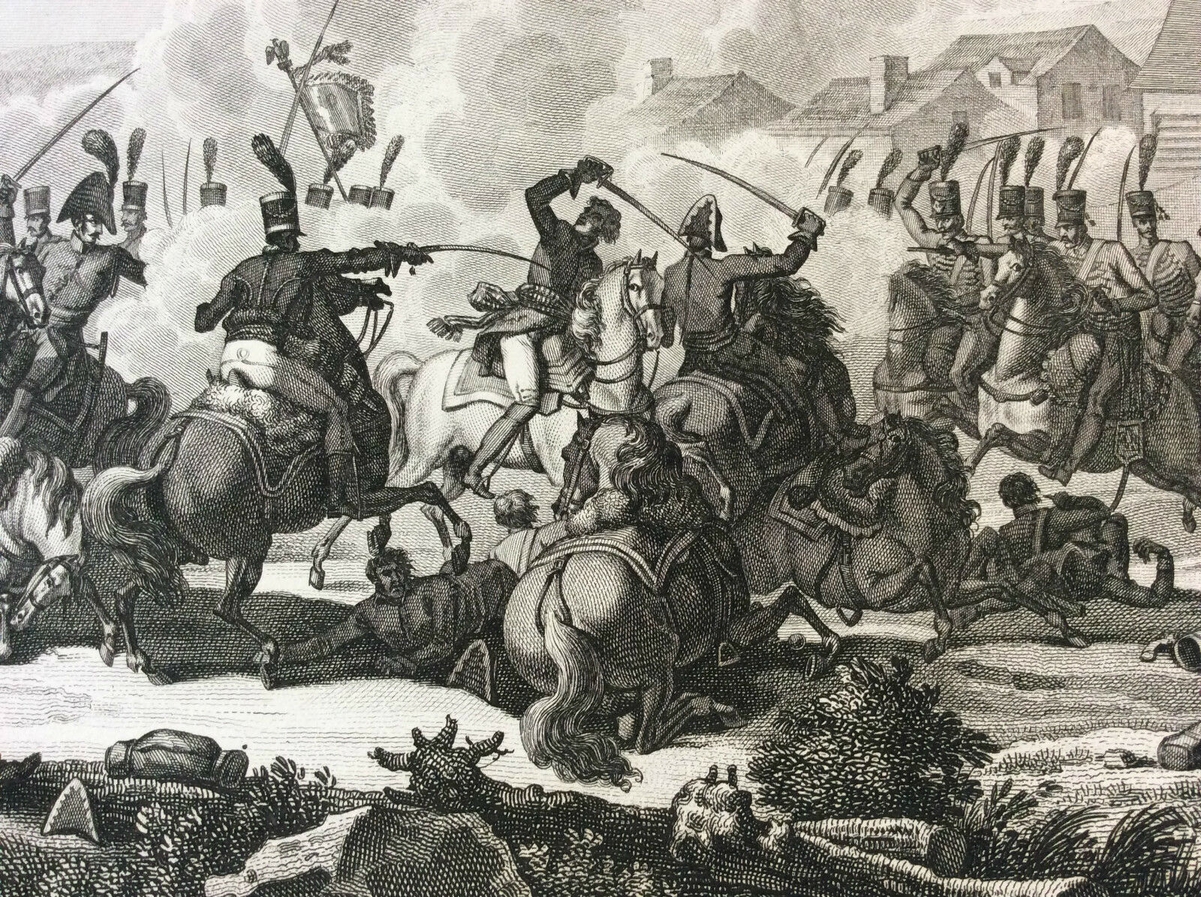
In the foreground, mounted soldiers attack one another with drawn sabres.
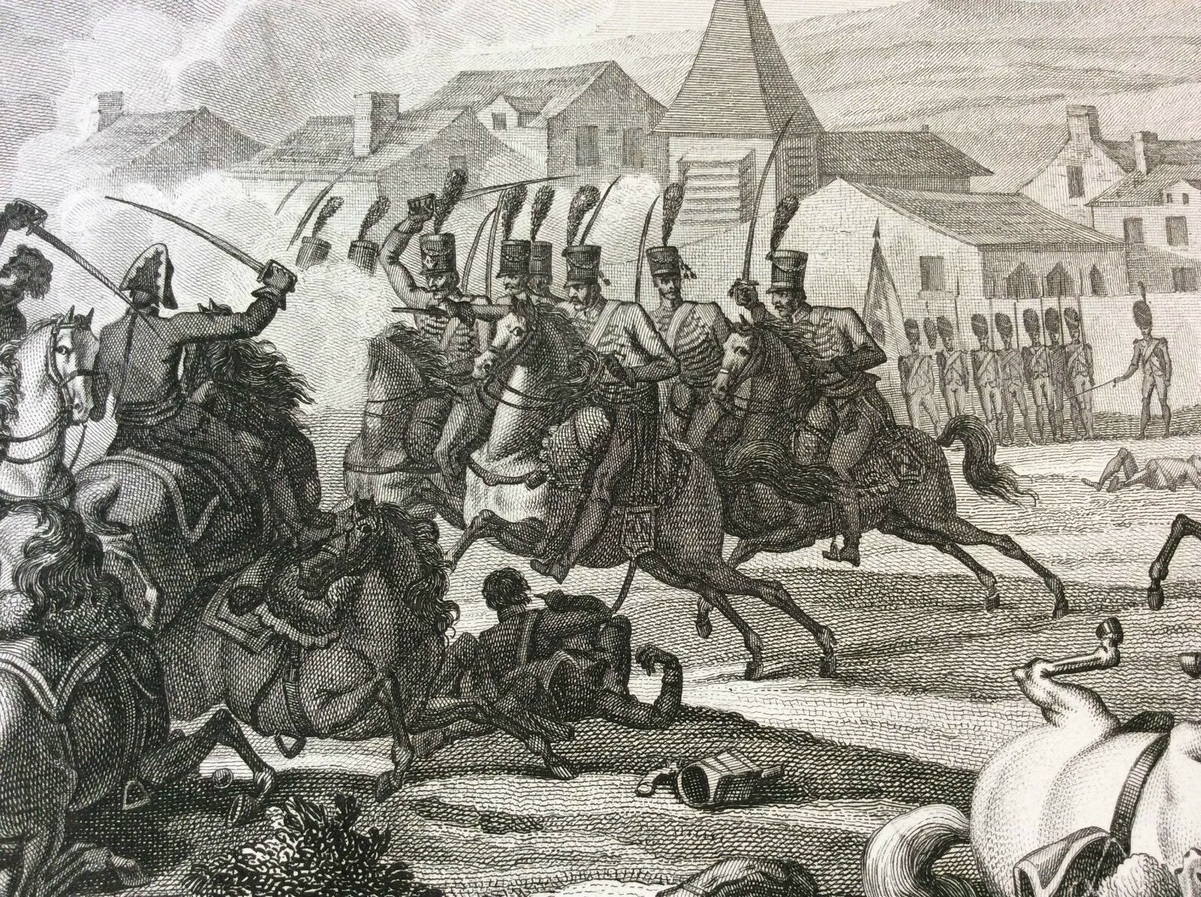
Several horses gallop at full speed, while others rear or fall amid the confusion.
Wounded and fallen combatants occupy the ground beneath the charging cavalry.
The artist has carefully arranged the principal figures to convey the intensity and movement of the encounter.
At the centre, a particularly dense group of mounted soldiers dominates the fighting.
The riders’ weapons and raised arms create strong diagonal lines across the composition.
On the right, additional cavalry formations advance near a group of buildings and a church tower.
The distant landscape and smoke-filled sky complete this dramatic representation of Napoleonic warfare.
HORSES AND EQUESTRIAN MOVEMENT
One of the most striking aspects of this engraving is the exceptional variety of horses represented.
Several animals are shown galloping, turning, rearing or collapsing.
The movements of their legs, heads and bodies contribute to the energy of the scene.
Swebach-Desfontaines was particularly admired for his ability to depict horses and military subjects.
His understanding of equestrian anatomy and movement is evident throughout the composition.
The careful treatment of saddles, harnesses, military uniforms and cavalry equipment adds to the historical and decorative interest of the print.
PRINCE LOUIS FERDINAND OF PRUSSIA (1772–1806)
Frederick Christian Louis Ferdinand of Prussia was born in 1772.
A member of the Prussian royal family, he was known both as a military officer and as a talented musician and composer.
He became an influential personality within the Prussian aristocracy.
During the years preceding the War of the Fourth Coalition, Louis Ferdinand strongly opposed French political and military influence in Germany.
He supported a more aggressive policy towards Napoleon.
At the beginning of the 1806 campaign, he received command of an advanced Prussian force.
His death at Saalfeld on 10 October 1806, at the age of thirty-three, became an important symbol of Prussia’s early military disasters.
He was remembered as a courageous and energetic officer whose career ended during the opening days of the campaign.
MARSHAL JEAN LANNES AND THE FRENCH FIFTH CORPS
Jean Lannes (1769–1809) was one of Napoleon’s most celebrated Marshals of the Empire.
He had distinguished himself during the French Revolutionary Wars and the campaigns of the First Empire.
At Saalfeld, Lannes commanded the French Fifth Corps.
His forces confronted the Prussian advance guard and gradually gained the advantage.
The successful French attack forced the opposing army into retreat.
The engagement demonstrated the mobility and coordination of Napoleon’s troops.
The victory was one of the first important French successes of the 1806 campaign.
JEAN-BAPTISTE GUINDEY AND THE FATAL ENCOUNTER
Jean-Baptiste Guindey (1785–1813) served in the French cavalry and belonged to the 10th Hussars.
He became especially famous for his role in the death of Prince Louis Ferdinand.
During the fighting near Saalfeld, Guindey confronted the Prussian prince in a mounted encounter.
Accounts of the incident describe the prince’s refusal to surrender and the exchange of sword blows.
The confrontation ended with the death of Louis Ferdinand.
The episode became one of the best-known individual encounters of the campaign and was subsequently described in French military histories.
SAALFELD AND THE ROAD TO JENA
The French victory at Saalfeld occurred four days before the decisive battles of Jena and Auerstedt.
On 14 October 1806, Napoleon defeated the Prussian forces commanded by Prince Hohenlohe at Jena.
On the same day, Marshal Louis Nicolas Davout won another major victory at Auerstedt.
These defeats led to the rapid collapse of Prussian military resistance.
French troops subsequently advanced towards Berlin.
On 27 October 1806, Napoleon entered the Prussian capital through the Brandenburg Gate.
The Battle of Saalfeld therefore forms an important part of the sequence of events that transformed the political balance of Central Europe.
JACQUES FRANÇOIS JOSEPH SWEBACH-DESFONTAINES
Jacques François Joseph Swebach-Desfontaines was born in Metz, France, in 1769 and died in Paris in 1823.
He was a distinguished French painter, draughtsman and printmaker, particularly celebrated for military scenes, cavalry and historical compositions.
He studied with his father and subsequently with Michel Hamon-Duplessis.
His artistic career developed during the French Revolution, and he exhibited at the Paris Salon.
From 1802 to 1813, he served as principal painter at the Sèvres porcelain manufactory.
After the fall of Napoleon, he also worked in Russia in connection with the Imperial Porcelain Manufactory.
His compositions are admired for their accurate representation of military equipment, animated horses and carefully organised historical narratives.
The present engraving demonstrates his particular skill in depicting the movement and confusion of cavalry combat.
COUCHÉ FILS AND PIGEOT
The composition was etched by Louis-François Couché, known as Couché fils.
The burin engraving bears the signature of Pigeot.
These engravers contributed to the reproduction and dissemination of important historical compositions during the nineteenth century.
The combination of etching and burin allowed the artists to develop both delicate landscape passages and sharply defined foreground figures.
The horses, soldiers, uniforms and weapons are rendered through numerous fine engraved lines.
The darker passages around the fallen combatants contrast with the lighter tones of the distant countryside.
The result is a rich and dynamic historical print.
NINETEENTH-CENTURY NAPOLEONIC PRINTMAKING
French publishers produced numerous engravings commemorating the principal events of Napoleon’s military campaigns.
These compositions depicted battles, cavalry engagements, sieges, troop movements and diplomatic ceremonies.
The death of Prince Louis Ferdinand at Saalfeld was an important subject because of its political significance and the dramatic circumstances of the prince’s death.
The composition was reproduced in historical print collections devoted to the French Consulate and Empire.
The Musée Carnavalet in Paris preserves an impression of the same subject, attributed to Swebach-Desfontaines and Pigeot.
This museum documentation provides an important reference for the historical identification of the work.
TECHNICAL DETAILS
Subject: Death of Prince Louis Ferdinand of Prussia at the Battle of Saalfeld.
Historical date: 10 October 1806.
Location: Saalfeld, Thuringia, Germany.
Historical period: Napoleonic Wars, War of the Fourth Coalition.
Prussian commander: Prince Louis Ferdinand of Prussia (1772–1806).
French commander: Marshal Jean Lannes (1769–1809).
Original draughtsman: Jacques François Joseph Swebach-Desfontaines (1769–1823).
Etcher: Louis-François Couché, known as Couché fils.
Burin engraver: Pigeot.
Period of the print: Nineteenth century.
Date of this impression: Circa 1850, as catalogued.
Technique: Antique French etching and burin engraving.
Sheet dimensions: 46.4 × 30.1 cm.
Engraved image dimensions: 37.8 × 24.5 cm.
Reference: 4401-89R324D25.
CONDITION
Antique example displaying the natural patina of aged paper. The engraved composition and original inscriptions remain well preserved.
COLLECTOR’S INTEREST
An impressive large nineteenth-century French historical engraving depicting the death of Prince Louis Ferdinand of Prussia during the Battle of Saalfeld in 1806.
Particularly interesting for collectors of Napoleonic history, Prussian military history, French cavalry, historical battles, equestrian art and antique European engravings.
The dramatic cavalry charge, numerous galloping horses, fallen soldiers and extensive battlefield landscape make this a particularly attractive and decorative composition.
The engraving also complements historical prints depicting the Battle of Jena and Napoleon’s entry into Berlin in October 1806.
Offered by Artculture6 – Antique Prints, Drawings and Works of Art.



Avis
Il n’y a pas encore d’avis.