Description
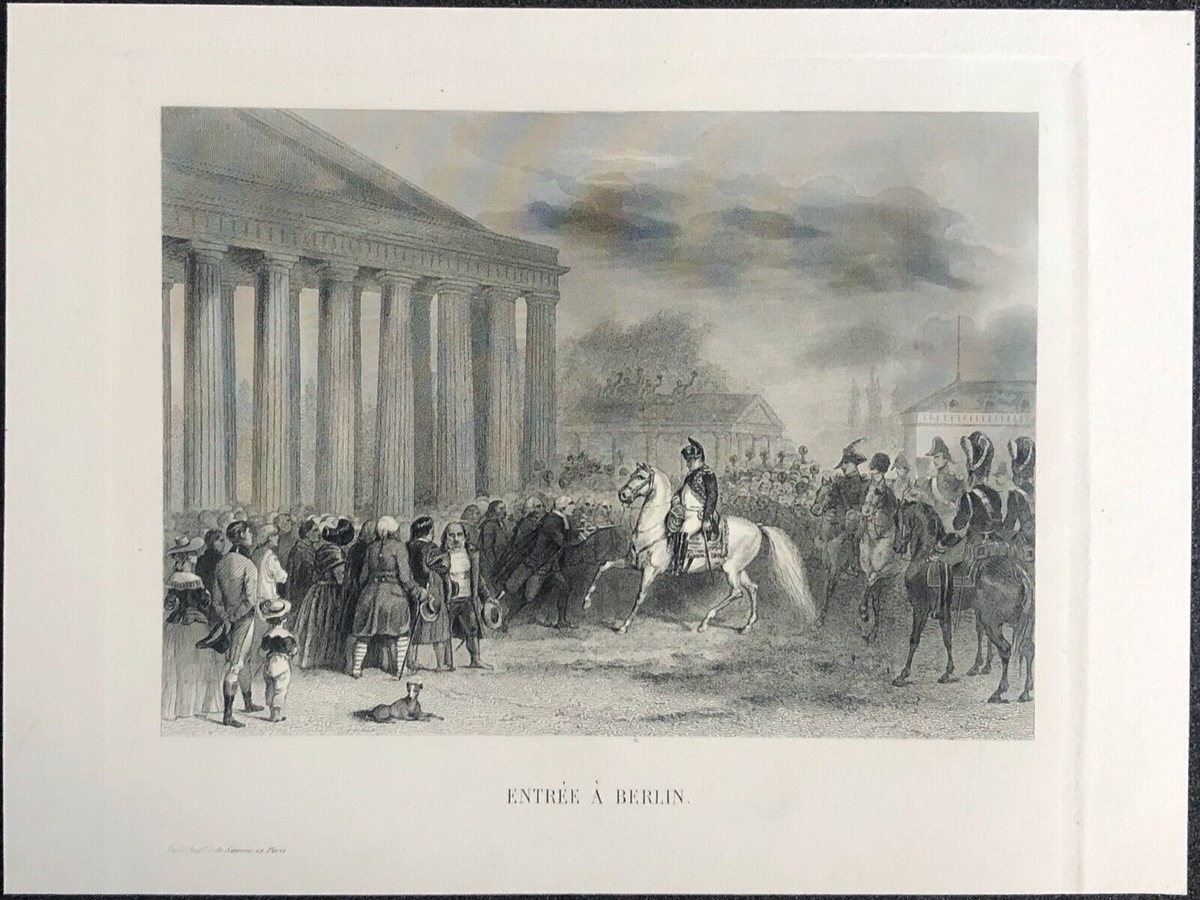
Berlin Prussia Germany 1806 – Original Nineteenth-Century French Engraving Depicting Napoleon Bonaparte’s Ceremonial Entry into the Prussian Capital on 27 October 1806.
Artculture6 presents this beautiful antique French historical engraving depicting the triumphant entry of Napoleon I into Berlin on 27 October 1806, following the decisive French victories against the Prussian army at Jena and Auerstedt.
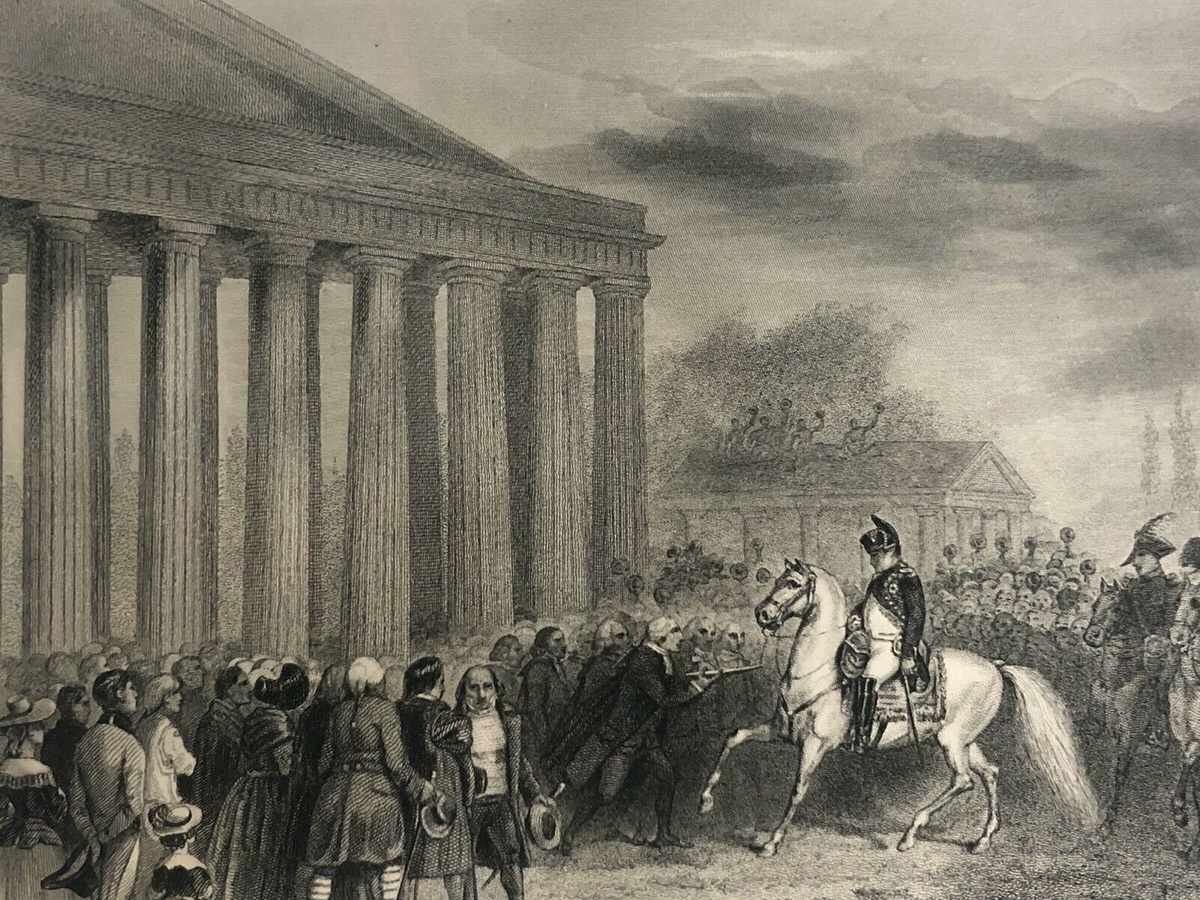
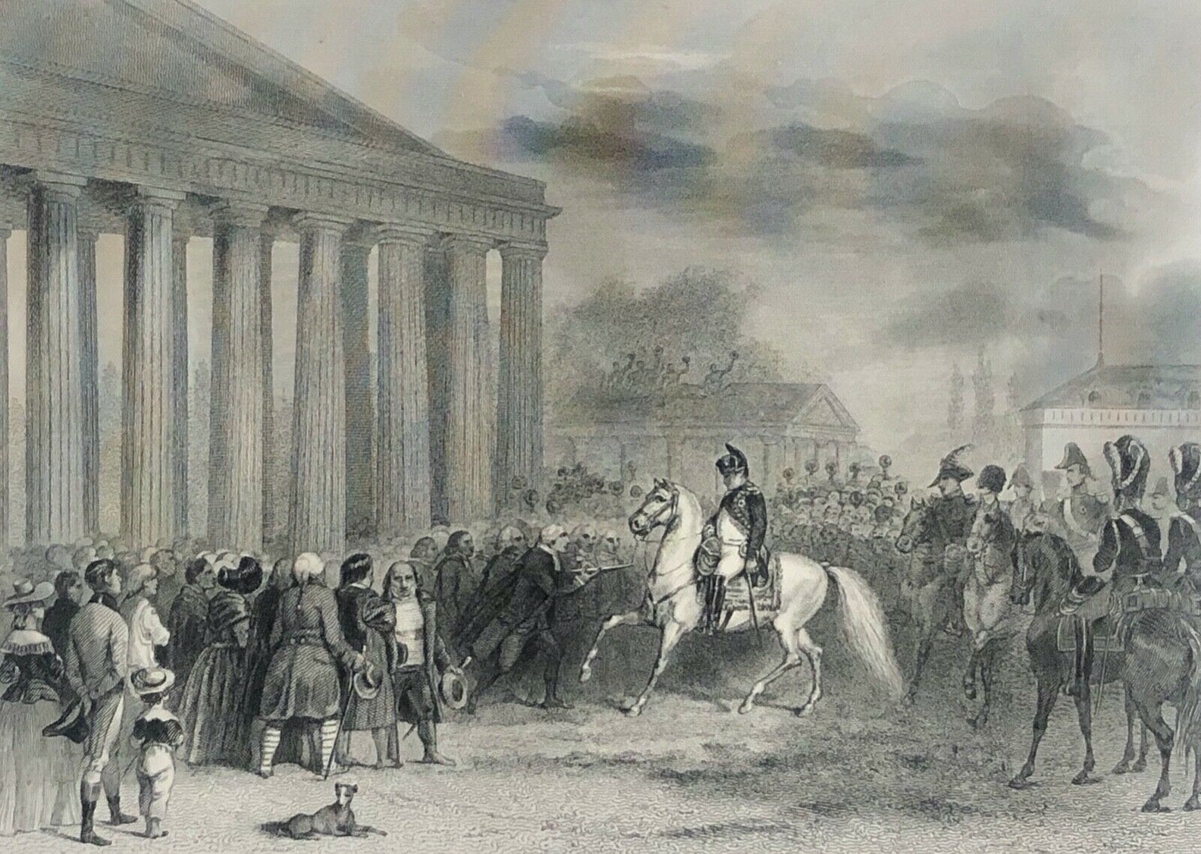
Entitled “ENTRÉE À BERLIN”, the composition represents Napoleon on a magnificent white horse, surrounded by military officers and welcomed by a large gathering of civilians.
An imposing classical building with a monumental colonnade dominates the left side of the scene.
This nineteenth-century engraving, dated circa 1862, offers a detailed representation of one of the most important political and military events of Napoleon’s Prussian campaign.
BERLIN – 27 OCTOBER 1806
On 27 October 1806, Napoleon Bonaparte entered the Prussian capital after a series of remarkable military victories.
Thirteen days earlier, on 14 October 1806, French forces had defeated the Prussian armies at the Battles of Jena and Auerstedt.
These engagements brought about the rapid collapse of organised Prussian resistance.
Napoleon subsequently advanced towards Berlin with his Grande Armée.
His arrival in the city represented a major triumph for the First French Empire.
The French emperor entered Berlin accompanied by his personal escort, officers and members of his military staff.
The event became an important subject for nineteenth-century historical paintings and engravings.
NAPOLEON BONAPARTE AND THE PRUSSIAN CAMPAIGN
In 1806, Napoleon was at the height of his military power.
Following the successful Austrian campaign of 1805 and the victory at Austerlitz, the political situation in Central Europe remained unstable.
Relations between France and Prussia deteriorated.
King Frederick William III of Prussia eventually entered the war against the French Empire.
Napoleon responded by launching a rapid military offensive.
The French army defeated the Prussian forces at Jena and Auerstedt on 14 October.
These victories opened the road to Berlin.
The French occupation of the Prussian capital became one of the defining events of the campaign.
A CEREMONIAL ENTRY INTO BERLIN
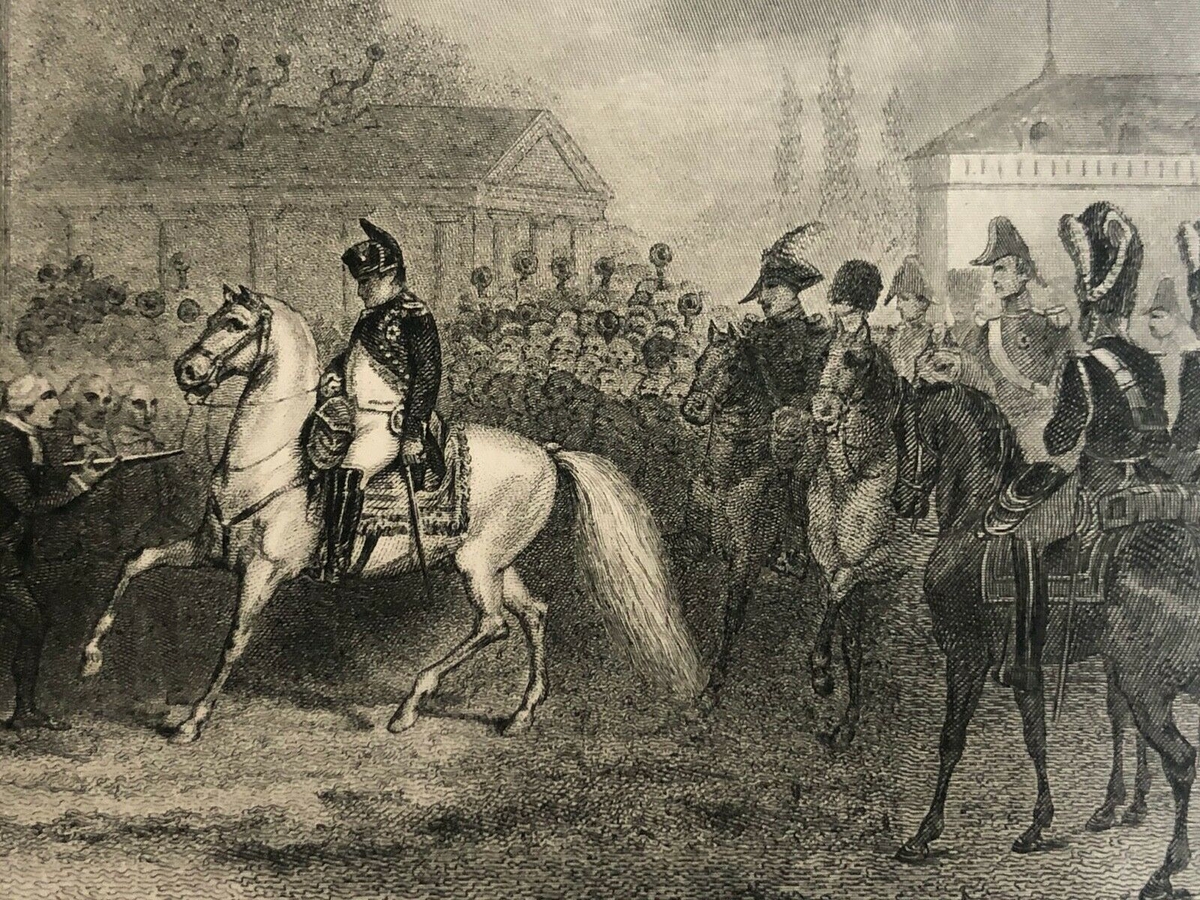
The engraving depicts the arrival of Napoleon on horseback before a large gathering of civilians and military personnel.
At the centre, the emperor rides a white horse.
He wears his characteristic bicorne hat and military uniform.
The horse is represented in a graceful walking movement, emphasising the ceremonial nature of the event.
On the left, a crowd of civilians and officials appears to welcome the emperor.
Several figures hold their hats, while others observe the procession.
Men, women and children are represented in a variety of poses.
The artist has carefully differentiated the costumes and attitudes of the spectators.
On the right, mounted French officers accompany the emperor.
Their military uniforms and equipment provide additional historical detail.
Further figures occupy the square and the streets beyond.
A MONUMENTAL CLASSICAL BUILDING
One of the most striking features of the engraving is the imposing building on the left.
Its long classical colonnade creates an impressive architectural setting.
Tall columns support an extensive entablature, giving the composition a solemn and monumental appearance.
The structure dominates the left side of the scene and balances the military procession on the right.
Other buildings appear behind the crowd.
Their roofs and façades are partly concealed by the numerous spectators.
The extensive cloudy sky adds atmosphere and depth.
The combination of architectural perspective, civilian spectators and military figures makes the engraving particularly attractive.
THE GRANDE ARMÉE IN BERLIN
Contemporary accounts describe Napoleon’s arrival accompanied by several of his leading commanders.
Among those present were Marshals Davout and Augereau.
Marshal Lefebvre led the Imperial Guard infantry in the procession.
Cavalry units, including Nansouty’s cuirassiers, were also positioned along the route.
Napoleon travelled with an escort of mounted guards and members of his military household.
The procession through Berlin symbolised the success of French military operations in Prussia.
The event was widely reported in French military bulletins and contemporary newspapers.
BERLIN UNDER FRENCH OCCUPATION
Following Napoleon’s arrival, Berlin became an important centre of French political and military activity.
The occupation represented a major turning point in Prussian history.
On 21 November 1806, Napoleon signed the Berlin Decree, establishing the Continental System.
This economic policy was designed to weaken Great Britain by restricting trade between British merchants and territories under French influence.
The decree became one of the most important measures of Napoleon’s European policy.
The occupation of Berlin therefore had consequences extending far beyond the immediate military campaign.
A FINE NINETEENTH-CENTURY FRENCH ENGRAVING
The present engraving illustrates the artistic interest in Napoleonic history during the nineteenth century.
Historical prints were an important means of preserving and disseminating images of major events.
The artist has carefully organised the composition around Napoleon and his white horse.
The surrounding military figures and civilian spectators create a strong sense of movement.
The architectural colonnade provides a monumental background.
Fine engraved lines and delicate shading distinguish the horses, military uniforms, civilian costumes and buildings.
The extensive sky introduces softer tonal values that contrast with the densely populated foreground.
The resulting composition combines historical narrative with architectural and artistic interest.
THE HISTORICAL SIGNIFICANCE OF NAPOLEON’S ENTRY
The entrance of Napoleon into Berlin was a major consequence of the French victories at Jena and Auerstedt.
It demonstrated the dramatic military success achieved by the Grande Armée during October 1806.
The event also marked the beginning of a difficult period for the Prussian monarchy.
The campaigns of 1806 and 1807 transformed the political situation in Central Europe.
Napoleon’s occupation of Berlin remains one of the best-known episodes of the War of the Fourth Coalition.
This antique engraving offers an attractive historical interpretation of that important event.
A COLLECTABLE HISTORICAL VIEW
The engraving brings together several appealing subjects for collectors.
Its central figure is Napoleon Bonaparte, one of the most influential historical figures of nineteenth-century Europe.
The scene also presents a detailed representation of the French military escort and the civilian population of Berlin.
The architecture contributes an additional element of historical interest.
The composition is particularly suitable for collections devoted to the First French Empire, Napoleonic campaigns, Prussian history and antique European engravings.
DIMENSIONS AND TECHNICAL DETAILS
Country depicted: Germany
Historical state: Kingdom of Prussia
City: Berlin
Subject: Napoleon’s ceremonial entry into Berlin
Historical date: 27 October 1806
Historical figure: Napoleon Bonaparte
Military campaign: Prussian Campaign of 1806
Historical period: First French Empire
Proposed engraving date: Circa 1862
Technique: Antique black-and-white engraving
Sheet dimensions: 19.3 × 14.5 cm
Engraved image dimensions: 14.3 × 10.2 cm
Original printed title: “ENTRÉE À BERLIN”

Avis
Il n’y a pas encore d’avis.