
Description
Hohenlinden Bavaria Germany 1800 – Original Nineteenth-Century French Engraving Depicting General Moreau’s Decisive Victory over the Austrian Army, Engraved by Jean-Jacques Frilley after Frédéric-Henri Schopin.
Artculture6 presents this remarkable antique French military engraving depicting the Battle of Hohenlinden, fought on 3 December 1800, during the French Revolutionary Wars.
The composition was originally painted by Frédéric-Henri Schopin (1804–1880) and engraved by Jean-Jacques Frilley, a French engraver active during the nineteenth century.
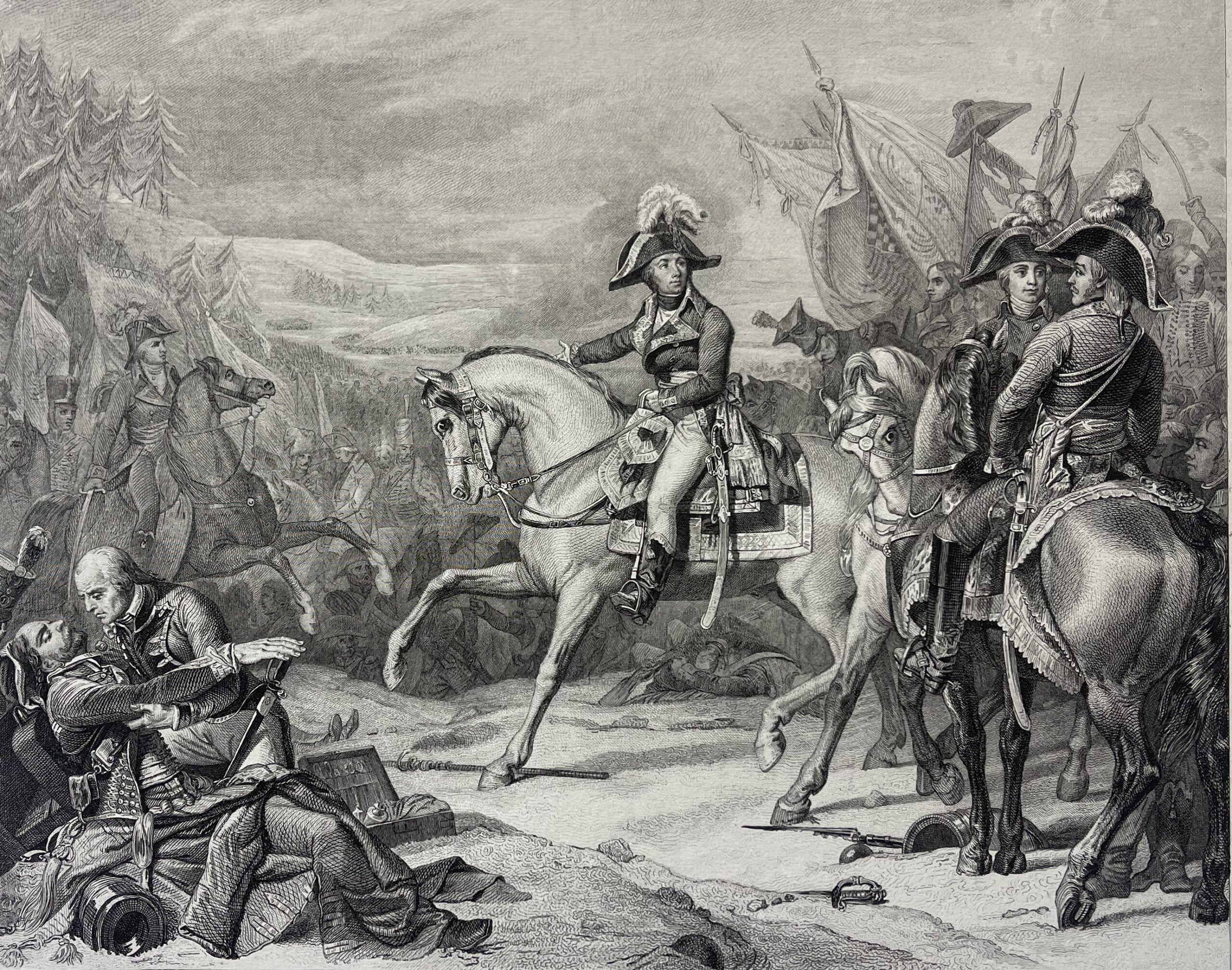
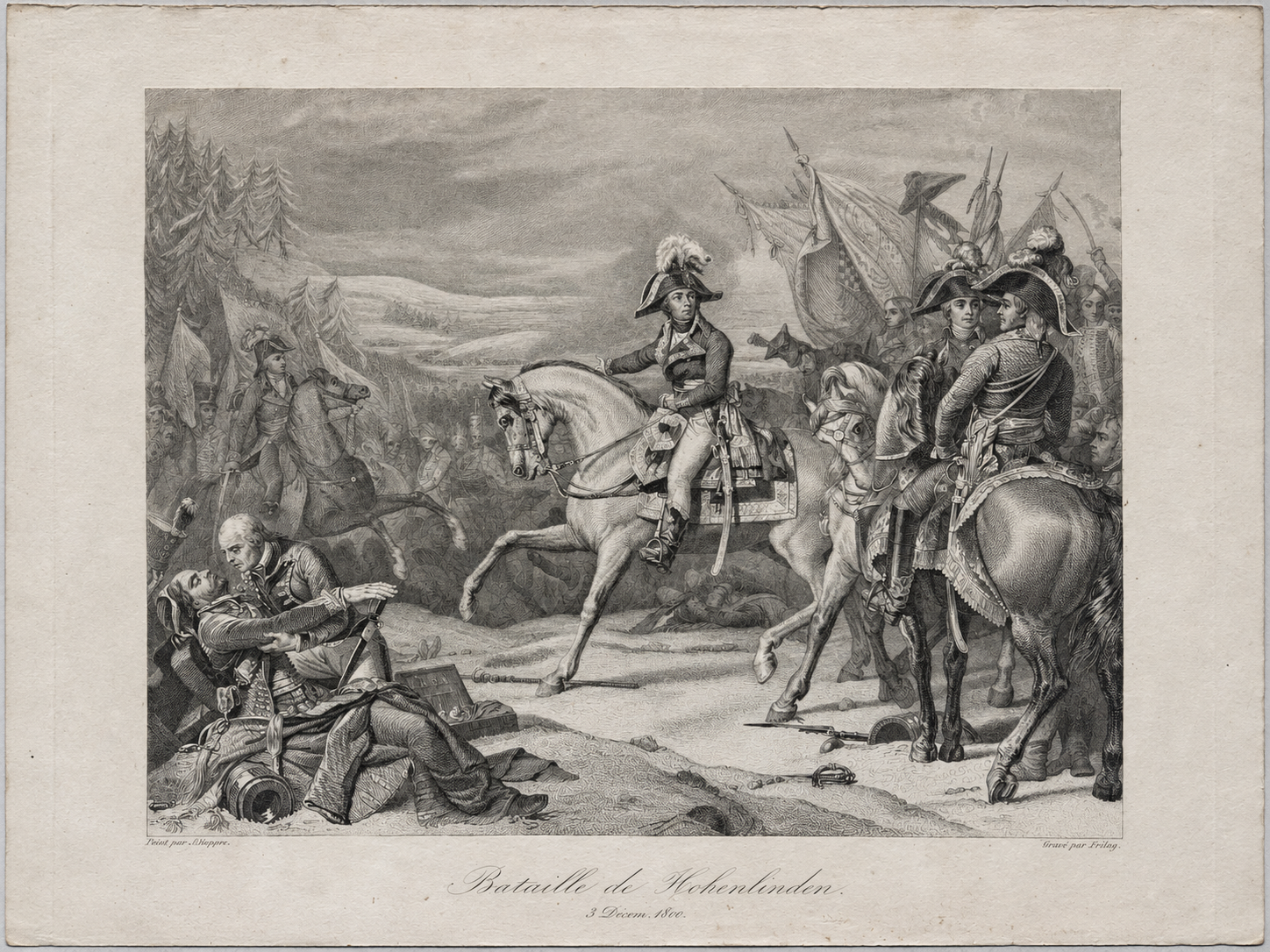
This beautiful historical print represents a large battlefield scene featuring mounted officers, cavalry, infantry, military standards, wounded soldiers and horses beneath an extensive cloudy sky.
The engraving is particularly interesting for its detailed execution, dramatic composition and historical significance.
HOHENLINDEN – A DECISIVE BATTLE IN BAVARIA
Hohenlinden is located in Bavaria, approximately east of Munich in southern Germany.
On 3 December 1800, the surrounding countryside became the scene of one of the most important French victories of the Revolutionary period.
The French Army of the Rhine was commanded by General Jean Victor Marie Moreau (1763–1813).
The opposing Austro-Bavarian army was led by Archduke John of Austria.
The battle took place during the War of the Second Coalition, a major European conflict involving France and several opposing powers.
The fighting occurred in difficult winter conditions, with snow-covered terrain, wooded areas and poor visibility affecting military movements.
Despite these challenges, the French forces succeeded in defeating the Austrian army.
The victory had important military and diplomatic consequences.
GENERAL JEAN VICTOR MARIE MOREAU
General Moreau was one of the leading French commanders of the Revolutionary Wars.
Born in Morlaix in 1763, he became particularly associated with the French Army of the Rhine.
During the campaign of 1800, Moreau conducted a series of successful operations against Austrian forces in southern Germany.
His troops advanced through the region, defeating opposing formations and strengthening the French military position.
The Battle of Hohenlinden represented the culmination of this campaign.
The French victory enabled Moreau to continue his advance towards Austria.
It also contributed to the diplomatic negotiations that ultimately produced the Treaty of Lunéville in February 1801.
A DRAMATIC NINETEENTH-CENTURY BATTLE COMPOSITION
The engraving presents an extensive military scene set in a winter landscape.
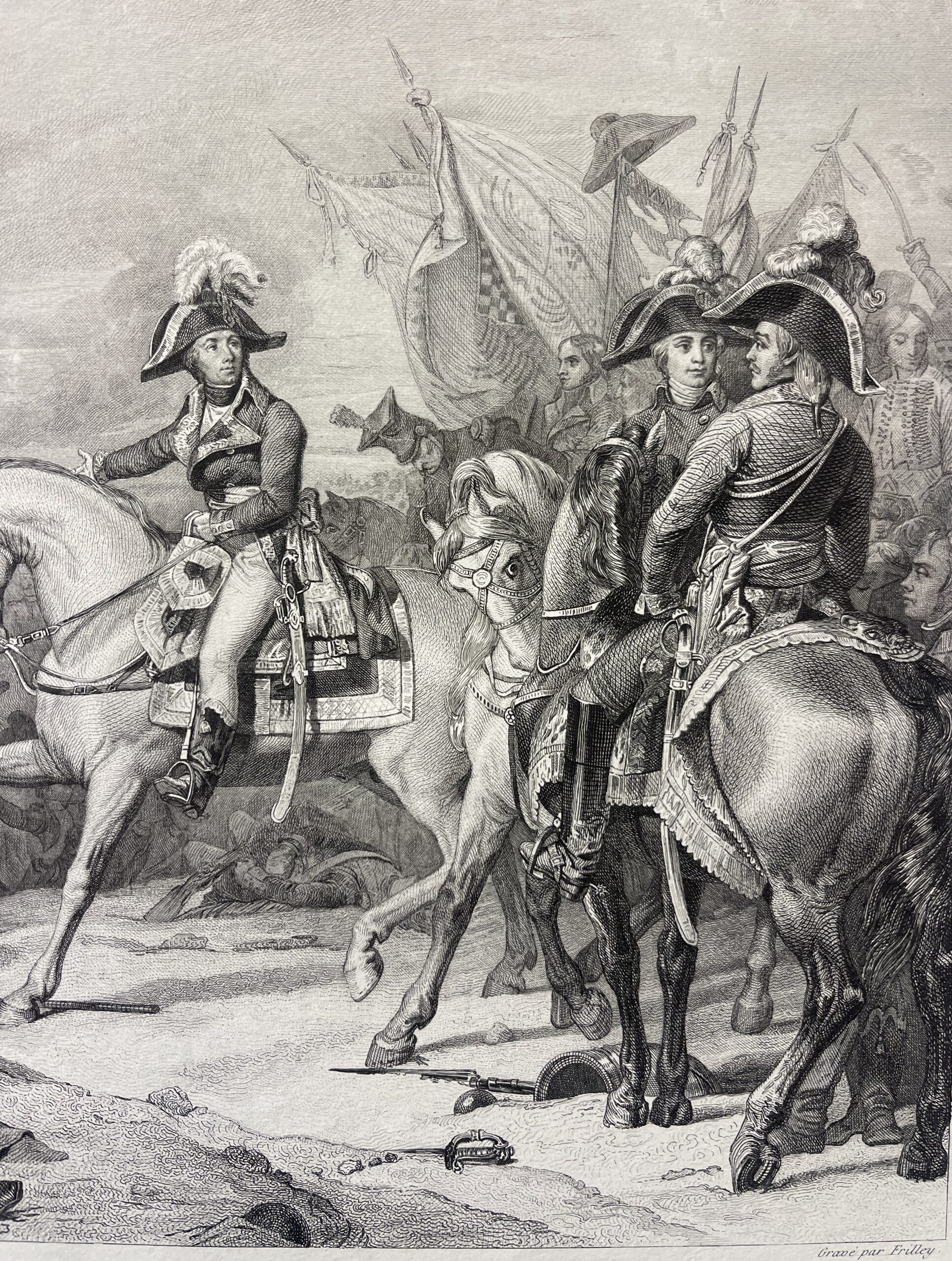
At the centre, a mounted French officer occupies a prominent position.
His horse is represented in motion, creating a strong sense of energy and command.
On the right, several officers gather on horseback near a group carrying military standards.
Numerous soldiers appear in the background, extending across the battlefield.
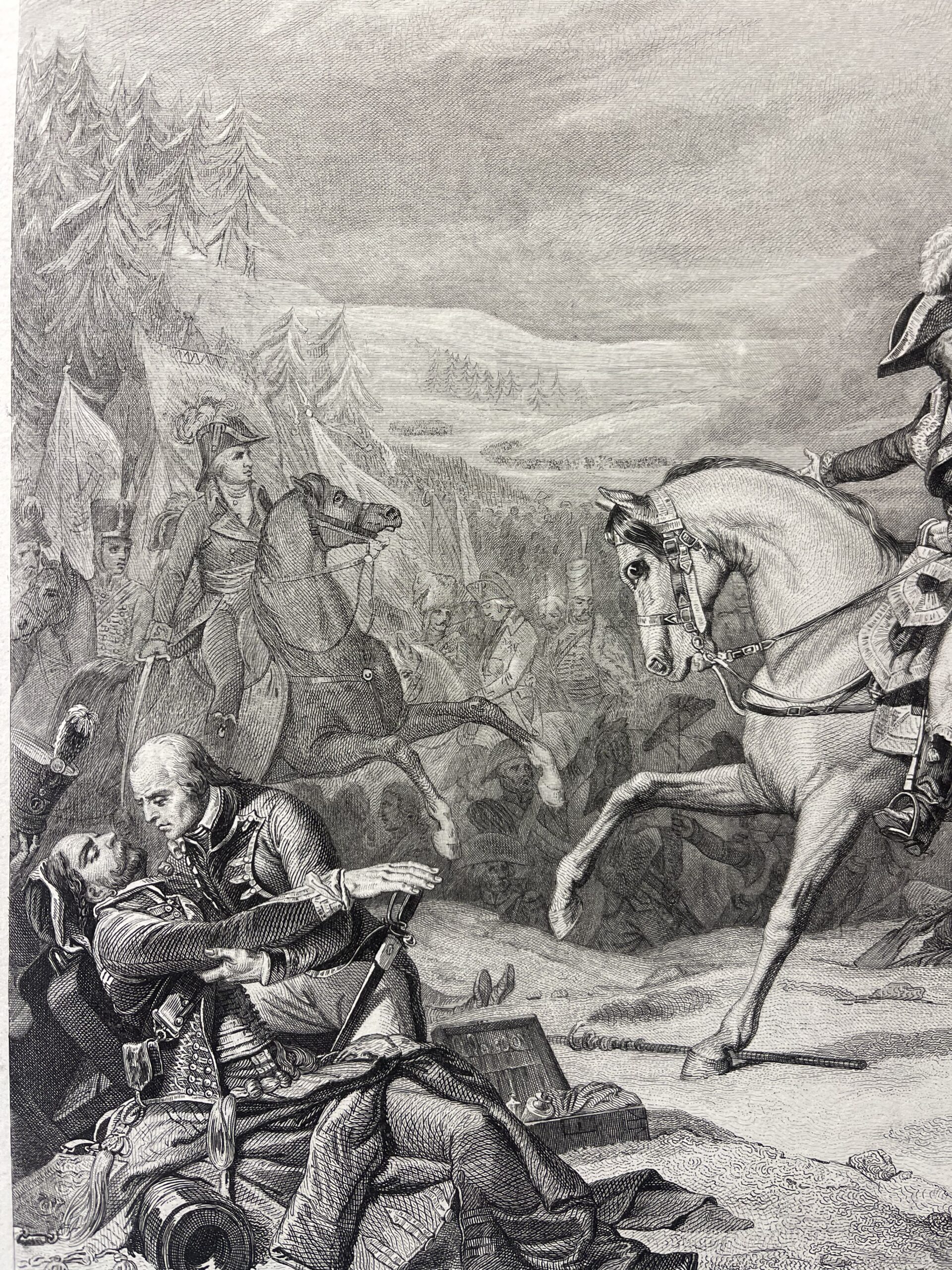
To the left, cavalrymen and infantry are represented among trees and military equipment.
In the foreground, two soldiers form a particularly expressive group, one supporting a wounded or exhausted companion.
Horses, discarded weapons and battlefield debris contribute to the historical atmosphere.
The landscape stretches towards distant hills beneath a large, overcast sky.
The composition combines the grandeur of military history with the human consequences of battle.
THE WINTER LANDSCAPE OF HOHENLINDEN
One of the most striking elements of the engraving is its atmospheric landscape.
Tall fir trees frame the composition on the left.
Snow-covered ground and distant hills suggest the winter conditions under which the battle took place.
The numerous soldiers gradually disappear into the hazy distance.
The cloudy sky gives the scene a dramatic quality.
The artist uses the natural landscape to emphasise the movement and scale of the armies.
This combination of military figures and winter scenery distinguishes the composition from more conventional battle engravings.
FRÉDÉRIC-HENRI SCHOPIN (1804–1880)
Frédéric-Henri Schopin was a French historical painter born in Lübeck in 1804.
He developed a successful career in France and produced several works devoted to historical subjects.
His compositions reflect the nineteenth-century interest in the major political and military events of French history.
Schopin created an important painting of the Battle of Hohenlinden, exhibited at the Salon of 1836.
The original painting is preserved in the collections of the Palace of Versailles.
The present engraving reproduces this historical composition.
The artist arranged the scene around a central mounted figure, supported by several secondary groups of soldiers and horses.
This carefully organised structure gives the work considerable depth and narrative interest.
JEAN-JACQUES FRILLEY – THE ENGRAVER
Jean-Jacques Frilley was a French nineteenth-century engraver.
He specialised in the interpretation of painted compositions through engraving.
The present work demonstrates his ability to reproduce complex military subjects.
The horses are carefully modelled through delicate engraved lines.
Uniforms, faces and weapons are represented with precision.
The foreground is composed of densely worked details, while the landscape becomes lighter towards the horizon.
The cloudy sky and distant military formations are rendered through subtle tonal gradations.
The result is a beautifully detailed historical print.
THE FRENCH ARMY AND THE AUSTRIAN FORCES
The Battle of Hohenlinden involved significant formations of infantry, cavalry and artillery.
French forces successfully disrupted the movements of the opposing Austrian columns.
The military operations unfolded across a landscape of forests, roads and open ground.
The Austrian army suffered a major defeat.
This victory weakened Austria’s military position and increased the pressure for a negotiated peace.
The Treaty of Lunéville, signed on 9 February 1801, marked an important diplomatic consequence of the French victories.
A MAJOR EVENT IN FRENCH REVOLUTIONARY HISTORY
Hohenlinden belongs to the final phase of the War of the Second Coalition.
Earlier in 1800, Napoleon Bonaparte had achieved his celebrated victory at Marengo in northern Italy.
Meanwhile, General Moreau was conducting the French campaign in Germany.
The victories of Marengo and Hohenlinden helped establish French military superiority over Austria.
The Battle of Hohenlinden therefore occupies an important place in the history of the French Republic and the events preceding Napoleon’s establishment of the First Empire.
A BEAUTIFUL ANTIQUE FRENCH ENGRAVING
The engraving is executed in black and white using the traditional intaglio process.
Its numerous finely engraved details create an attractive historical composition.
The contrasts between the dark foreground, the mounted officers and the lighter distant landscape give the print remarkable depth.
The precision of the costumes, horses and military equipment makes the scene particularly interesting to collectors.
The original printed inscriptions identify the artists and historical subject.
DIMENSIONS AND TECHNICAL DETAILS
- Country depicted: Germany
- Region: Bavaria
- Location: Hohenlinden, near Munich
- Historical event: Battle of Hohenlinden
- Date of battle: 3 December 1800
- French commander: General Jean Victor Marie Moreau
- Austrian commander: Archduke John of Austria
- Original painter: Frédéric-Henri Schopin (1804–1880)
- Engraver: Jean-Jacques Frilley
- Engraving date: Circa 1840
- Technique: Black-and-white intaglio engraving
- Sheet dimensions: 33.5 × 27.4 cm
- Engraved image dimensions: 27.5 × 21.6 cm
- Historical period: French Revolutionary Wars
CONDITION
Antique engraving displaying the natural patina of aged paper.
The composition, mounted officers, soldiers, military standards, horses and detailed landscape remain clearly visible.
The original printed inscriptions are preserved.
Please examine the photographs for the appearance and condition of the sheet.
COLLECTOR’S INTEREST
A remarkable historical engraving representing one of the major French victories of the Revolutionary Wars.
Particularly interesting for collectors of General Moreau, French military history, the Battle of Hohenlinden, Bavarian history and antique nineteenth-century engravings.
The combination of Schopin’s historical composition and Frilley’s finely executed engraving makes this an attractive addition to a collection of European military art.
ARTCULTURE6 REFERENCE: 4963-47R520D63

Avis
Il n’y a pas encore d’avis.