Egypt Moses Rescued from Nile 1874 Gustave Dore Pannemaker Doms Biblical Wood Engraving
39,00 €
Egypt Moses Rescued from the Nile – Original French Biblical Wood Engraving after Gustave Doré, 1874.
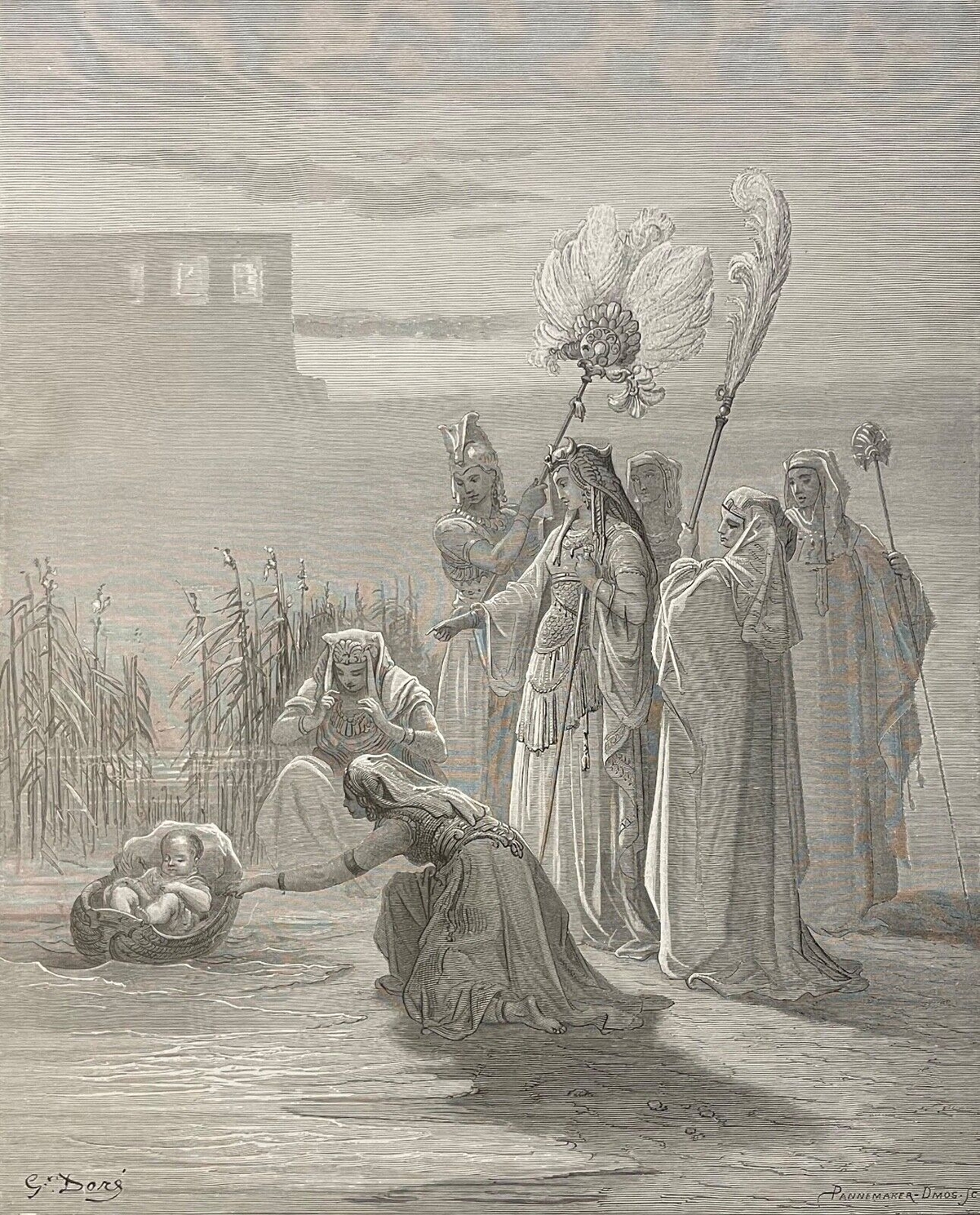
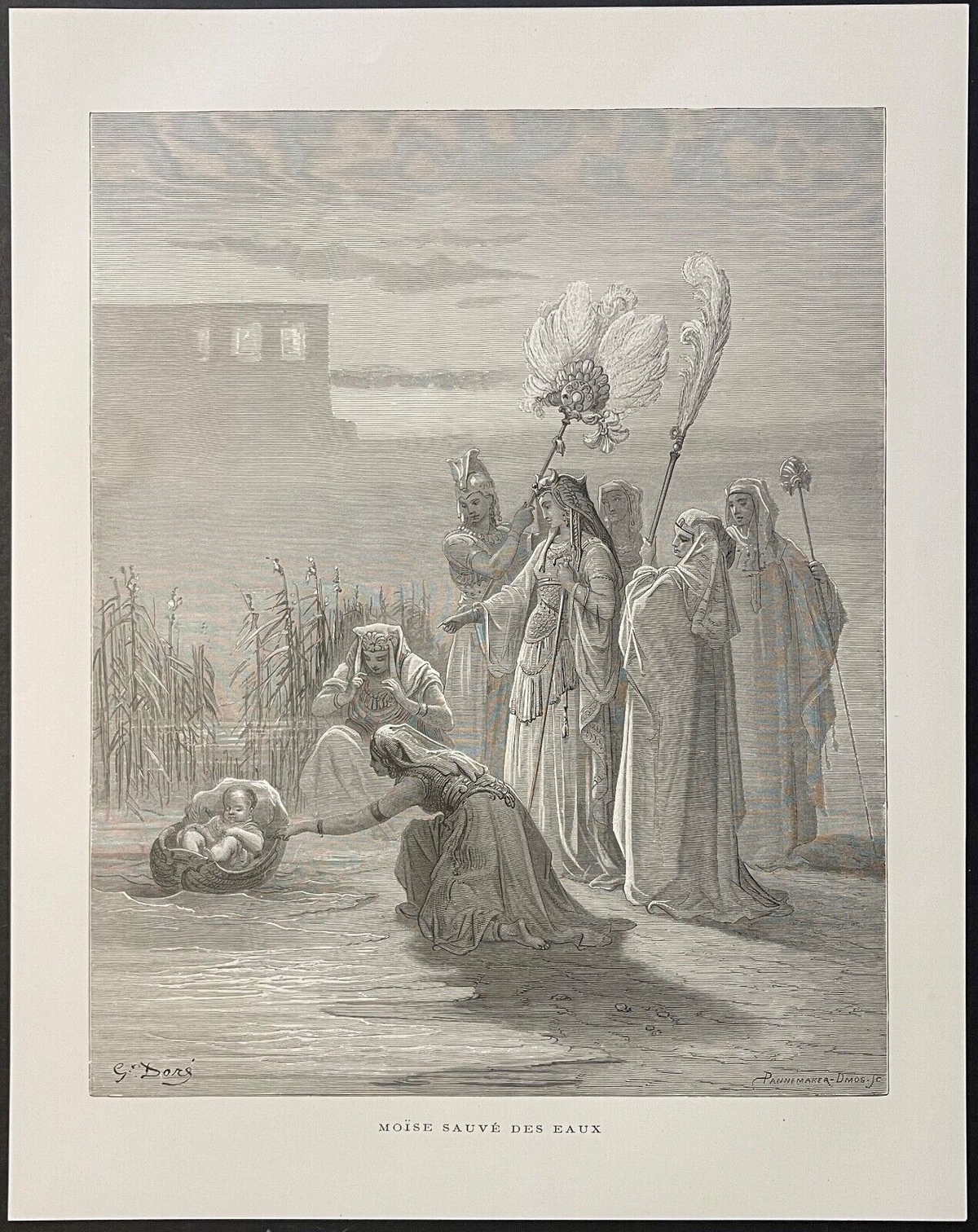
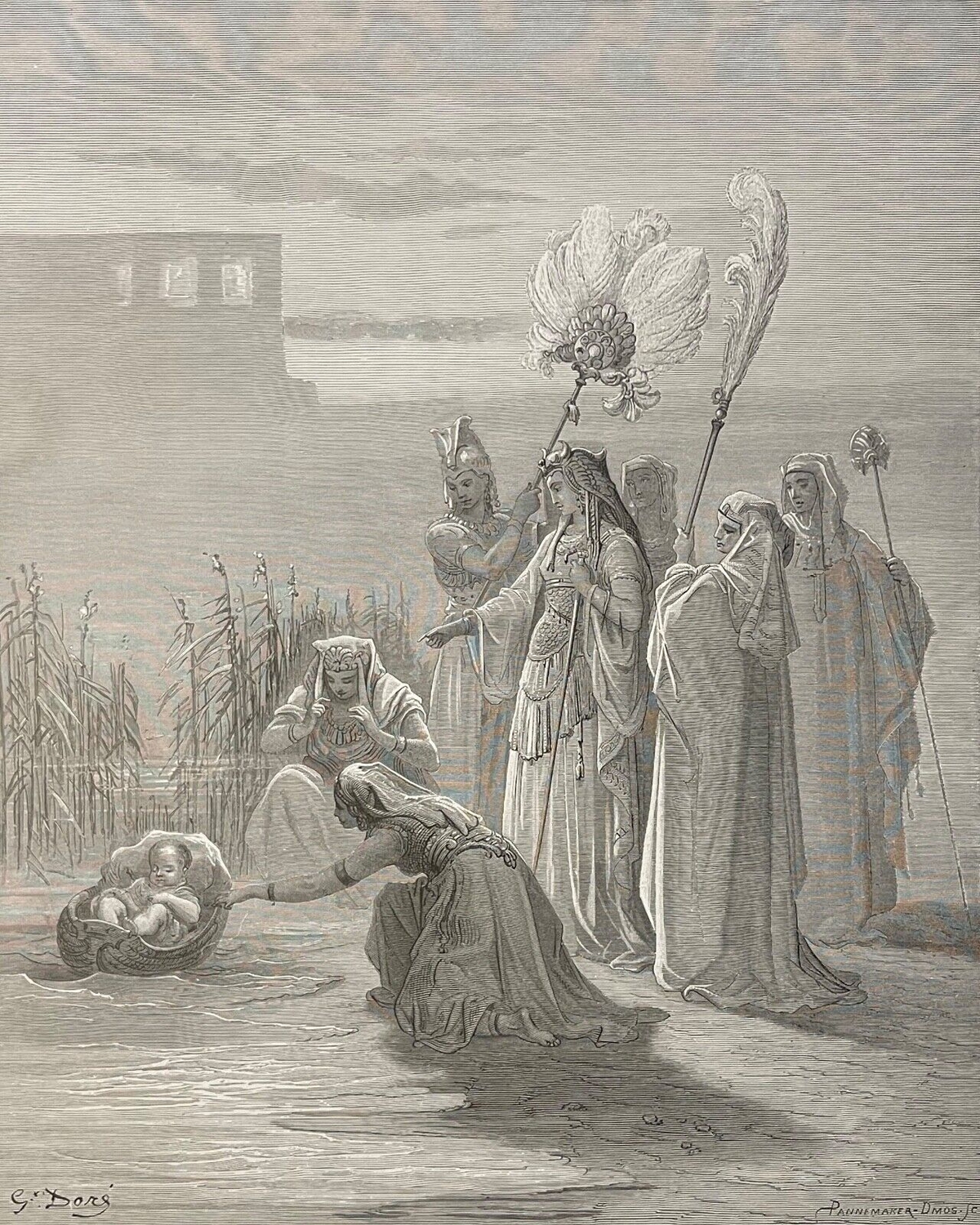
Beautiful nineteenth-century wood engraving depicting Pharaoh’s daughter discovering the infant Moses in a basket among the reeds of the Nile River.
The composition features the Egyptian princess surrounded by richly dressed female attendants carrying elaborate ceremonial feather fans, while a servant kneels to rescue the baby from the water.
Artist: Gustave Doré (1832–1883).
Engravers: Adolphe-François Pannemaker and Albert Doms.
Technique: Original wood engraving.
Date: 1874, as catalogued.
Sheet dimensions: 30 × 23.8 cm.
Engraved image: 24.6 × 19.8 cm.
Reference: 5215-185R669.
Description
Egypt Moses Rescued from the Nile – Original nineteenth-century French biblical wood engraving dated 1874, after Gustave Doré (1832–1883), engraved by Adolphe-François Pannemaker and Albert Doms, depicting Pharaoh’s daughter discovering the infant Moses among the reeds of the Nile River.
Artculture6 presents this beautiful antique French wood engraving after Gustave Doré, one of the most celebrated illustrators of the nineteenth century.
The composition illustrates the biblical episode traditionally known as Moses Saved from the Waters, narrated in Exodus 2:1–10.
The infant Moses is discovered in a basket among the reeds of the Nile, surrounded by the daughter of Pharaoh and her richly dressed attendants.
The remarkable composition combines the tenderness of the biblical story with elaborate costumes, ceremonial feather fans and the atmospheric landscape of ancient Egypt.
MOSES RESCUED FROM THE NILE
The engraving depicts the moment when the infant Moses is discovered beside the waters of the Nile.
In the lower left foreground, the baby lies inside a small basket floating among the reeds.
His body is partly wrapped in cloth, and his face is turned towards the approaching women.
A female servant kneels beside the water and extends her arm towards the basket.
Behind her, another woman watches the child with concern and curiosity.
The principal group is dominated by the daughter of Pharaoh, represented in richly decorated Egyptian clothing.
She extends her hand towards the rescued child while her attendants gather behind her.
The scene conveys both the solemnity of the royal procession and the tenderness of the infant’s discovery.
PHARAOH’S DAUGHTER
The daughter of Pharaoh occupies an important position in the composition.
She is depicted wearing an elegant, richly ornamented gown and an elaborate ceremonial headdress.
Her jewellery and draped garments distinguish her from the surrounding attendants.
Gustave Doré presents the princess as a dignified and compassionate figure.
Although she belongs to the royal family responsible for the persecution of the Hebrews, she chooses to protect the abandoned child.
Her decision becomes one of the most important moments in the biblical narrative.
The composition emphasises her gesture of concern towards the baby.
THE EGYPTIAN ATTENDANTS AND CEREMONIAL FANS
Several female attendants accompany the princess.
Their elaborate costumes and distinctive hairstyles contribute to the historical and decorative appearance of the scene.
Two attendants carry tall ceremonial feather fans.
These imposing accessories rise above the group and create an elegant vertical movement.
The large feathers are engraved with exceptional attention to detail.
Their decorative forms contrast with the straight lines of the distant architecture and the delicate reeds along the riverbank.
The attendants’ gestures and expressions reinforce the impression of a carefully organised royal procession interrupted by an unexpected discovery.
THE BIBLICAL STORY OF MOSES
According to the Book of Exodus, the Israelites were living in Egypt under the rule of Pharaoh.
Fearing the growth of the Hebrew population, Pharaoh ordered the death of newborn Hebrew boys.
A woman from the tribe of Levi concealed her infant son for three months.
When she could no longer hide him safely, she placed him inside a waterproof basket among the reeds of the Nile.
The baby’s sister remained nearby to observe what would happen.
Pharaoh’s daughter came down to the river and discovered the basket.
When she opened it, she found the crying infant.
Moved by compassion, she decided to save him.
The baby’s sister offered to find a Hebrew nurse.
The child’s own mother was therefore able to care for him during his early years.
He was eventually brought to Pharaoh’s daughter, who adopted him and named him Moses.
MOSES AND THE HISTORY OF ANCIENT ISRAEL
Moses became one of the central figures of the Hebrew Bible.
Raised within the Egyptian royal household, he later discovered his connection to the Hebrew people.
According to the biblical narrative, he was chosen by God to lead the Israelites out of slavery.
His story includes the confrontation with Pharaoh, the ten plagues of Egypt, the crossing of the Red Sea and the journey through the wilderness.
Moses is also associated with the revelation of the Law at Mount Sinai.
The episode represented in this engraving marks the beginning of that extraordinary destiny.
THE LANDSCAPE OF THE NILE
Gustave Doré places the biblical action within an atmospheric Egyptian landscape.
Tall reeds occupy the left side of the composition.
The water in the foreground is represented through numerous fine horizontal engraved lines.
The small basket rests close to the riverbank.
In the distance, architectural structures appear through a light atmospheric haze.
The open sky and delicate treatment of the landscape contribute to the peaceful character of the scene.
The contrast between the expansive natural setting and the richly decorated royal procession creates an elegant visual balance.
THE ART OF GUSTAVE DORÉ (1832–1883)
Paul Gustave Louis Christophe Doré was born in Strasbourg, France, in 1832.
He became one of the most influential illustrators of nineteenth-century Europe.
His extensive artistic career included drawing, engraving designs, painting and sculpture.
Doré illustrated major literary and religious works, including Dante’s Divine Comedy, Cervantes’ Don Quixote and numerous biblical narratives.
His compositions are particularly admired for their dramatic lighting, expressive figures and remarkable imagination.
His biblical illustrations became widely known throughout Europe and North America.
They profoundly influenced the visual interpretation of Old and New Testament narratives.
Gustave Doré died in Paris in 1883.
ADOLPHE-FRANÇOIS PANNEMAKER (1822–1900)
Adolphe-François Pannemaker was a distinguished wood engraver active in France during the nineteenth century.
He was particularly admired for his ability to translate complex illustrations into detailed wood engravings.
Pannemaker collaborated on numerous projects involving the works of Gustave Doré.
His technical skill allowed him to reproduce delicate textures, architectural details and subtle variations of light.
The present composition demonstrates the precision of nineteenth-century wood engraving.
ALBERT DOMS – WOOD ENGRAVER
Albert Doms was an engraver active during the nineteenth century who collaborated with Pannemaker on several biblical compositions after Gustave Doré.
His contribution is documented by the engraved signature appearing at the lower right of the image.
The inscription is reproduced in the form Pannemaker-Dmos, with the letters of Doms transposed.
Together, the engravers translated Doré’s original design into a finely detailed wood engraving.
The costumes, faces, feathers and atmospheric effects demonstrate the demanding nature of this work.
THE WOOD ENGRAVING TECHNIQUE
The present example is an original nineteenth-century printed wood engraving, traditionally called a xylography.
The composition was engraved on end-grain wood, a technique particularly suited to the reproduction of detailed illustrations.
Fine lines create the various shades of grey.
Closely spaced engraved marks describe the folds of the garments, the ornamental headdresses and the ceremonial fans.
The open landscape is represented with lighter horizontal lines.
The result is an elegant combination of precise drawing and atmospheric tonal effects.
Unlike a modern photographic reproduction, this is a period impression of a wood-engraved image.
THE ORIGINAL DESIGN AND THE 1874 IMPRESSION
The composition is associated with Gustave Doré’s biblical illustrations published during the nineteenth century.
An early version of the image is documented in 1866.
The present example is catalogued as an impression from 1874.
It reproduces the design Moïse sauvé des eaux, with the printed signatures of Gustave Doré and the engravers Pannemaker and Doms.
The original French title appears beneath the engraving:
MOÏSE SAUVÉ DES EAUX
This distinction between the original design and the date of the present impression is important for the historical description of the print.
TECHNICAL DETAILS
Subject: Moses Rescued from the Nile.
Original French title: Moïse sauvé des eaux.
Biblical reference: Exodus 2:1–10.
Original artist: Gustave Doré (1832–1883).
Wood engravers: Adolphe-François Pannemaker (1822–1900) and Albert Doms.
Country: France.
Period: Nineteenth century.
Date of this impression: 1874, as catalogued.
Technique: Original wood engraving, end-grain woodcut.
Sheet dimensions: 30 × 23.8 cm.
Engraved image dimensions: 24.6 × 19.8 cm.
Printed title: Moïse sauvé des eaux.
Reference: 5215-185R669.
CONDITION
Antique example displaying the natural patina of aged paper.
The engraved composition, printed title and original engraved signatures remain well preserved.
The reverse of the sheet is also illustrated in the photographs.
COLLECTOR’S INTEREST
An attractive nineteenth-century French biblical wood engraving after Gustave Doré, depicting the discovery of the infant Moses by Pharaoh’s daughter.
Particularly interesting for collectors of biblical engravings, Old Testament illustrations, Egyptian history and iconography, French wood engraving and the works of Gustave Doré.
The delicate representation of the Nile, the elaborate Egyptian costumes, the great ceremonial feather fans and the expressive figures make this composition especially appealing.
An attractive addition to a collection of nineteenth-century European religious prints.
Offered by Artculture6 – Antique Prints, Drawings and Works of Art.


Avis
Il n’y a pas encore d’avis.