

Description
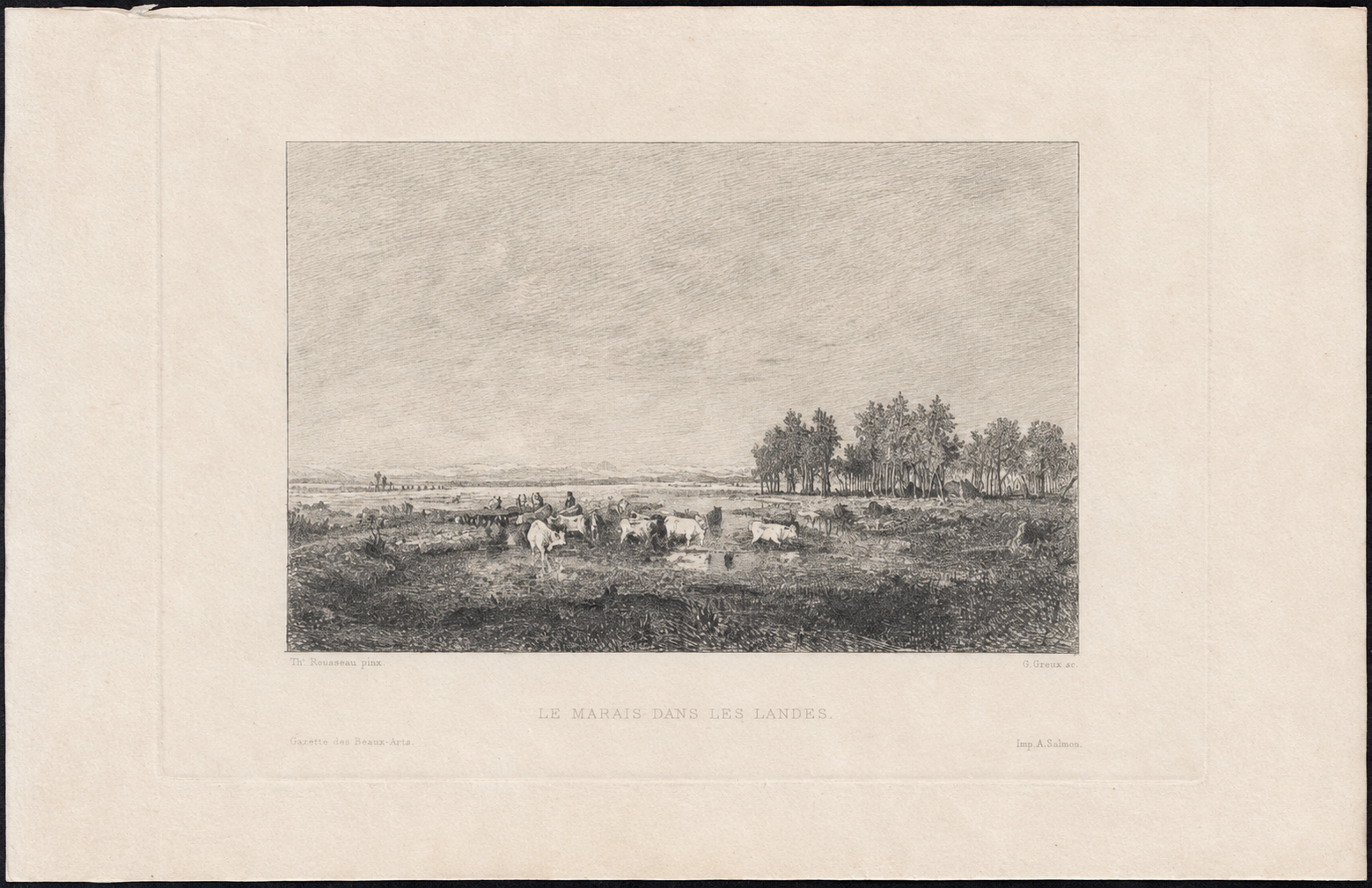
Landes France 1881 – Antique French landscape etching by Gustave Greux (1838–1919), after the celebrated Barbizon School painter Théodore Rousseau (1812–1867), depicting cattle in a vast marshland landscape beneath an expansive cloudy sky.
Artculture6 presents this beautiful nineteenth-century French etching entitled Le Marais dans les Landes, an atmospheric rural composition engraved by Gustave-Marie Greux after a painting by Théodore Rousseau.
The landscape depicts a herd of cattle grazing and moving through the marshy countryside of southwestern France.
The composition is particularly remarkable for its extensive sky, delicate engraved shading and carefully balanced arrangement of animals, trees and open wetlands.
Executed in 1881, this fine engraving reflects the growing importance of naturalistic landscape art in nineteenth-century France.
THE MARSHES OF THE LANDES – A BEAUTIFUL FRENCH LANDSCAPE
The engraving represents a broad, peaceful marshland extending towards a distant horizon.
In the foreground, grasses and low vegetation cover the uneven ground.
Areas of water and damp pasture create subtle reflections and variations in texture.
At the centre of the composition, numerous cattle are distributed across the open countryside.
Several animals stand close together, while others are positioned farther away.
Their bodies are carefully described through delicate engraved outlines and subtle tonal contrasts.
The scene is animated by a few distant human figures and additional livestock.
On the right, a compact group of tall trees rises above the landscape.
Their dark foliage provides an important visual contrast with the lighter areas of the marsh and the extensive sky.
The resulting composition conveys a strong sense of tranquillity, space and atmospheric depth.
THE HISTORIC LANDSCAPE OF THE LANDES REGION
The Landes region is situated in southwestern France, near the Atlantic coast.
During the nineteenth century, extensive areas of this territory consisted of open heathland, wet pastures, marshes and agricultural land.
Before the great forestry and drainage projects that transformed much of the region, its natural landscape was characterised by vast open spaces and seasonal wetlands.
Livestock farming played an important role in the traditional rural economy.
Cattle and other animals grazed in the open countryside, often moving through marshy terrain.
These landscapes attracted artists interested in natural observation and the changing effects of light.
The present composition captures the distinctive atmosphere of a traditional rural environment, where the animals form an integral part of the landscape.
THÉODORE ROUSSEAU (1812–1867) – MASTER OF THE BARBIZON SCHOOL
Théodore Rousseau was born in Paris in 1812.
He became one of the most influential French landscape painters of the nineteenth century.
Rejecting the conventions of academic landscape painting, Rousseau devoted himself to the direct observation of nature.
His work focused on forests, trees, plains, rivers, marshes and atmospheric effects.
He developed a highly personal approach to landscape painting, giving the natural environment a central artistic importance.
Rousseau became closely associated with Barbizon, a village near the Forest of Fontainebleau.
During the nineteenth century, Barbizon attracted artists seeking a more direct and naturalistic relationship with the landscape.
Among the leading painters associated with this movement were Jean-François Millet, Charles-François Daubigny, Narcisse Diaz de la Peña and Théodore Rousseau.
Their work played a major role in the development of modern French landscape painting.
Rousseau’s paintings are particularly admired for their emotional intensity, carefully observed trees and atmospheric treatment of light.
He died in Barbizon in 1867.
AN IMPRESSIVE SKY AND AN EXTENSIVE HORIZON
One of the most remarkable aspects of this etching is the exceptional importance given to the sky.
The horizon is positioned relatively low within the composition.
This arrangement allows the upper part of the image to be occupied by an extensive atmospheric expanse.
Numerous closely arranged engraved lines create delicate gradations of light and shade.
The subtle changes in the density of the hatching suggest clouds, atmospheric moisture and soft daylight.
The open sky contrasts with the darker foreground, where the grazing cattle and marsh vegetation are represented in greater detail.
This careful balance between the sky and the land creates a powerful feeling of openness and tranquillity.
CATTLE IN THE MARSHLAND
The cattle form the principal living elements of the composition.
Several animals occupy the middle ground, their light-coloured bodies standing out against the darker marsh.
Some appear to be grazing, while others stand in shallow water or on damp ground.
The animals are represented with careful attention to their anatomy and natural behaviour.
Their relatively small scale emphasises the immensity of the surrounding landscape.
The arrangement of the herd gives life to the scene without disturbing its peaceful atmosphere.
The presence of cattle also reflects the importance of agricultural activity in the rural landscape of nineteenth-century France.
GUSTAVE-MARIE GREUX (1838–1919)
Gustave-Marie Greux was born in Paris in 1838.
He became an accomplished French engraver, particularly admired for his interpretations of paintings by important nineteenth-century artists.
Greux studied under the painter Charles Gleyre.
His work demonstrates a refined command of etching and an exceptional sensitivity to tonal values.
He produced engraved interpretations of paintings by artists including Théodore Rousseau and Jean-François Millet.
During the nineteenth century, reproductive and interpretative engraving played an essential role in the circulation of important works of art.
Engravers such as Greux translated the effects of painted compositions into complex arrangements of lines and tonal contrasts.
This required both technical precision and a careful understanding of the original painter’s artistic intentions.
Greux’s landscape etchings are particularly notable for their atmospheric treatment and delicate graphic execution.
He died in 1919.
A FINE EXAMPLE OF NINETEENTH-CENTURY FRENCH ETCHING
The present engraving demonstrates the exceptional technical skill of Gustave Greux.
The sky is rendered through fine, closely arranged horizontal and diagonal lines.
The marsh vegetation is represented with shorter, more irregular strokes, creating subtle variations in texture.
The cattle are carefully modelled through delicate outlines and engraved shading.
Their lighter forms contrast with the darker areas of the wet ground.
The trees on the right are treated with an intricate network of lines, giving the foliage an impressive density.
In the distance, small figures and animals are represented with remarkable economy of means.
The result is an atmospheric interpretation of Rousseau’s original landscape, preserving the quiet beauty and naturalistic character of the painting.
THE BARBIZON SCHOOL AND THE DEVELOPMENT OF LANDSCAPE ART
The Barbizon School played a fundamental role in the transformation of French landscape painting during the nineteenth century.
Its artists sought to represent the natural environment through direct observation rather than idealised classical conventions.
Forests, rural paths, marshes and agricultural landscapes became important artistic subjects in their own right.
Théodore Rousseau was one of the leading figures of this movement.
His work helped establish landscape painting as a major independent genre.
The present etching illustrates the continuing importance of his artistic achievements during the decades following his death.
It also demonstrates the ability of nineteenth-century French printmakers to communicate the visual qualities of atmospheric landscape painting through engraving.
AN ANTIQUE FRENCH ETCHING OF 1881
The original landscape by Théodore Rousseau was painted around 1852–1853.
The engraved interpretation by Gustave Greux dates from 1881.
This antique print combines the naturalistic vision of one of the great Barbizon School painters with the refined technical abilities of an accomplished French engraver.
Its peaceful marshland setting, extensive sky and carefully observed cattle give the work particular artistic appeal.
DIMENSIONS AND TECHNICAL DETAILS
Country: France
Region represented: Landes, southwestern France
Subject: Marsh landscape with a herd of cattle
Original painter: Théodore Rousseau (1812–1867)
Engraver: Gustave-Marie Greux (1838–1919)
Artistic movement: Barbizon School
Original painting: Circa 1852–1853
Date of engraved composition: 1881
Technique: Antique etching
Sheet dimensions: 27.4 × 17.3 cm
Engraved image dimensions: 15.8 × 10.3 cm
Period: Nineteenth century

Avis
Il n’y a pas encore d’avis.