Spain Francisco Goya Aguarda Que Te Unten Los Caprichos 67 Goat Witchcraft Heliogravure c1970
29,00 €
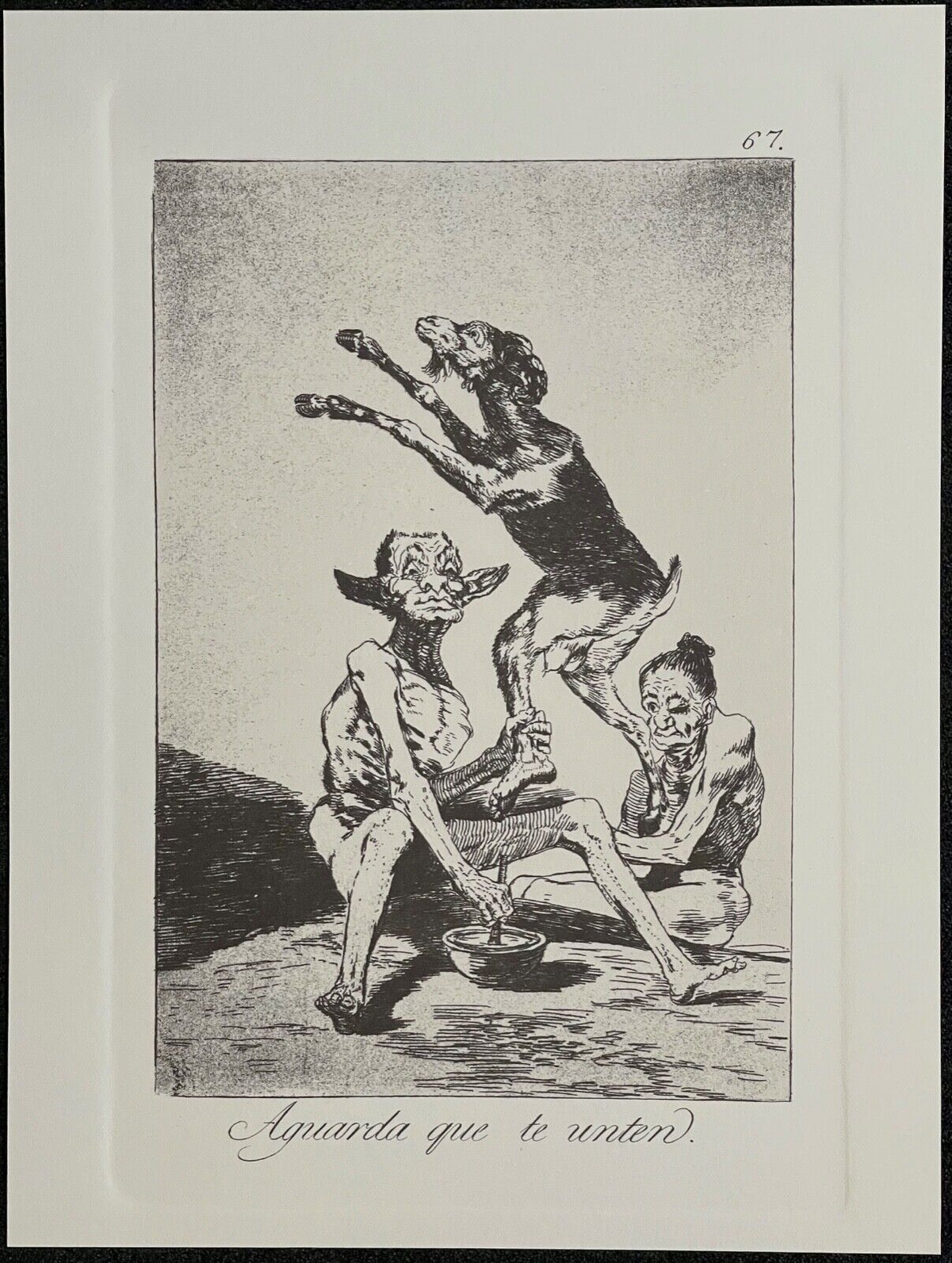
Francisco Goya – Aguarda que te unten – Los Caprichos Plate 67 – Heliogravure circa 1970
Fine twentieth-century heliogravure after Francisco de Goya (1746–1828), reproducing plate 67 of Los Caprichos, originally published in Madrid in 1799.
A remarkable supernatural scene depicting a large rearing goat surrounded by two grotesque figures preparing a mysterious magical ointment.
An extraordinary composition combining witchcraft, animal symbolism and Goya’s satire of ignorance and superstition.
Technique: Heliogravure, circa 1970.
Sheet dimensions: 25.1 × 19 cm.
Image dimensions: 19.1 × 13 cm.
Reference: 4930-60R549.
Description
Francisco Goya Aguarda Que Te Unten – Los Caprichos Plate 67 – Goat and Witchcraft – Heliogravure circa 1970
Francisco Goya Aguarda Que Te Unten – Fine twentieth-century heliogravure circa 1970 after plate 67 of the celebrated Spanish series Los Caprichos, originally published in Madrid in 1799.
Artculture6 presents this remarkable heliogravure after Francisco de Goya y Lucientes (1746–1828), one of the greatest Spanish painters and printmakers.
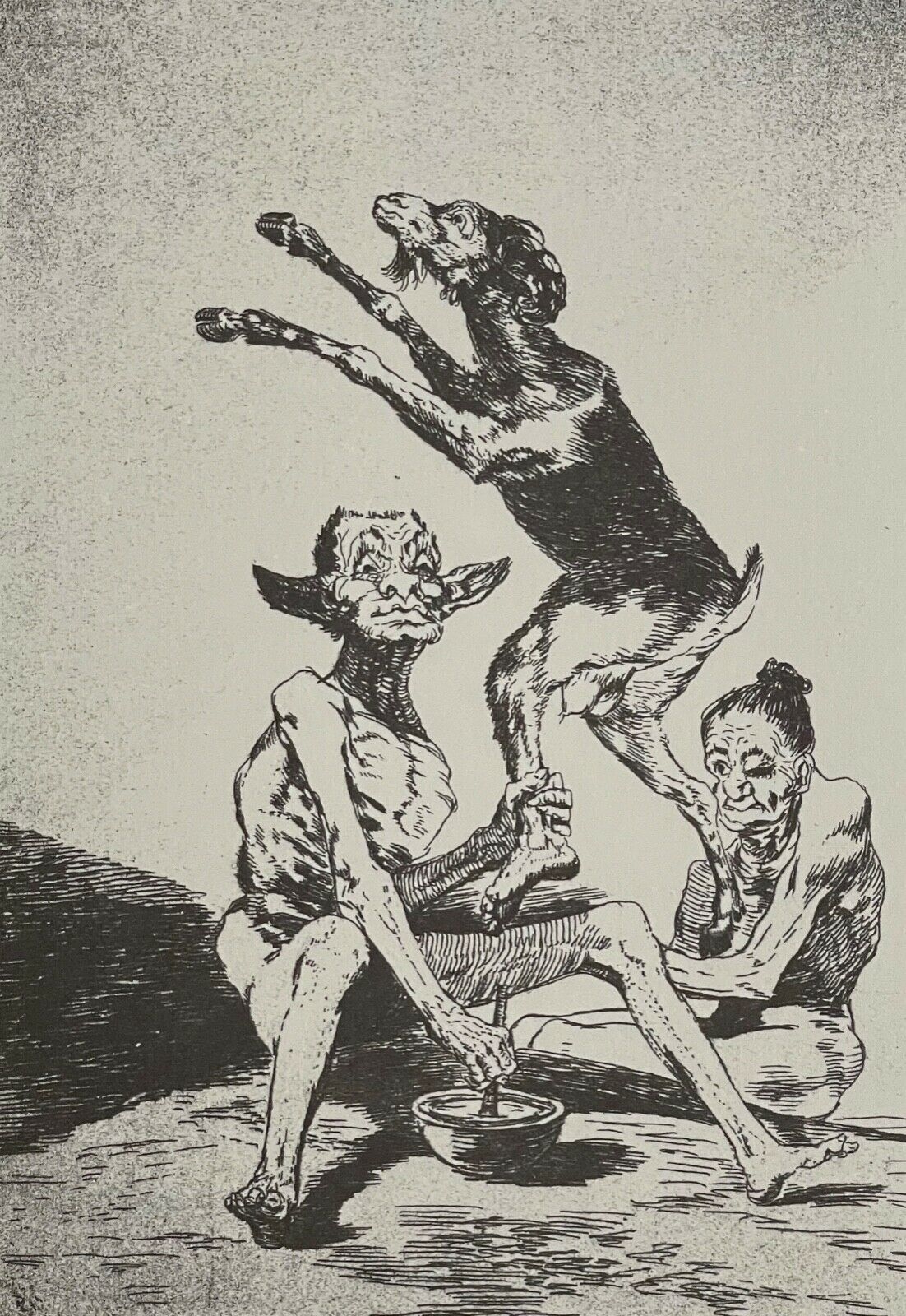
The composition, entitled Aguarda que te unten (Wait Till You Have Been Anointed), depicts a large rearing goat surrounded by two grotesque figures engaged in a mysterious ritual involving a bowl of magical ointment.
This extraordinary scene belongs to the fantastic section of Los Caprichos, where Goya combines witchcraft, animal symbolism and grotesque imagery with a profound criticism of superstition and ignorance.
AGUARDA QUE TE UNTEN – WAIT TILL YOU HAVE BEEN ANOINTED
At the centre of the composition sits a strange creature with human characteristics and large animal-like ears.
Its body is represented in a seated position, with the legs extended on either side of a small bowl.
The creature holds a brush, which it dips into the mysterious preparation contained in the vessel.
On the right, a second grotesque figure with an aged face and hair gathered into a small knot holds the hind leg of a large goat.
The goat rises dramatically above the two figures, its front legs extended upwards.
Its powerful body and dark coat create a remarkable contrast with the lighter background.
The arrangement suggests an extraordinary ceremony intended to prepare the animal for supernatural flight.
THE GOAT AND ITS SYMBOLISM
The goat occupies an important place in traditional European representations of witchcraft.
In folklore and fantastic imagery, goats were frequently associated with witches’ gatherings, magical ceremonies and the figure of the Devil.
Goya incorporated these associations into several of his paintings and prints.
In Aguarda que te unten, the goat appears to be the subject of a ritual involving magical ointment.
The animal’s dynamic pose suggests that it may be preparing to leap or fly.
Its expressive head, raised forelegs and carefully engraved coat give the composition a lively and slightly disturbing character.
THE MAGICAL OINTMENT
The small bowl placed between the two figures is an essential detail of the composition.
The central character stirs or collects a mysterious substance with a brush.
The other figure holds the goat’s leg, apparently preparing it to receive the ointment.
According to traditional beliefs associated with witchcraft, certain magical preparations could enable witches or supernatural creatures to fly.
Goya transforms this popular belief into an absurd and grotesque scene.
The ritual becomes a striking illustration of the irrational ideas circulating within contemporary society.
A SATIRE OF IGNORANCE AND SUPERSTITION
The meaning of the composition extends beyond its fantastic appearance.
Historical commentaries on Los Caprichos interpret the transformation into a goat as an allegory of ignorance and foolishness.
One traditional explanation suggests that people ultimately become goats through the anointing of ignorance and stupidity.
The animal therefore represents the consequences of irrational thinking.
Goya uses the language of witchcraft to criticise those who accept absurd beliefs without questioning them.
The grotesque figures, strange ceremony and exaggerated animal symbolism give the work both a humorous and disturbing character.
WITCHCRAFT IN LOS CAPRICHOS
Witches, sorcerers, demons and fantastic animals occupy an important place in the later plates of Los Caprichos.
Goya frequently depicted magical flights, witches’ gatherings, supernatural transformations and imaginary rituals.
These scenes were not simply illustrations of popular legends.
They formed part of the artist’s broader criticism of superstition, ignorance, social hypocrisy and the abuse of authority.
The presence of the goat and the magical ointment makes Aguarda que te unten a characteristic example of this remarkable series of fantastic compositions.
FRANCISCO DE GOYA (1746–1828)
Francisco José de Goya y Lucientes was born in Fuendetodos, Spain, in 1746.
He became one of the most influential European artists of the late eighteenth and early nineteenth centuries.
His career included royal portraits, religious paintings, historical compositions, drawings and an extraordinary body of graphic work.
Goya developed a highly personal artistic language combining realism, imagination, psychological observation and social criticism.
His prints frequently examine superstition, hypocrisy, corruption, ignorance and the darker aspects of human behaviour.
His innovative approach to printmaking contributed significantly to the development of modern European art.
LOS CAPRICHOS – EIGHTY SATIRICAL PRINTS
Published in Madrid in 1799, Los Caprichos consists of eighty compositions examining the beliefs, customs and contradictions of Spanish society.
Goya employed etching, aquatint and related intaglio techniques to create remarkable variations of tone and texture.
The series combines scenes of everyday life with grotesque characters and supernatural creatures.
The later plates are especially remarkable for their representations of witches, demons, owls, goats and fantastic human-animal hybrids.
These images transform social criticism into memorable visual allegories.
Aguarda que te unten, plate 67, is particularly attractive for its unusual ritual and striking animal subject.
THE ORIGINAL COMPOSITION
The original image was created during the late 1790s and published in 1799.
The composition is dominated by the rearing goat, whose body forms a strong diagonal movement across the upper part of the image.
The two figures beneath the animal provide a contrasting arrangement of seated and crouching postures.
The central bowl directs attention towards the mysterious ritual.
The original print was executed using etching, burnished aquatint and drypoint.
A preparatory drawing by Goya is preserved in the Museo Nacional del Prado in Madrid.
The original work is catalogued as Delteil 104 and Harris 102.
ENGRAVING TECHNIQUE AND ARTISTIC DETAIL
The original composition demonstrates Goya’s exceptional ability to combine precise drawing with fantastic imagery.
The goat’s coat is rendered through numerous closely spaced lines, creating contrasts between the illuminated and shaded portions of its body.
The figures display expressive faces and exaggerated anatomical details.
The brush, bowl and animal’s leg are carefully represented, making the nature of the ritual immediately apparent.
The restrained background allows the strange group to dominate the composition.
The result is an unusual and visually striking scene of supernatural activity.
THE HELIOGRAVURE PROCESS
The present example is a twentieth-century heliogravure produced circa 1970 after Goya’s original composition.
Heliogravure is a photomechanical printing process capable of reproducing fine graphic details and subtle tonal variations.
It has frequently been used in high-quality reproductions of important historical prints and drawings.
This example preserves the expressive characters, the striking rearing goat and the contrasts of Goya’s original composition.
This is a circa 1970 heliogravure reproduction, not an original eighteenth-century etching or aquatint printed during Goya’s lifetime.
TECHNICAL DETAILS
Artist of the original composition: Francisco de Goya y Lucientes (1746–1828).
Original title: Aguarda que te unten.
English title: Wait Till You Have Been Anointed.
Series: Los Caprichos.
Plate number: 67.
Original publication: Madrid, Spain, 1799.
Original technique: Etching, burnished aquatint and drypoint.
Technique of this example: Heliogravure.
Date of this example: Circa 1970.
Sheet dimensions: 25.1 × 19 cm.
Image dimensions: 19.1 × 13 cm.
Reference: 4930-60R549.
CONDITION
Vintage example displaying the natural patina of the paper.
The reproduced composition remains well preserved.
COLLECTOR’S INTEREST
An attractive twentieth-century heliogravure after one of Francisco Goya’s celebrated fantastic prints.
Particularly interesting for collectors of Spanish art, Los Caprichos, witchcraft, goat imagery, supernatural rituals, grotesque creatures and historical printmaking.
The imposing goat, mysterious magical ointment and expressive figures make this composition a memorable example of Goya’s satirical imagination.
An appealing addition to a collection devoted to Goya and the history of European fantastic art.
Offered by Artculture6 – Antique Prints, Drawings and Works of Art.


Avis
Il n’y a pas encore d’avis.