
Description
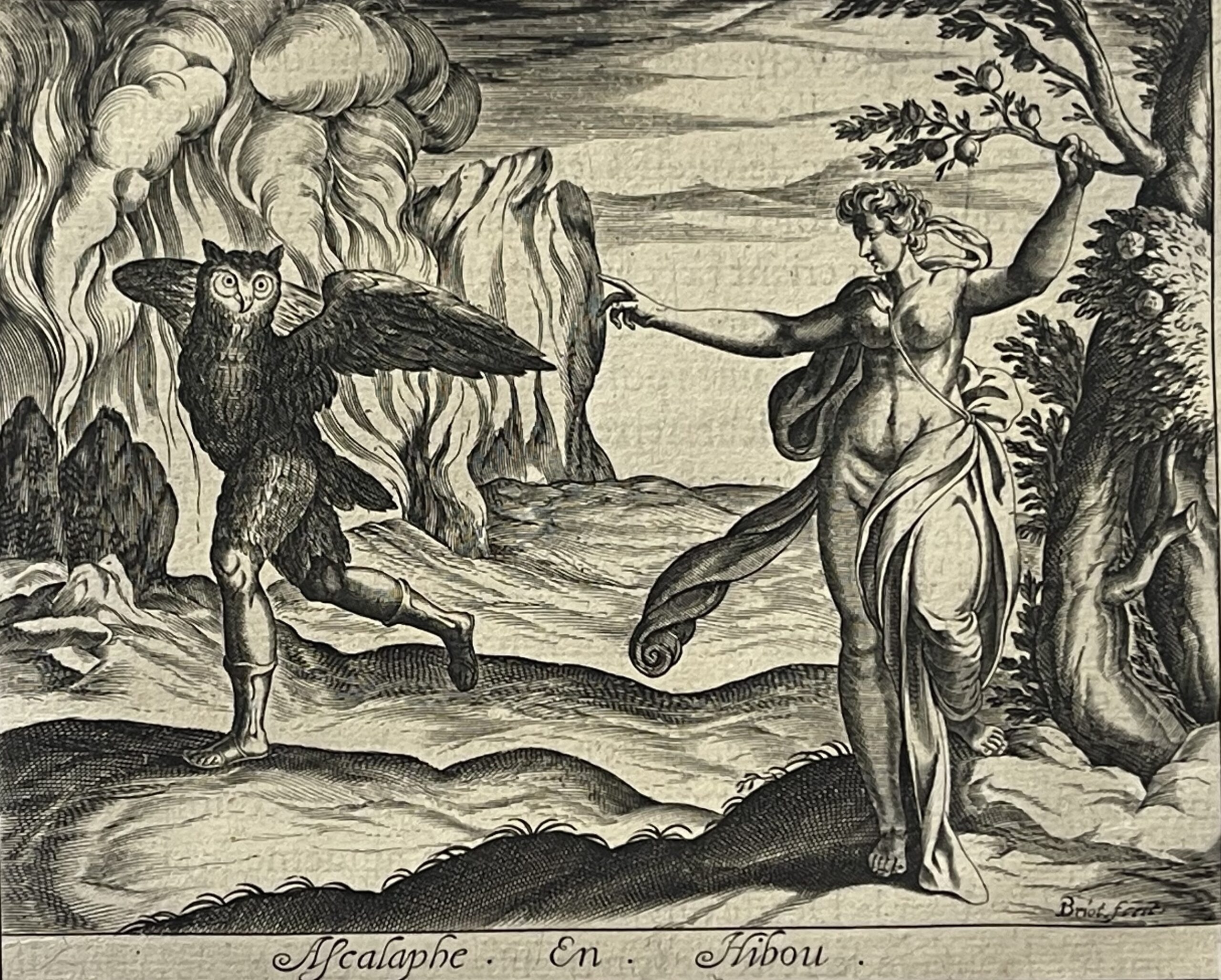
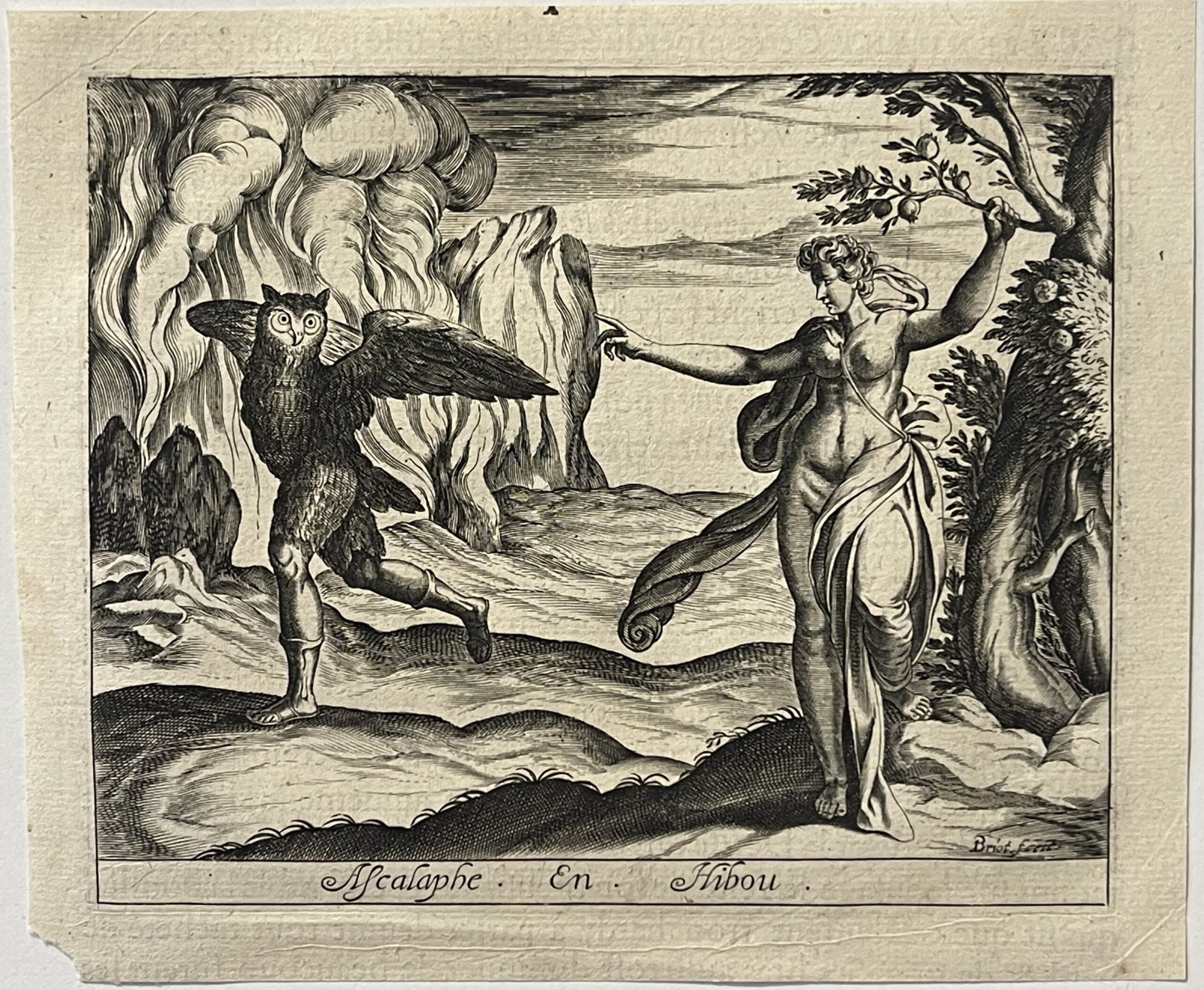
Ascalaphus owl engraving, an original 1619 copperplate print by Isaac Briot (1585–1670), depicting the dramatic transformation of Ascalaphus into an owl by Proserpina (Persephone).
This beautiful early 17th-century engraving illustrates one of the remarkable mythological transformations described by the Roman poet Ovid in his celebrated Metamorphoses.
The original engraved title reads Ascalaphe en Hibou.
The composition bears the signature of Isaac Briot, a distinguished French engraver active during the first half of the 17th century.
The Myth of Ascalaphus and Proserpina
According to classical mythology, Ascalaphus was the son of Acheron, the river god of the Underworld, and the nymph Orphne.
When Proserpina was abducted by Pluto and taken to the Underworld, her mother Ceres desperately sought her return.
Jupiter eventually agreed that Proserpina could leave the realm of the dead, provided she had eaten no food during her captivity.
However, Proserpina had consumed several seeds from a pomegranate.
Ascalaphus, who had witnessed this forbidden act, revealed what he had seen.
His disclosure prevented Proserpina from returning permanently to the world above.
Enraged by his betrayal, the goddess punished Ascalaphus by transforming him into an owl, a nocturnal bird associated in ancient mythology with darkness and ominous predictions.
A Dramatic Scene of Mythological Transformation
The engraving represents the extraordinary moment of Ascalaphus’ transformation.
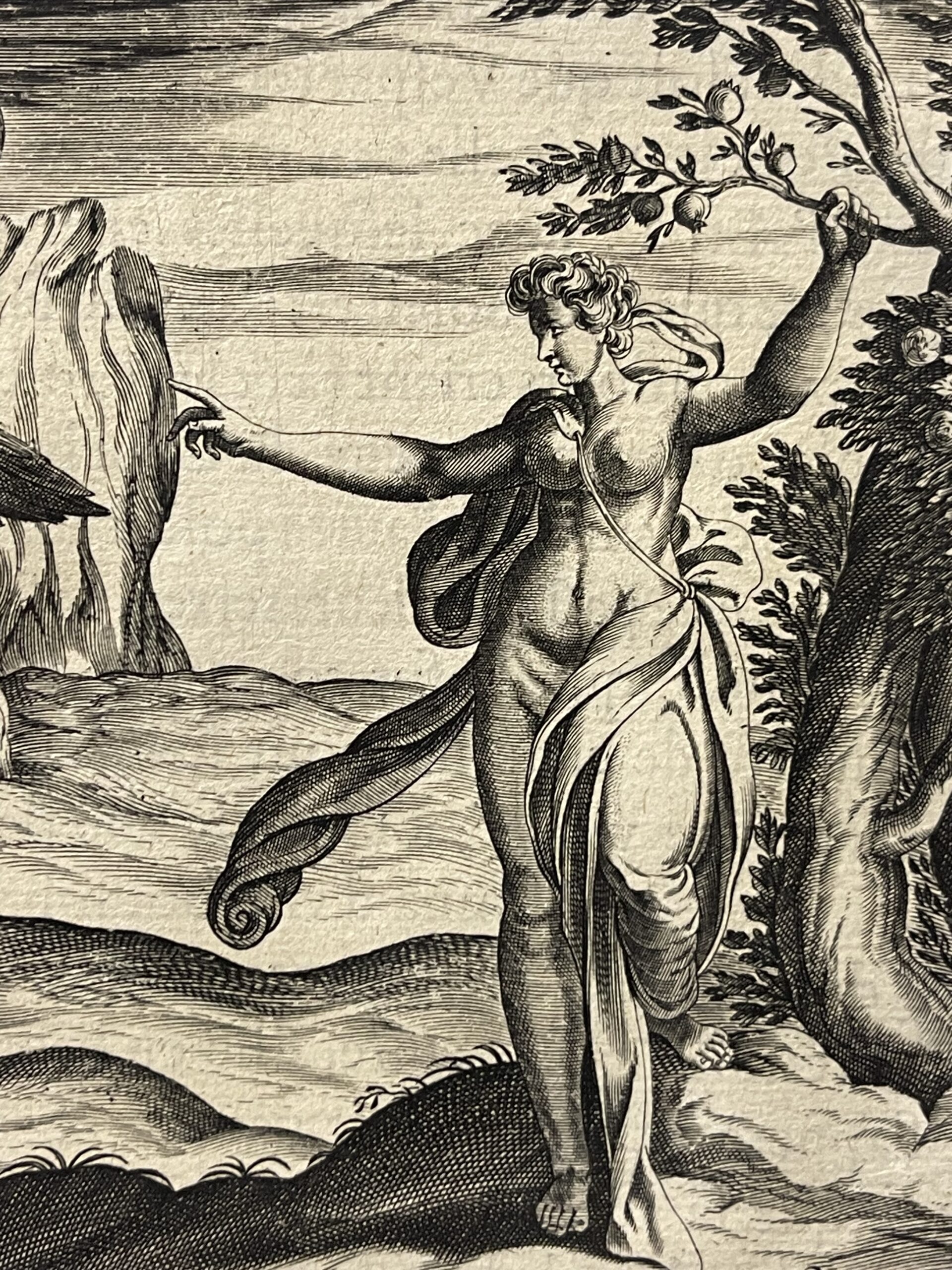
On the right stands Proserpina, depicted as an elegant classical female figure with flowing drapery.
She raises one arm towards the branch of a fruit-bearing tree while extending the other in the direction of Ascalaphus.
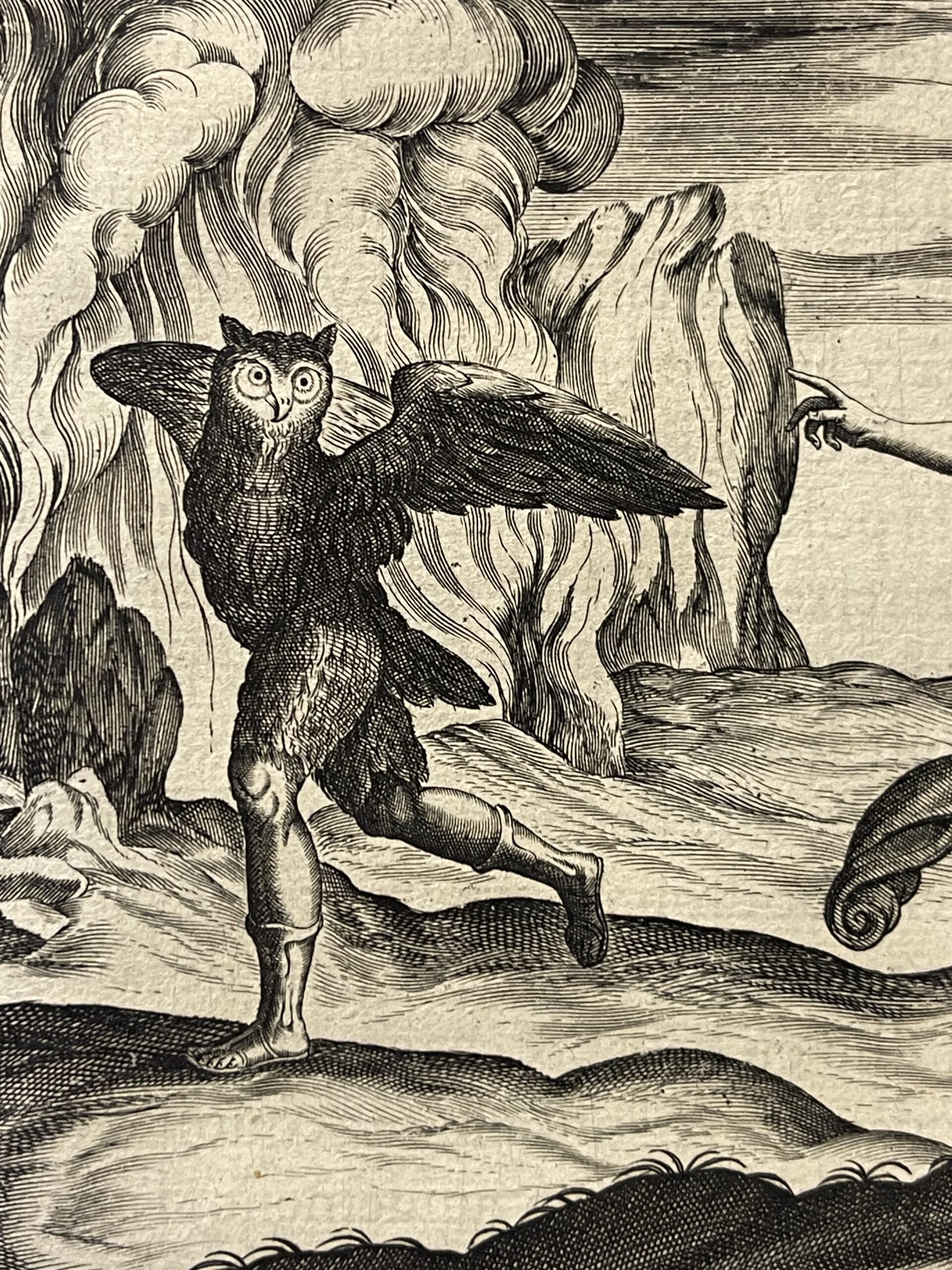
On the left, the unfortunate figure is shown in the process of changing into an owl.
His head has already assumed the characteristic appearance of the bird, with large circular eyes and a hooked beak.
Enormous wings extend from his transforming body, while his legs retain their human appearance.
Behind the figures, towering flames rise among rocky formations, suggesting the supernatural landscape of the Underworld.
The powerful contrast between the dark flames, the sculptural figures and the delicate landscape creates a dramatic and highly expressive composition.
Isaac Briot (1585–1670)
Isaac Briot was a French engraver associated with an important family of artists, engravers and medal-makers.
During the early 17th century, he produced numerous engraved compositions, including portraits, religious subjects and illustrations inspired by classical mythology.
His work is distinguished by energetic drawing, finely controlled line engraving and a remarkable ability to represent movement and complex narrative subjects.
The present engraving demonstrates his skill in depicting the supernatural transformations and dramatic gestures characteristic of Baroque mythological art.
Early 17th-Century Copperplate Engraving
Copperplate engraving was one of the principal techniques used to reproduce historical, literary and mythological subjects during the Renaissance and early Baroque periods.
The engraver worked directly into a copper plate, creating intricate lines that could produce detailed printed impressions.
Fine parallel strokes and crosshatching were used to model the figures, establish shadows and reproduce the textures of rocks, trees, garments and feathers.
In this composition, the transformation of Ascalaphus is rendered with particular precision.
The engraving of the owl’s feathers, the anatomical treatment of the figures and the dramatic flames illustrate the technical refinement of early 17th-century French printmaking.
A Fine Antique Mythological Print
This original 1619 engraving is particularly appealing to collectors of antique European prints, classical mythology, early Baroque art and works by Isaac Briot.
Its unusual subject and dramatic composition make it an attractive example of early 17th-century graphic art.
Dimensions
- Sheet: 15.6 × 13 cm
- Engraved image: 13.6 × 11 cm
Condition
An antique impression displaying the natural patina of the paper.
Beautiful preservation of the engraved composition and original inscriptions.
Some age-related marks and irregularities are visible in the margins.

Avis
Il n’y a pas encore d’avis.