Description
Antonio Tempesta 1612 – Philip II of Spain on His Throne – Antique Italian copperplate etching depicting the powerful Spanish Habsburg monarch receiving a gentleman at his royal court.
Artculture6 presents this remarkable antique Italian etching by Antonio Tempesta (1555–1630), one of the most celebrated and prolific printmakers of the late Renaissance and early Baroque period.
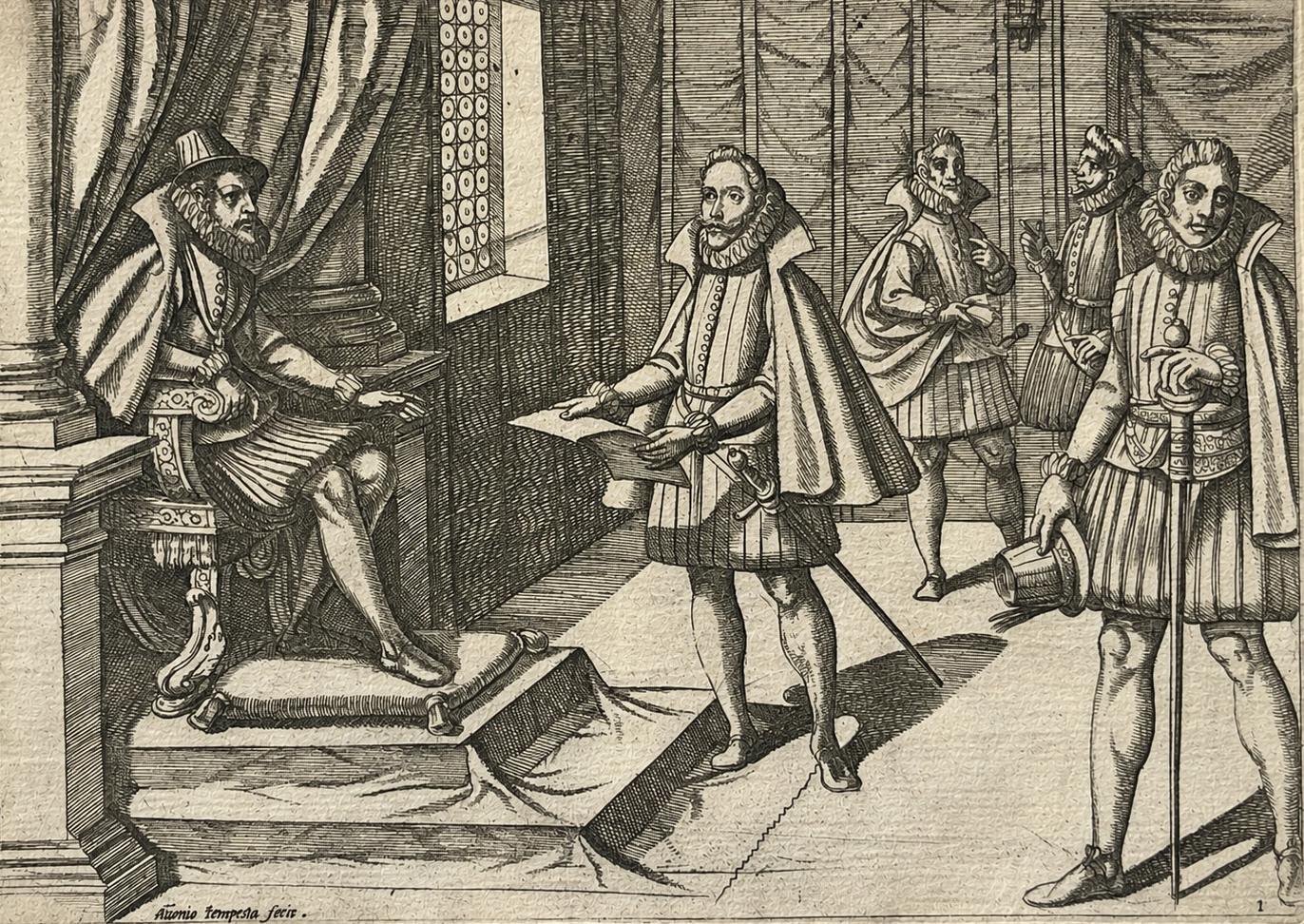
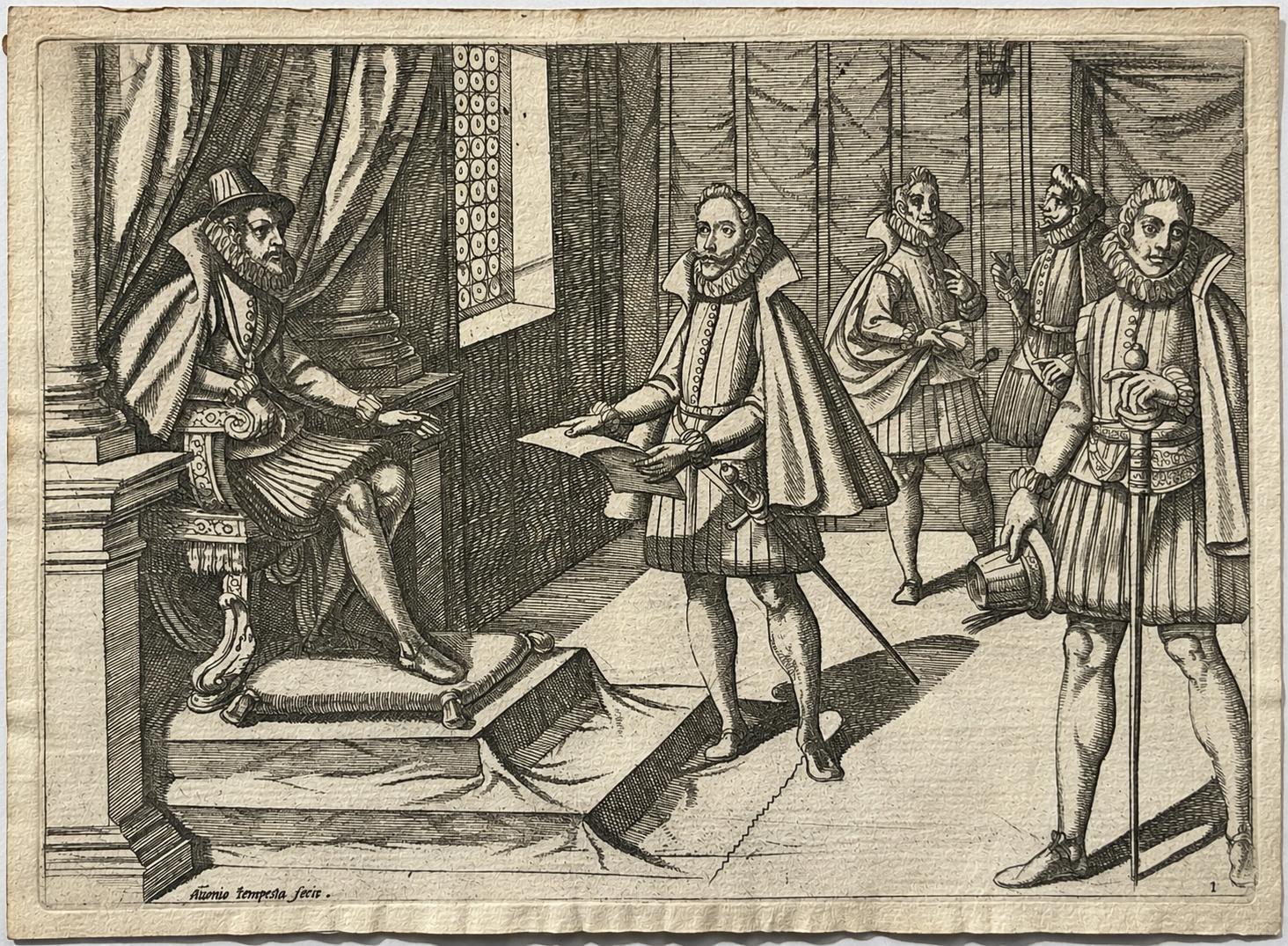
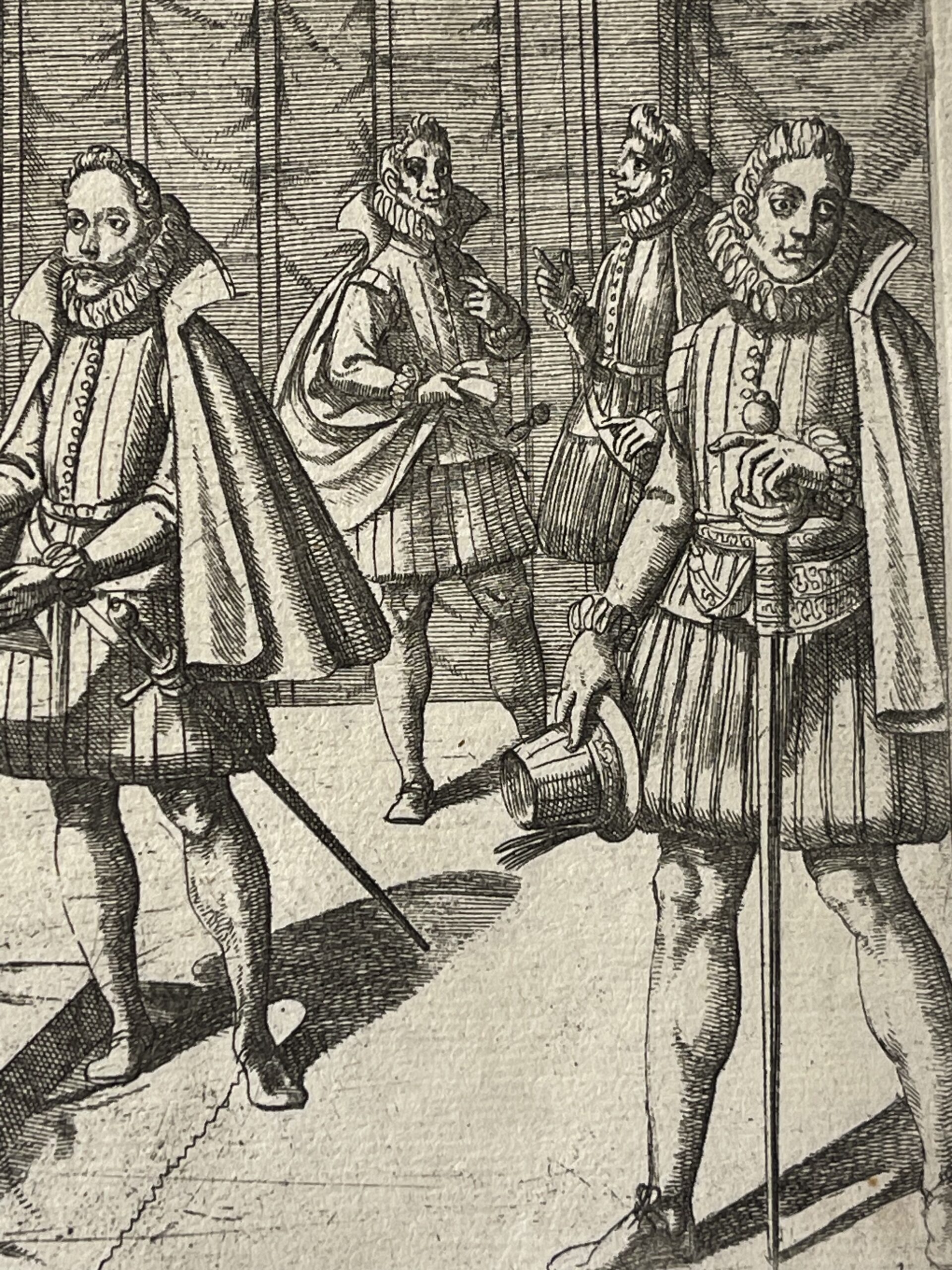
The composition depicts King Philip II of Spain seated on his throne, receiving a courtier presenting a document, while several richly dressed gentlemen observe the royal audience.
Originally created in 1612, this historical composition is distinguished by its precise engraving, elaborate Renaissance costumes and impressive architectural interior.
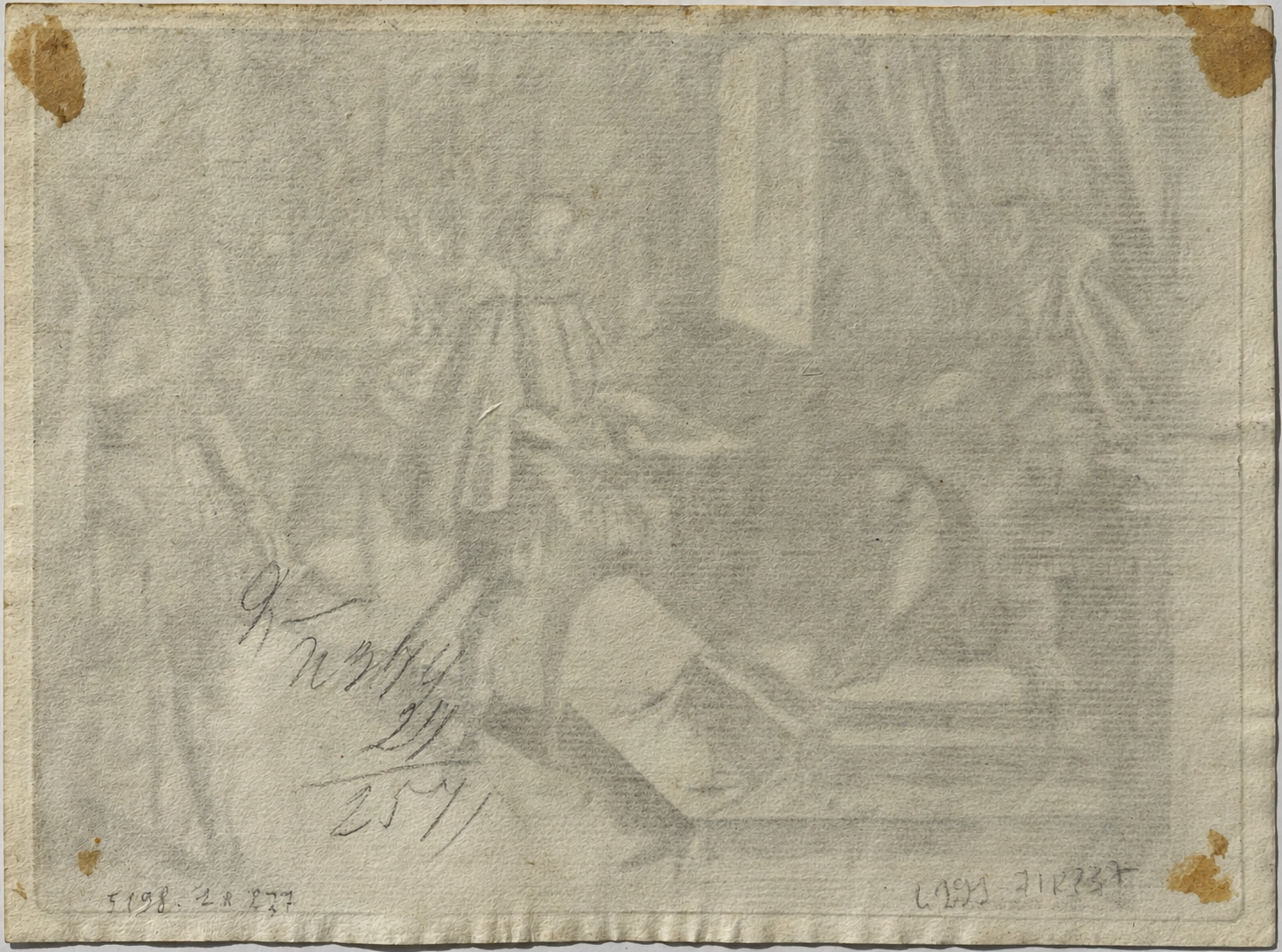
The present example is an antique impression believed to date from the late seventeenth or early eighteenth century, printed on laid linen paper.
PHILIP II OF SPAIN (1527–1598) – THE POWERFUL HABSBURG MONARCH
Philip II was born in Valladolid in 1527, the son of Emperor Charles V and Isabella of Portugal.
He became King of Spain in 1556 following his father’s abdication.
During his reign, the Spanish monarchy controlled extensive territories across Europe, the Americas and Asia.
Philip also ruled important possessions in Italy and the Netherlands.
In 1580, he became King of Portugal, temporarily uniting the two Iberian crowns.
His government was characterised by an extensive royal administration, major diplomatic developments and prolonged military conflicts.
Among the most famous events of his reign were the Dutch Revolt, the wars involving the Ottoman Empire and the Spanish Armada’s expedition against England in 1588.
Philip II was also responsible for the construction of the magnificent Royal Monastery of San Lorenzo de El Escorial near Madrid, one of the principal architectural symbols of his monarchy.
He died in 1598.
PHILIP II OF SPAIN SEATED ON HIS THRONE
The engraving represents a formal audience inside a richly decorated royal chamber.
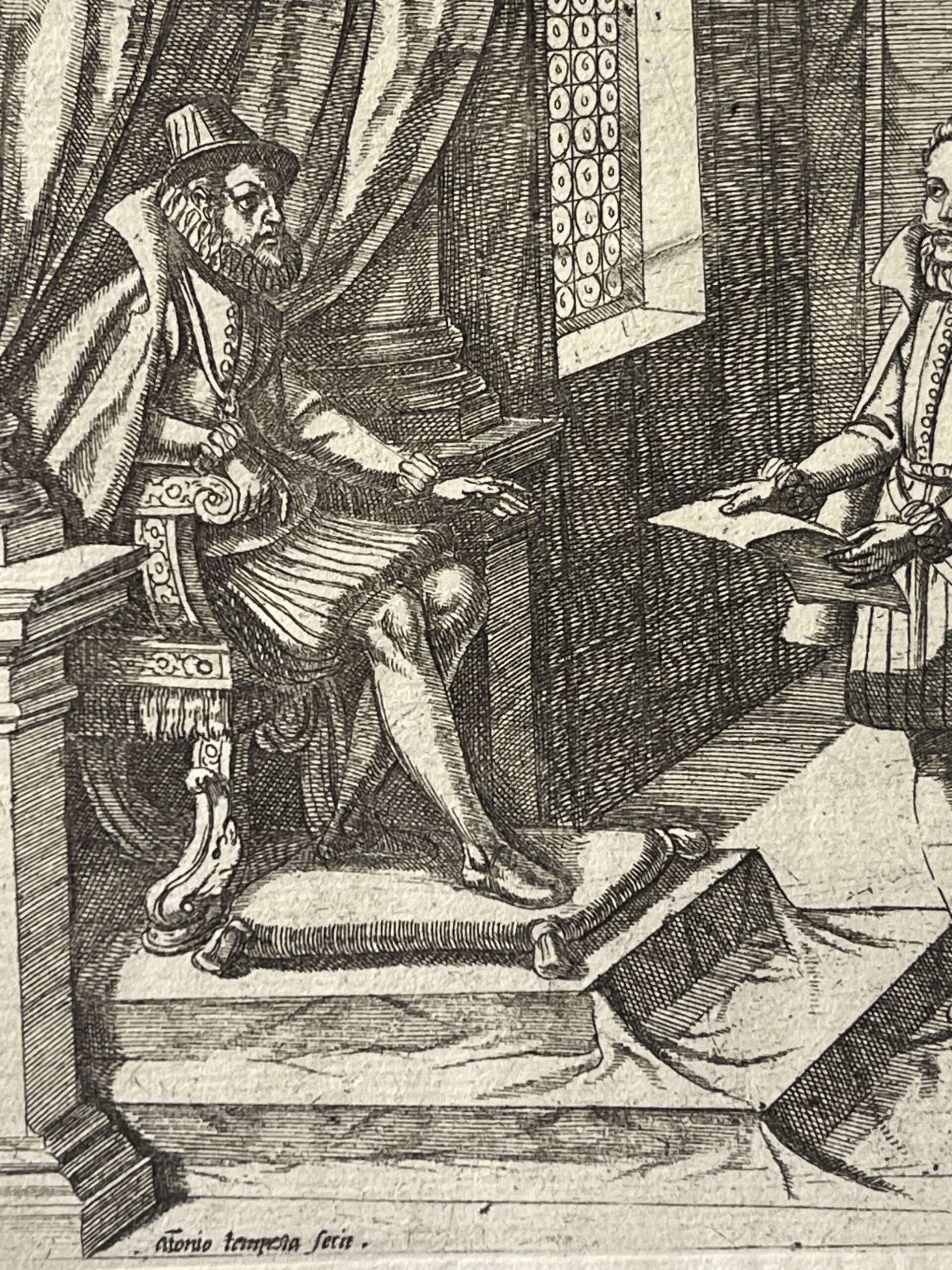
On the left, Philip II occupies an imposing carved throne placed upon a raised platform.
The king is represented wearing a cap, a substantial ruff collar and an elaborate court costume.
His seated posture conveys authority and dignity.
The royal chair is distinguished by its richly ornamented wooden structure, decorative arms and carved supports.
A large cushion rests upon the platform beneath the king’s feet.
Behind the throne, heavy draperies frame a window composed of numerous small panes.
The extensive engraved shading creates a particularly convincing impression of an aristocratic interior.
THE COURTIER PRESENTING A DOCUMENT
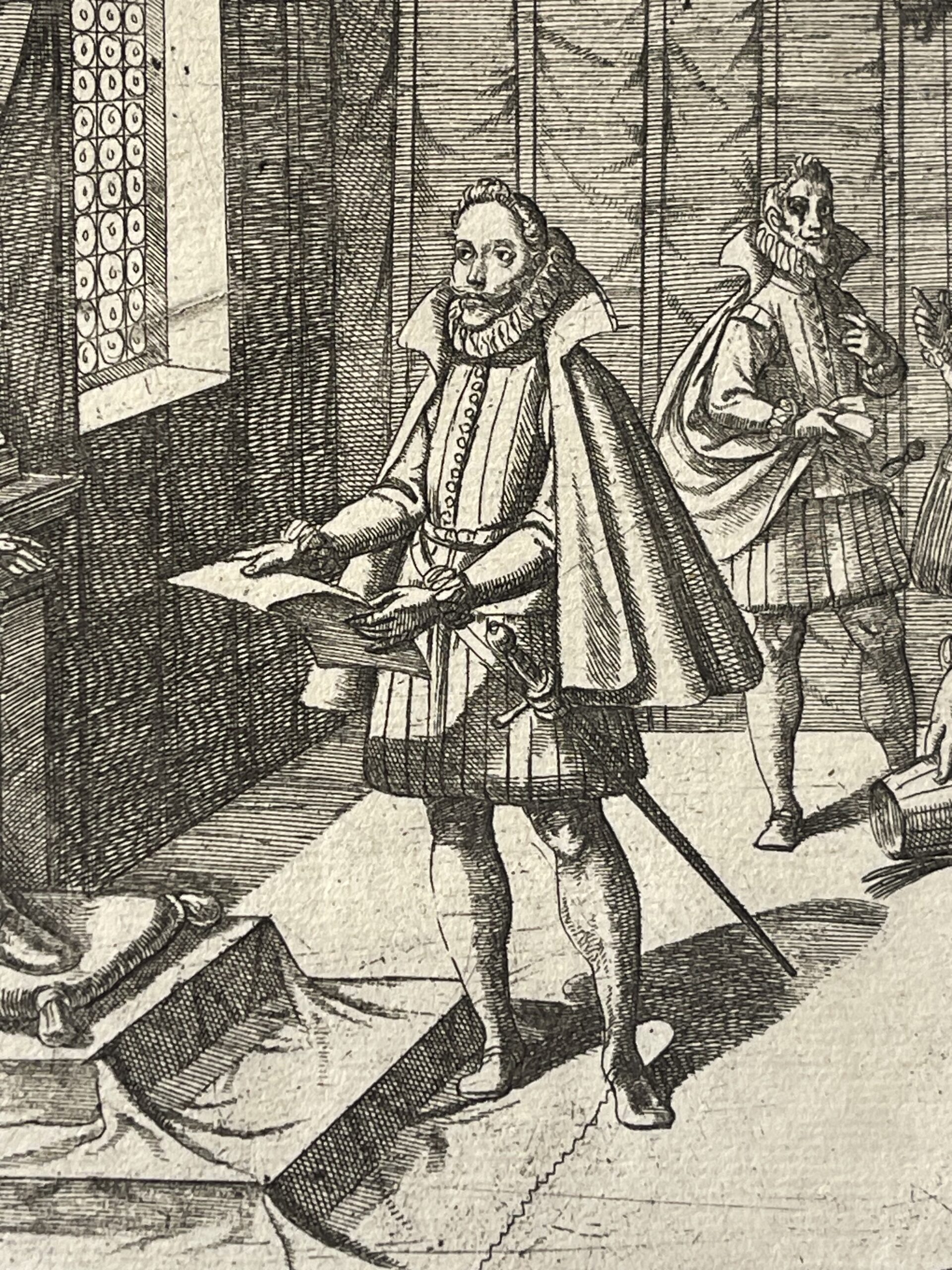
At the centre of the composition stands a gentleman holding an open document.
He appears to be presenting or reading its contents to the seated monarch.
The figure wears a fashionable late Renaissance costume comprising a closely fitted doublet, a large ruff collar, short breeches, stockings and a flowing cape.
An elegant sword hangs at his side.
The artist has carefully represented his hands, facial expression and formal posture.
The document creates a direct visual relationship between the two principal figures, emphasising the administrative and ceremonial nature of the audience.
The scene evokes the political authority exercised by the Spanish monarchy and the complex etiquette of its royal court.
GENTLEMEN OF THE SPANISH ROYAL COURT
Three additional gentlemen complete the composition.
Two figures stand in the background, apparently engaged in conversation or observing the presentation.
On the right, a richly dressed courtier occupies a prominent position in the foreground.
He wears an elaborate doublet decorated with buttons, a voluminous cloak, short breeches and a large pleated ruff.
He holds a broad-brimmed hat and a long staff.
His confident posture and carefully described costume provide an attractive contrast with the central figure.
The arrangement of the characters gives the scene a convincing theatrical and ceremonial quality.
RENAISSANCE COSTUME AND COURT FASHION
The engraving is particularly remarkable for its detailed representation of aristocratic clothing.
The gentlemen wear the characteristic starched ruff collars that became fashionable throughout European courts during the late sixteenth century.
The elaborately constructed doublets, short breeches and flowing cloaks reflect the formal dress associated with the Spanish Habsburg court.
The costumes are enriched by decorative buttons, belts, gloves, swords and other accessories.
Antonio Tempesta has employed extremely fine engraved lines to describe the different textiles and the folds of the garments.
The resulting composition offers an interesting historical representation of European court fashion around the turn of the seventeenth century.
ANTONIO TEMPESTA (1555–1630)
Antonio Tempesta was born in Florence in 1555.
A painter, draughtsman and engraver, he became one of the most prolific Italian printmakers of his generation.
His artistic training developed in the Florentine environment, where he studied with Santi di Tito and the Flemish-born artist Jan van der Straet, also known as Stradanus.
Tempesta subsequently established himself in Rome and participated in numerous important decorative commissions.
His extensive production includes historical subjects, biblical scenes, religious compositions, mythology, hunting scenes, military subjects and representations of important historical figures.
His work is distinguished by vigorous compositions, precise linear engraving and an exceptional ability to depict complex scenes involving numerous figures.
Antonio Tempesta’s prints are represented in major international museum collections, including the Louvre, the Uffizi Gallery and the National Gallery of Art.
He died in Rome on 5 August 1630.
A FINE EXAMPLE OF EARLY BAROQUE ENGRAVING
The artistic quality of the present etching is particularly evident in its detailed treatment of the figures and architectural setting.
The faces, hands and garments are represented through delicate engraved lines and closely arranged hatching.
The richly carved throne is carefully described, including its decorative supports and upholstered elements.
The large curtains, window and wooden wall panels provide an impressive architectural background.
Strong contrasts between illuminated surfaces and darker areas create depth and volume.
The pavement is rendered in perspective, helping to organise the composition and connect the different figures within the interior.
The combination of royal portraiture, court ceremony and richly detailed costume gives this antique print considerable visual interest.
A HISTORICAL COMPOSITION CREATED IN 1612
This etching was originally created in 1612, fourteen years after the death of Philip II.
The scene is therefore a retrospective historical representation of the Spanish monarch and his court.
The composition is known under the English title:
« Philip II of Spain on His Throne »
The subject reflects the importance of royal imagery and historical narrative in European art during the early seventeenth century.
Printed representations of monarchs and their courts played an important role in preserving and circulating images associated with political authority.
The composition is attributed to Antonio Tempesta and documented in an important American museum collection.
AN ANTIQUE IMPRESSION ON LAID PAPER
The present example is believed to be a later antique impression dating from the late seventeenth or early eighteenth century.
It is printed on traditional laid linen paper.
The engraving displays the fine linear execution characteristic of copperplate intaglio printing.
The plate mark surrounds the engraved composition.
DIMENSIONS AND TECHNICAL DETAILS
Artist: Antonio Tempesta (1555–1630)
Artistic school: Italian, Florentine
Subject: Philip II of Spain on His Throne
Historical figure: Philip II of Spain (1527–1598)
Original composition: 1612
Printing period: Believed late 17th to early 18th century
Technique: Copperplate etching
Paper: Antique laid linen paper
Sheet dimensions: 18.4 × 13.5 cm
Plate mark dimensions: 17.5 × 12.7 cm
Period: Early Baroque

Avis
Il n’y a pas encore d’avis.