1770 French Children’s Games – La Toupie – Augustin de Saint-Aubin Colour Engraving
119,00 €
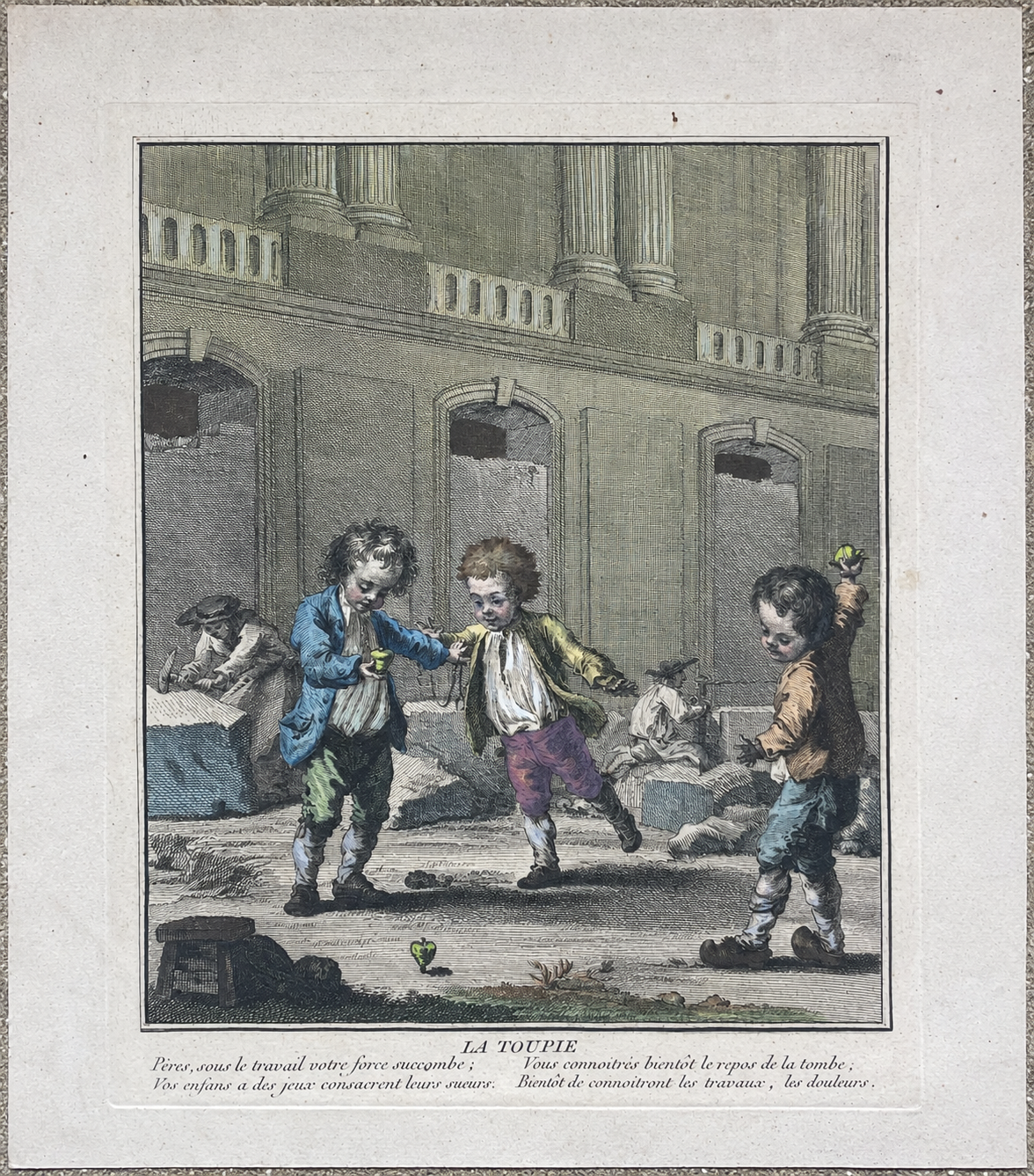
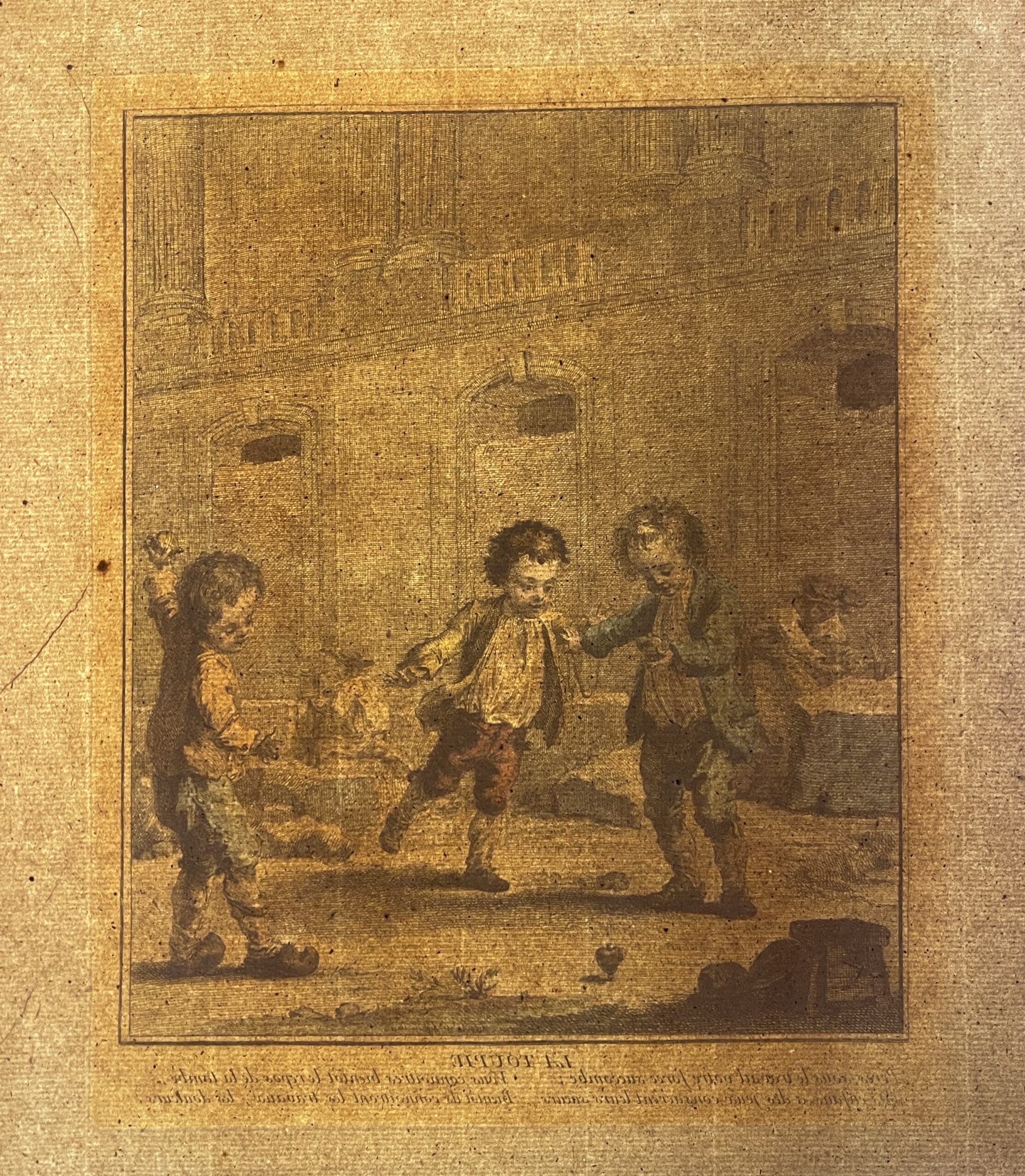
Charming eighteenth-century French colour engraving La Toupie (The Spinning Top), associated with Augustin de Saint-Aubin (1736–1807), circa 1770.
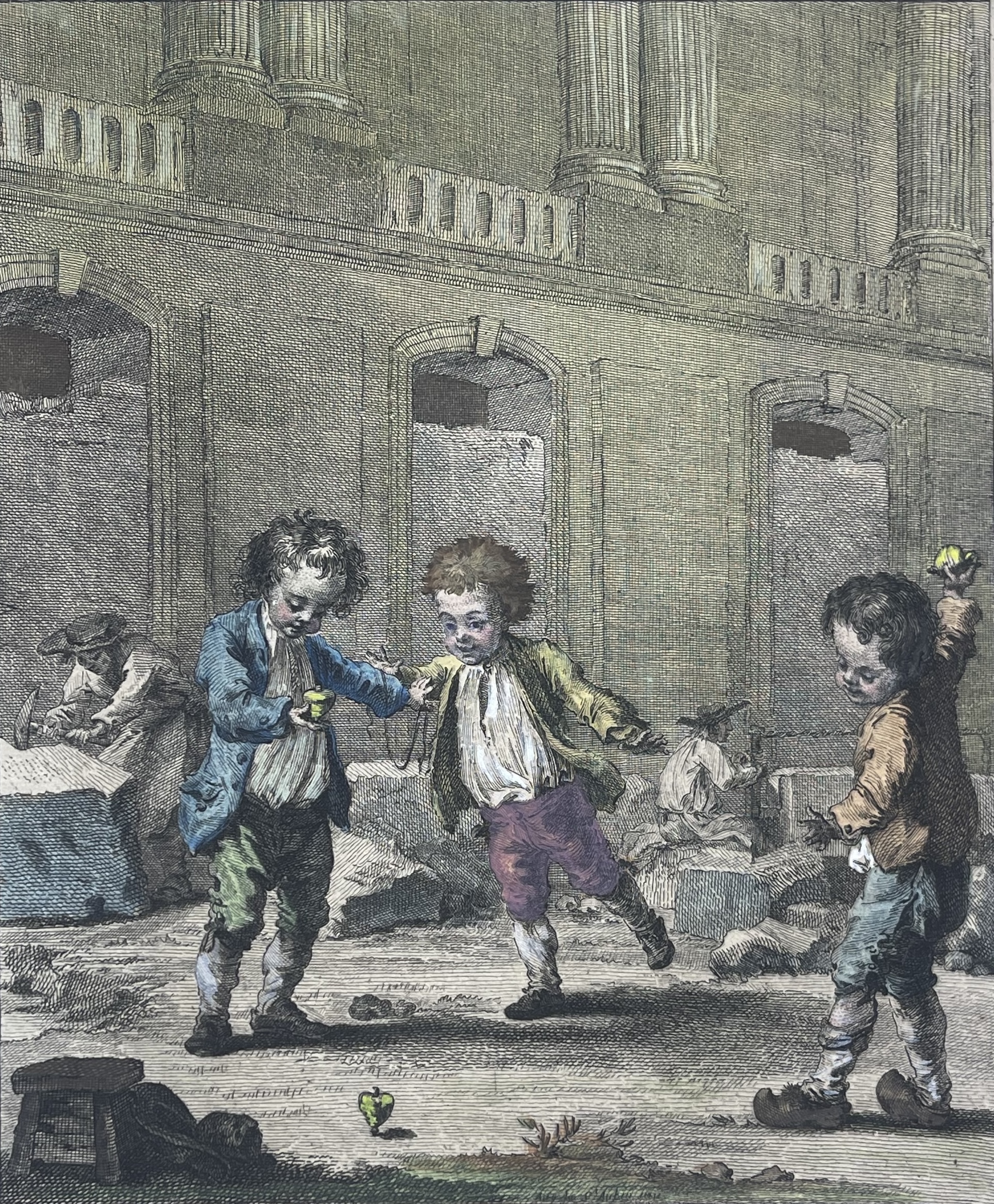
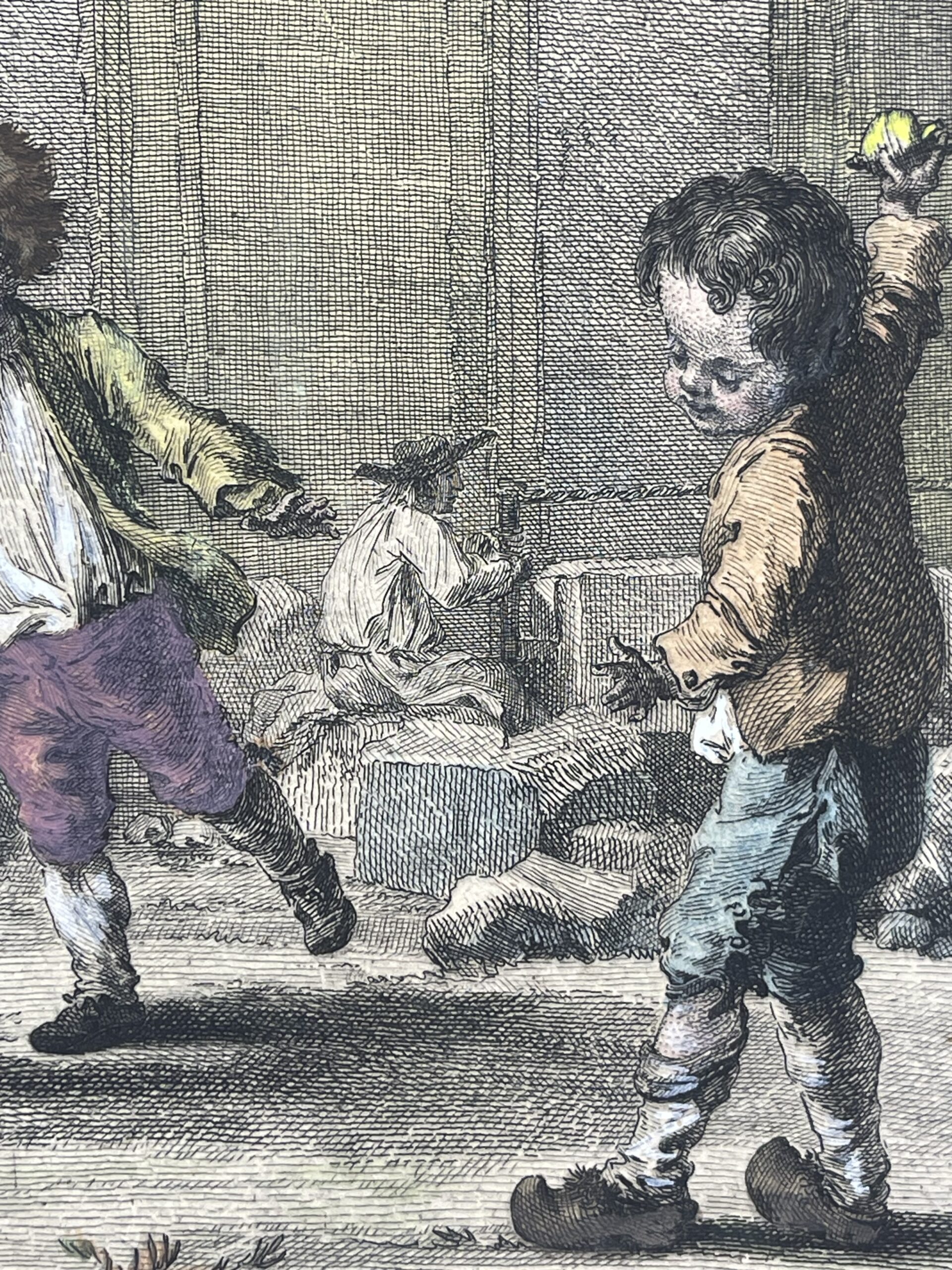
Three Parisian boys play with spinning tops while stoneworkers labour in the background.
From the celebrated series Les Différents Jeux des Petits Polissons de Paris, listed as Bocher 398.
Antique impression on laid linen paper with original French verses.
Sheet: 25.7 × 22.3 cm.
Engraved image: 19.7 × 16.2 cm.
Description
AUGUSTIN DE SAINT-AUBIN – LA TOUPIE – PARIS CHILDREN’S GAMES – CIRCA 1770
Antique French Colour Engraving – Les Différents Jeux des Petits Polissons de Paris – Bocher 398
An attractive eighteenth-century French engraving entitled La Toupie (The Spinning Top), associated with Augustin de Saint-Aubin (1736–1807), one of the most accomplished French draughtsmen and engravers of the period.
e celebrated series Les différents jeux des petits polissons de Paris, a collection of six engravings illustrating popular children’s games in eighteenth-century Paris.
A LIVELY SCENE OF PARISIAN CHILDHOOD
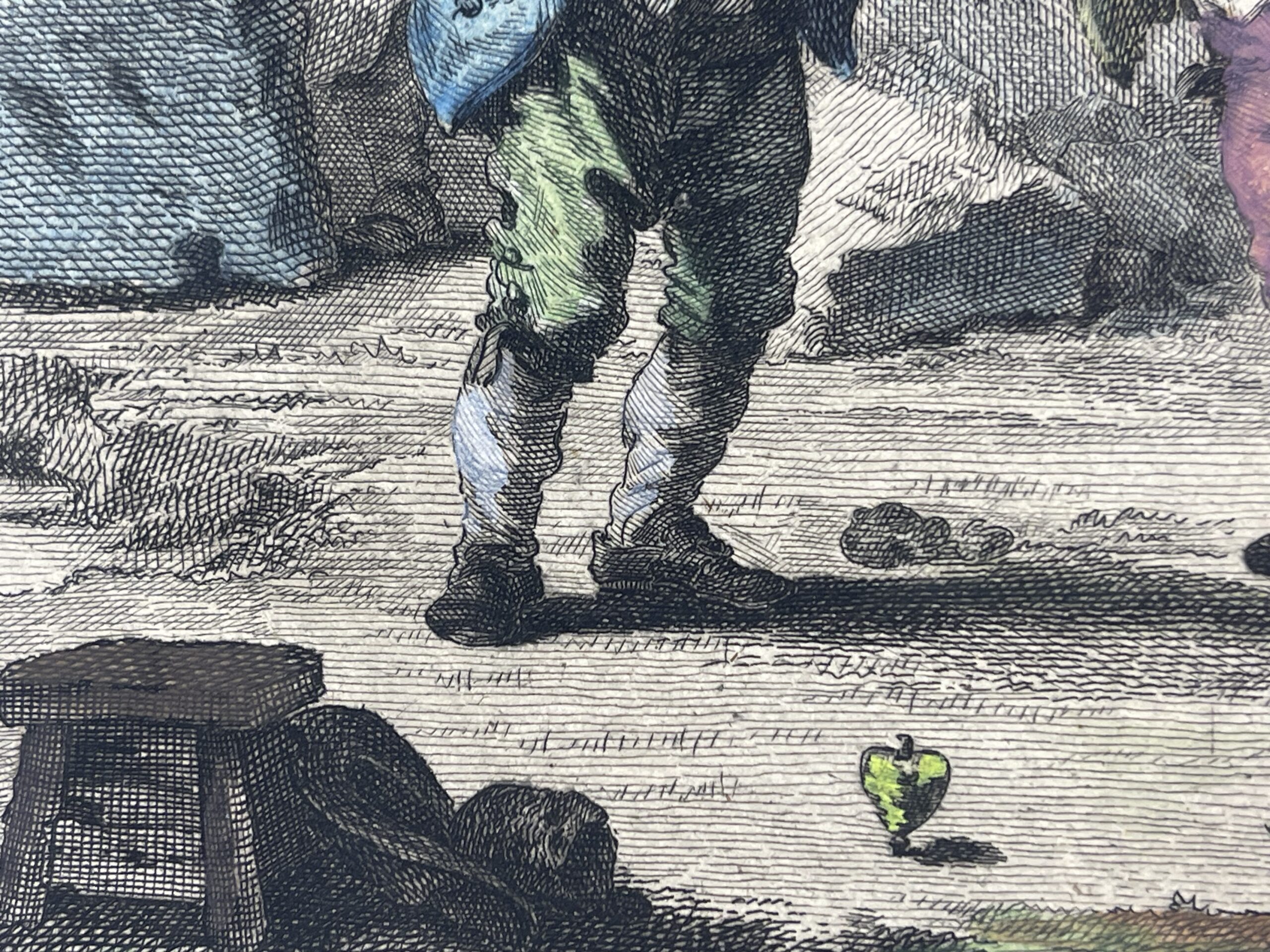
The composition depicts three young boys absorbed in the traditional game of spinning tops.
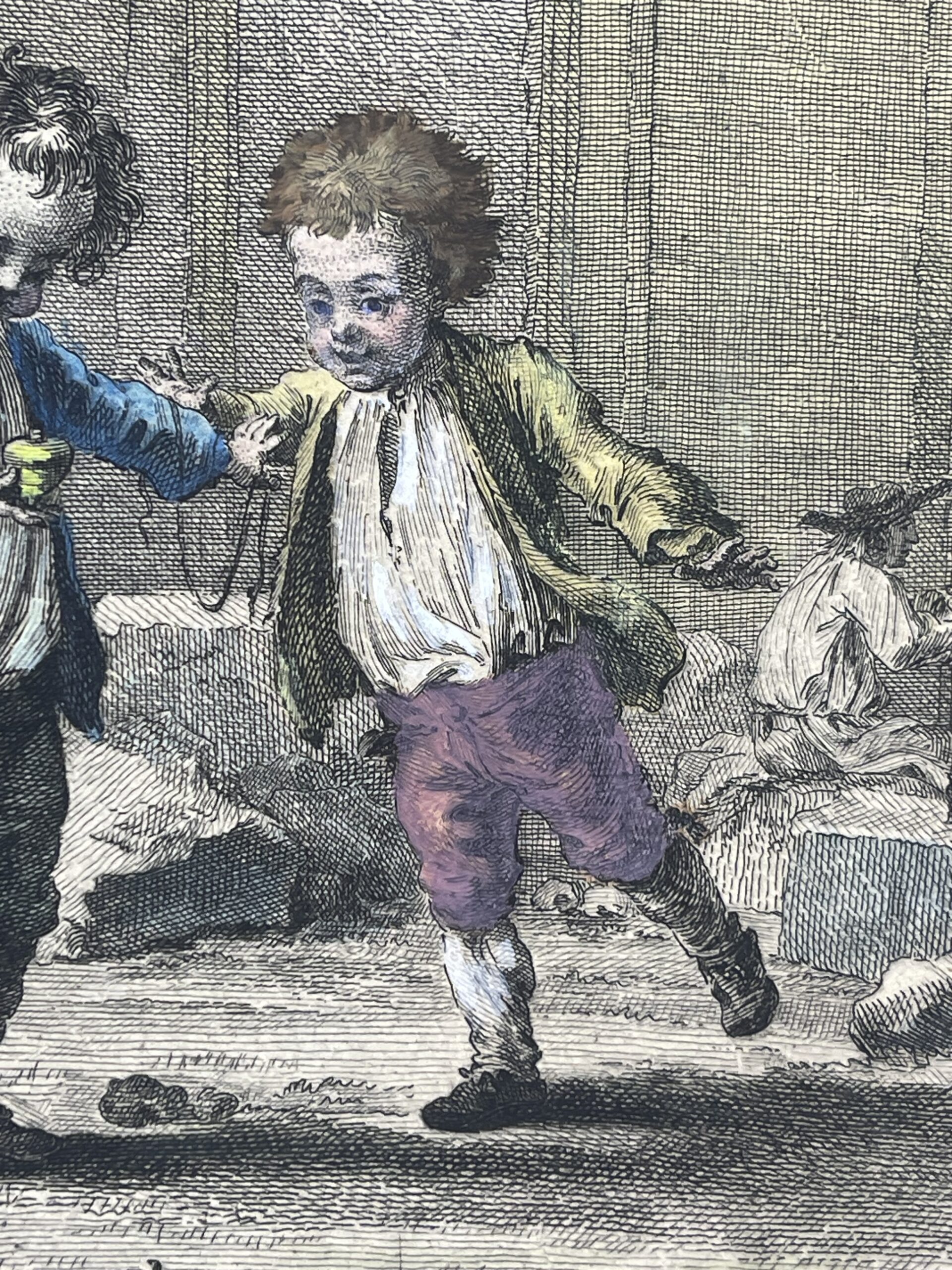
In the centre, a child wearing a yellow jacket and red breeches has just launched his top onto the ground.
His animated posture expresses the excitement of the game.
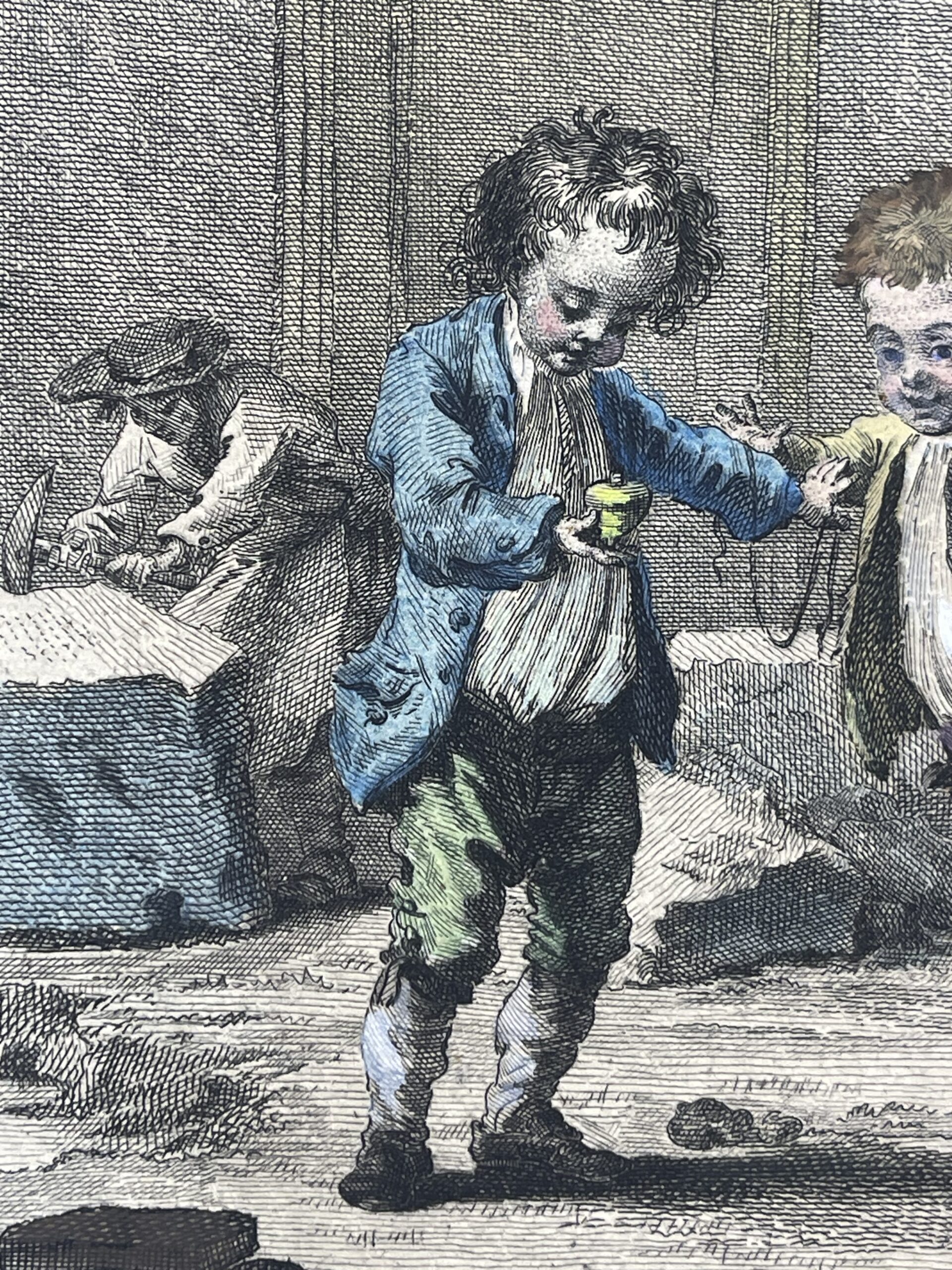
To his left, another boy dressed in blue carefully observes his spinning top, while a third child stands to the right, preparing to take his turn.
The children’s expressions and gestures are represented with delightful naturalness.
Their clothing provides an interesting record of French popular dress during the late eighteenth century.
In the background, two stoneworkers are engaged in their labour beneath the columns of a monumental building.
This contrast between carefree childhood and adult work gives the scene an additional social and moral dimension.
THE SPINNING TOP IN EIGHTEENTH-CENTURY FRANCE
Spinning tops were among the most popular traditional children’s toys in eighteenth-century Europe.
Made principally from wood, they were set in motion with a string or whip and provided an inexpensive form of entertainment.
The game was particularly popular among children playing in streets and public spaces.
Saint-Aubin’s engraving offers a fascinating visual document of everyday Parisian childhood before the French Revolution.
Rather than depicting aristocratic entertainment, the artist turns his attention to ordinary children and the small pleasures of daily life.
A MORAL VERSE BENEATH THE IMAGE
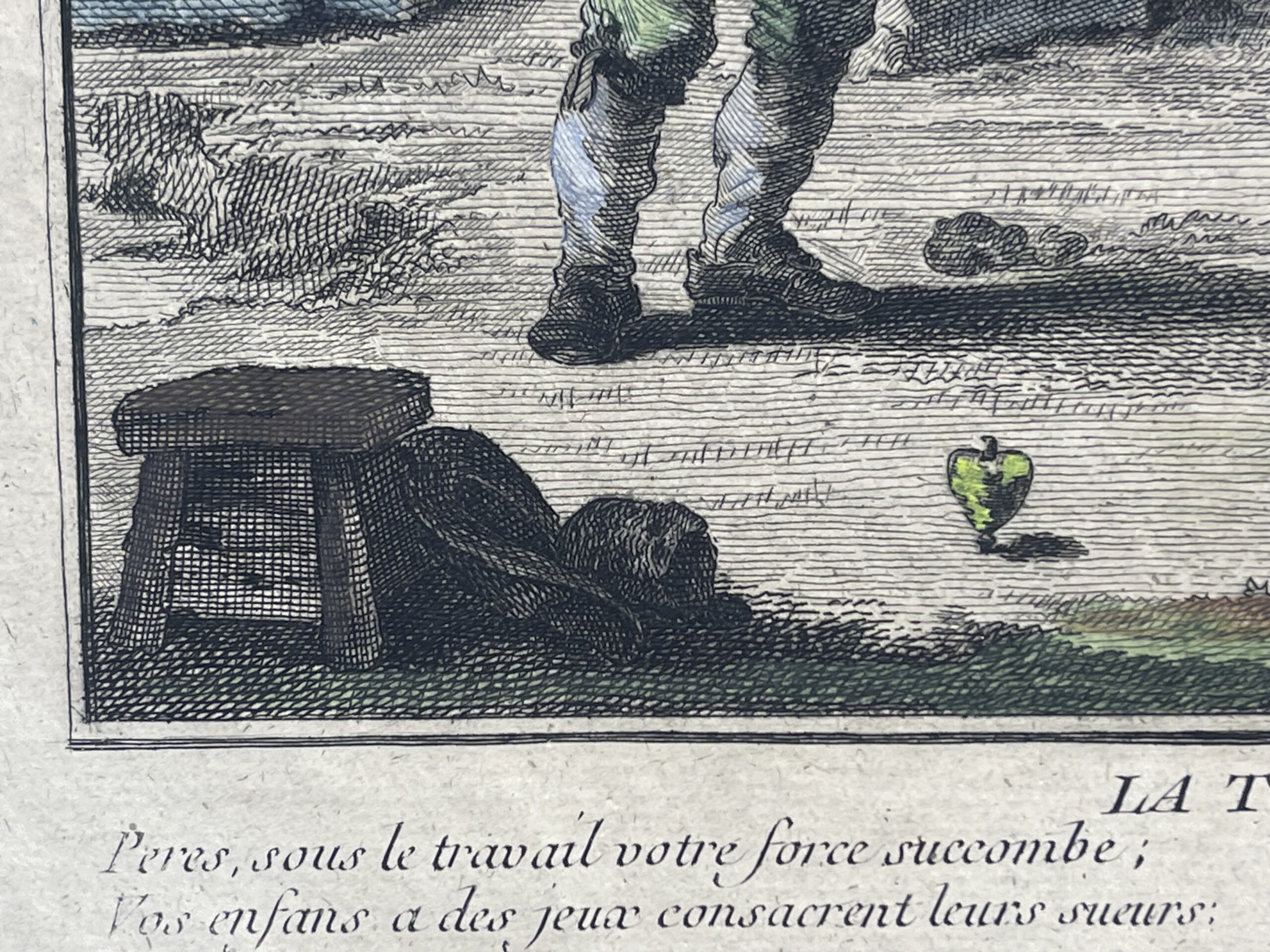
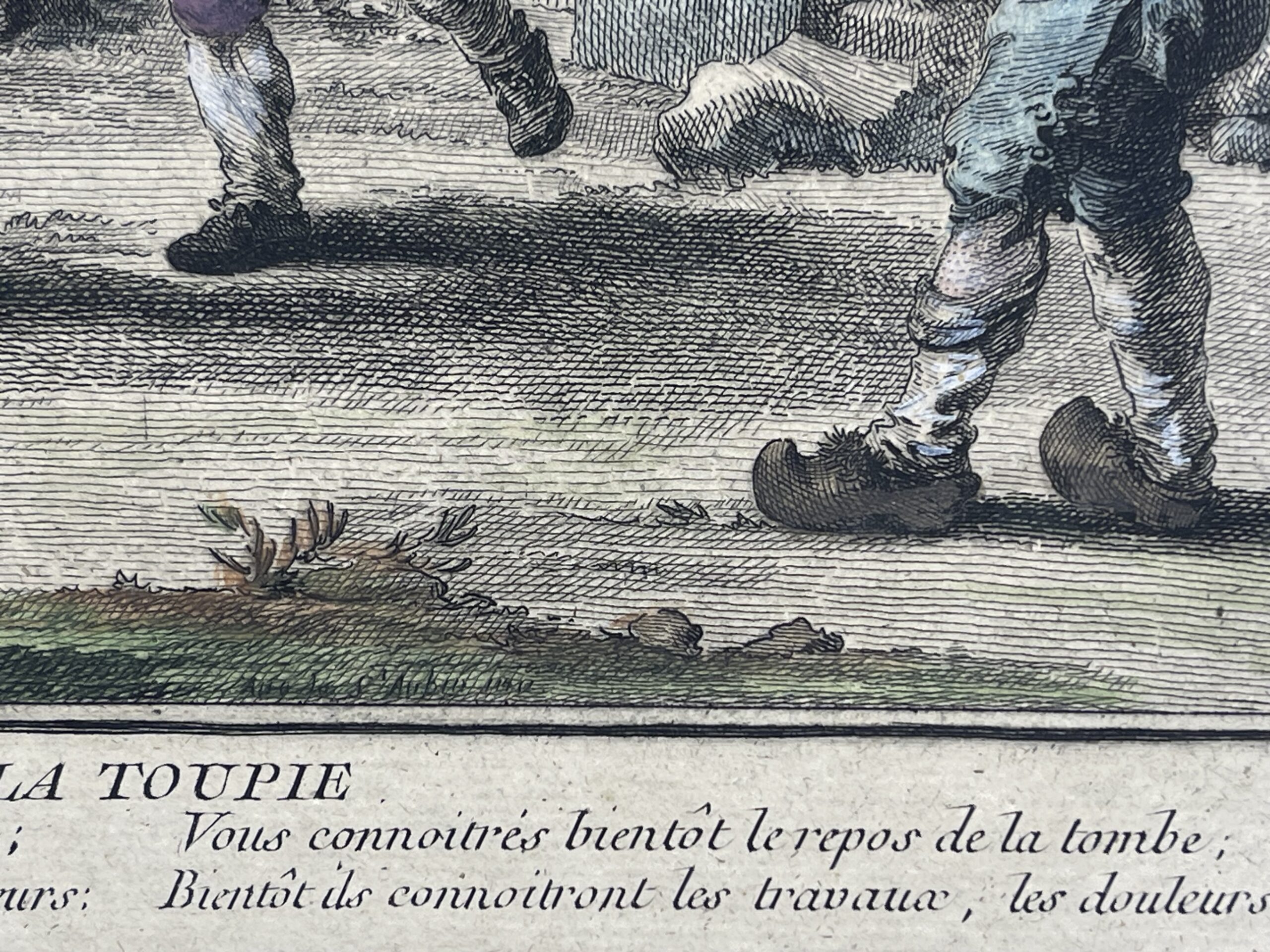
The engraving is accompanied by a four-line French poem reflecting upon the contrast between childhood amusement and the responsibilities of adulthood.
The verses remind the viewer that youthful games eventually give way to labour and the difficulties of adult existence.
The stoneworkers represented in the background reinforce this moral interpretation.
This combination of genre illustration and moral poetry is characteristic of certain French prints produced during the Enlightenment.
LES DIFFÉRENTS JEUX DES PETITS POLISSONS DE PARIS
La Toupie forms part of an important series of six engravings illustrating traditional games played by Parisian children.
The series includes:
Le Sabot – The Spinning Top.
Le Coupe-tête – Leapfrog.
La Fossette ou le jeu des noyaux – The Game of Stones.
La Sortie du collège – Leaving School.
La Corde – Skipping Rope.
La Toupie – The Top Game.
Published around 1770, the series is particularly valued for its lively representation of eighteenth-century French social history.
It provides an unusual and engaging record of the games, clothing and daily activities of children in Paris.
AUGUSTIN DE SAINT-AUBIN (1736–1807)
Augustin de Saint-Aubin was a prominent French engraver, draughtsman and portrait artist.
Born in Paris into a distinguished family of artists, he studied with his elder brother Gabriel-Jacques de Saint-Aubin and the engraver Étienne Fessard.
He was admitted to the Royal Academy of Painting and Sculpture in 1775 and appointed Engraver to the King and his Library in 1777.
His work encompasses portraits, decorative compositions, literary illustrations and scenes of everyday life.
Saint-Aubin is especially admired for his precise draughtsmanship, elegant engraved lines and remarkable ability to capture human gestures and expressions.
His engravings of Parisian children’s games belong to the most appealing examples of eighteenth-century French genre illustration.
BIBLIOGRAPHICAL REFERENCES
The composition is recorded in Emmanuel Bocher’s catalogue raisonné of eighteenth-century French engravings under number 398.
An example dated 1770 is preserved in the Cabinet des Estampes et des Dessins, Strasbourg.
The Musée Carnavalet in Paris also holds an example associated with the same series.
These institutional references establish the historical importance of the composition.
AN ATTRACTIVE EIGHTEENTH-CENTURY PRINT
The engraving is printed on antique laid linen paper and retains its original French title and accompanying verse.
The delicate colouring, charming subject and substantial margins make it especially attractive to collectors of historical prints.
It is of particular interest to those studying childhood, traditional toys, French social history and eighteenth-century Paris.
DETAILS
Artist: Augustin de Saint-Aubin (1736–1807).
Original title: La Toupie.
English title: The Spinning Top.
Series: Les Différents Jeux des Petits Polissons de Paris.
Date: Circa 1770.
Technique: Antique intaglio engraving with colour.
Paper: Antique laid linen paper.
Sheet dimensions: 25.7 × 22.3 cm.
Engraved image: 19.7 × 16.2 cm.
Catalogue reference: Bocher 398.
Period: 18th century.
Origin: Paris, France.
Subject: Children’s games, spinning tops, Parisian street life and social history.
CONDITION
Antique impression showing the natural patina of aged paper.
The engraved composition, delicate colours and original French inscriptions are well preserved.
A charming and historically significant eighteenth-century engraving associated with Augustin de Saint-Aubin and the popular games of Parisian children.
Reference: 5131-6R619
Dating from around 1770, this charming composition depicts three young boys playing with spinning tops in a Parisian street, while stoneworkers carry out their daily labour in the background.

Avis
Il n’y a pas encore d’avis.