Description
Rome Italy 1704 – Andabatae – Original Early Eighteenth-Century Dutch Engraving Depicting Two Ancient Roman Gladiators Fighting on Horseback with Lances.
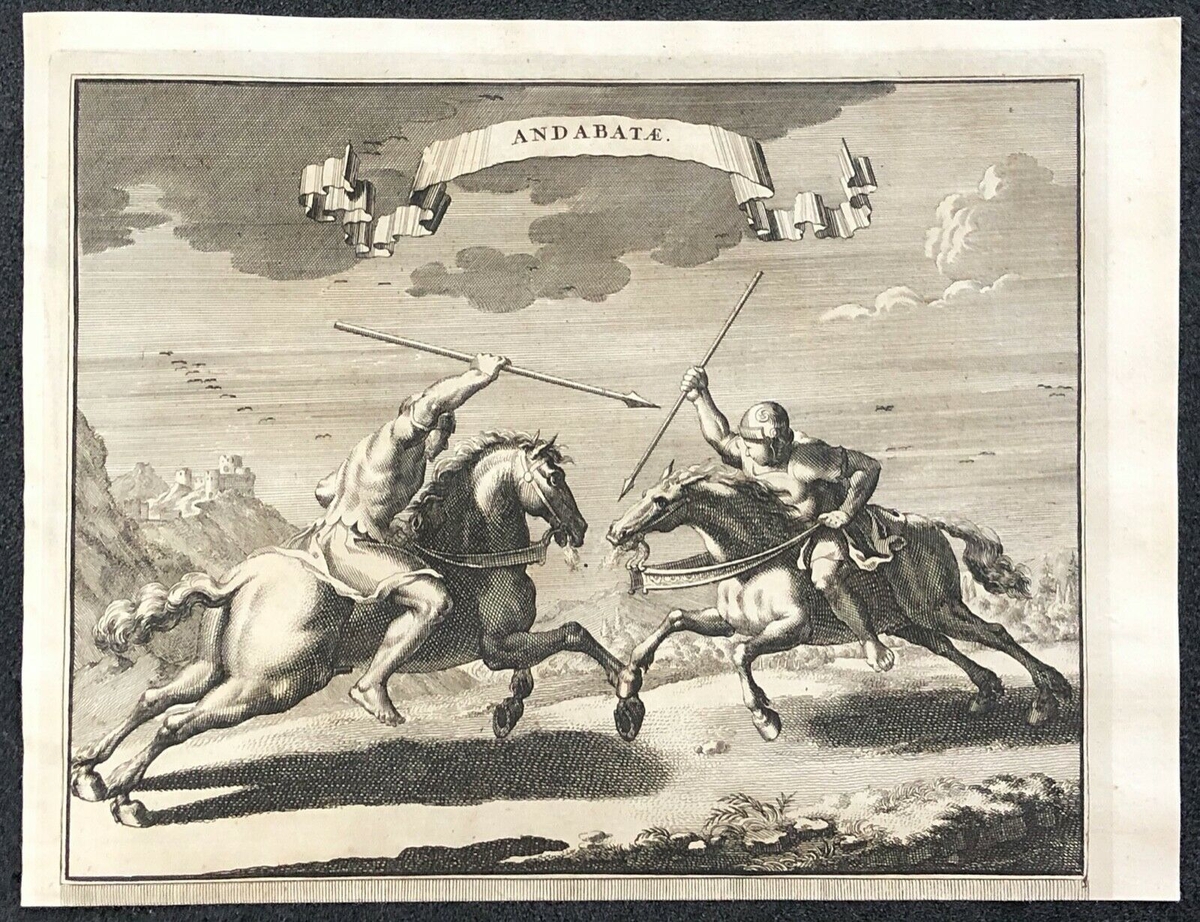
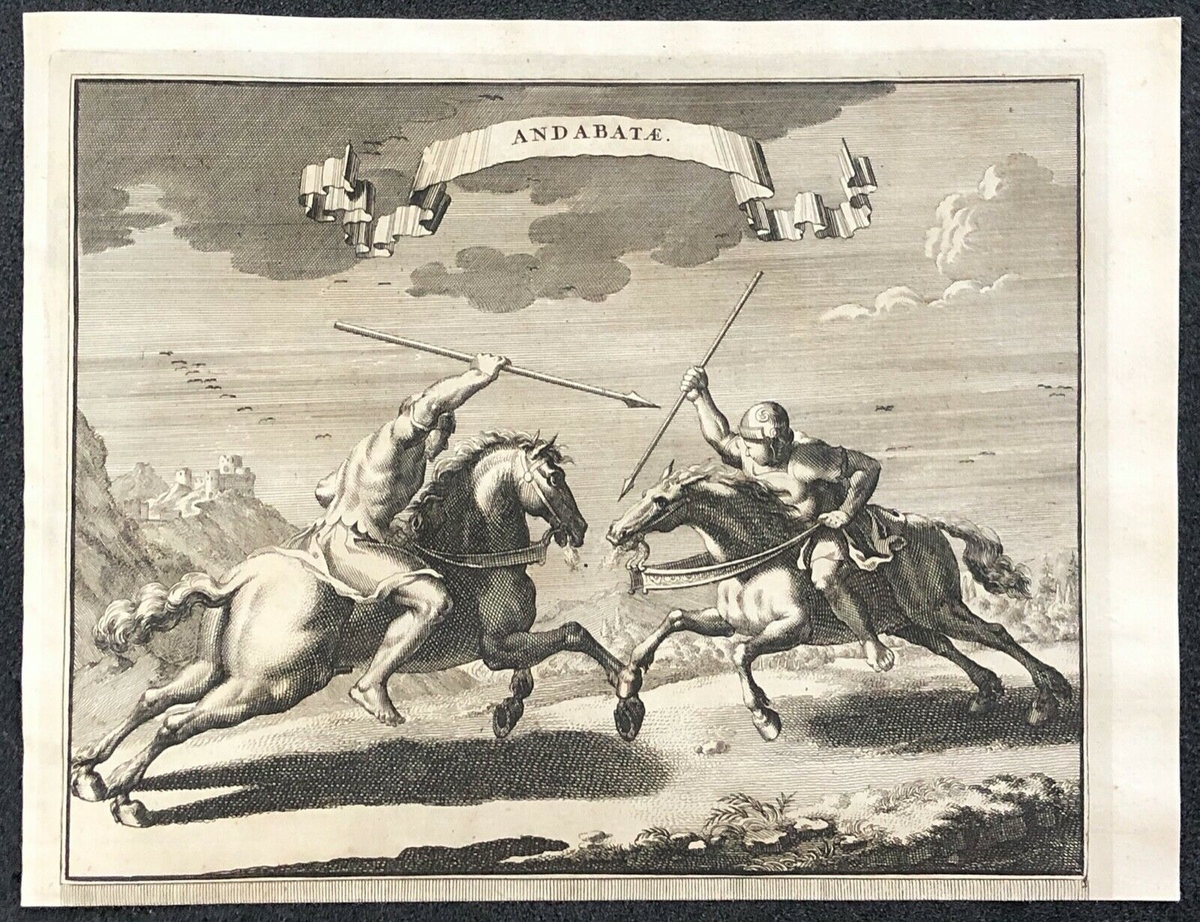
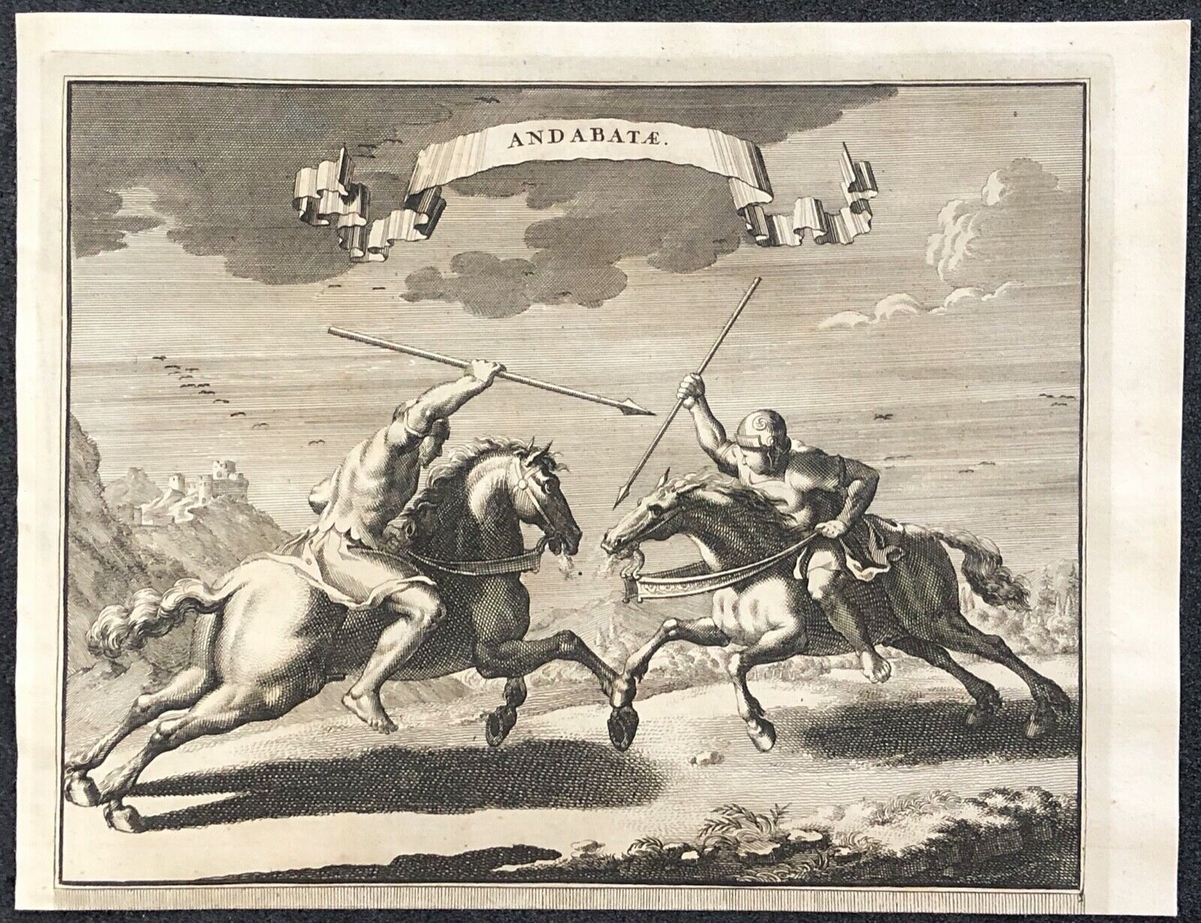
Artculture6 presents this remarkable antique engraving, published in the Netherlands in 1704, representing an impressive equestrian combat between two gladiators associated with the ancient Roman category known as the Andabatae.
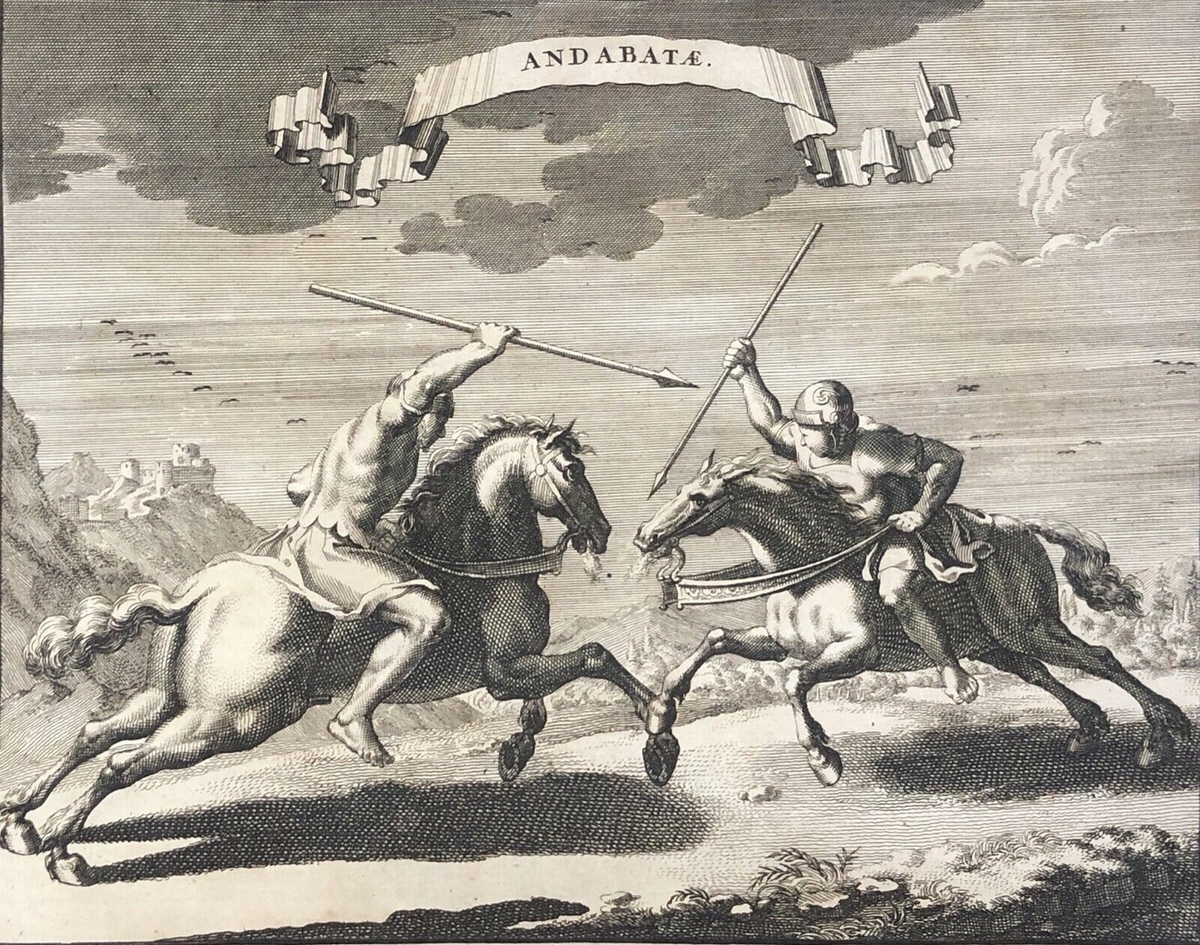
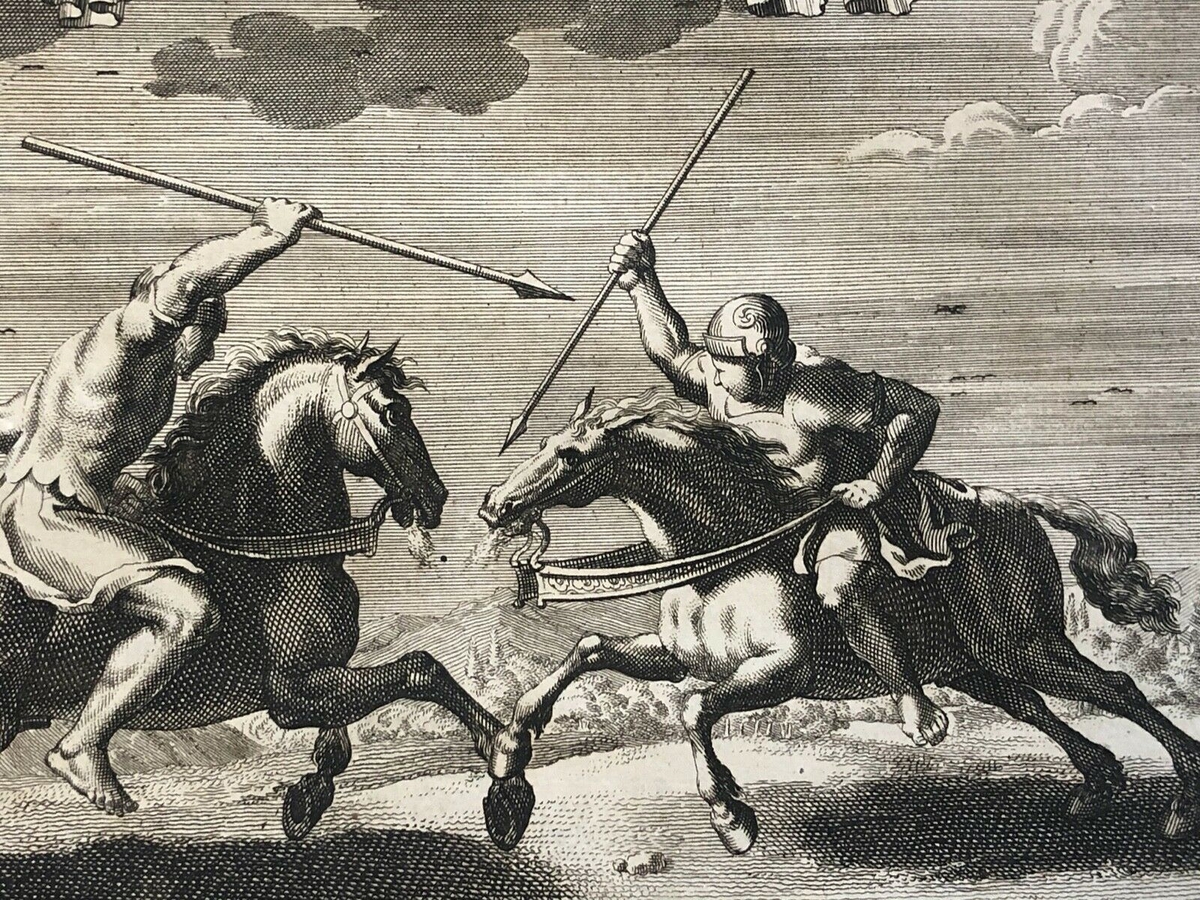
The composition depicts two powerful horses galloping towards one another, each carrying an armed combatant holding a long spear.
Above the scene, an elegant decorative ribbon bears the original Latin inscription:
“ANDABATÆ”
The landscape features rocky hills, fortified buildings, distant mountains and an extensive cloudy sky.
Executed with exceptional attention to movement, anatomy and engraved detail, this historical print offers a fascinating interpretation of ancient Roman gladiatorial combat.
ANDABATAE – A DISTINCTIVE CLASS OF ROMAN GLADIATORS
The Andabatae were an unusual category of gladiators known from ancient Roman literary references.
Gladiators in Rome were divided into several classes according to their equipment, weapons and methods of fighting.
Some used swords and shields, while others employed nets, tridents or specialised protective armour.
The Andabatae were traditionally described as fighters wearing helmets that obstructed their vision.
The absence of normal openings for the eyes made their combat particularly difficult.
The Roman writer Cicero referred to this type of gladiator during the first century BC.
The unusual character of the Andabatae attracted the attention of scholars studying ancient Roman customs.
In later European illustrations, these combatants were sometimes represented fighting on horseback.
Although the mounted interpretation is well established in historical iconography, surviving ancient evidence does not conclusively establish that the Andabatae fought as horsemen.
This engraving is therefore particularly interesting as an early eighteenth-century artistic interpretation of a Roman subject.
A DRAMATIC COMBAT BETWEEN TWO HORSEMEN
The composition represents two mounted combatants rushing towards one another.
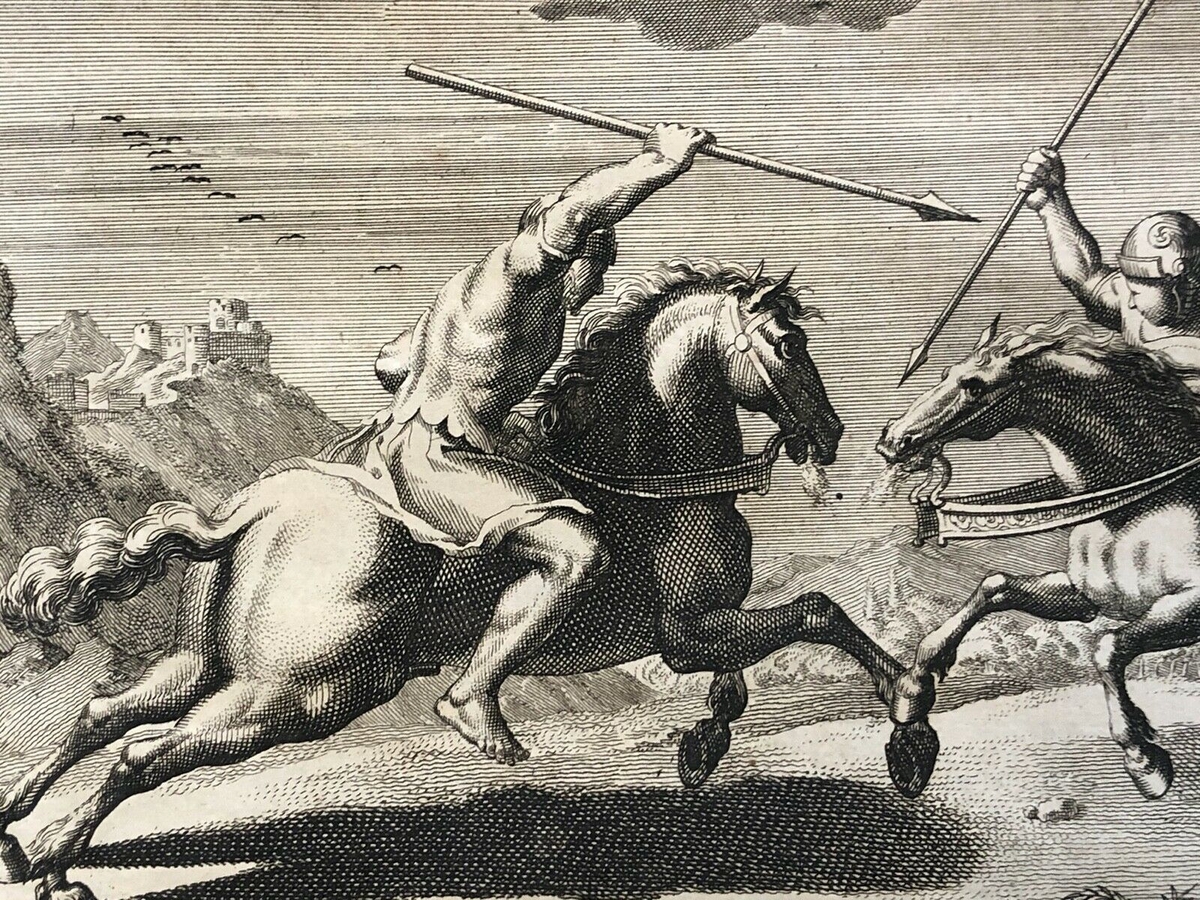
On the left, a rider wearing a short tunic raises a long spear above his head.
His horse gallops forward with its hind legs fully extended and its forelegs lifted.
The animal’s muscular body is rendered with remarkable precision.
Its mane and tail are swept backwards, emphasising the speed of the movement.
On the right, a second rider wearing an ancient-style helmet prepares to confront his opponent.
He holds a long spear high in one hand while controlling his horse with the other.
His horse advances in a powerful gallop.
The heads of the two animals approach one another near the centre of the composition.
Their opposing movements create an exceptional impression of energy and dramatic tension.
THE HORSES – A REMARKABLE EQUESTRIAN COMPOSITION
The representation of horses is one of the finest qualities of this engraving.
Both animals are shown in dynamic positions.
Their muscular bodies are carefully modelled through delicate engraved lines.
The necks, shoulders, legs and hindquarters display a detailed understanding of equestrian anatomy.
The flowing manes and tails contribute to the impression of speed.
The horses’ bridles and reins are also carefully represented.
The artist employs contrasting passages of light and shadow to emphasise the volume of the animals.
The powerful movements of their legs create a dramatic rhythm across the composition.
This lively equestrian scene will be particularly attractive to collectors of antique horse engravings and historical sporting or military imagery.
ANCIENT ROMAN GLADIATORIAL COMBAT
Gladiatorial spectacles were an important part of public entertainment in ancient Rome.
Professional fighters and other combatants performed in amphitheatres before large audiences.
Gladiators could be distinguished by the weapons and equipment they carried.
Among the better-known categories were the Murmillones, Thraces, Retiarii, Secutores and Equites.
The Equites were gladiators associated with mounted combat.
The Andabatae, by contrast, were particularly known for the restriction of their vision.
Ancient literary sources provide only limited information about their precise equipment and fighting methods.
Their unusual characteristics nevertheless made them an attractive subject for later historical illustrations.
The present engraving reflects the fascination of early modern European artists with ancient Roman customs and military traditions.
A HISTORICAL INTERPRETATION OF ANCIENT ROME
The print does not represent a documented individual battle or identifiable Roman gladiators.
Instead, it offers an artistic reconstruction of a category of ancient fighters.
The two horsemen are depicted in a dramatic confrontation intended to illustrate their weapons and manner of combat.
The combination of classical costume, helmets, lances and powerful horses creates a striking historical image.
The engraving also reflects the visual conventions of early eighteenth-century European art.
The horses are presented in highly expressive attitudes, while the surrounding landscape provides an idealised setting.
This type of representation was particularly valued by collectors interested in classical antiquity, Roman customs and the history of military spectacle.
A ROCKY LANDSCAPE WITH FORTIFIED BUILDINGS
The background contributes significantly to the dramatic character of the engraving.
On the left, a rocky hill rises above the landscape.
Several fortified buildings and towers can be distinguished near its summit.
An irregular pathway appears to wind towards the architectural structures.
Further into the distance, mountains extend towards the horizon.
The surrounding countryside is represented through fine parallel lines and carefully arranged shading.
The architectural setting evokes an imagined ancient landscape.
The sky occupies a considerable part of the composition.
Large clouds provide strong contrasts between light and dark areas.
Small birds appear in the distance, adding a further sense of space and atmosphere.
THE ART OF EARLY EIGHTEENTH-CENTURY ENGRAVING
During the seventeenth and eighteenth centuries, the Netherlands was an important centre of European printmaking.
Engravers developed highly sophisticated techniques for representing landscapes, architecture, animals and historical subjects.
The present engraving demonstrates considerable technical skill.
The horses are rendered through numerous fine lines and cross-hatching.
Darker areas of the composition contain densely arranged engraved strokes.
The figures and weapons are defined by clear contours and carefully balanced shading.
The landscape is treated with lighter lines, allowing the horses and gladiators to dominate the scene.
The sky is represented by long horizontal strokes and delicately modelled clouds.
The result is a finely balanced engraving combining precise observation with dramatic movement.
THE LATIN INSCRIPTION ANDABATÆ
The word “ANDABATÆ” appears at the top of the composition inside a decorative ribbon.
It is the plural Latin form of Andabata, a particular type of Roman gladiator.
The inscription identifies the historical subject and provides an important connection with classical terminology.
The elegant cartouche is carefully engraved, with curved folds and ornamental ends.
Its position above the figures gives the composition a formal and decorative character.
The preservation of this original Latin inscription enhances the historical interest of the print.
HORSES AND COMBAT IN EUROPEAN ART
Equestrian scenes occupied an important place in European art.
Artists frequently represented horses as symbols of strength, nobility, military power and movement.
Battle scenes, tournaments and historical combats offered opportunities to demonstrate the physical qualities of the horse.
In this engraving, the animals are not simply secondary figures.
They are essential to the composition.
Their bodies form two opposing movements that meet at the centre of the scene.
The riders’ raised lances complete the dramatic arrangement.
The combination of equestrian anatomy and historical combat makes this engraving particularly appealing.
A FINE ANTIQUE ENGRAVING ON LAID PAPER
The work is printed on antique laid paper.
The sheet has a pleasant natural tone acquired through age.
The engraved image is surrounded by margins, with the original title clearly visible within the composition.
The fine printed lines preserve the detailed modelling of the horses, figures and surrounding landscape.
The print offers a beautiful example of the artistic interest in Roman antiquity during the early eighteenth century.
DIMENSIONS AND TECHNICAL DETAILS
Subject: Ancient Roman gladiators, Andabatae.
Historical setting: Ancient Rome, Italy.
Place of publication: Netherlands.
Date: 1704.
Period: Early eighteenth century.
Technique: Antique intaglio engraving.
Support: Antique laid paper.
Original Latin title: ANDABATÆ.
Sheet dimensions: 21.7 × 17.3 cm.
Engraved image dimensions: 19.7 × 15.7 cm.
Iconography: Mounted gladiators, horses, spears, helmets and historical combat.
Engraver: Not identified.

Avis
Il n’y a pas encore d’avis.