Description
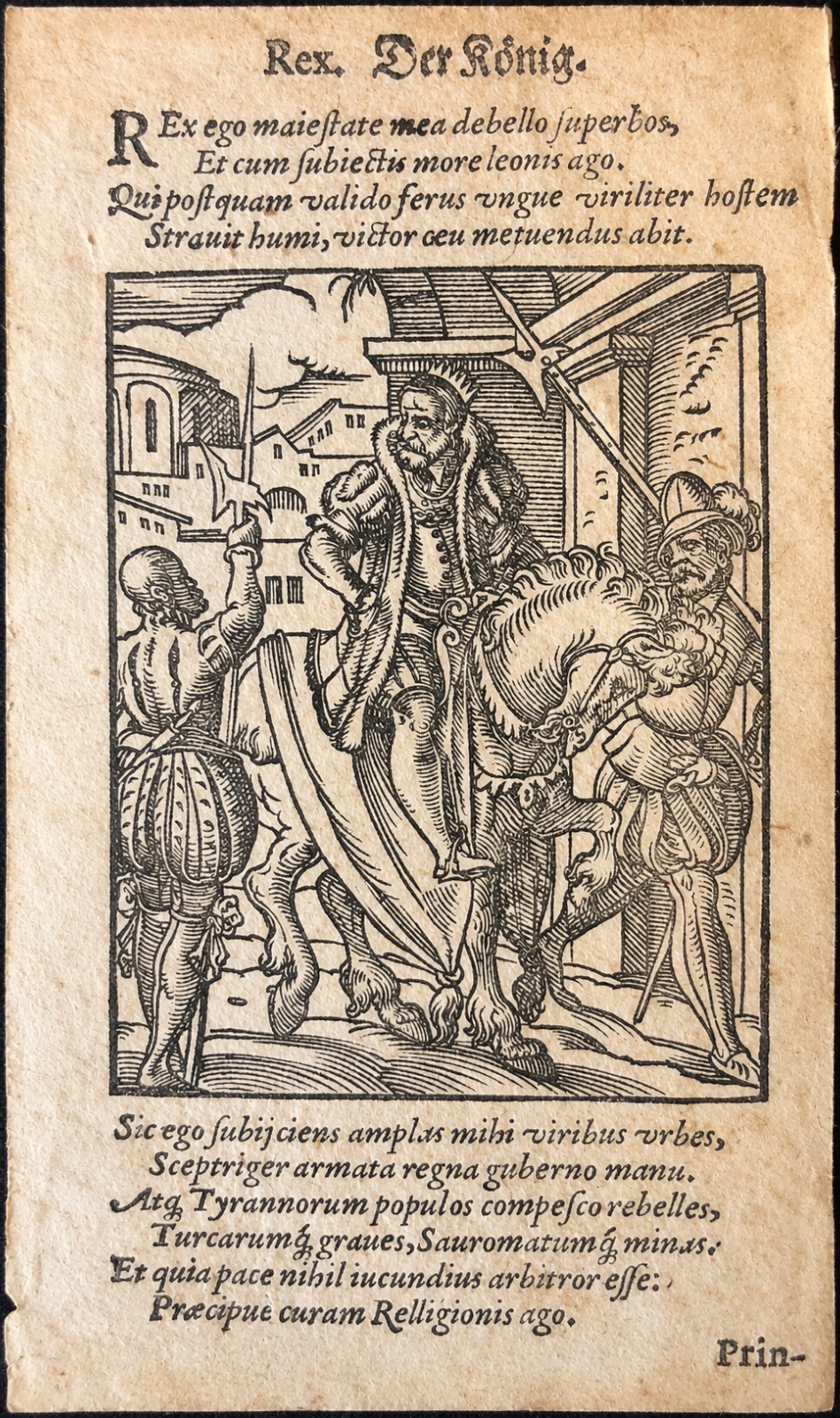
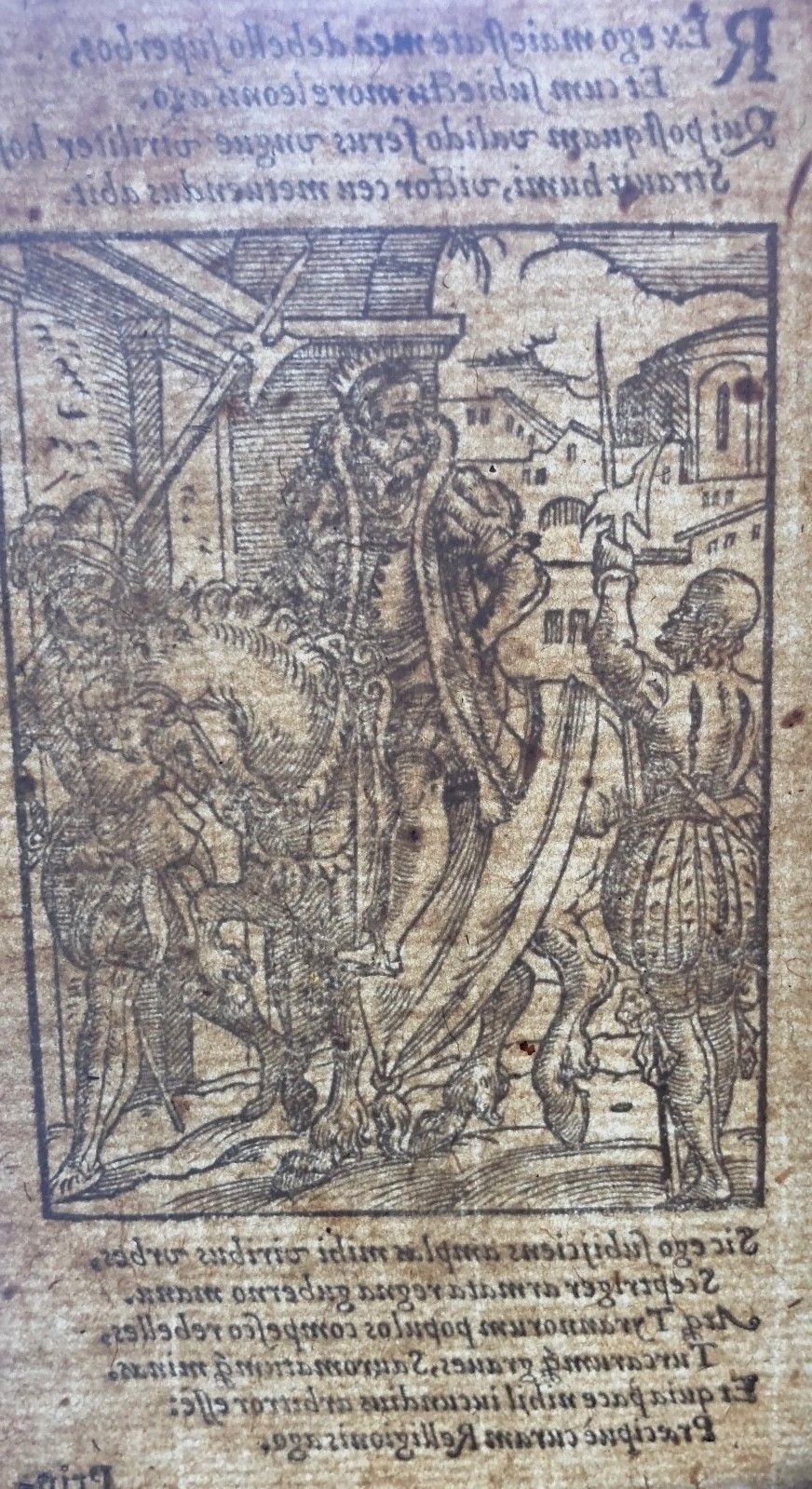
Germany 1568 – Jost Amman (1539–1591) – Rex Der König – Original German Renaissance Woodcut Depicting a Crowned King on Horseback, an Allegory of Royal Power and Authority.
Artculture6 presents this remarkable sixteenth-century German woodcut by Jost Amman (1539–1591), one of the most celebrated draughtsmen and printmakers of the German Renaissance.
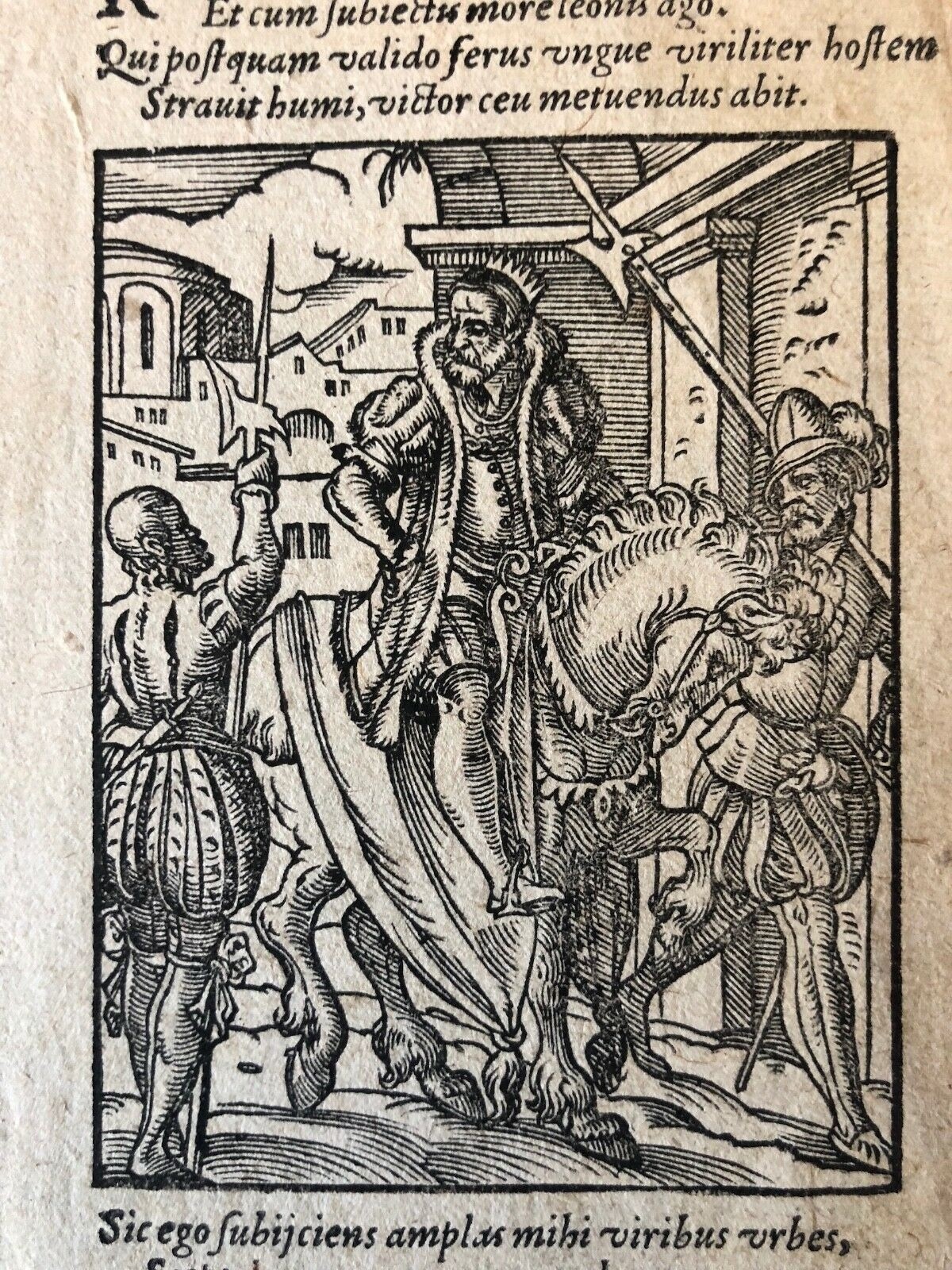
Entitled “Rex – Der König” (The King), this finely executed composition depicts a crowned monarch mounted on a richly decorated horse, accompanied by two figures in elaborate Renaissance costumes.
The image is surrounded by Latin verses celebrating the virtues, responsibilities and authority of a sovereign.
Dated 1568, the composition offers a fascinating representation of kingship, political authority and Renaissance ceremonial dress.
Its exceptional graphic precision and rich symbolic imagery make it particularly interesting for collectors of early German woodcuts, Renaissance art, historical costume and royal iconography.
REX – DER KÖNIG – THE REPRESENTATION OF ROYAL AUTHORITY
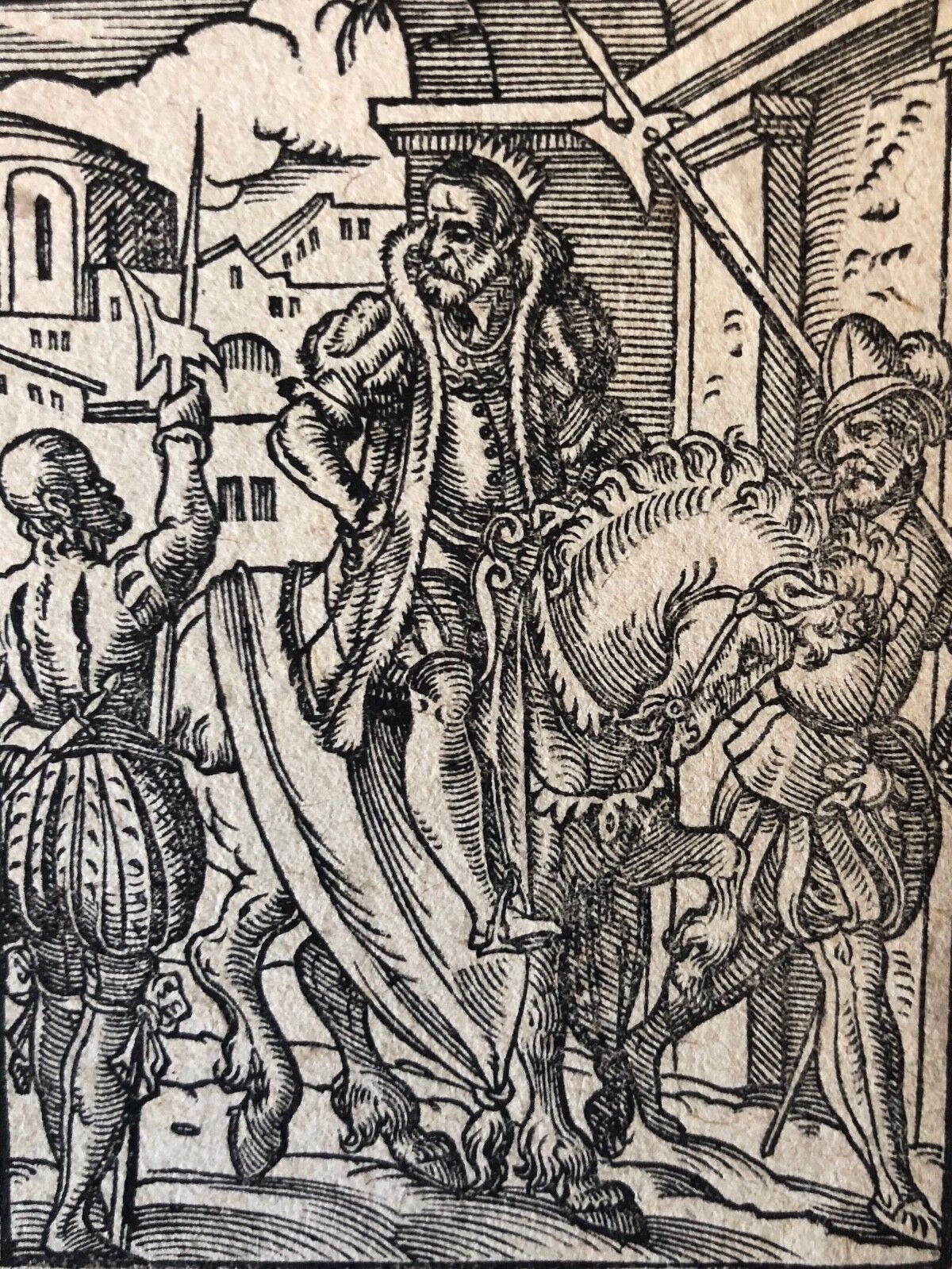
At the centre of the composition stands a majestic crowned king mounted on a powerful horse.
The sovereign wears an elaborate Renaissance costume beneath a magnificent fur-lined mantle.
His crown emphasises his royal dignity, while his confident posture expresses authority and command.
One hand rests upon his hip, reinforcing the imposing character of the figure.
The monarch’s clothing is particularly interesting.
The richly decorated doublet, fitted garments, large sleeves and heavy fur-lined cloak provide a detailed representation of sixteenth-century aristocratic fashion.
The artist has carefully distinguished the different textures of the fabrics through precise woodcut lines.
The fur lining, in particular, is represented with numerous curved strokes and dark contrasts.
The entire composition is conceived as a symbolic image of monarchy rather than as a portrait of a specific historical ruler.
THE KING ON HORSEBACK – A SYMBOL OF POWER
The horse occupies a central position in the engraving.
Its head is turned slightly downwards, while its body is presented in an elegant, controlled movement.
The animal possesses an abundant mane and a carefully decorated bridle.
A large ornamental covering descends along its body.
The saddle and harness contain numerous decorative details.
Throughout European history, the representation of a sovereign on horseback was associated with military authority, nobility, courage and the ability to govern.
This tradition became particularly important in Renaissance art, when equestrian imagery was employed to celebrate rulers, commanders and members of the aristocracy.
The present woodcut combines these established symbols with the distinctive visual language of German Renaissance printmaking.
TWO FIGURES ACCOMPANYING THE MONARCH
On the left stands a man wearing a short Renaissance garment with conspicuous padded breeches.
His costume includes fitted stockings, an elaborate doublet and a cap.
He raises one arm towards the king, apparently addressing or acknowledging the sovereign.
The carefully represented clothing is typical of the elaborate male fashions of the sixteenth century.
On the right, another figure stands beside the horse.
He wears a broad-brimmed hat with a feather and a richly decorated costume.
His sleeves are voluminous, while the lower part of his garment includes the characteristic fitted and gathered elements of Renaissance dress.
The two attendants provide a striking contrast with the king’s imposing appearance.
Their gestures and clothing contribute to the ceremonial and narrative qualities of the scene.
AN ARCHITECTURAL SETTING OF THE GERMAN RENAISSANCE
The background contains a detailed architectural environment.
On the left, a group of buildings appears behind the figures.
Their roofs, windows and façades suggest a European town of the sixteenth century.
An arched gateway is visible in the distance.
On the right, an imposing architectural structure frames the composition.
Columns, masonry and decorative features are rendered through closely arranged lines.
The urban setting creates depth while reinforcing the impression of a public and ceremonial encounter.
Despite the small size of the print, the artist includes an extraordinary variety of details.
THE SYMBOLISM OF KINGSHIP IN RENAISSANCE EUROPE
During the Renaissance, the king was regarded not only as a political ruler but also as the embodiment of justice, order and the protection of his subjects.
Royal imagery frequently combined symbols of military strength with references to moral responsibility.
The crown represented sovereignty.
The horse symbolised noble status and military power.
The richly decorated garments expressed dignity and magnificence.
The surrounding architectural setting suggested the kingdom and its institutions.
In this woodcut, these elements are accompanied by Latin verses presenting the king as a powerful ruler responsible for maintaining order.
The combination of image and moralising text reflects the humanist culture of sixteenth-century Europe.
THE LATIN VERSES – THE VOICE OF THE KING
The original Latin text above the woodcut begins:
“Rex. Der König.”
It continues:
“Rex ego maiestate mea debello superbos,
Et cum subiectis more leonis ago.”
The king declares that he defeats the proud through his majesty and exercises his authority with the strength of a lion.
The verses continue by celebrating military courage and the ability to overcome powerful enemies.
The text beneath the image emphasises the king’s responsibilities as a ruler.
It refers to the government of cities and kingdoms, the suppression of rebellion and the preservation of peace.
The concluding lines place particular emphasis on the importance of religion.
This combination of military authority, justice, peace and religious responsibility reflects the political ideals expressed in Renaissance moral literature.
The original Latin typography is an integral part of the historical character of the sheet.
JOST AMMAN (1539–1591) – MASTER OF THE GERMAN RENAISSANCE
Jost Amman was born in Zurich, Switzerland, in 1539.
He became one of the most prolific and influential graphic artists of the German Renaissance.
In 1561, he settled in Nuremberg, an important centre of artistic production, printing and commercial activity.
Amman worked in the tradition of the celebrated German engraver Virgil Solis.
His career developed rapidly, and he became known for his exceptional ability to create detailed illustrations on a wide variety of subjects.
His work included portraits, historical scenes, heraldic designs, biblical subjects, military compositions, representations of trades and professions, animals and costumes.
Amman’s artistic language is characterised by precise contours, expressive figures, elaborate costumes and a remarkable understanding of decorative detail.
His compositions frequently combine vivid narrative imagery with carefully structured architectural or landscape settings.
He died in Nuremberg in 1591.
Today, his woodcuts are recognised as important documents of German Renaissance art and sixteenth-century European society.
THE ART OF SIXTEENTH-CENTURY WOODCUT PRINTING
The present work was produced using the traditional technique of woodcut printing, also known as xylography.
In this process, the design is cut into the surface of a wooden block.
The areas intended to print remain raised, while the surrounding wood is removed.
Ink is applied to the raised surfaces, and the image is transferred to paper by pressure.
Woodcut printing was particularly important in German-speaking Europe during the Renaissance.
It allowed artists to produce detailed illustrations that could be combined with printed texts.
In the present composition, Jost Amman’s precise drawing is translated into a rich network of black lines.
The folds of the garments, the fur lining of the royal mantle, the horse’s mane and the architectural details are all carefully defined.
The contrasting black and white passages give the image a strong visual character.
Despite its small format, the composition possesses remarkable expressive power.
A HISTORICAL IMAGE WITH LATIN AND GERMAN TEXT
The original printed title combines Latin and German:
“Rex – Der König”
Both words mean “The King”.
The Latin verses surrounding the image form an essential part of the composition.
They express the moral and political ideals associated with the sovereign.
This relationship between text and image was an important feature of German Renaissance graphic art.
The present woodcut offers a particularly interesting example of the way visual art, political symbolism and humanist literature were combined during the sixteenth century.
RENAISSANCE COSTUME AND EQUESTRIAN ICONOGRAPHY
One of the most attractive qualities of this woodcut is its attention to historical costume.
The king’s fur-lined mantle, ornate doublet, fitted stockings and crown provide a detailed representation of royal dress.
The attendants wear distinctive Renaissance garments with padded breeches, elaborate sleeves and feathered headwear.
The horse’s rich harness and decorative covering further enhance the ceremonial atmosphere.
These details make the work particularly interesting for collectors and historians studying European fashion, court culture and equestrian representation during the Renaissance.
AN IMPORTANT EXAMPLE OF GERMAN RENAISSANCE GRAPHIC ART
The composition demonstrates the remarkable artistic achievements of Jost Amman.
The figures are closely grouped, yet their individual gestures and costumes remain clearly distinguishable.
The horse occupies much of the foreground, creating a strong diagonal movement through the scene.
The crowned king forms the central focus, while the two attendants balance the composition.
The surrounding buildings and architectural elements provide depth.
The Latin text frames the image and reinforces its symbolic meaning.
The result is a beautifully conceived Renaissance woodcut combining political allegory, historical costume and sophisticated graphic execution.
DIMENSIONS AND TECHNICAL DETAILS
Country: Germany.
Artistic school: German Renaissance.
Artist: Jost Amman (1539–1591).
Original title: Rex – Der König.
English title: The King.
Date of composition: 1568.
Historical period: Sixteenth century.
Technique: Original woodcut / xylography.
Subject: Allegory of royal authority, crowned king on horseback.
Sheet dimensions: 13.3 × 7.5 cm.
Languages: Latin and German.
Iconography: Royal power, monarchy, military authority, Renaissance costume and equestrian representation.

Avis
Il n’y a pas encore d’avis.