Description
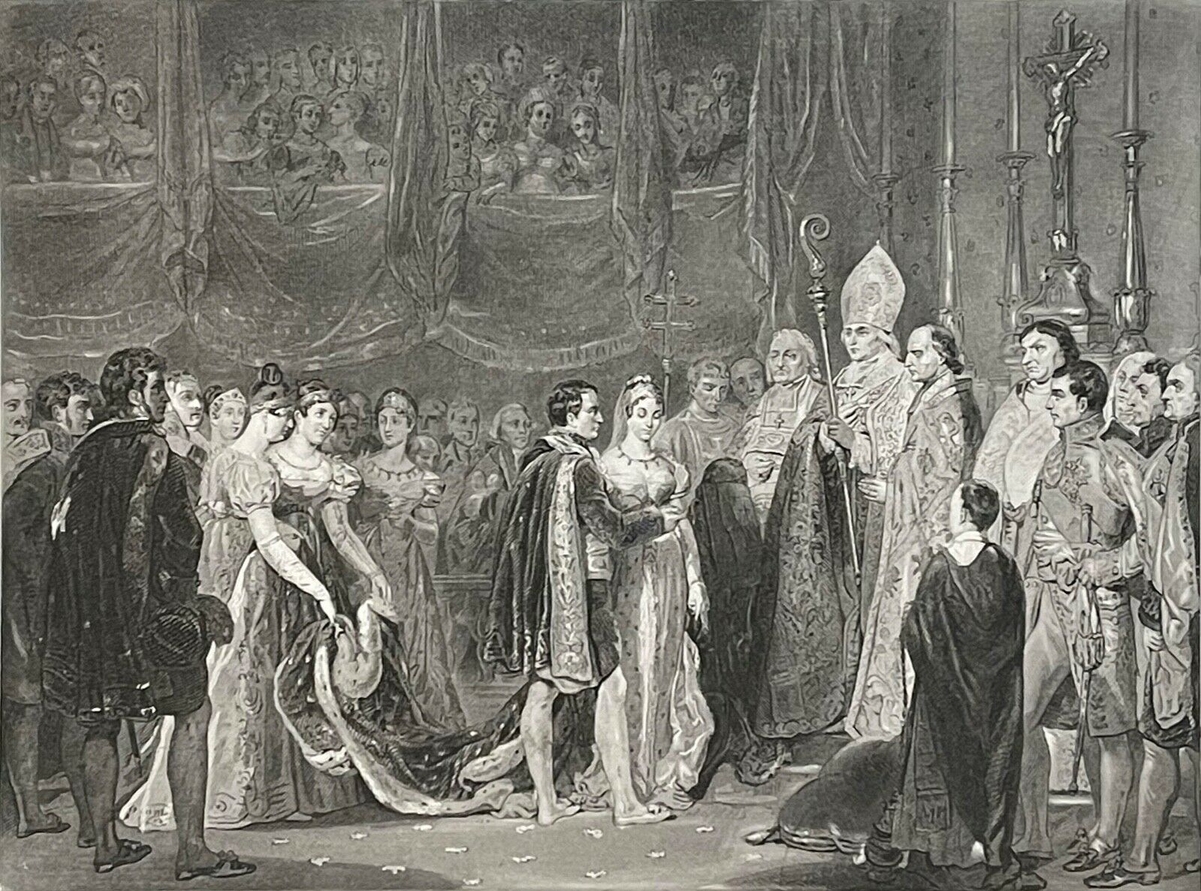
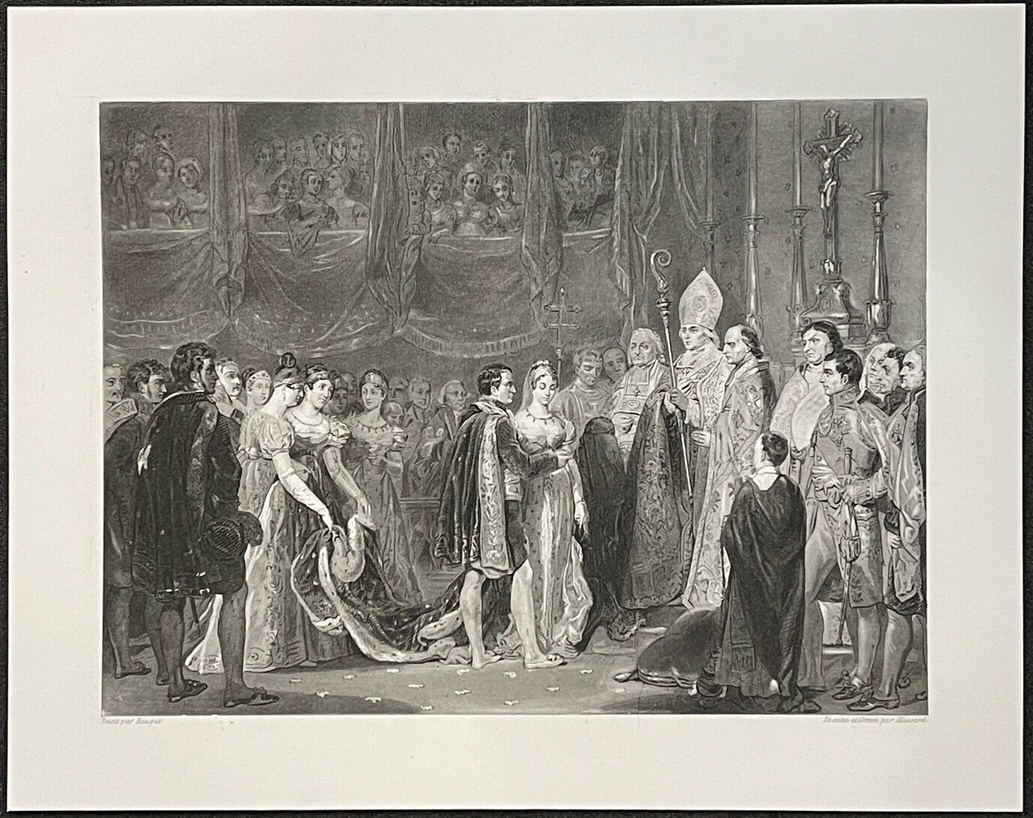
Paris France 1810 – The Imperial Wedding of Napoleon Bonaparte and Marie Louise of Austria – Original Nineteenth-Century French Engraving after Georges Rouget, Engraved by Léopold Massard.
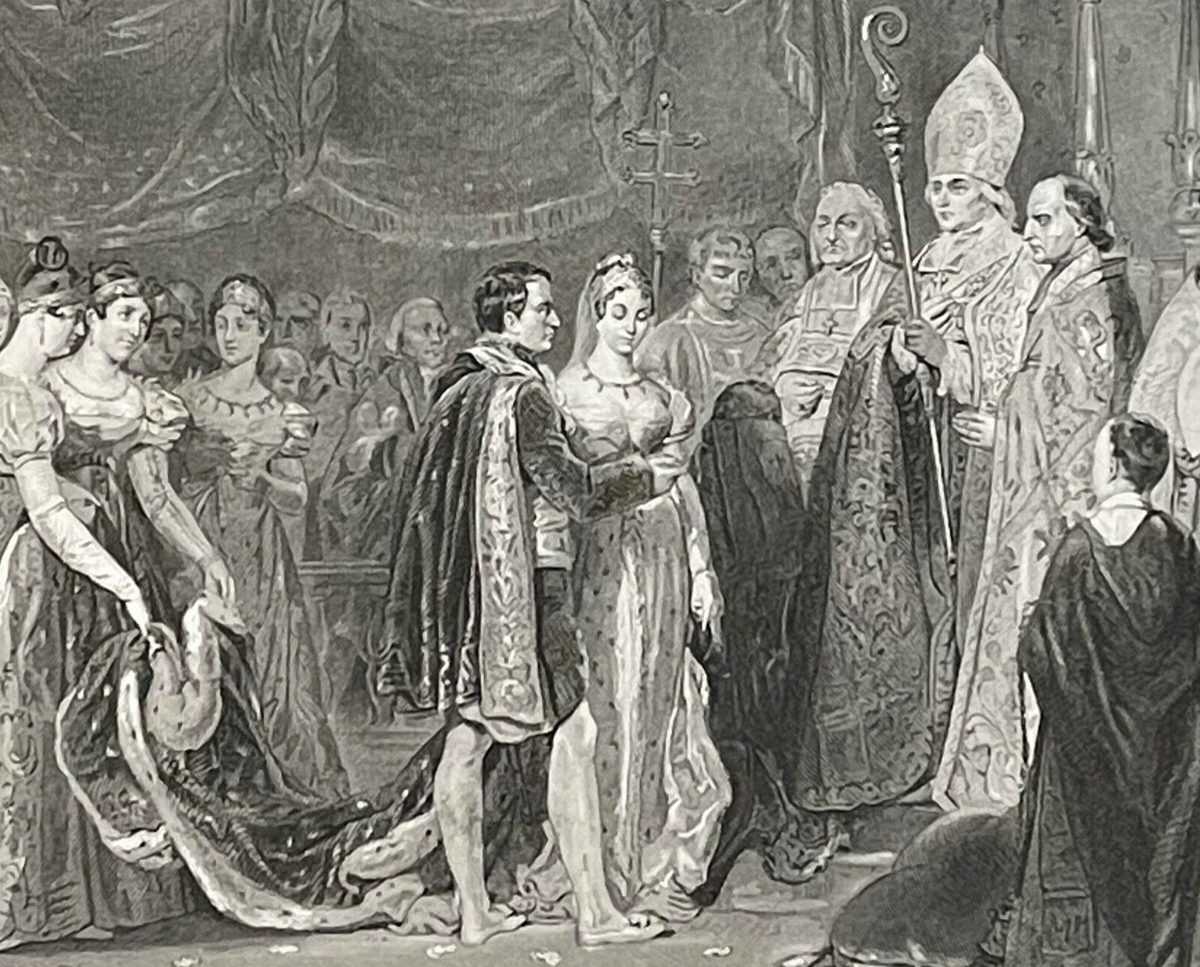
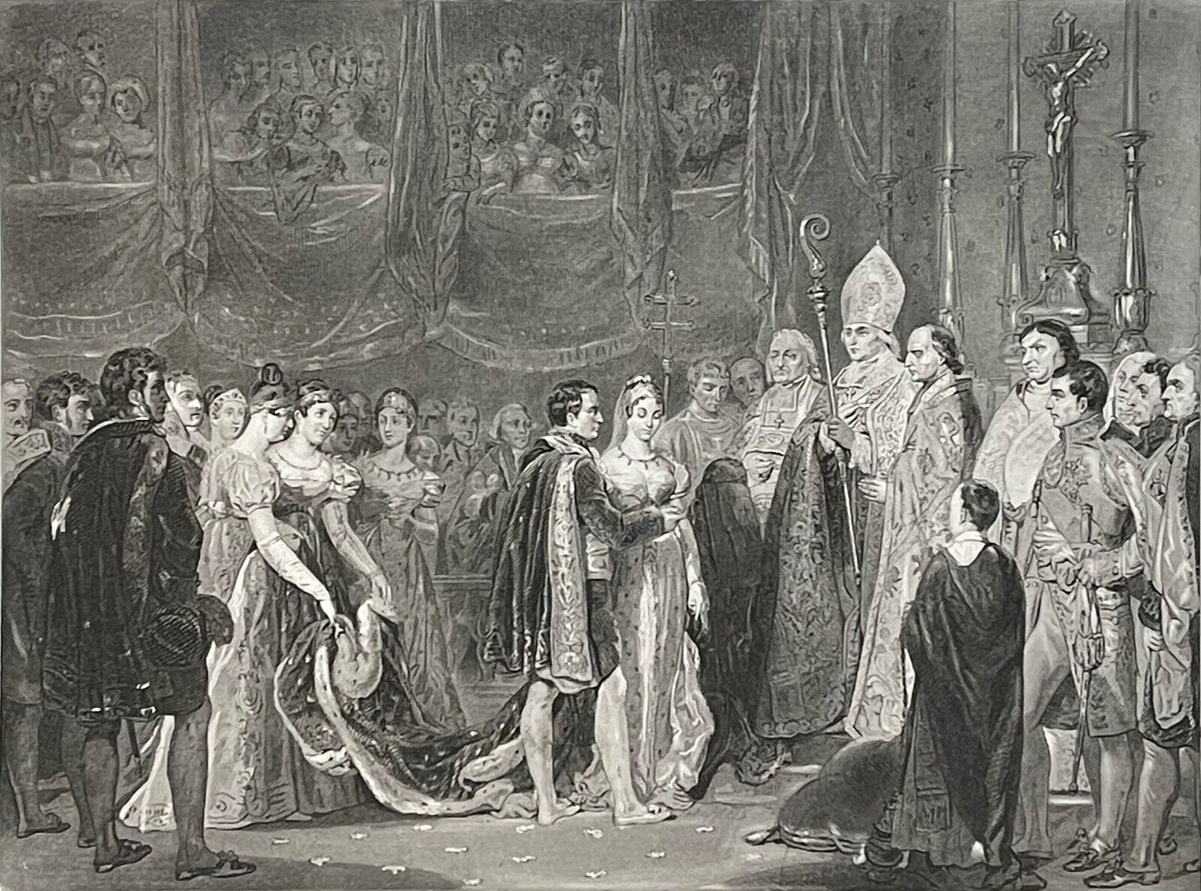
Artculture6 presents this remarkable antique French historical engraving, produced circa 1840, depicting the religious marriage ceremony of Emperor Napoleon I and Archduchess Marie Louise of Austria, celebrated on 2 April 1810 in the Salon Carré of the Louvre Palace in Paris.
The composition is based on a painting by Georges Rouget (1783–1869), a distinguished French historical painter and pupil of Jacques-Louis David.
The engraving was executed by Léopold Massard (1812–1889), an accomplished French nineteenth-century engraver.
This elegant and richly detailed composition portrays one of the most important dynastic ceremonies of Napoleon’s reign, attended by members of the imperial family, leading dignitaries, ecclesiastical authorities and representatives of the European aristocracy.
PARIS – THE IMPERIAL WEDDING OF 2 APRIL 1810
The marriage of Napoleon Bonaparte and Marie Louise of Austria was an event of considerable political and historical significance.
Following the dissolution of his marriage to Empress Joséphine de Beauharnais, Napoleon sought a new dynastic alliance that would provide an heir to the French imperial throne.
His choice fell upon Marie Louise of Habsburg-Lorraine (1791–1847), daughter of Emperor Francis I of Austria.
The proposed marriage also represented an important diplomatic development in relations between France and Austria.
Only months earlier, the two empires had fought against one another during the Austrian Campaign of 1809, culminating in Napoleon’s victory at the Battle of Wagram.
The new alliance was intended to strengthen relations between the two powerful European dynasties.
The civil marriage was celebrated at Saint-Cloud on 1 April 1810.
The following day, the religious ceremony took place in Paris.
THE SALON CARRÉ OF THE LOUVRE TRANSFORMED INTO AN IMPERIAL CHAPEL
The religious ceremony took place in the Salon Carré of the Louvre Palace.
For this exceptional occasion, the great hall was transformed into a magnificent ceremonial chapel.
The imperial architects Charles Percier and Pierre Fontaine participated in the preparation of the decorations.
Rich draperies, ornamental textiles and elaborate furnishings created a setting worthy of the imperial court.
A large crucifix dominated the altar, surrounded by tall candlesticks.
Special galleries accommodated spectators and members of the court.
The engraving faithfully evokes the splendour of the ceremony through its extensive architectural and decorative details.
In the upper part of the composition, several groups of spectators appear in galleries decorated with large hanging fabrics.
The arrangement of the interior creates a theatrical atmosphere, characteristic of the great imperial ceremonies of the early nineteenth century.
NAPOLEON I AND MARIE LOUISE OF AUSTRIA
At the centre of the composition stand Napoleon and Marie Louise.
The emperor wears an elaborate ceremonial costume and an imperial mantle.
Marie Louise is represented in a magnificent light-coloured wedding gown, accompanied by a long court train.
Their costumes reflect the splendour and formality of the imperial court.
The elaborate drapery of the bridal gown and the imperial mantle receives particular attention from the engraver.
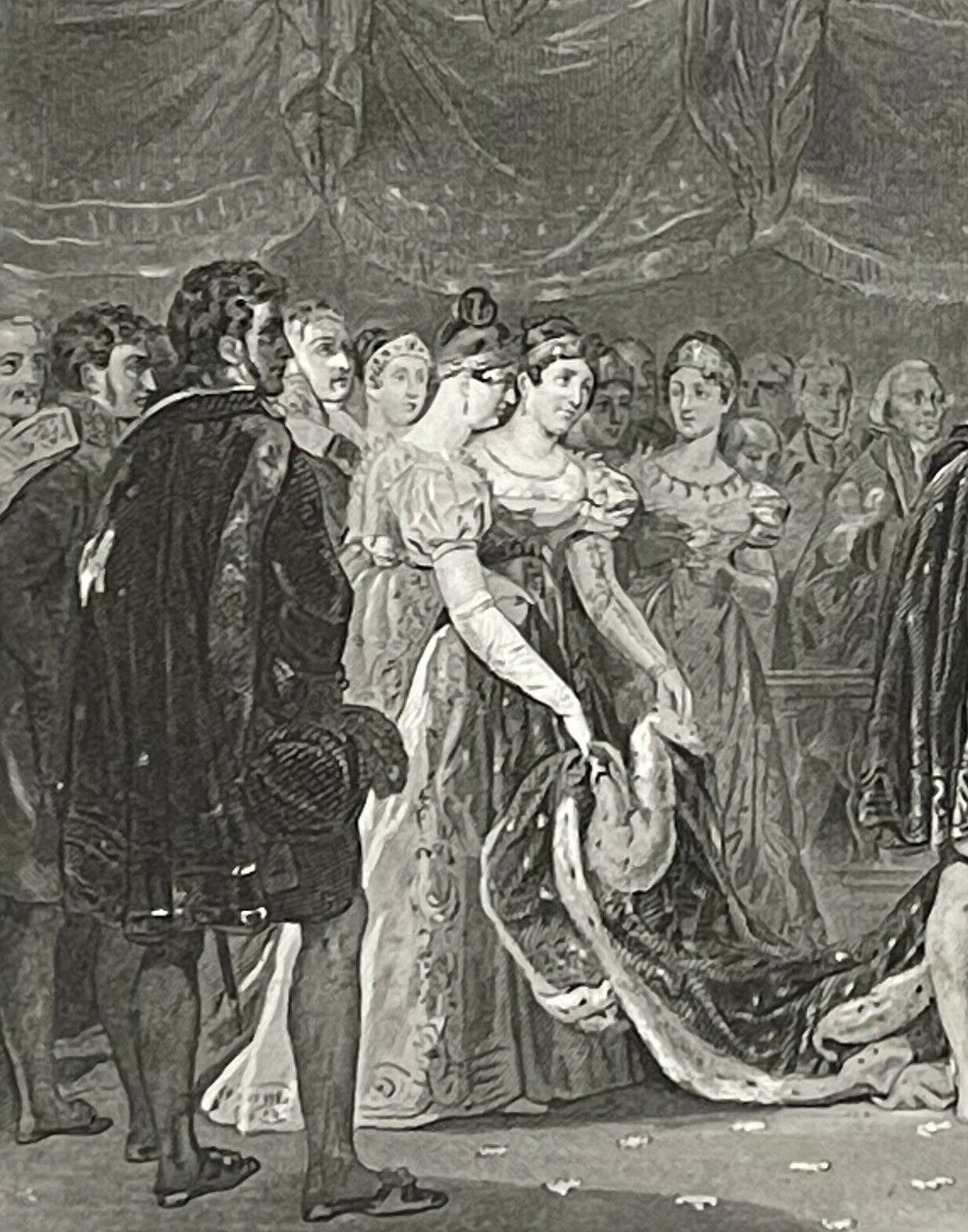
Several attendants support the ceremonial garments, emphasising the importance of the occasion.
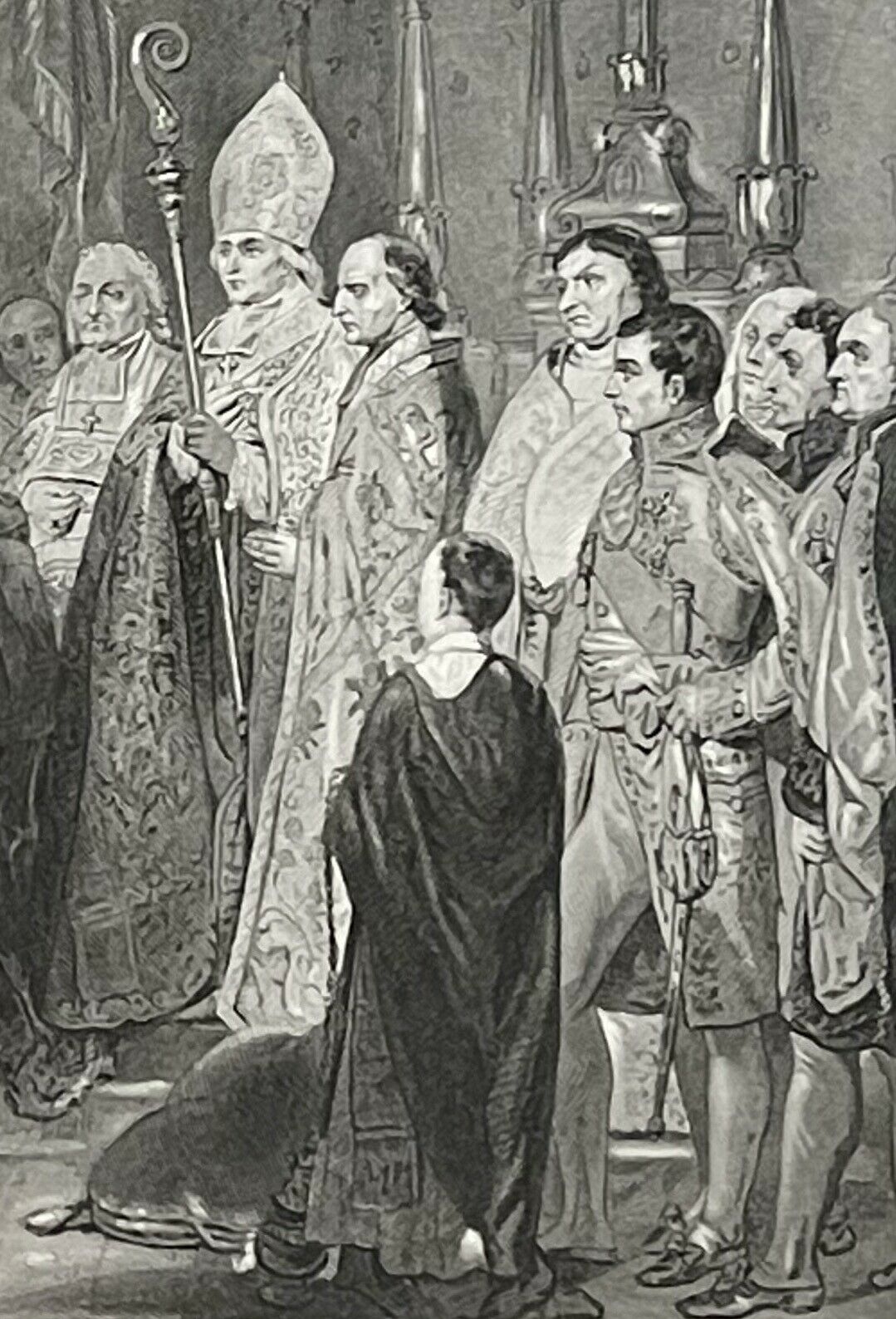
Napoleon and Marie Louise stand before Cardinal Fesch, who presides over the religious ceremony.
The composition places the imperial couple at the centre of a large assembly of ecclesiastical and political dignitaries.
CARDINAL JOSEPH FESCH (1763–1839)
Cardinal Joseph Fesch was Napoleon Bonaparte’s maternal uncle.
He became Archbishop of Lyon and was one of the most influential religious figures associated with the First French Empire.
Fesch participated in several important ceremonies during Napoleon’s reign.
On 2 April 1810, he officiated at the religious marriage of Napoleon and Marie Louise.
In the engraving, the cardinal occupies a prominent position on the right.
He wears richly decorated episcopal vestments and a mitre, while holding his pastoral staff.
The large crucifix and candlesticks behind him reinforce the religious character of the ceremony.
The engraver has carefully represented the details of the cardinal’s ceremonial garments.
A MAGNIFICENT ASSEMBLY OF THE IMPERIAL COURT
The engraving contains an exceptional number of historical figures.
On the left, several ladies of the imperial court are represented wearing elegant gowns in the fashion of the First Empire.
Their dresses display the high waistlines, delicate fabrics and refined decorative details characteristic of the period.
Other figures wear military uniforms, ceremonial mantles and court costumes.
Their varied poses and gestures create a lively representation of the event.
Behind the imperial couple, additional dignitaries and attendants appear in the background.
On the right, ecclesiastical figures and representatives of the imperial administration surround Cardinal Fesch.
The numerous spectators in the galleries further emphasise the scale and importance of the occasion.
The composition provides an attractive visual document of ceremonial fashion during Napoleon’s reign.
GEORGES ROUGET (1783–1869)
Georges Rouget was a French historical painter born in Paris in 1783.
He studied under Jacques-Louis David (1748–1825), one of the leading artists of French Neoclassicism.
Rouget became an accomplished painter of portraits, historical subjects and official ceremonies.
His association with David exposed him to the great artistic projects of the Napoleonic period.
He participated in the execution of important historical compositions and subsequently developed his own career.
Rouget’s paintings demonstrate a particular interest in the careful arrangement of figures, the accuracy of ceremonial costumes and the representation of major political events.
His composition of the wedding of Napoleon and Marie Louise belongs to this tradition of French historical painting.
The painting is preserved in the historical collections of the Palace of Versailles.
The present engraving provides a detailed nineteenth-century interpretation of this important work.
LÉOPOLD MASSARD (1812–1889) – THE ENGRAVER
Léopold Massard was a French engraver active during the nineteenth century.
He specialised in the reproduction and interpretation of painted compositions through engraving.
His work demonstrates considerable precision in the treatment of figures, architectural settings and decorative details.
The present engraving is particularly remarkable for the delicate rendering of the numerous participants in the imperial ceremony.
Faces, hands, military uniforms, dresses and ecclesiastical vestments are represented through finely controlled engraved lines.
The rich fabrics and draperies are described by varied hatching, allowing the artist to create subtle contrasts between light and shadow.
The large number of figures makes the composition a fine example of nineteenth-century historical engraving.
THE ART OF IMPERIAL CEREMONIAL ENGRAVING
During the nineteenth century, historical engravings played an important role in preserving images of major political and dynastic events.
Large official paintings were often reproduced as engravings, enabling collectors and historians to appreciate their compositions.
The wedding of Napoleon and Marie Louise was particularly suitable for this artistic tradition.
The elaborate costumes, ceremonial setting and distinguished participants offered numerous opportunities for detailed graphic interpretation.
In the present work, the engraver has carefully organised the composition around the imperial couple.
The contrast between the light-coloured dresses and the darker ceremonial garments gives the scene considerable depth.
The architectural decoration, religious furnishings and spectators create a rich historical environment.
The result is an elegant representation of one of the most celebrated ceremonies of the First French Empire.
MARIE LOUISE AND THE BIRTH OF THE KING OF ROME
The marriage between Napoleon and Marie Louise fulfilled an important dynastic objective.
On 20 March 1811, Marie Louise gave birth to their son, Napoleon François Charles Joseph Bonaparte.
The child received the title King of Rome.
His birth appeared to secure the future of the imperial dynasty.
However, the political situation in Europe changed dramatically during the following years.
Napoleon’s military defeats eventually led to his abdication in April 1814.
Marie Louise subsequently returned to Austrian territory.
The marriage of 1810 nevertheless remains one of the defining ceremonial events of Napoleon’s reign.
A REMARKABLE HISTORICAL FRENCH ENGRAVING
This antique engraving combines historical importance with considerable artistic refinement.
The composition is particularly attractive for the extensive representation of imperial costumes and ceremonial decorations.
The figures are carefully arranged, creating a balanced scene filled with details.
The bridal gown, imperial mantle, episcopal vestments and military uniforms provide a fascinating visual record of early nineteenth-century court fashion.
The architectural setting of the Louvre adds further historical interest.
The connection with Georges Rouget and Léopold Massard makes this work particularly appealing to collectors of French historical engraving.
DIMENSIONS AND TECHNICAL DETAILS
- Country depicted: France.
- City: Paris.
- Location: Salon Carré, Louvre Palace.
- Historical event: Religious marriage of Napoleon I and Marie Louise of Austria.
- Date of ceremony: 2 April 1810.
- Historical figures: Napoleon Bonaparte, Marie Louise of Austria, Cardinal Joseph Fesch and members of the imperial court.
- Original painter: Georges Rouget (1783–1869).
- Engraver: Léopold Massard (1812–1889).
- Engraving date: Circa 1840.
- Technique: Antique black-and-white engraving.
- Sheet dimensions: 27.2 × 21.7 cm.
- Engraved image dimensions: 22.3 × 16.6 cm.
- Historical period: First French Empire.
CONDITION
Antique engraving displaying the natural patina of aged paper.
The historical composition, numerous figures, ceremonial costumes, architectural details and religious furnishings remain clearly visible.
The fine engraved details are well preserved.
Please examine the accompanying photographs for the appearance and condition of the sheet.
COLLECTOR’S INTEREST
A beautiful nineteenth-century French historical engraving depicting the imperial wedding of Napoleon Bonaparte and Marie Louise of Austria in Paris on 2 April 1810.
Particularly interesting for collectors of Napoleon I, the First French Empire, French royal and imperial ceremonies, historical costume and antique European engravings.
The exceptional number of figures, elaborate ceremonial garments and magnificent interior setting make this an attractive historical print.
Its association with Georges Rouget and Léopold Massard adds further artistic interest.
ARTCULTURE6 REFERENCE: 5025-1R554

Avis
Il n’y a pas encore d’avis.