Description
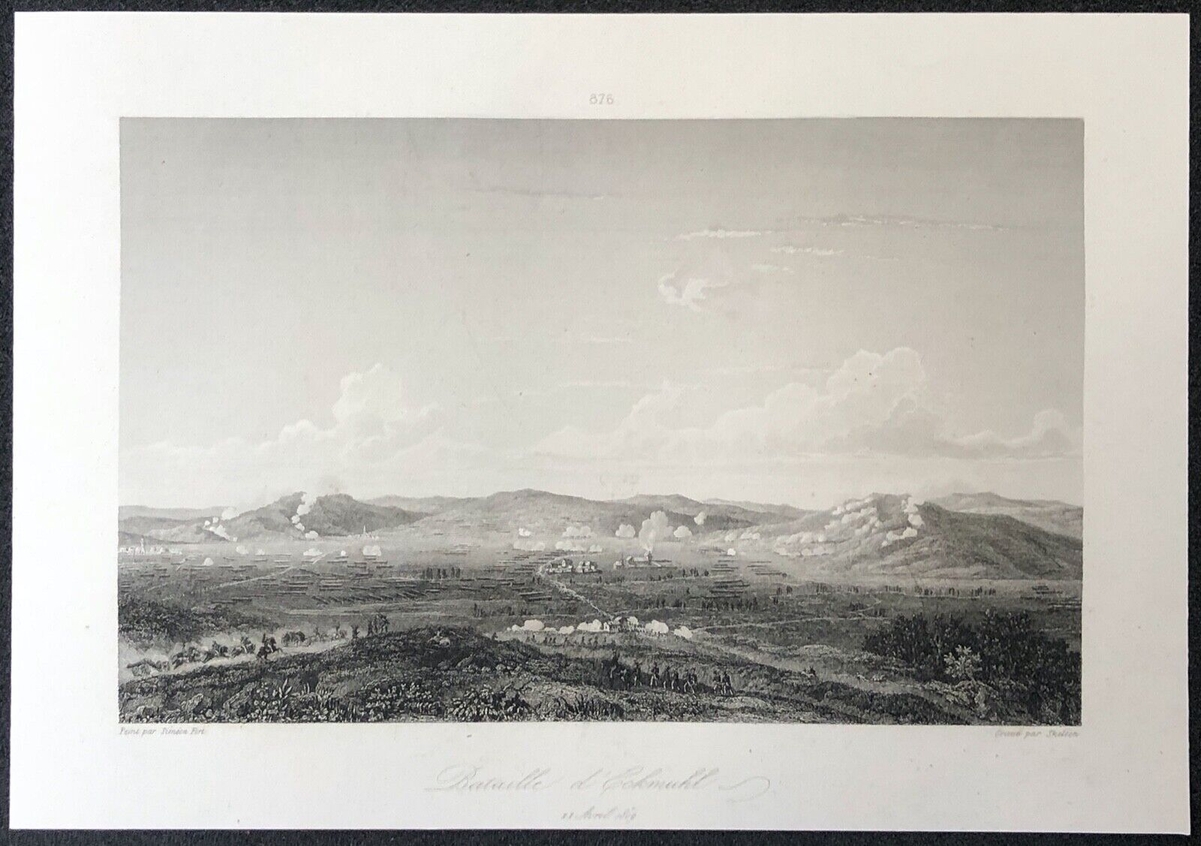
Eckmühl Bavaria Germany 1809 – Original Nineteenth-Century French Engraving Depicting Napoleon Bonaparte’s Victory over the Austrian Army on 22 April 1809, after Jean-Antoine-Siméon Fort.
Artculture6 presents this remarkable antique French historical engraving, produced circa 1840–1841, depicting the Battle of Eckmühl during Napoleon’s German and Austrian campaign of 1809.
The panoramic composition is based on an original work by Jean-Antoine-Siméon Fort (1793–1861), a French painter and draughtsman celebrated for his detailed topographical representations of historical military campaigns.
The original composition was executed in 1835 and is documented in the French national collections associated with Versailles.
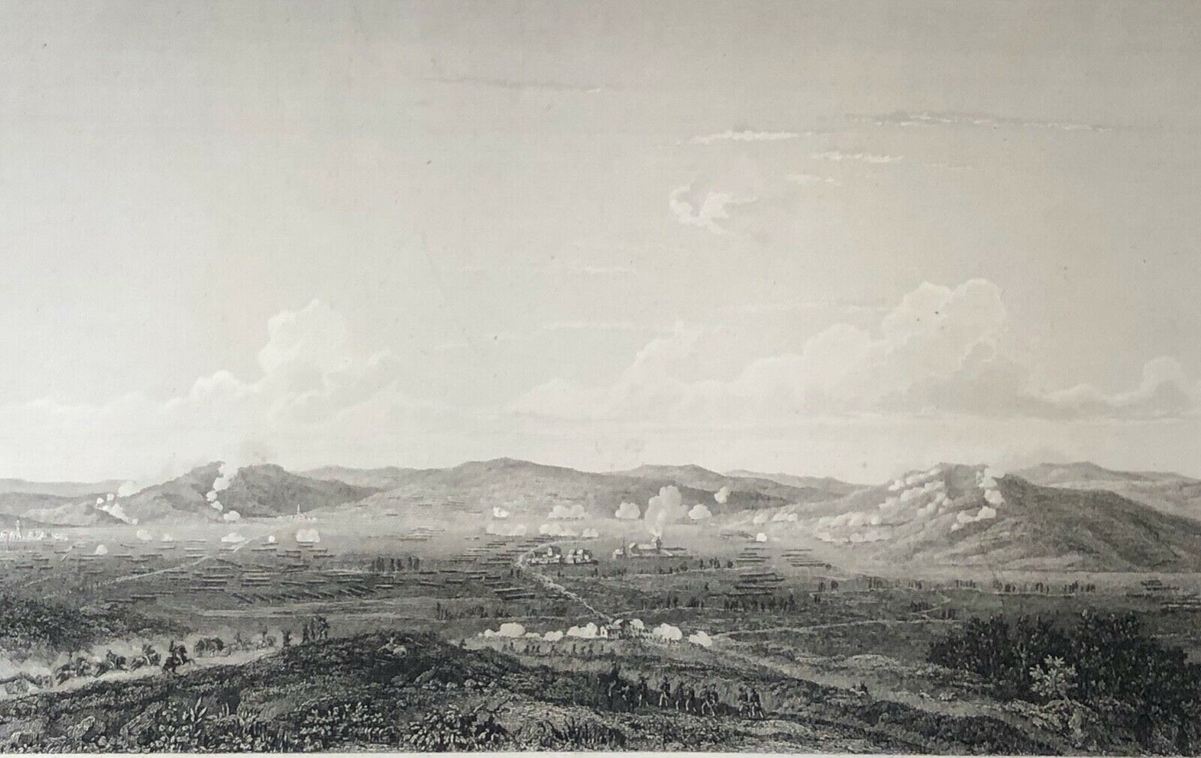
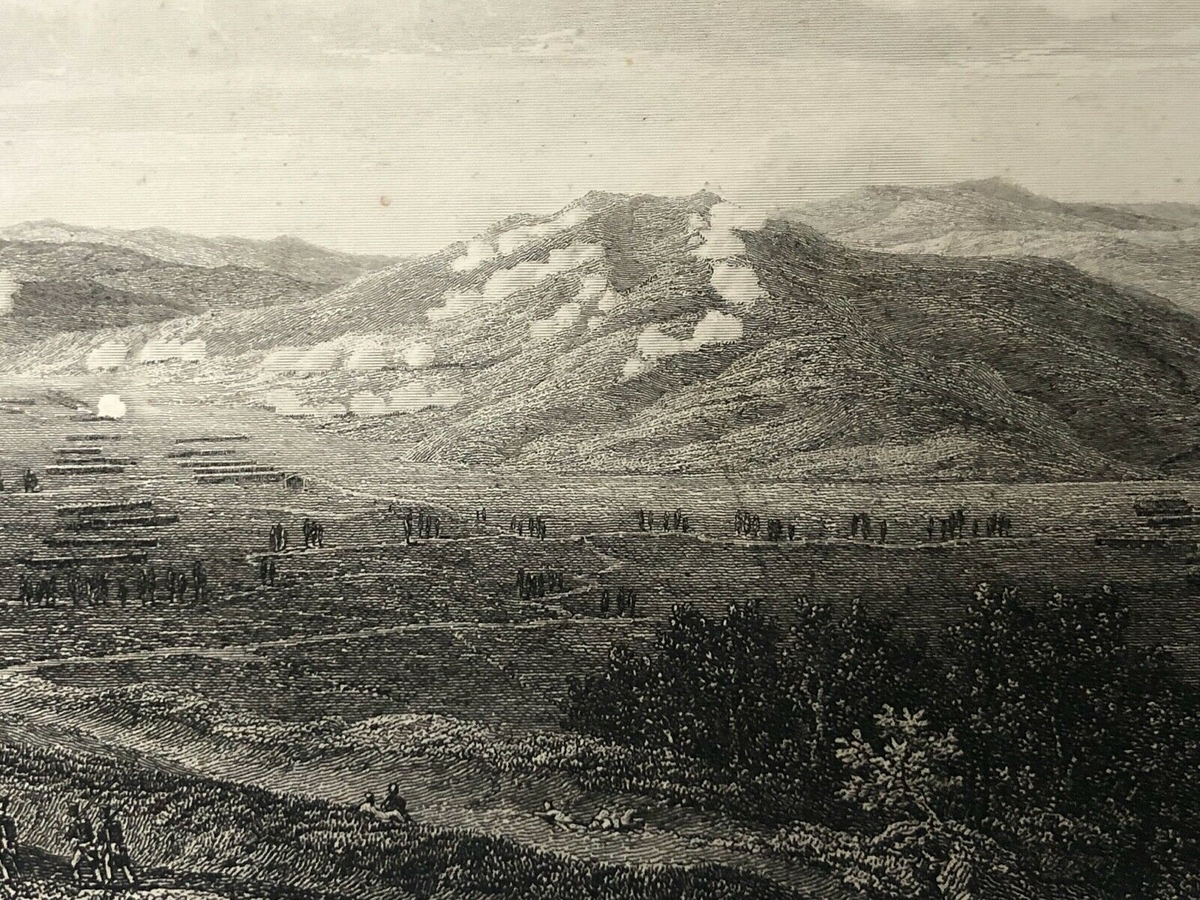
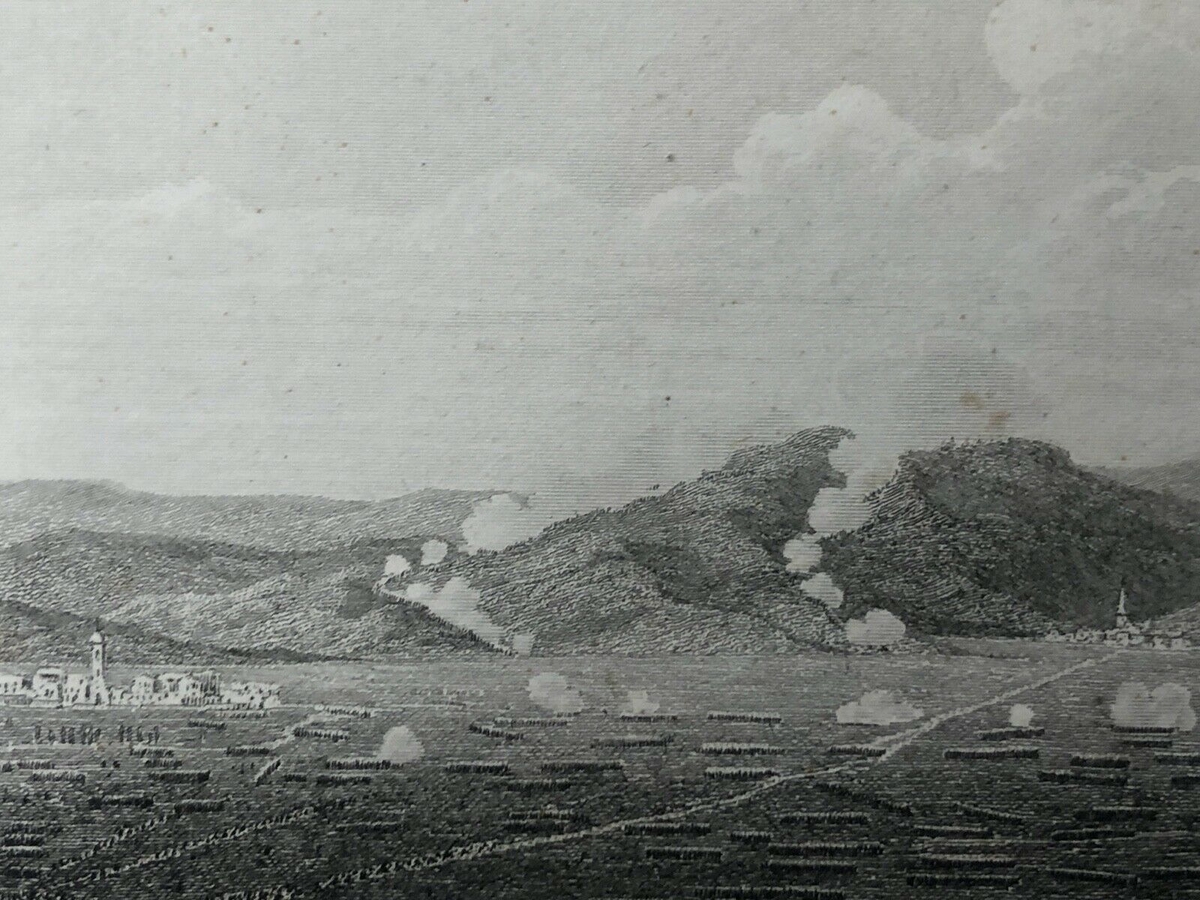
This beautifully detailed engraving represents an extensive battlefield surrounded by the rolling hills of Bavaria.
Numerous military formations, roads, villages, artillery positions and columns of smoke extend across the landscape beneath an immense cloudy sky.
ECKMÜHL – A DECISIVE BATTLE IN BAVARIA
Eckmühl, now known as Eggmühl, is situated in Bavaria, southern Germany, near Regensburg.
On 22 April 1809, the surrounding countryside became the setting for an important battle between Napoleon’s forces and the Austrian army commanded by Archduke Charles.
The engagement formed part of the War of the Fifth Coalition.
During April 1809, Austria had launched a new military campaign against the French Empire.
Napoleon rapidly assembled his forces in southern Germany and began a series of operations designed to defeat the Austrian army.
The Battle of Eckmühl became one of the decisive engagements of this campaign.
French forces succeeded in defeating the Austrian positions and compelling Archduke Charles to retreat towards the Danube.
NAPOLEON’S GERMAN CAMPAIGN OF 1809
The military operations of April 1809 were characterised by exceptionally rapid movements.
After arriving to take command of his army, Napoleon reorganised the French and allied forces.
On 20 April, the French won the Battle of Abensberg.
The following day, Napoleon achieved another success at Landshut.
On 22 April, he moved northward to join the forces of Marshal Davout and confront the Austrian army near Eckmühl.
The fighting involved large formations of infantry, cavalry and artillery.
The French victory opened the way towards Regensburg, which was captured on 23 April.
These operations contributed significantly to Napoleon’s advance towards Vienna.
THE BATTLE OF 22 APRIL 1809
The Battle of Eckmühl was fought across an extensive landscape of hills, villages and roads.
The Austrian forces occupied positions that Napoleon sought to overcome through coordinated attacks.
The French army was supported by troops commanded by Marshals Davout, Lannes and Lefebvre, together with allied German formations.
Artillery fire and cavalry movements played important roles in the battle.
Napoleon’s troops gradually overcame the opposing positions.
The Austrian army was forced to withdraw towards the Danube and Regensburg.
The victory helped restore French military superiority in southern Germany.
Marshal Louis-Nicolas Davout subsequently received the title Prince of Eckmühl, commemorating the importance of the campaign.
AN EXCEPTIONAL PANORAMIC BATTLEFIELD
The engraving represents the battlefield from an elevated viewpoint.
The extensive perspective allows the spectator to observe military movements across a large area.
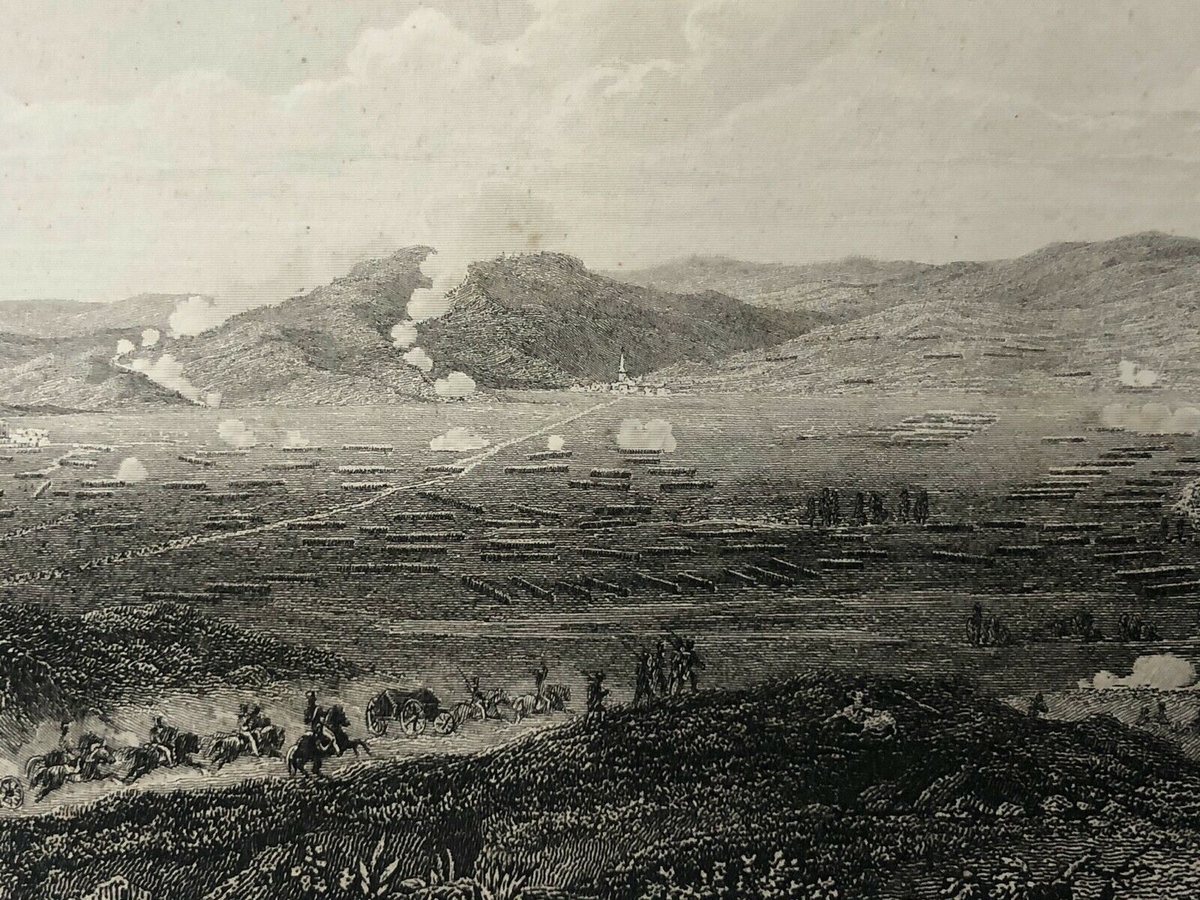
In the foreground, uneven ground, grasses and low vegetation create a detailed natural setting.
On the left, a road winds through the countryside.
Several mounted soldiers and military vehicles can be distinguished travelling along the route.
Further into the composition, large formations of troops occupy the open fields.
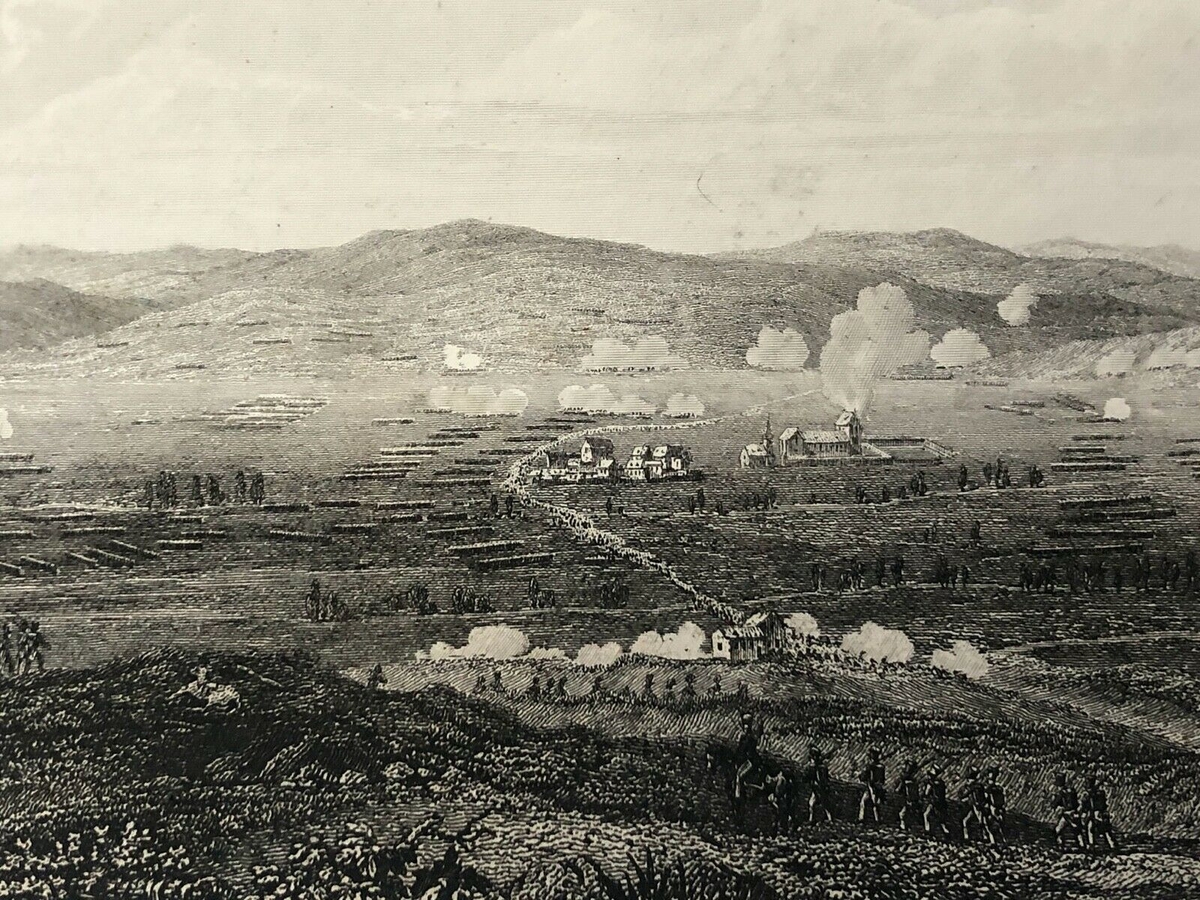
At the centre, small villages and buildings appear among the military positions.
Lines of soldiers advance across the plain and along the roads.
On the right, higher ground and wooded slopes dominate part of the battlefield.
Numerous clouds of smoke rise from artillery positions throughout the landscape.
The sky occupies a particularly important part of the composition.
Its extensive cloud formations give the engraving a dramatic atmospheric character.
THE LANDSCAPE OF BAVARIA
One of the most interesting qualities of this engraving is its topographical treatment.
The landscape includes carefully represented hills, valleys, cultivated fields, roads and small settlements.
The military formations appear as tiny groups within the immense countryside.
This approach enables the viewer to appreciate the scale of the operations.
The artist has carefully distinguished open terrain from wooded areas.
The winding roads connect the villages and different parts of the battlefield.
The distant hills gradually disappear into the atmospheric perspective.
The resulting composition combines military history with the artistic qualities of a nineteenth-century landscape print.
JEAN-ANTOINE-SIMÉON FORT (1793–1861)
Jean-Antoine-Siméon Fort was a French painter and draughtsman particularly associated with historical landscapes and military subjects.
He produced numerous compositions depicting the great campaigns of the French Revolutionary and Napoleonic periods.
Fort developed a distinctive approach to military painting.
Rather than concentrating exclusively on individual combatants, he frequently represented the entire battlefield within a vast landscape.
His works provide extensive views of the terrain, troop positions, roads and surrounding geographical features.
This combination of artistic observation and historical interest makes his compositions particularly appealing to collectors.
In 1835, Fort created a panoramic representation of the Battle of Eckmühl.
The present engraving reproduces this historical composition.
THE ART OF NINETEENTH-CENTURY FRENCH ENGRAVING
During the nineteenth century, engraved interpretations of major paintings became an important means of distributing historical images.
The present engraving demonstrates considerable technical precision.
The terrain is represented through fine engraved lines and closely arranged hatching.
The hills and wooded slopes are carefully modelled through variations in tonal density.
The military formations are reproduced with numerous small figures.
The roads and villages remain clearly visible despite their relatively small scale.
Artillery smoke is represented by lighter passages contrasting with the surrounding landscape.
The sky is treated with delicate gradations of grey.
These techniques create an impressive sense of depth and distance.
ARTILLERY AND MILITARY MOVEMENTS
The engraving illustrates the importance of artillery and coordinated troop movements during Napoleonic warfare.
Across the landscape, numerous small formations can be distinguished.
The long lines of infantry suggest the scale of the forces involved.
Roads and routes connect different parts of the battlefield.
Artillery smoke appears throughout the central and distant areas.
Small groups of mounted soldiers are visible in the foreground.
The composition places particular emphasis on the organisation of the battlefield and its geographical setting.
This makes the engraving especially interesting for collectors of military topography and Napoleonic campaign history.
THE ROAD TO REGENSBURG AND VIENNA
The French victory at Eckmühl had important strategic consequences.
Following the battle, Austrian forces withdrew towards Regensburg.
The French captured the city on 23 April 1809.
Napoleon subsequently continued his offensive towards the Austrian capital.
The campaign eventually led to the occupation of Vienna and the battles of Aspern-Essling and Wagram.
Eckmühl therefore represents an important stage in the military operations that shaped the Austrian Campaign of 1809.
A REMARKABLE HISTORICAL LANDSCAPE
The extensive landscape gives this print a distinctive appearance.
Unlike many battle engravings that concentrate on a small group of soldiers, the present composition presents the entire military setting.
The broad plain, distant villages, hills and artillery smoke contribute to its historical character.
The dramatic sky and careful tonal treatment add considerable artistic interest.
The engraving is particularly attractive for collectors of Napoleon I, the French Empire, military history and antique European landscapes.
DIMENSIONS AND TECHNICAL DETAILS
- Country depicted: Germany
- Region: Bavaria
- Location: Eckmühl, now Eggmühl
- Historical event: Battle of Eckmühl
- Date of battle: 22 April 1809
- French commander: Napoleon I
- French marshal associated with the battle: Louis-Nicolas Davout
- Austrian commander: Archduke Charles of Austria
- Military campaign: German and Austrian Campaign of 1809
- Original artist: Jean-Antoine-Siméon Fort (1793–1861)
- Original composition date: 1835
- Engraving date: Circa 1840–1841
- Technique: Black-and-white intaglio engraving
- Sheet dimensions: 28 × 20.3 cm
- Engraved image dimensions: 23 × 14.7 cm
- Historical period: First French Empire
CONDITION
Antique engraving displaying the natural patina of aged paper.
The extensive landscape, artillery smoke, military formations and topographical details remain clearly visible.
The engraved composition presents fine tonal variations and delicate linework.
Please examine the photographs for the appearance and condition of the sheet and its margins.
COLLECTOR’S INTEREST
A beautiful nineteenth-century French military engraving depicting Napoleon’s victory at Eckmühl on 22 April 1809.
Particularly interesting for collectors of Napoleonic history, Marshal Davout, the First French Empire, Bavarian history and antique military prints.
The panoramic landscape after Jean-Antoine-Siméon Fort provides an attractive visual representation of the historical battlefield.
Its detailed topography, extensive troop formations and impressive atmospheric effects make this a fine example of nineteenth-century French historical engraving.
ARTCULTURE6 REFERENCE: 5215-694R686

Avis
Il n’y a pas encore d’avis.