England Duke of York c.1808 – Royal Portrait after Van Dyck – Engraved by Miger
69,00 €
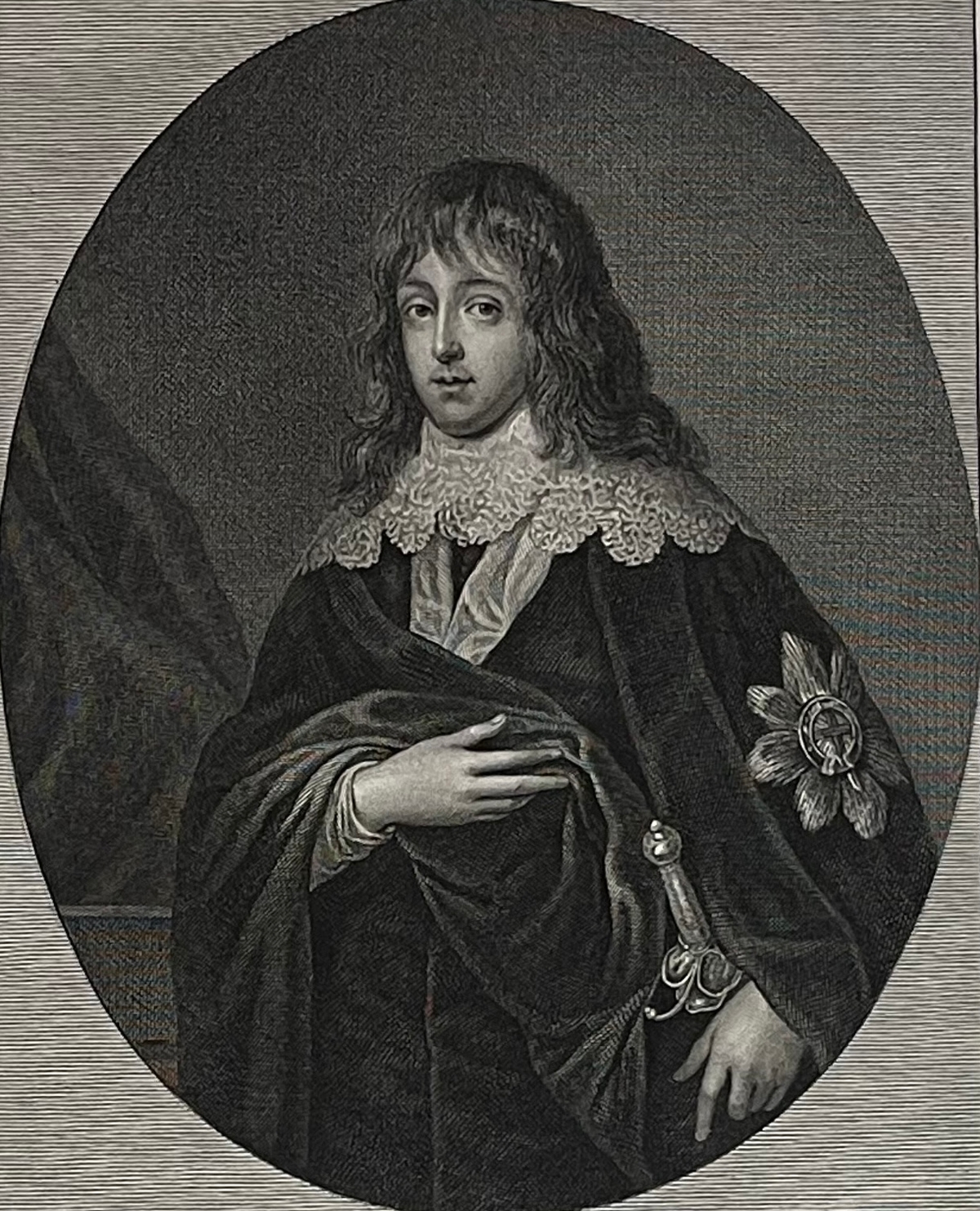
Fine large-format antique French burin engraving by Simon Charles Miger (1736–1820), after a portrait historically attributed to Anthony van Dyck (1599–1641).
Entitled Le Duc d’Yorck, the print traditionally depicts James Stuart (1633–1701), Duke of York and future King James II of England.
The elegant oval portrait features a richly engraved lace collar, flowing hair, the Order of the Garter and a ceremonial sword.
Engraver: Simon Charles Miger.
Artist after: Anthony van Dyck.
Date: Circa 1808.
Technique: Original burin engraving.
Paper: Antique laid paper.
Sheet: 43.5 × 29.5 cm.
Engraved composition with text: 36.6 × 23.6 cm.
Reference: 5341-71R753
Description
Duke of York Van Dyck engraving – Historical royal portrait engraved by Simon Charles Miger circa 1808.
An impressive large-format French engraving by Simon Charles Miger (1736–1820), after a portrait historically attributed to the celebrated Flemish painter Anthony van Dyck (1599–1641).
Entitled Le Duc d’Yorck, this finely executed portrait was traditionally identified as James Stuart (1633–1701), Duke of York and future King James II of England.
The composition is distinguished by its elegant oval portrait, delicate engraved details and elaborate French historical inscriptions.
THE DUKE OF YORK — A ROYAL PORTRAIT
The young nobleman is depicted within a large oval frame.
His long, flowing hair falls naturally over his shoulders.
He wears a magnificent lace collar and a dark cloak with richly arranged folds.
On his left shoulder is the star of the Order of the Garter, one of the most prestigious orders of chivalry associated with the British monarchy.
One hand rests upon the folds of his cloak, while the other is positioned near the hilt of his sword.
His expression is calm and dignified.
The dark background provides a striking contrast with the illuminated face, hands and lace collar.
The result is an elegant example of aristocratic portraiture in the tradition of the Flemish Baroque.
JAMES II OF ENGLAND (1633–1701)
James Stuart was born on 14 October 1633 at St James’s Palace in London.
He was the second surviving son of King Charles I and Henrietta Maria of France.
He received the title Duke of York during his childhood.
The English Civil War and the subsequent overthrow of the monarchy forced him into exile.
During this period, he spent time in France and continental Europe.
Following the restoration of the English monarchy in 1660, his elder brother became King Charles II.
James subsequently held important naval and military positions, including the office of Lord High Admiral.
In 1685, he succeeded his brother as King James II of England and Ireland, and James VII of Scotland.
His reign was marked by major religious and political tensions.
The Glorious Revolution of 1688 resulted in his removal from power.
He spent his final years in exile in France and died at Saint-Germain-en-Laye on 16 September 1701.
ANTHONY VAN DYCK (1599–1641)
Anthony van Dyck was one of the greatest Flemish portrait painters of the seventeenth century.
Born in Antwerp in 1599, he developed his artistic career under the influence of Peter Paul Rubens.
He worked in Italy and later became the principal court painter to King Charles I of England.
His elegant portraits of royal and aristocratic sitters established a distinctive style that influenced European portraiture for generations.
Van Dyck was particularly admired for his refined treatment of faces, luxurious fabrics and graceful poses.
His portraits combined aristocratic dignity with a remarkable sense of individuality.
SIMON CHARLES MIGER (1736–1820)
Simon Charles Miger was a French engraver born in Nemours in 1736.
He became known for his accomplished engraved portraits and reproductions of paintings by important European masters.
His technique displays an exceptional command of burin engraving.
Closely arranged lines and cross-hatching create subtle transitions between light and shadow.
In this portrait, Miger pays particular attention to the young sitter’s hair, lace collar, cloak and facial expression.
The elaborate texture of the fabrics is rendered with considerable precision.
A FINE HISTORICAL PORTRAIT ENGRAVING
The portrait is enclosed within a large oval set against a rectangular background.
Below the image appears the original engraved title:
LE DUC D’YORCK
A decorative coat of arms and an extensive historical text accompany the portrait.
The print belongs to the tradition of French reproductive engraving after the works of the Flemish school.
Examples of this composition are preserved in important European museum collections, including the Rijksmuseum in Amsterdam and the Museum of Fine Arts in Ghent.
The engraving is dated to approximately 1808.
A LARGE-FORMAT COLLECTOR’S PRINT
This antique French engraving is particularly attractive to collectors of British royal portraits, historical engravings, Flemish Baroque painting and works associated with Anthony van Dyck.
The impressive oval composition, decorative heraldic elements and carefully engraved details make it an elegant historical and decorative print.
DETAILS
Original title: Le Duc d’Yorck.
Traditional identification: James II of England (1633–1701).
Artist after: Anthony van Dyck (1599–1641).
Intermediate draughtsman: I. J. van den Berghe.
Engraver: Simon Charles Miger (1736–1820).
Artistic school: Flemish.
Print date: Circa 1808.
Period: Late 18th to early 19th century.
Technique: Original burin engraving.
Paper: Antique laid paper.
Sheet dimensions: 43.5 × 29.5 cm.
Engraved composition including text: 36.6 × 23.6 cm.
Format: Vertical.
Reference: 5341-71R753W.
CONDITION
Antique impression displaying the natural patina of aged paper.
The portrait, lace collar, clothing, heraldic decoration and original inscriptions remain clearly visible.
The engraving retains strong contrasts and finely rendered details.
The sheet preserves generous margins, and the plate mark is visible.
Minor age-related marks can be seen in the photographs.
An attractive large-format antique French engraving by Simon Charles Miger after a historical portrait associated with Anthony van Dyck and the British royal court.
Reference: 5341-71R753



Avis
Il n’y a pas encore d’avis.