Jerusalem 1579 – Nicanor’s Severed Head Displayed – Johannes Wierix Renaissance Engraving
149,00 €
Original Flemish Renaissance copper engraving by Johannes Wierix (1549–circa 1615), after Gerard van Groeningen.
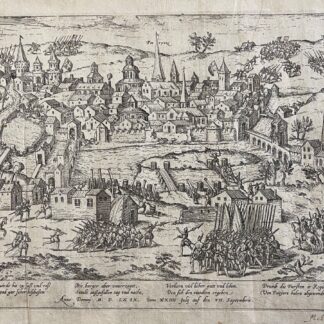
The Head and Hand of Nicanor Shown to the People, a detailed Biblical scene depicting the Maccabean victory in ancient Jerusalem.
Fine burin engraving on antique watermarked laid paper, with elaborate Renaissance architecture and numerous figures.
Composition: Circa 1579.
Sheet: 32.6 × 22.5 cm.
Plate mark: 28.5 × 20.3 cm.
Minor signs of age, including a small hole at the lower plate border, faint old folds and small marginal tears.
Reference: 5224-2R667
Description
Johannes Wierix Nicanor engraving – An original Flemish Renaissance copper engraving, circa 1579, after Gerard van Groeningen, depicting the head and hand of Nicanor displayed before the people of Jerusalem.
A remarkable early Flemish Renaissance engraving by Johannes Wierix (1549–circa 1615), after a design by Gerard van Groeningen.
Dating from a composition documented circa 1579, this elaborate historical print represents the public display of the severed head and right hand of Nicanor following the victory of Judas Maccabeus.
The engraving is distinguished by its exceptionally detailed figures, monumental Renaissance architecture and sophisticated linework.
THE HEAD AND HAND OF NICANOR SHOWN TO THE PEOPLE
The central scene depicts a soldier standing upon a raised platform before a large gathering in Jerusalem.
He holds the severed head of Nicanor aloft, while gesturing towards the assembled crowd.
Numerous soldiers and civilians surround the platform.
Some raise their hands in astonishment, while others look towards the displayed trophy.
The variety of faces, expressions and gestures gives the composition remarkable dramatic intensity.
The figures wear elaborate garments, armour and head coverings characteristic of sixteenth-century Flemish historical imagery.
JUDAS MACCABEUS AND THE DEFEAT OF NICANOR
The event is described in the First Book of Maccabees, chapter 7.
Nicanor was a military commander serving the Seleucid king Demetrius I.
During the conflict between the Seleucid Empire and the Jewish forces led by Judas Maccabeus, Nicanor was sent to suppress the resistance in Judaea.
In 161 BC, his army was defeated at the Battle of Adasa.
Nicanor was killed, and his head and right hand were subsequently displayed in Jerusalem.
The event became an important symbol of the Maccabean victory.
AN IMAGINARY RENAISSANCE VIEW OF JERUSALEM
The background presents an extraordinary architectural setting.
A large classical city square is surrounded by monumental buildings, columns, staircases and elaborate façades.
A circular domed building rises on the right, while a triumphal architectural structure dominates the centre.
Numerous small figures occupy the streets, steps and upper galleries.
The artist interpreted ancient Jerusalem through the architectural vocabulary of the European Renaissance.
This combination of Biblical history and contemporary sixteenth-century design is characteristic of Flemish historical engraving.
JOHANNES WIERIX (1549–CIRCA 1615)
Johannes Wierix was one of the finest Flemish engravers of the late sixteenth century.
Born in Antwerp, he belonged to the celebrated Wierix family of printmakers.
His engravings are particularly admired for their extraordinary precision, delicate handling of line and sophisticated rendering of human figures.
He produced numerous religious, historical and allegorical compositions.
His work represents one of the highest achievements of Flemish Renaissance engraving.
GERARD VAN GROENINGEN
Gerard van Groeningen was a Flemish draughtsman active during the sixteenth century.
His historical and religious compositions were translated into engravings by several important printmakers.
His designs frequently combined numerous figures, dramatic narrative scenes and complex architectural settings.
In this engraving, Wierix reproduces the rich composition with remarkable technical skill.
FINE COPPERPLATE ENGRAVING
The engraving demonstrates the precision possible through the burin technique.
Closely arranged lines reproduce facial expressions, armour, drapery, architectural decoration and the shadows of the monumental setting.
The composition is exceptionally detailed while remaining visually balanced.
A Latin inscription beneath the image identifies the Biblical subject.
A COLLECTABLE FLEMISH OLD MASTER PRINT
This original engraving is especially attractive to collectors of Johannes Wierix, Flemish Old Master prints, Renaissance graphic art and Biblical history.
Its detailed representation of the Maccabean victory, combined with its complex architectural background, gives it considerable historical and artistic interest.
DETAILS
Subject: The Head and Hand of Nicanor Shown to the People.
Location depicted: Jerusalem, ancient Judaea.
Engraver: Johannes Wierix (1549–circa 1615).
Designer: Gerard van Groeningen.
School: Flemish Renaissance.
Composition date: Circa 1579.
Technique: Original copperplate engraving.
Paper: Antique watermarked laid paper.
Sheet dimensions: 32.6 × 22.5 cm.
Plate mark: 28.5 × 20.3 cm.
Biblical subject: First Book of Maccabees, chapter 7.
CONDITION
Antique impression showing the natural patina of aged paper.
The engraved composition, numerous figures and original Latin inscription remain clearly visible.
Minor defects include a small hole near the lower edge of the plate mark, faint traces of old folds and small beginnings of tears along the sheet margins.
These details are shown in the photographs.
Despite these imperfections, the engraving remains an attractive and finely detailed example of Flemish Renaissance printmaking.
Reference: 5224-2R667



Avis
Il n’y a pas encore d’avis.