

Description
Holywell Cotton Works in Wales United Kingdom – Original antique engraving published on 25 June 1792.
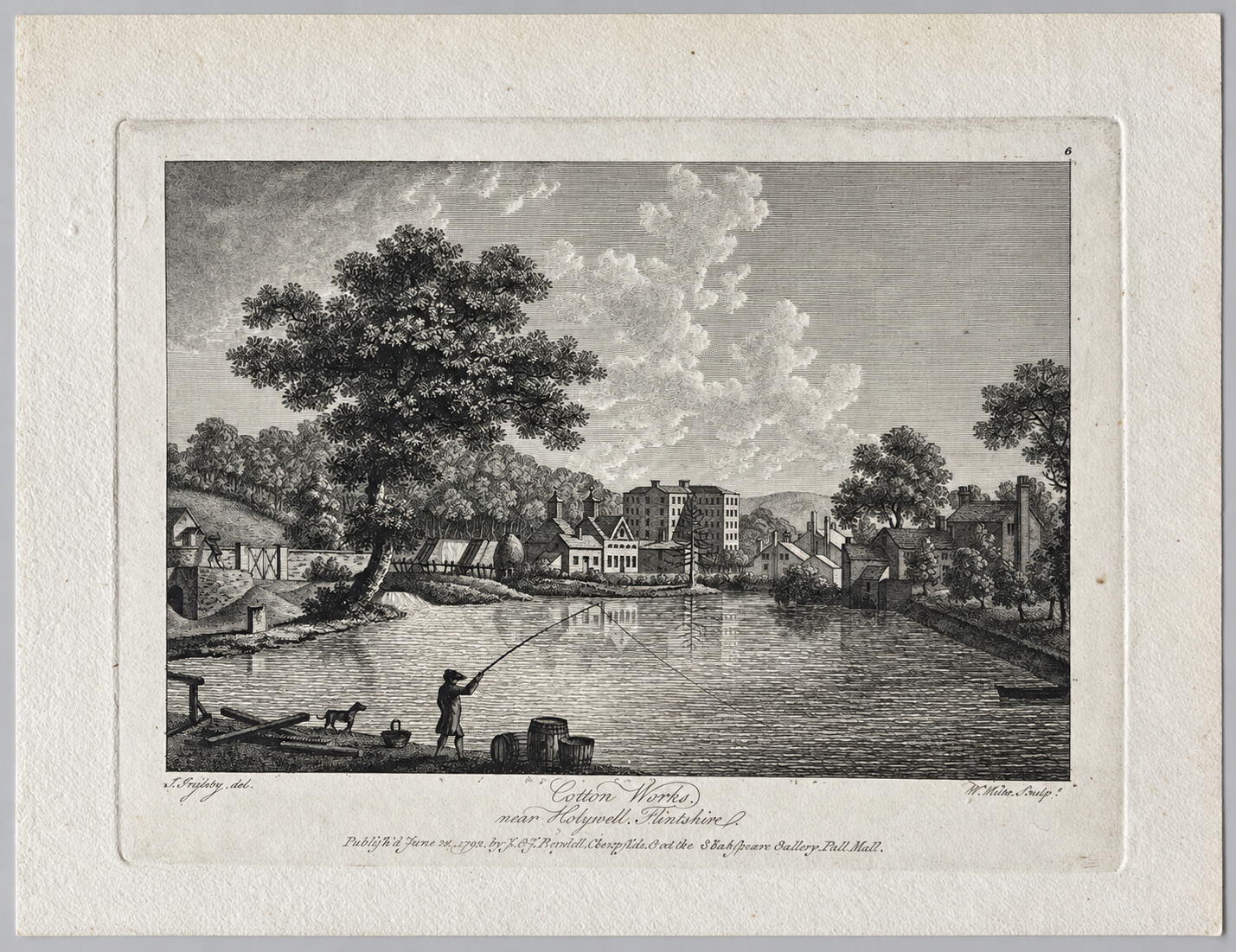
A remarkable original 18th-century British engraving depicting the historic cotton works near Holywell, Flintshire, in North Wales, United Kingdom.
Drawn by John Ingleby (1749–1808) and engraved by William Watts (1752–1851), this beautiful industrial landscape was published in London by John and Josiah Boydell on 25 June 1792.
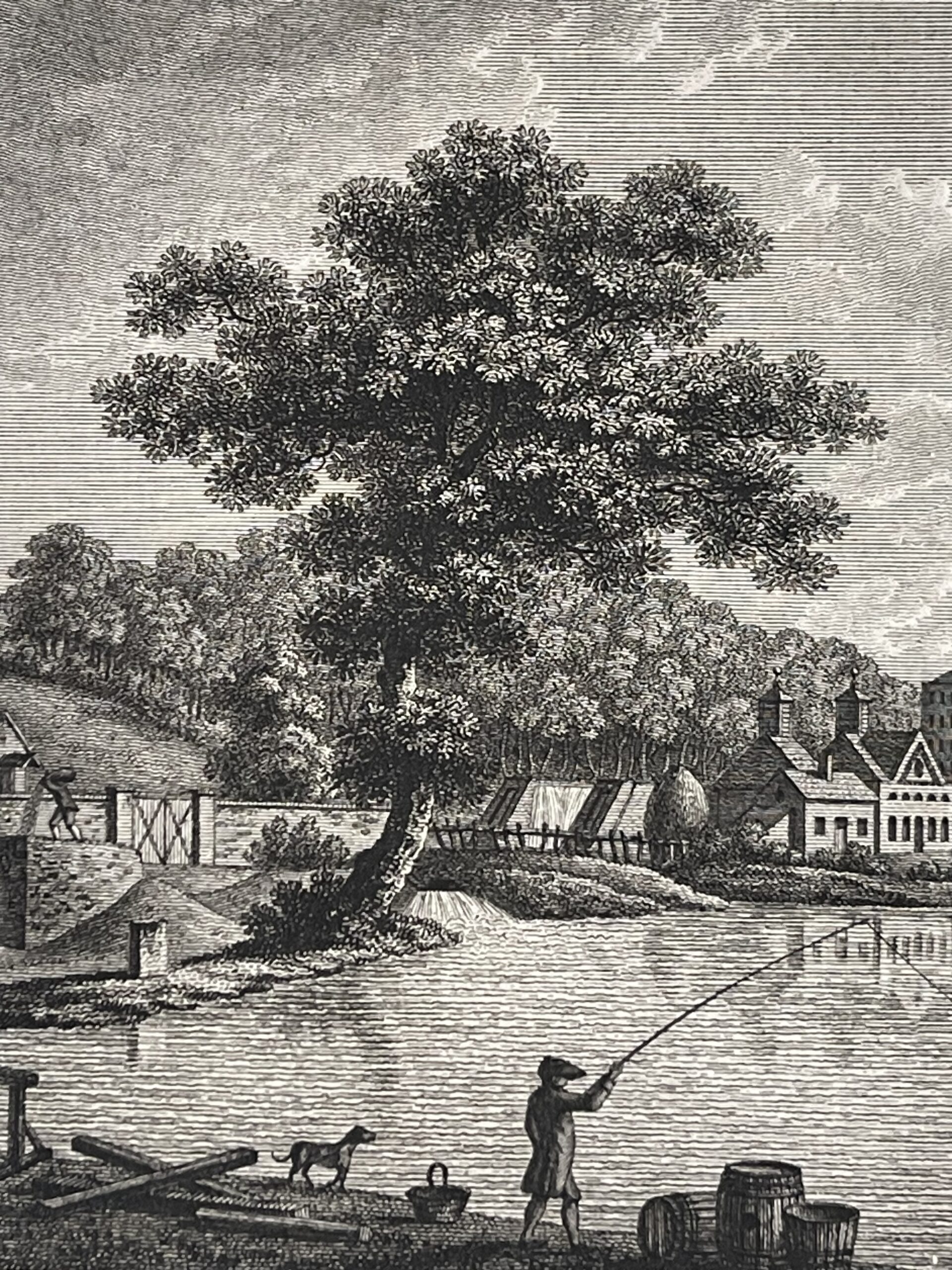
The composition combines an early cotton manufacturing complex, a large water reservoir, traditional buildings, wooded countryside and a fisherman standing beside the water.
An attractive historical print documenting the development of British textile manufacturing during the Industrial Revolution.
Cotton Works near Holywell – A Historical Welsh Landscape
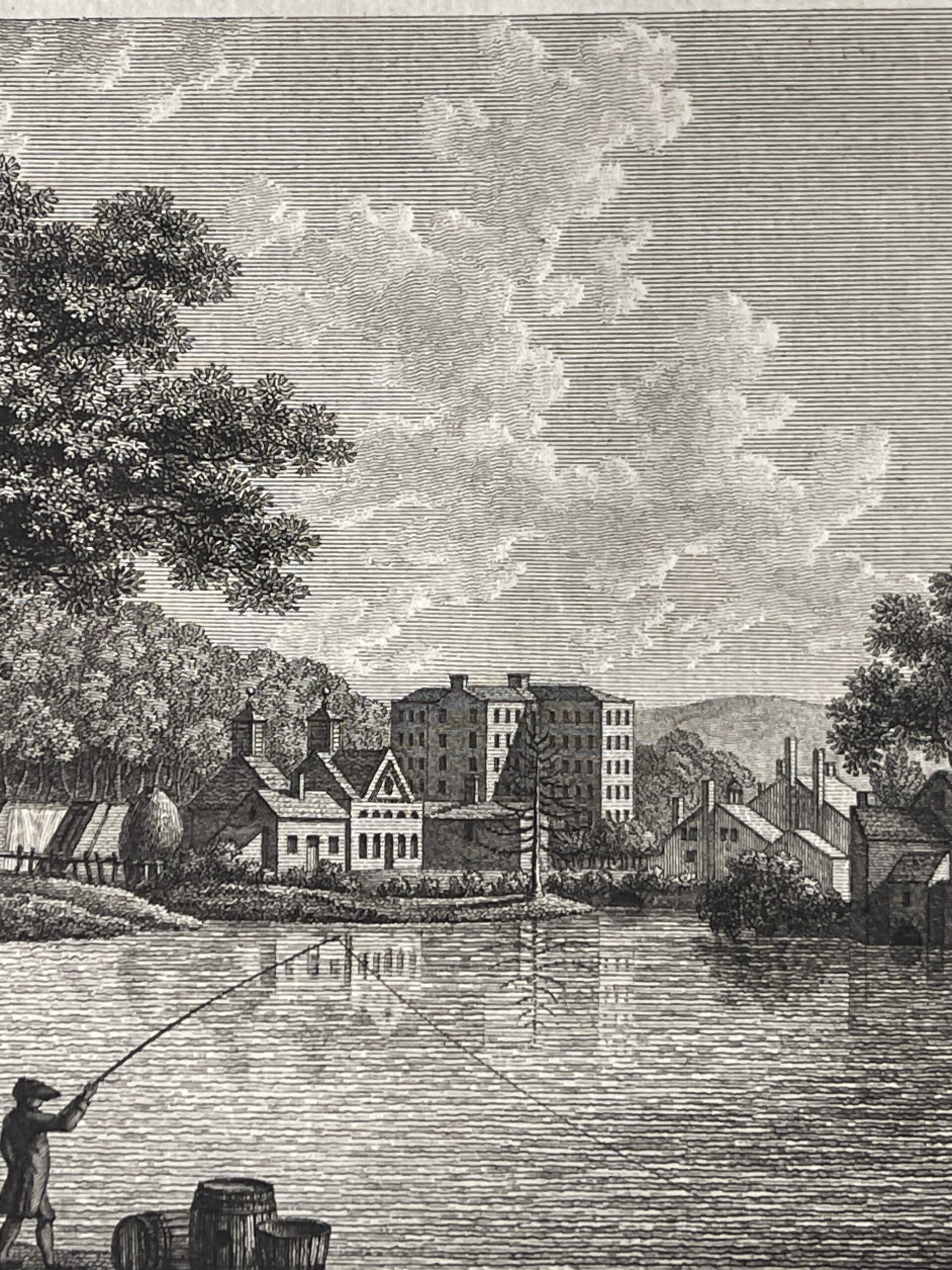
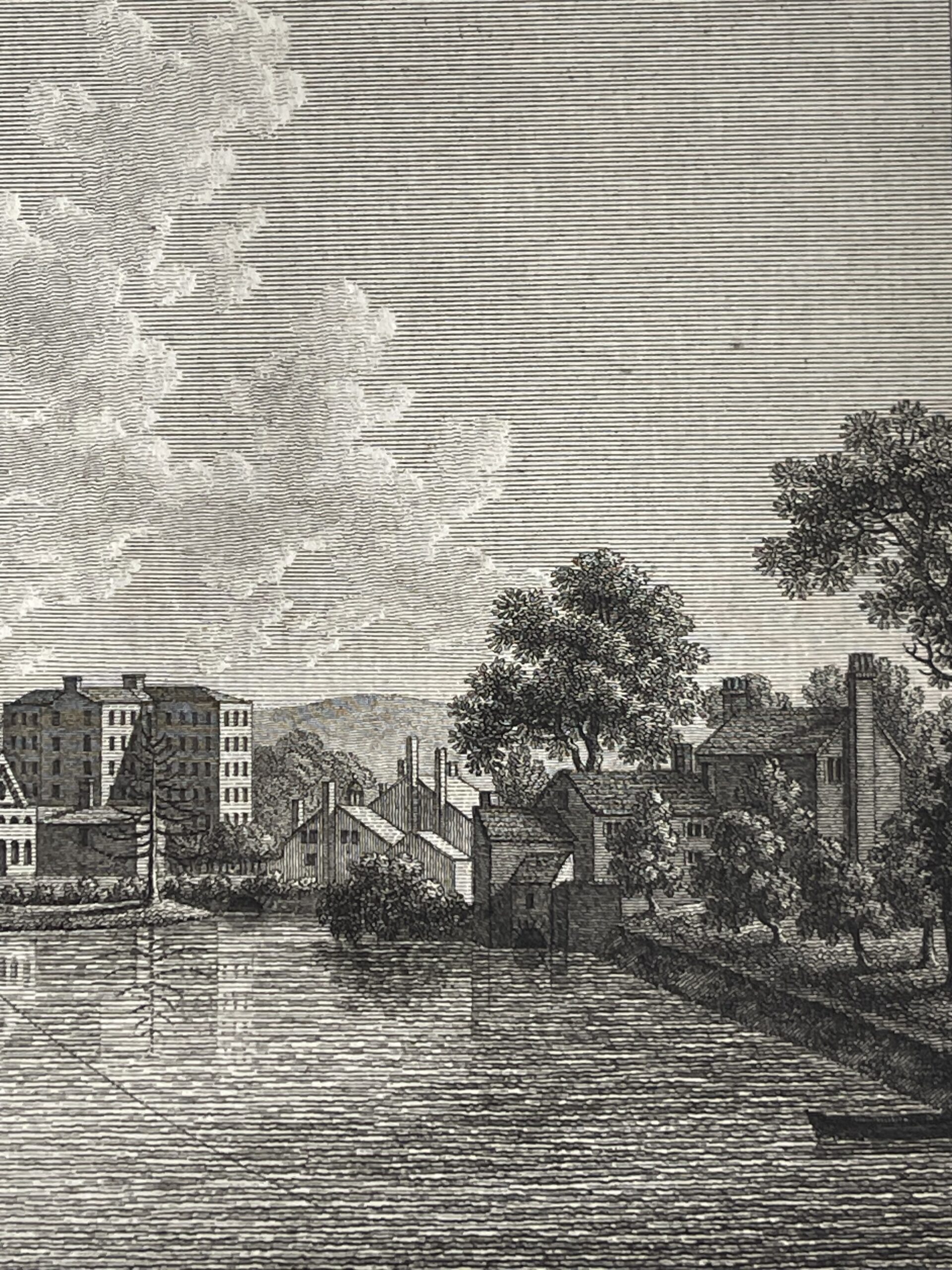
The engraving presents an extensive reservoir surrounded by buildings, trees and distant hills.
In the foreground, a fisherman stands beside the water holding a long fishing rod.
A dog and several containers appear nearby, adding a picturesque detail to the quiet rural scene.
On the left, a large leafy tree dominates the composition, its carefully engraved branches creating a striking contrast against the sky.
Across the water, a group of traditional houses and manufacturing buildings occupies the opposite bank.
An imposing multi-storey industrial building rises in the distance, illustrating the development of the textile industry in North Wales during the late 18th century.
The calm surface of the reservoir reflects the surrounding buildings and vegetation.
The carefully engraved sky, filled with delicate clouds, gives the composition an especially attractive atmosphere.
Holywell and the Industrial Revolution
Holywell, in Flintshire, became an important centre of industrial activity during the 18th century.
The surrounding Greenfield Valley offered abundant water resources, making it particularly suitable for industries requiring mechanical power.
Waterwheels and hydraulic installations supplied energy to mills and manufacturing equipment before the widespread use of steam power.
The cotton industry became an essential part of the economic transformation of Britain, especially with the mechanisation of spinning and textile production.
Large manufacturing buildings were constructed to accommodate increasingly complex machinery.
This 1792 engraving captures that transformation at an early stage, showing the relationship between industrial architecture, water management and the surrounding countryside.
The Importance of Water Power
Water power was central to many early British factories.
Reservoirs provided a means of storing and regulating water supplies, helping manufacturers maintain the flow required to operate machinery.
The presence of the large reservoir in this composition is therefore particularly significant.
It illustrates the engineering infrastructure needed to support manufacturing during the first Industrial Revolution.
Although the landscape appears peaceful, the buildings in the background represent an important period of technological and economic change.
The contrast between the fisherman and the industrial complex makes the composition especially interesting.
John Ingleby – Welsh Draughtsman
John Ingleby (1749–1808) was a Welsh artist known for his detailed drawings of buildings, landscapes and industrial sites.
His work provides valuable visual evidence of the architecture and economic development of North Wales during the late 18th century.
Ingleby combined careful observation of topographical details with the picturesque qualities appreciated by contemporary collectors.
The view of Cotton Works near Holywell is an excellent example of his interest in the changing landscape of Wales.
The industrial buildings are accurately integrated into the surrounding trees, water and countryside.
Engraved by William Watts
William Watts (1752–1851) was a British engraver particularly known for his landscape and topographical prints.
His work included numerous views of British towns, monuments, estates and industrial locations.
This engraving demonstrates his skill in reproducing fine architectural details, delicate reflections and subtle atmospheric effects.
The carefully executed lines of the water and sky create a harmonious balance between the industrial complex and the natural landscape.
Despite the relatively small engraved format, the composition contains an impressive amount of historical detail.
Published by John and Josiah Boydell
The engraving was published in London on 25 June 1792 by John and Josiah Boydell.
The Boydell firm was one of the most important British publishers and printsellers of the late 18th century.
Their engraved publications contributed significantly to the circulation of landscape views, historical subjects and architectural illustrations throughout Britain and Europe.
The publication information is engraved beneath the composition.
The title reads:
« Cotton Works, near Holywell, Flintshire. »
Museum References
An example of the same engraving is preserved in the National Library of Wales, accession number 1131475.
The composition is also represented in the collections of Museum Wales, inventory number NMW A 6571.
These institutional references confirm the historical importance and bibliographical identification of the subject.
The engraving is of particular interest to collectors studying the industrial development of Wales and the emergence of mechanised textile manufacturing.
A Fine Example of 18th-Century Industrial Printmaking
Antique engravings of industrial sites provide a fascinating record of manufacturing technology before the age of modern photography.
Unlike conventional landscapes centred on castles or picturesque ruins, this composition depicts a manufacturing environment integrated into the Welsh countryside.
The reservoir, cotton mills and associated buildings illustrate the practical use of natural resources during the Industrial Revolution.
The engraving also has considerable artistic appeal through its elegant composition, refined linework and detailed treatment of the landscape.
Characteristics
- Location: Holywell, Flintshire, Wales, United Kingdom
- Original title: Cotton Works near Holywell, Flintshire
- Draughtsman: John Ingleby (1749–1808)
- Engraver: William Watts (1752–1851)
- Publishers: John and Josiah Boydell, London
- Publication date: 25 June 1792
- Period: 18th century
- Technique: Original antique intaglio engraving
- Subject: Cotton factories, water reservoir, fisherman and Welsh industrial landscape
- Sheet dimensions: 23.8 × 18 cm
- Engraved image dimensions: 17.9 × 12.1 cm
- Colour: Black and white
Condition
An attractive original antique engraving printed on period paper with margins.
The plate impression is clearly visible.
The print retains detailed architectural features, delicate reflections and finely engraved atmospheric effects.
Please examine the photographs carefully for the exact condition of the paper and printed surface.
Historical and Collecting Interest
This original 1792 engraving is particularly appealing to collectors of British industrial history, early textile manufacturing, antique Welsh landscapes and historical engineering.
Its representation of the Holywell cotton works provides a fascinating visual record of the use of water power during the Industrial Revolution.
The association with John Ingleby, William Watts and the celebrated Boydell publishing house adds historical and bibliographical interest.
An elegant and unusual 18th-century engraving suitable for collections devoted to British history, industrial archaeology and original antique prints.
An authentic 18th-century antique engraving, not a modern reproduction.
The photographs show the actual item offered for sale.


Avis
Il n’y a pas encore d’avis.