Spain Francisco Goya La Filiacion Los Caprichos 57 Marriage Genealogy Satire Heliogravure c1970
29,00 €
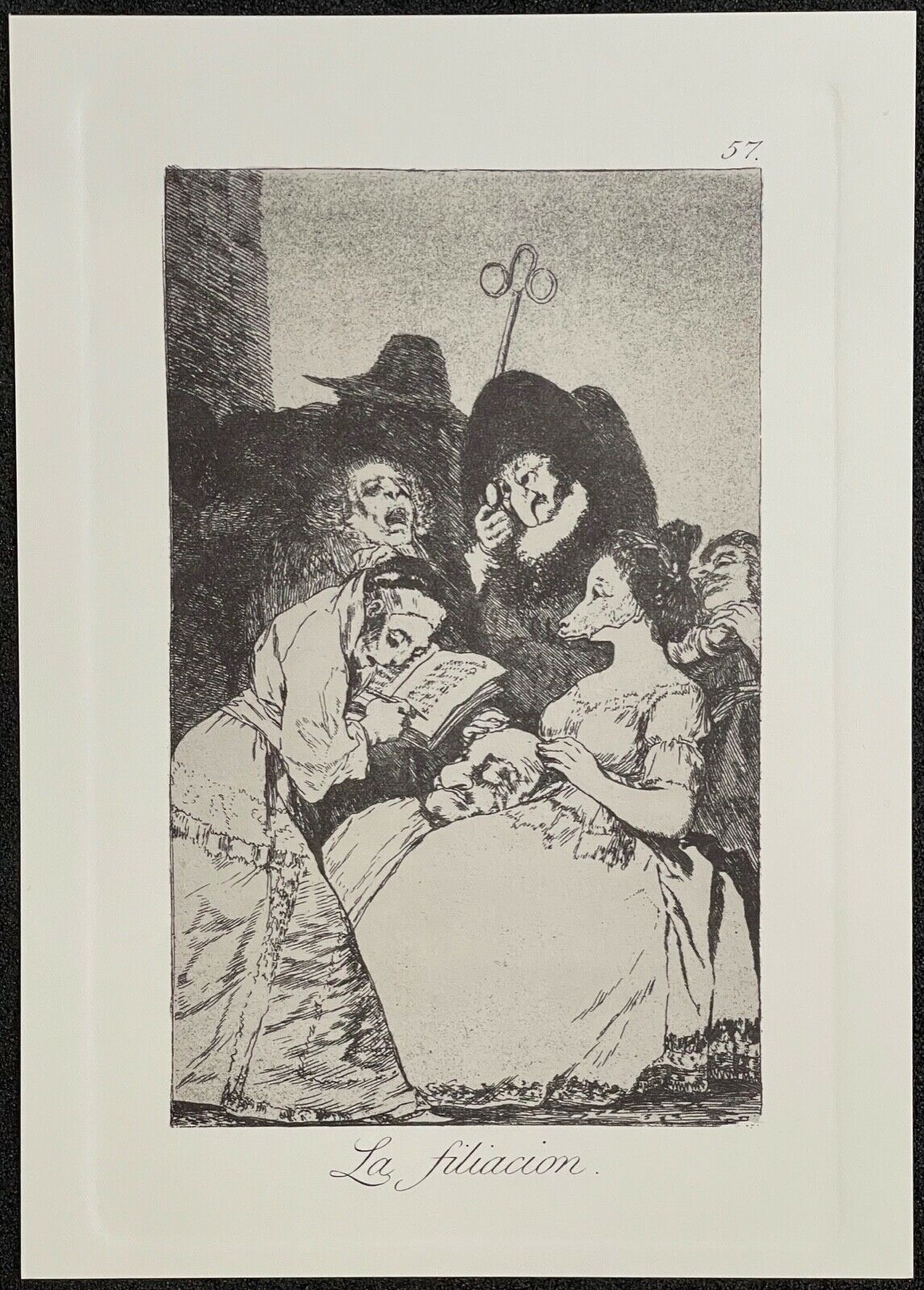
Francisco Goya – La Filiacion – Los Caprichos Plate 57 – Heliogravure circa 1970
Fine twentieth-century heliogravure after Francisco de Goya (1746–1828), reproducing plate 57 of Los Caprichos, originally published in Madrid in 1799.
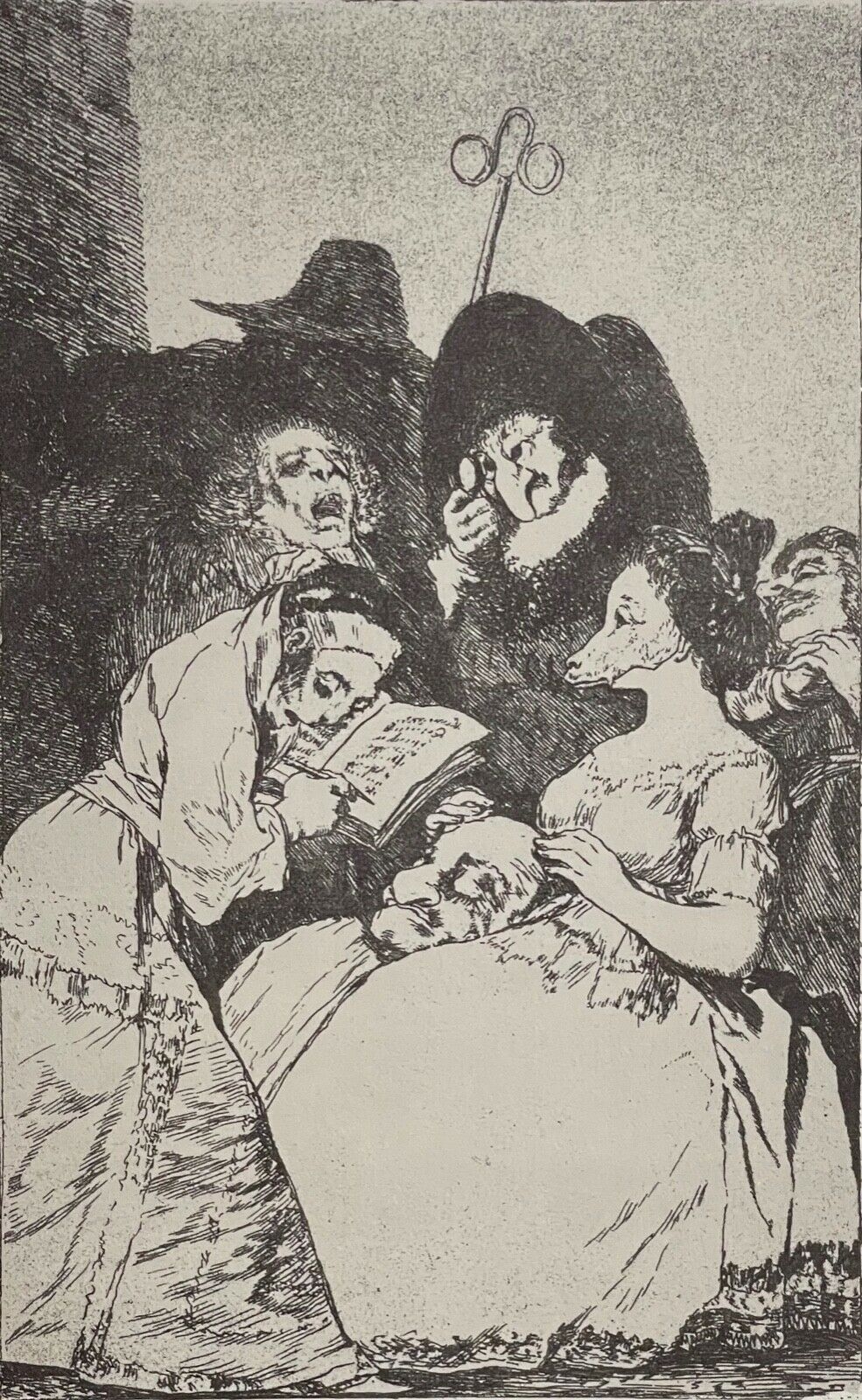
A remarkable satire of marriage, genealogy and aristocratic pretension, depicting a masked seated figure surrounded by grotesque characters examining a document of family lineage.
The composition combines social criticism, animal masks, exaggerated expressions and Goya’s characteristic irony.
Technique: Heliogravure, circa 1970.
Sheet dimensions: 25 × 17.8 cm.
Image dimensions: 16 × 11.8 cm.
Reference: 4930-62R550.
Description
Francisco Goya La Filiacion – Los Caprichos Plate 57 – Marriage and Genealogy Satire – Heliogravure circa 1970
Francisco Goya La Filiacion – Fine twentieth-century heliogravure circa 1970 after plate 57 of the celebrated Spanish series Los Caprichos, originally published in Madrid in 1799.
Artculture6 presents this remarkable heliogravure after Francisco de Goya y Lucientes (1746–1828), one of the most influential Spanish painters and printmakers in European art history.
The composition, entitled La filiación (The Lineage or The Filiation), depicts an extraordinary gathering of grotesque figures examining the ancestry of a masked individual in a scene associated with marriage and social status.
The image is a striking satire of arranged marriages, aristocratic pretension, false appearances and the importance attached to family lineage in eighteenth-century Spanish society.
LA FILIACION – THE LINEAGE
The composition is dominated by a group of curious and grotesque characters assembled around a seated figure.
In the foreground, a woman wearing an elaborate dress sits in profile.
Her face is concealed behind a fox-like mask, while another grotesque mask rests upon her lap.
Beside her, a figure bends over an open document, apparently examining a record of family ancestry or noble descent.
This document plays a central role in the scene, suggesting the formal examination of a person’s lineage before marriage.
Behind the seated woman appears another character with an exaggerated face and prominent nose, using an eyeglass to inspect the proceedings.
Several additional figures gather in the shadows, including a character whose expression suggests laughter or mockery.
An unusual object with two circular loops rises above the group, contributing to the strange theatrical appearance of the composition.
MARRIAGE, ANCESTRY AND SOCIAL PRETENSION
Goya frequently criticised the importance attached to wealth, noble ancestry and social position in the marriages of his time.
In La filiación, the formal examination of family origins becomes a scene of deception and absurdity.
The elaborate genealogical document appears to establish the respectability and noble descent of the prospective bride.
Yet the person whose ancestry is being examined wears an animal mask, suggesting that appearances may conceal an entirely different reality.
The possible bridegroom, represented by the grotesque figure with an eyeglass, seems more interested in the supposed distinction of the family than in understanding the individual before him.
Goya exposes the foolishness of judging people according to their ancestry, titles or outward appearance.
The image suggests that social ambition can make individuals blind to deception.
THE FOX MASK AND ITS SYMBOLISM
One of the most remarkable details of this composition is the animal mask worn by the seated figure.
The mask resembles the head or muzzle of a fox.
In European visual traditions, the fox frequently symbolises cunning, deception and manipulation.
Its presence introduces an ironic contrast between the solemn procedure of verifying noble ancestry and the possibility of deliberate fraud.
Another grotesque mask rests upon the seated figure’s lap, further emphasising the theme of disguise.
Goya uses these objects to question the authenticity of social identities and the reliability of appearances.
The masks transform the apparent marriage ceremony into a theatrical performance in which almost nothing can be accepted at face value.
AN AMBIGUOUS SCENE OF IDENTITY
The meaning of La filiación has been discussed by historians and specialists in Goya’s prints.
Some traditional commentaries interpret the image as a satire of an elderly prospective husband deceived by the supposed noble ancestry of his future wife.
Other interpretations focus on the uncertainty surrounding the identity and appearance of the seated figure.
The animal masks and grotesque features introduce questions about disguise, gender presentation and social identity.
The exact roles of some participants remain open to interpretation.
This ambiguity is characteristic of Goya’s artistic method.
Rather than presenting a simple moral narrative, he combines humour, grotesque imagery and social criticism to expose the contradictions of human behaviour.
GROTESQUE FIGURES AND THEATRICAL EXPRESSIONS
The composition is remarkable for the exaggerated features of the surrounding characters.
One figure bends forward to examine the genealogical record.
Another looks through an eyeglass, apparently attempting to verify the identity or appearance of the seated person.
Behind them, figures with distorted faces observe the proceedings.
The central group is brightly illuminated, while the surrounding spectators emerge from darker areas.
This arrangement directs the viewer’s attention towards the documents, masks and facial expressions.
The result is a scene full of ironic detail and psychological observation.
FRANCISCO DE GOYA (1746–1828)
Francisco José de Goya y Lucientes was born in Fuendetodos, Spain, in 1746.
He became one of the leading European artists of the late eighteenth and early nineteenth centuries.
His career included royal portraits, religious paintings, historical compositions, drawings and an extraordinary body of graphic work.
Goya developed a distinctive artistic language combining realism, psychological observation, satire and fantastic imagery.
His prints frequently examine ignorance, hypocrisy, superstition, corruption, social ambition and the abuse of authority.
His innovative approach to engraving and his penetrating criticism of society contributed significantly to the development of modern European art.
LOS CAPRICHOS – EIGHTY SATIRICAL PRINTS
Published in Madrid in 1799, Los Caprichos consists of eighty compositions examining the social and moral contradictions of contemporary Spanish society.
The series addresses superstition, ignorance, hypocrisy, marriage arrangements, aristocratic pretension and the abuse of power.
Goya employed etching and aquatint, together with related graphic techniques, to create remarkable variations of tone and texture.
The compositions combine realistic observation with caricature, grotesque figures and fantastic imagery.
La filiación, plate 57, is particularly interesting for its treatment of social ambition and the importance attached to genealogy.
Through masks, exaggerated expressions and a mysterious gathering, Goya transforms a formal social ritual into an extraordinary satire.
THE ORIGINAL COMPOSITION AND PREPARATORY DRAWINGS
The original print was created in the late 1790s and published as plate 57 of Los Caprichos in 1799.
Goya developed several preparatory drawings for this composition, exploring different arrangements and interpretations of the characters.
These studies reveal the evolution of the scene before its final engraved form.
The composition is distinguished by the central seated figure, the elaborate masks and the surrounding group of grotesque observers.
The title La filiacion appears beneath the original image.
The number 57 identifies its position within the celebrated series.
The original engraving is catalogued as Delteil 94 and Harris 92.
ETCHING AND AQUATINT
The original composition was executed using etching and aquatint.
These techniques allowed Goya to combine precise linear detail with tonal contrasts.
The clothing and facial expressions are rendered through carefully controlled graphic lines.
The darker areas surrounding the central figures create an atmosphere of theatrical mystery.
The masks, eyeglass, genealogical document and unusual accessories are represented with considerable attention to detail.
Their presence contributes to the complex symbolism of the composition.
THE HELIOGRAVURE PROCESS
The present example is a twentieth-century heliogravure produced circa 1970 after Goya’s original composition.
Heliogravure is a photomechanical printing process capable of reproducing the fine details and tonal variations of historical graphic works.
It has frequently been used in high-quality reproductions of important engravings and drawings.
This example preserves the expressive figures, masks and dramatic contrasts of Goya’s original composition.
This is a circa 1970 heliogravure reproduction, not an original eighteenth-century etching or aquatint printed during Goya’s lifetime.
TECHNICAL DETAILS
Artist of the original composition: Francisco de Goya y Lucientes (1746–1828).
Original title: La filiación.
English title: The Lineage / The Filiation.
Series: Los Caprichos.
Plate number: 57.
Original publication: Madrid, Spain, 1799.
Original technique: Etching and aquatint.
Technique of this example: Heliogravure.
Date of this example: Circa 1970.
Sheet dimensions: 25 × 17.8 cm.
Image dimensions: 16 × 11.8 cm.
Reference: 4930-62R550.
CONDITION
Vintage example displaying the natural patina of the paper.
The reproduced composition and original inscriptions remain well preserved.
COLLECTOR’S INTEREST
An attractive twentieth-century heliogravure after one of Francisco Goya’s most celebrated satirical print series.
Particularly interesting for collectors of Spanish art, Los Caprichos, historical printmaking, marriage satire, genealogy, aristocratic history and grotesque imagery.
The unusual animal masks, exaggerated characters and ironic examination of family lineage make this composition a distinctive example of Goya’s social criticism.
An appealing addition to a collection devoted to Goya and the history of European graphic art.
Offered by Artculture6 – Antique Prints, Drawings and Works of Art.


Avis
Il n’y a pas encore d’avis.