Spain Francisco Goya Esta Vmd Como Digo Los Caprichos 76 Military Satire Heliogravure c1970
29,00 €
Francisco Goya – Esta Vmd Pues Como Digo – Los Caprichos Plate 76 – Heliogravure circa 1970
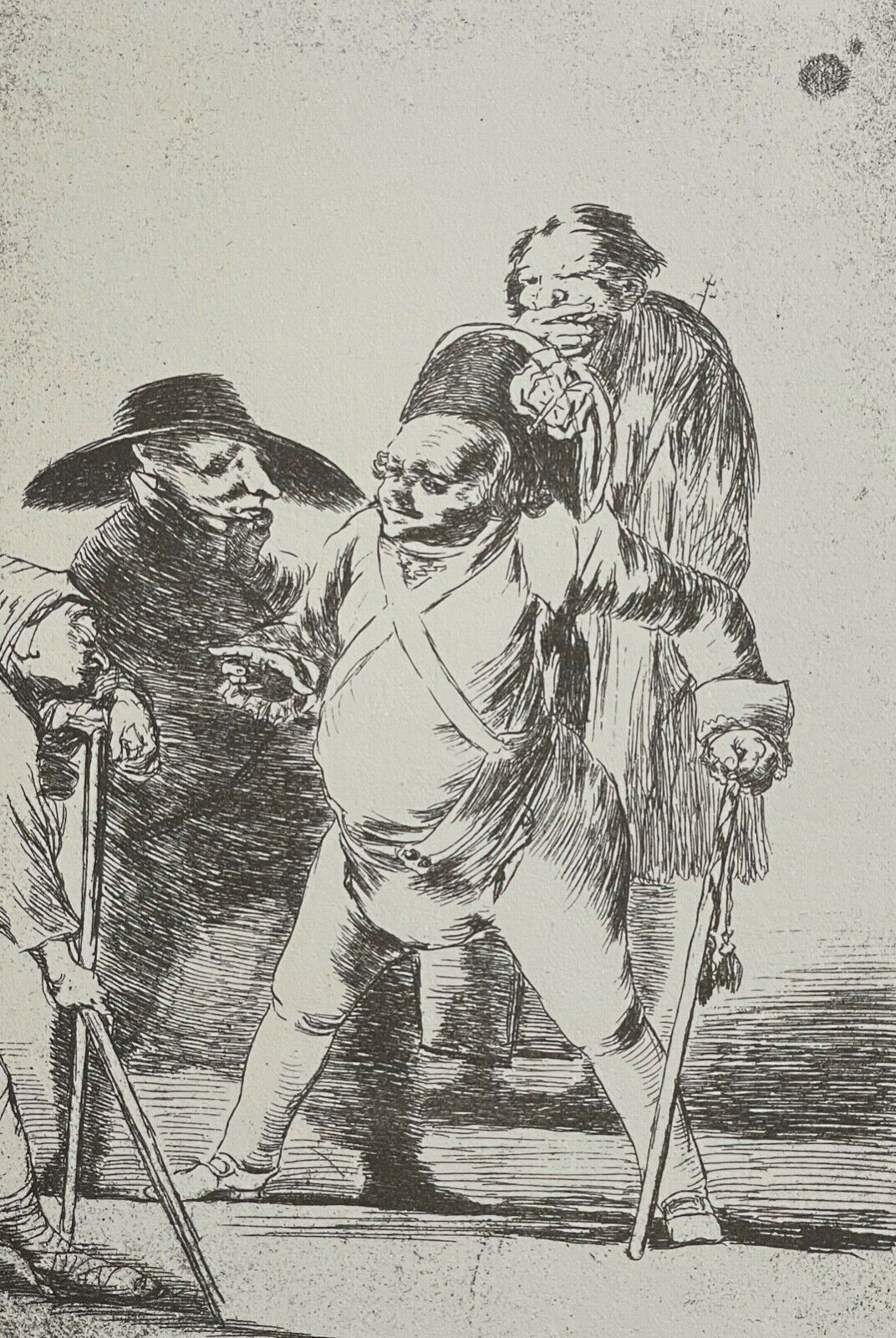
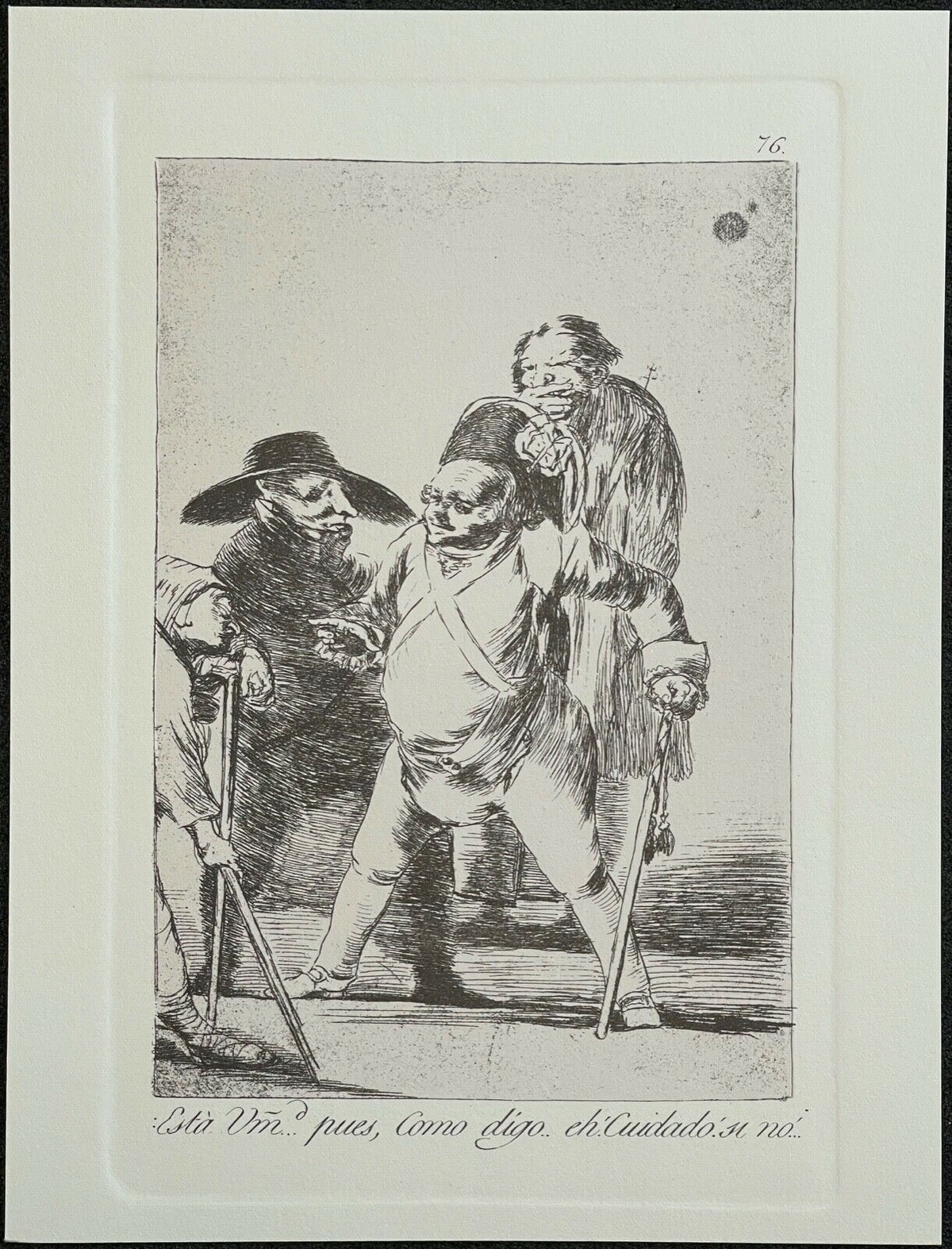
Fine twentieth-century heliogravure after Francisco de Goya (1746–1828), reproducing plate 76 of Los Caprichos, originally published in Madrid in 1799.
A powerful satire of military arrogance depicting a corpulent Spanish general surrounded by several observers, including a disabled man with crutches.
The composition criticises vanity, intimidation and the abuse of authority. The principal officer has sometimes been associated with General Tomás de Morla.
Technique: Heliogravure, circa 1970.
Sheet dimensions: 25.2 × 19.2 cm.
Image dimensions: 19.3 × 13.1 cm.
Reference: 4930-75R550L85.
Description
Francisco Goya Esta Vmd Pues Como Digo – Los Caprichos Plate 76 – Military Satire – Heliogravure circa 1970
Francisco Goya Esta Vmd Pues Como Digo – Fine twentieth-century heliogravure circa 1970 after plate 76 of the celebrated Spanish series Los Caprichos, originally published in Madrid in 1799.
Artculture6 presents this remarkable heliogravure after Francisco de Goya y Lucientes (1746–1828), one of the greatest Spanish painters and printmakers.
The composition, entitled Está Vmd… pues, como digo… ¡eh! Cuidado! si no…, is a powerful satire of military arrogance, pretentious authority and the abuse of power.
Its English title may be rendered as You Understand?… Well, As I Say… Hey! Be Careful! Otherwise…
The engraving depicts a corpulent military officer surrounded by several figures, including a disabled man supported by crutches and another observer attempting to conceal his amusement.
The image belongs to Goya’s extraordinary series of eighty satirical prints known as Los Caprichos.
THE ARROGANT GENERAL – A SCENE OF MILITARY SATIRE
At the centre of the composition stands a large, heavily built military officer.
His imposing stomach, broad stance and exaggerated gestures give him a deliberately comic appearance.
He wears an elaborate uniform and carries a walking stick or staff associated with his authority.
His expression conveys an air of self-importance, as though delivering an impressive speech or threatening those around him.
On the left, a darkly dressed man wearing a broad-brimmed hat observes the general.
Another figure, partly visible in the foreground, supports himself on crutches.
Behind the central officer stands a third man who appears to cover his mouth to conceal his laughter.
The contrast between the general’s exaggerated dignity and the reactions of the surrounding figures gives the composition its satirical force.
A CRITICISM OF THE ABUSE OF AUTHORITY
The original Spanish title is deliberately fragmented.
The officer appears to interrupt his own speech with a warning or threat, as if expecting absolute obedience from those listening.
The unfinished words create the impression of a pompous individual attempting to assert his importance.
The traditional commentary associated with the print explains that the officer’s insignia and staff lead him to imagine himself superior to ordinary people.
He abuses the authority entrusted to him and intimidates those who are weaker than himself.
However, he becomes humble and submissive when confronted with individuals of greater power.
Goya exposes this contradiction through the absurd appearance of the central figure and the reactions of his companions.
The image is therefore a satire not simply of an individual officer but of the hypocrisy and vanity associated with unjustified authority.
A POSSIBLE REFERENCE TO GENERAL TOMÁS DE MORLA
Some historians have proposed that the principal figure may allude to Tomás de Morla y Pacheco (1748–1812), a Spanish artillery general.
Morla was a prominent military officer who enjoyed the protection of Manuel Godoy, one of the most influential political figures in Spain during the reign of Charles IV.
His personality was associated with boastfulness and an excessive reliance on verbal intimidation.
The interpretation connects the exaggerated military figure in Goya’s print with the behaviour of certain officers whose social position exceeded their actual achievements.
Morla subsequently played a role in the events surrounding the French occupation of Madrid during the Napoleonic period.
Although the identification remains a scholarly hypothesis rather than a definitive portrait, it provides an interesting historical context for Goya’s satire.
THE DISABLED OBSERVER AND THE REACTION OF THE CROWD
The figure supported by crutches is particularly significant.
His physical vulnerability contrasts sharply with the apparent confidence of the corpulent general.
This opposition reinforces the theme of authority exercised against those unable to resist.
The man behind the officer attempts to hide his laughter, suggesting that the general’s display of importance is not taken seriously by everyone present.
The broad-brimmed hat of the observer on the left adds another strong visual element to the composition.
Together, the characters create an ironic scene in which military rank and outward dignity become objects of ridicule.
FRANCISCO DE GOYA (1746–1828)
Francisco José de Goya y Lucientes was born in Fuendetodos, Spain, in 1746.
He became one of the most important European artists of the late eighteenth and early nineteenth centuries.
His remarkable career included royal portraits, religious painting, historical compositions, drawings and a highly influential body of graphic work.
Goya developed a distinctive artistic language combining realism, psychological observation, imagination and social criticism.
His prints frequently examined ignorance, hypocrisy, superstition, corruption and the misuse of political or religious authority.
His work played an important role in the development of modern European art.
LOS CAPRICHOS – A MASTERPIECE OF SPANISH SATIRE
Published in Madrid in 1799, Los Caprichos consists of eighty compositions examining the customs, beliefs and contradictions of Spanish society.
Goya used this extraordinary series to criticise social pretension, ignorance, injustice, superstition and abuses of power.
The prints combine realistic observations of contemporary life with fantasy, caricature and grotesque imagery.
The original works were executed using etching and aquatint, sometimes accompanied by other intaglio techniques.
Plate 76 belongs to the final section of the series, in which Goya continued to explore the absurdity of human behaviour.
Unlike several neighbouring plates featuring witches and fantastic creatures, this composition relies primarily upon the expressive appearance of recognisable human figures.
THE ORIGINAL COMPOSITION
The original print was produced between approximately 1797 and 1799.
It presents a group of figures arranged around the central officer.
The general’s exaggerated body and uniform dominate the scene, while the other characters provide contrasting expressions and postures.
The finely engraved clothing and prominent dark passages create a strong sense of visual movement.
The man’s walking stick, the crutches of the disabled figure and the expressive faces all contribute to the meaning of the satire.
The number 76 appears in the upper-right corner.
The original Spanish inscription is printed beneath the image.
A preparatory drawing by Goya is preserved in the Museo Nacional del Prado in Madrid, illustrating the development of the composition.
ARTISTIC TECHNIQUE AND TONAL CONTRAST
The original print was executed using etching, burnished aquatint and drypoint.
These techniques allowed Goya to combine precise graphic lines with subtle tonal effects.
The facial expressions, folds of clothing and contrasting textures are particularly important in conveying the grotesque character of the figures.
The relatively open background places emphasis upon the personalities and gestures of the central group.
The resulting composition is both humorous and sharply critical.
THE HELIOGRAVURE PROCESS
The present example is a twentieth-century heliogravure produced circa 1970 after Goya’s original composition.
Heliogravure is a photomechanical printing process capable of reproducing the fine graphic details and tonal variations of historical engravings.
It has frequently been employed in high-quality reproductions of important European prints and drawings.
This example reproduces the central figures, original Spanish title, plate number and expressive character of Goya’s composition.
This is a circa 1970 heliogravure reproduction, not an original eighteenth-century etching or aquatint printed during Goya’s lifetime.
TECHNICAL DETAILS
Artist of the original composition: Francisco de Goya y Lucientes (1746–1828).
Original title: Está Vmd… pues, como digo… ¡eh! Cuidado! si no…
English title: You Understand?… Well, As I Say… Be Careful! Otherwise…
Series: Los Caprichos.
Plate number: 76.
Original publication: Madrid, Spain, 1799.
Original technique: Etching, burnished aquatint and drypoint.
Technique of this example: Heliogravure.
Date of this example: Circa 1970.
Sheet dimensions: 25.2 × 19.2 cm.
Image dimensions: 19.3 × 13.1 cm.
Reference: 4930-75R550L85.
CONDITION
Vintage example displaying the natural patina of the paper.
The reproduced composition and original inscriptions remain well preserved.
COLLECTOR’S INTEREST
An attractive twentieth-century heliogravure after one of Francisco Goya’s most celebrated satirical print series.
Particularly interesting for collectors of Spanish art, Los Caprichos, political caricature, military history, historical printmaking and eighteenth-century social criticism.
The grotesque central figure, the expressive observers and the subtle criticism of military pretension make this an appealing example of Goya’s sharp satirical vision.
Offered by Artculture6 – Antique Prints, Drawings and Works of Art.



Avis
Il n’y a pas encore d’avis.