
Description
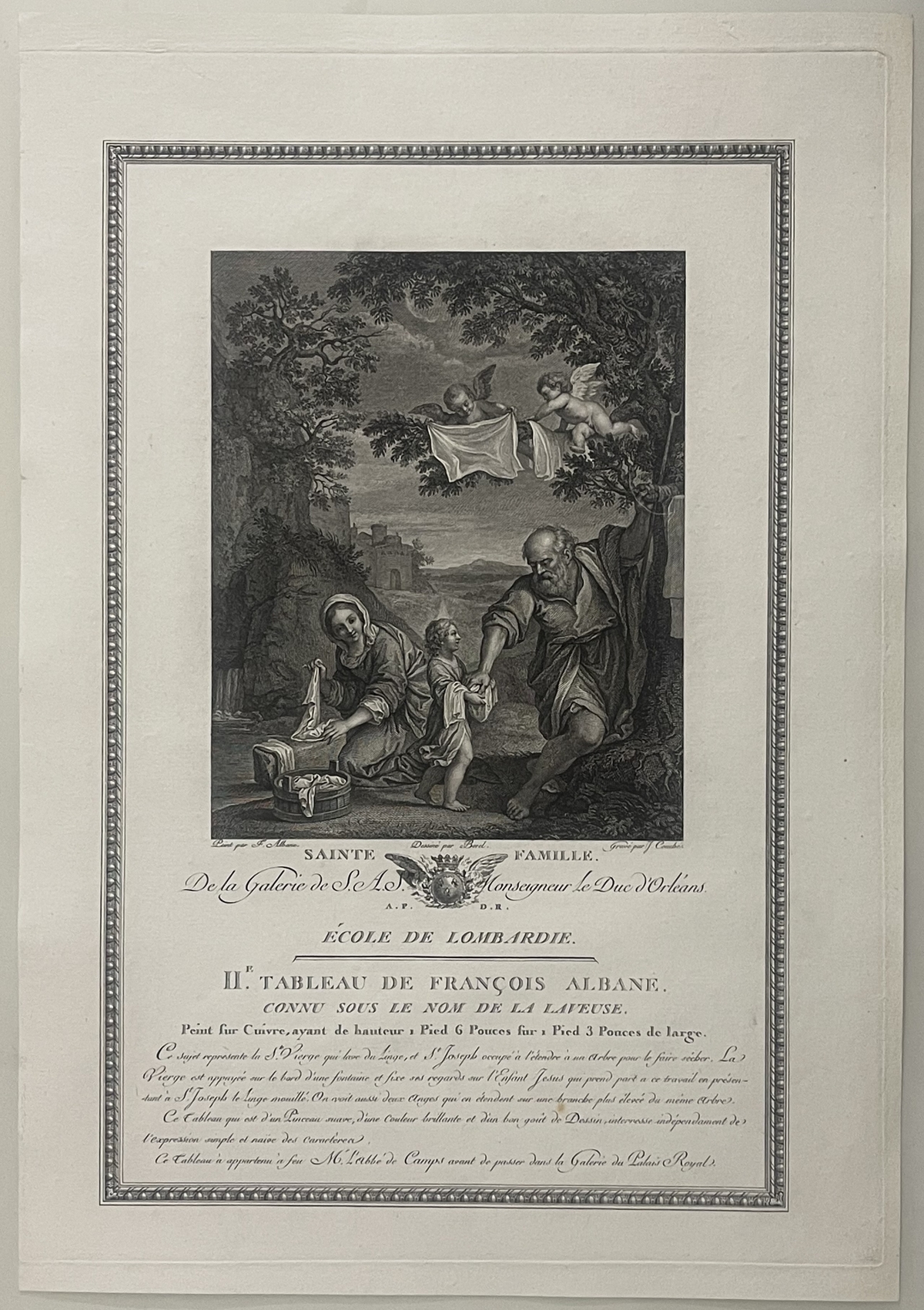
Francesco Albani Holy Family engraving – Original French Old Master print of 1786, engraved by Jacques Couché.
A fine large-format eighteenth-century engraving after a painting by Francesco Albani (1578–1660), the celebrated Italian Baroque painter of the Bolognese school.
Engraved by Jacques Couché after a drawing by Borel, this attractive religious composition depicts the Holy Family in a wooded landscape.
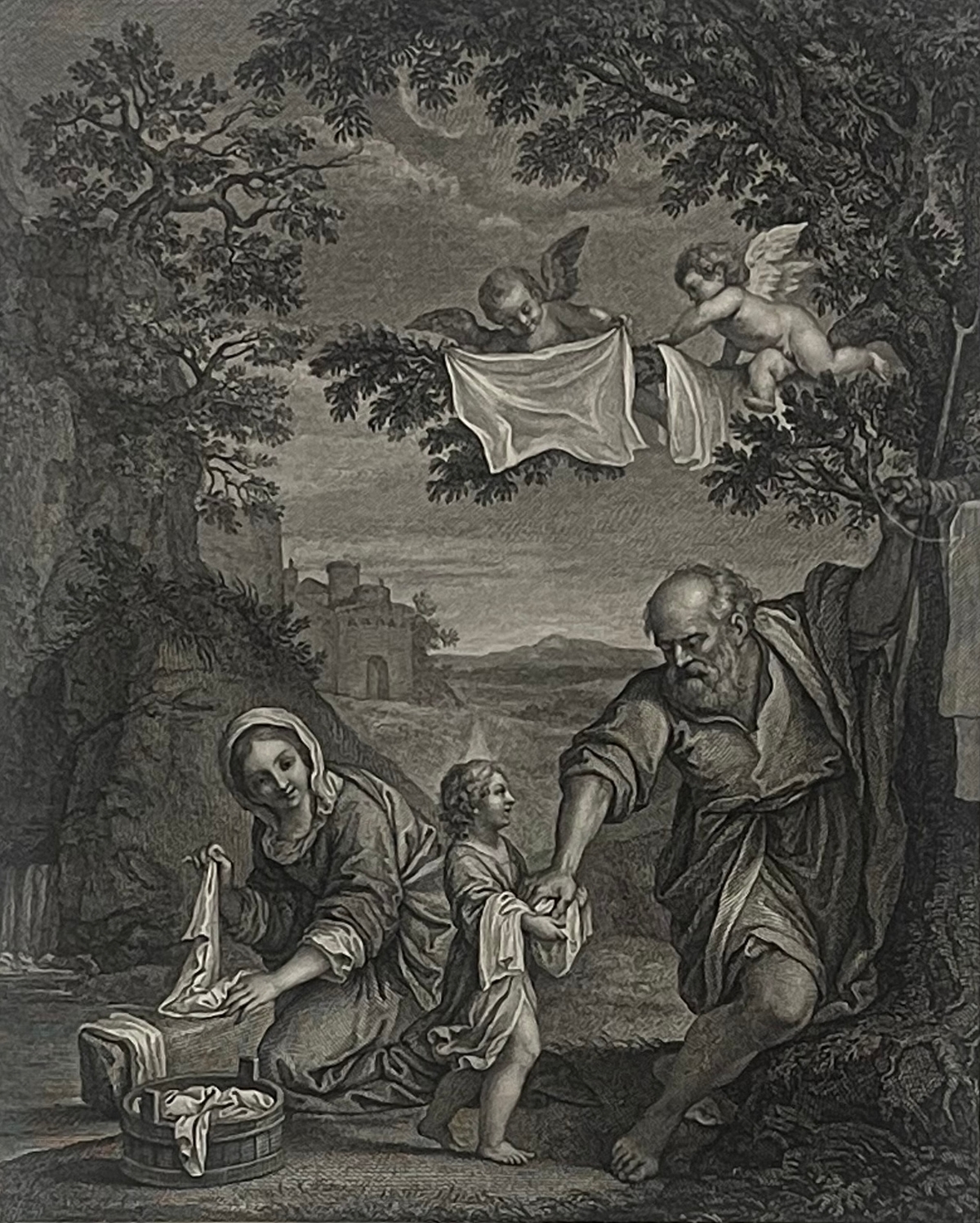
The Virgin Mary is washing linen beside a fountain, while the Christ Child stands between Mary and Saint Joseph. Above the figures, two angels are hanging pieces of cloth among the branches of a tree.
The painting was historically known as La Laveuse, or The Washerwoman.
THE HOLY FAMILY — THE WASHERWOMAN
The engraving presents an intimate scene from the everyday life of the Holy Family.
On the left, the Virgin Mary kneels beside a small basin containing linen.
She holds a piece of cloth in her hands, engaged in a domestic task.
The young Christ stands beside her, while Saint Joseph leans towards him and extends his hand.
The figures are surrounded by trees and vegetation.
In the upper part of the composition, two angels hold pieces of white linen suspended among the branches.
A distant building and rolling landscape complete the background.
The composition combines religious symbolism with a peaceful representation of domestic life.
FRANCESCO ALBANI (1578–1660)
Francesco Albani was one of the leading painters of the Bolognese school during the seventeenth century.
Born in Bologna in 1578, he studied within the artistic circle of the Carracci.
He became particularly renowned for his elegant religious and mythological compositions.
His paintings are characterised by balanced arrangements of figures, graceful gestures, delicate landscapes and harmonious lighting.
Albani developed a distinctive interpretation of classical Baroque painting, combining religious devotion with an idealised vision of nature.
His works were highly appreciated by European collectors and were frequently reproduced in engravings.
He died in Bologna in 1660.
A GENTLE RELIGIOUS COMPOSITION
The painting offers a particularly intimate representation of the Holy Family.
Rather than presenting a solemn religious ceremony, Albani depicts Mary and Joseph engaged in everyday activities with the young Christ.
The Virgin is occupied with washing linen, while Joseph gently attends to the child.
The two angels introduce a heavenly element into the peaceful domestic scene.
The surrounding landscape contributes to the calm and harmonious atmosphere.
The composition reflects the elegance and idealised naturalism associated with seventeenth-century Italian painting.
JACQUES COUCHÉ — EIGHTEENTH-CENTURY ENGRAVER
Jacques Couché was a French engraver active during the eighteenth century.
He became particularly associated with the reproduction of paintings from important European collections.
His engravings helped make celebrated works of earlier masters available to a wider audience.
The present print was engraved by Couché after a drawing by Borel, based on the original painting by Francesco Albani.
The engraving displays fine linework and carefully arranged hatching.
The delicate treatment of the figures contrasts with the darker foliage and trees.
A FINE ORIGINAL ENGRAVING OF 1786
This large eighteenth-century engraving is accompanied by an elaborate engraved border, historical inscriptions and a descriptive text in French.
The original printed inscriptions include:
SAINTE FAMILLE
ÉCOLE DE LOMBARDIE
IIe TABLEAU DE FRANÇOIS ALBANE
CONNU SOUS LE NOM DE LA LAVEUSE
The engraved text also describes the original painting as an oil painting on copper.
The sheet is particularly attractive for its generous proportions and the careful combination of a religious composition with decorative and historical engraving.
AN ATTRACTIVE OLD MASTER PRINT
This original eighteenth-century print is particularly appealing to collectors of Italian Baroque art, French historical engravings, religious iconography and the Bolognese school.
Its large format, elaborate inscriptions and refined engraved details make it a fine example of eighteenth-century reproductive printmaking.
DETAILS
Original artist: Francesco Albani (1578–1660).
Artistic school: Italian, Bologna.
Subject: The Holy Family, also known as The Washerwoman.
Draughtsman: Borel.
Engraver: Jacques Couché.
Print date: 1786.
Technique: Original intaglio engraving.
Paper: Antique laid paper.
Sheet dimensions: 44 × 30.6 cm.
Engraved composition including text: 36.8 × 23.9 cm.
Period: 18th century.
Reference: 5341-62R753W.

Avis
Il n’y a pas encore d’avis.