
Description
BRAZIL – INDIGENOUS HEALING RITUAL – ANDRÉ THEVET – 16TH-CENTURY WOODCUT
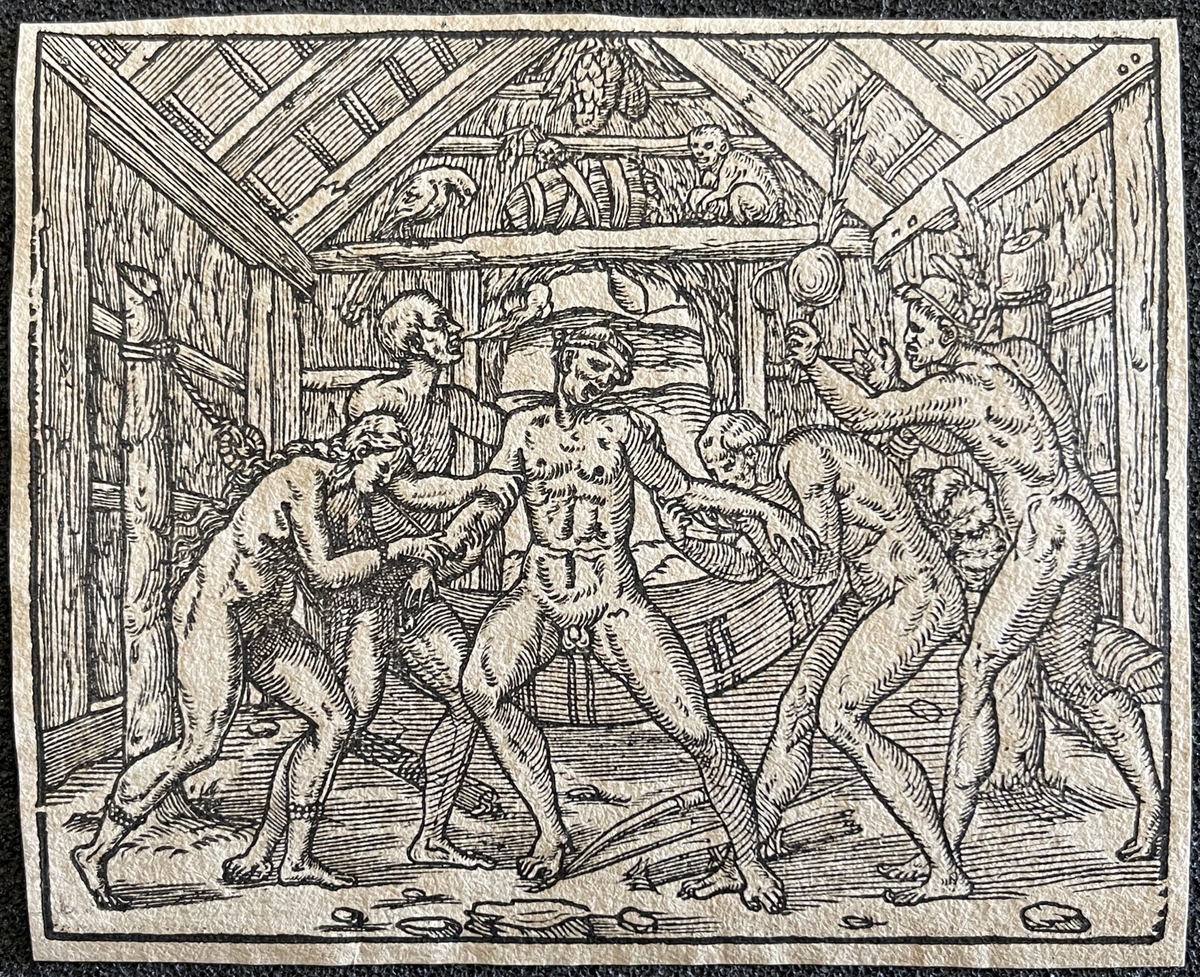
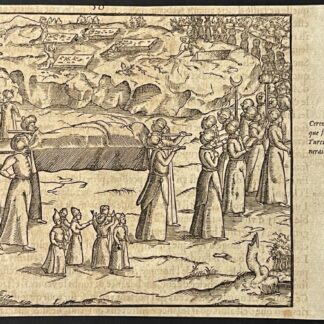
An exceptional early woodcut illustrating an Indigenous healing practice in sixteenth-century Brazil, associated with the writings of French explorer and cosmographer André Thevet (1516–1592).
This remarkable composition is known as La succión de las llagas, or The Sucking of Wounds, and depicts a traditional therapeutic practice among the Indigenous peoples of coastal Brazil, particularly the Tupinambá.
The image is associated with André Thevet’s celebrated travel account, Les Singularitez de la France antarctique, first published in Paris in 1557 and subsequently issued in other sixteenth-century editions.
INDIGENOUS MEDICINE IN SIXTEENTH-CENTURY BRAZIL
The engraving depicts a group of Indigenous figures gathered inside a communal wooden dwelling.
At the centre stands a man with his legs apart, surrounded by several individuals performing a healing ritual. Their gestures suggest the practice of drawing illness or harmful substances from the body through suction.
Traditional healing among Indigenous peoples of Brazil combined practical knowledge of the human body with ritual practices and spiritual beliefs.
The image is particularly significant as an early European representation of Indigenous medical traditions in South America.
The detailed interior, wooden beams, suspended objects and expressive figures provide additional ethnographic interest.
ANDRÉ THEVET AND FRENCH EXPLORATION OF BRAZIL
André Thevet was a French Franciscan friar, traveller and royal cosmographer whose writings introduced European readers to the geography, peoples and natural history of the Americas.
In 1555, he joined the French expedition led by Nicolas Durand de Villegagnon, which attempted to establish a French colony in Guanabara Bay, near present-day Rio de Janeiro.
This short-lived colonial settlement became known as France Antarctique.
Following his return to France, Thevet published Les Singularitez de la France antarctique, one of the important early French accounts of Brazil and the New World.
The work included numerous woodcut illustrations depicting Indigenous customs, animals, plants and other subjects that fascinated European readers during the Age of Exploration.
AN IMPORTANT EARLY ETHNOGRAPHIC IMAGE
This composition is an unusual historical document illustrating how European travellers represented Indigenous therapeutic practices during the sixteenth century.
It is of particular interest to collectors of early Americana, the history of medicine, Brazilian history, ethnographic prints and Renaissance travel literature.
The woodcut also demonstrates the distinctive graphic language of sixteenth-century book illustration, with strong contours, expressive figures and closely spaced engraved lines.
DETAILS
Author associated with the composition: André Thevet (1516–1592).
Subject: Indigenous healing ritual and wound suction.
Geographic subject: Brazil, Tupinambá peoples.
Date traditionally assigned to this impression: 1575.
Original composition documented in the sixteenth century.
Technique: Woodcut.
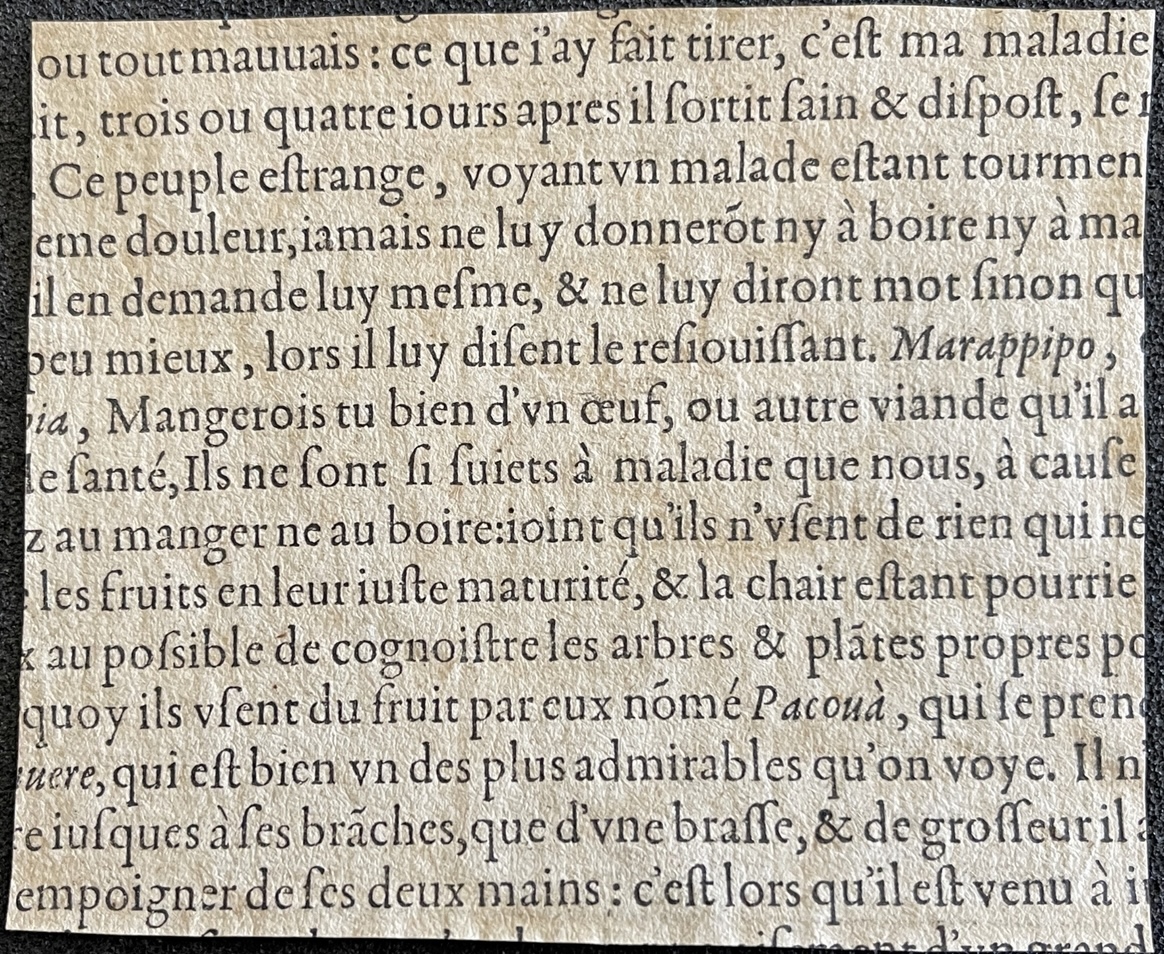
Paper: Antique laid linen paper.
Sheet dimensions: 10.9 × 9 cm.
Printed image dimensions: 10.6 × 8.6 cm.
Period: 16th century.

Avis
Il n’y a pas encore d’avis.