Saint Stephen’s Martyrdom 1728 – Biblical Stoning Scene after Bernard Picart
89,00 €
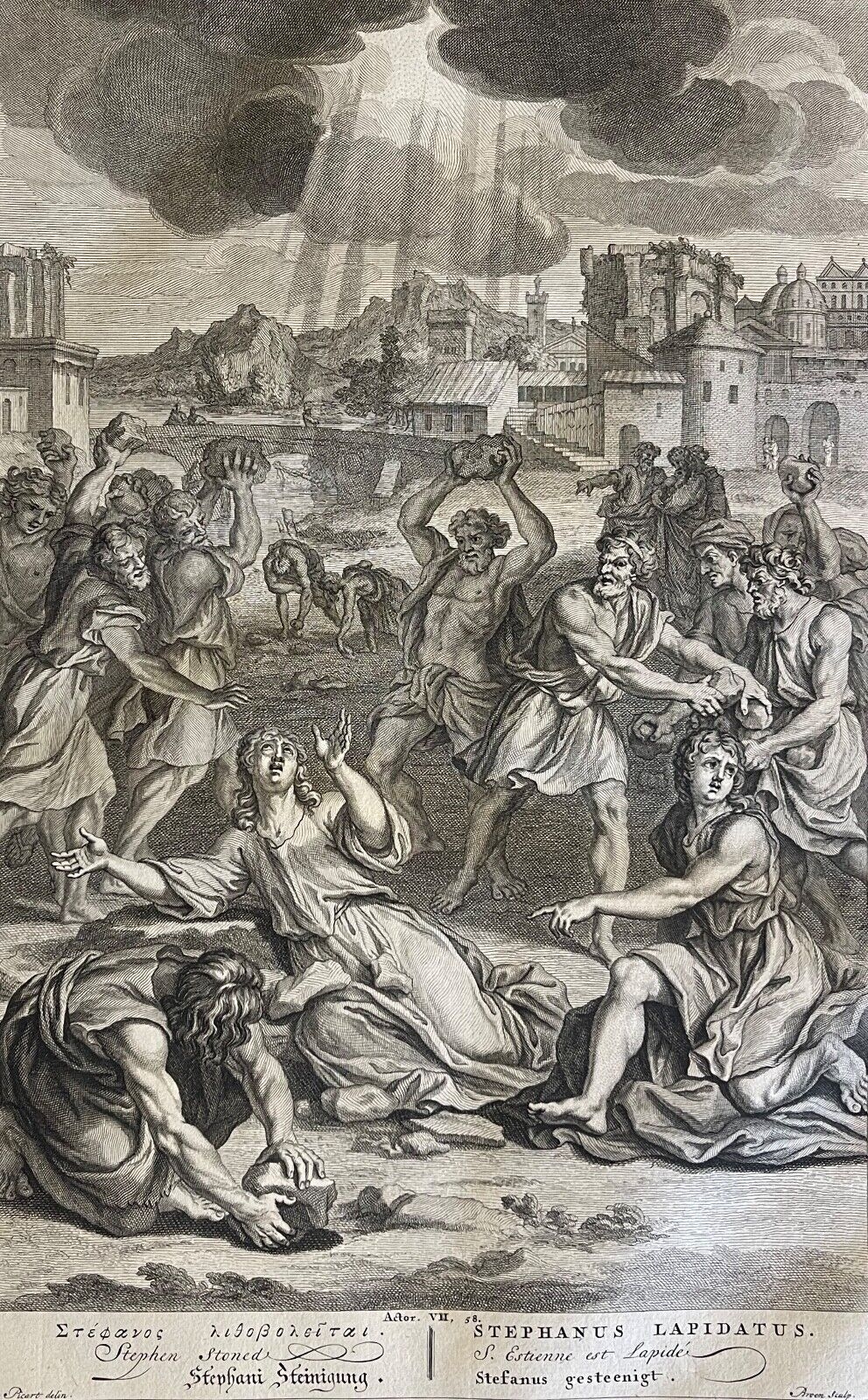
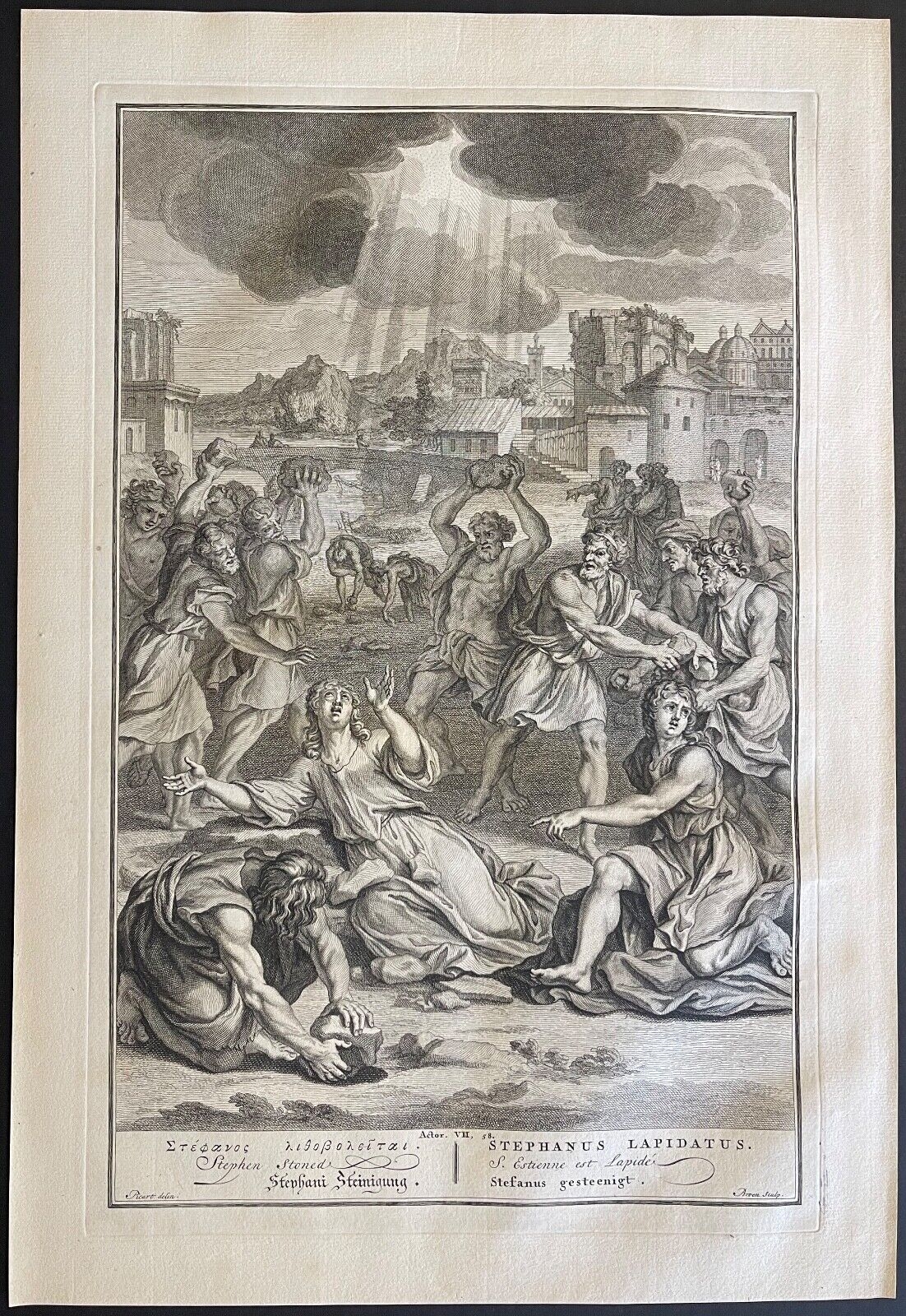
Original large-format eighteenth-century Biblical engraving dated 1728, after Bernard Picart (1673–1733), depicting the stoning and martyrdom of Saint Stephen.
An exceptionally detailed religious composition showing the saint surrounded by his persecutors, beneath a dramatic sky illuminated by heavenly light.
Original Latin and French inscriptions, with the biblical reference Acts 7:58.
Sheet: 40.4 × 27.6 cm.
Engraved composition with caption: 34.5 × 21.6 cm.
Paper: Antique laid paper.
Description
SAINT STEPHEN MARTYRDOM ENGRAVING – BERNARD PICART – 1728
Original Eighteenth-Century Biblical Engraving – The Stoning of Saint Stephen
An impressive antique engraving dated 1728, after a composition by Bernard Picart (1673–1733), depicting the martyrdom of Saint Stephen, traditionally recognised as the first Christian martyr.
This finely executed large-format engraving illustrates the dramatic stoning of Saint Stephen, surrounded by a crowd of persecutors, with the monumental architecture of an ancient city in the background.
The scene is remarkable for its expressive figures, powerful movements, elaborate drapery and dramatic celestial atmosphere.
THE STONING OF SAINT STEPHEN
The composition represents the biblical account of Saint Stephen’s martyrdom, described in the Acts of the Apostles, chapter 7.
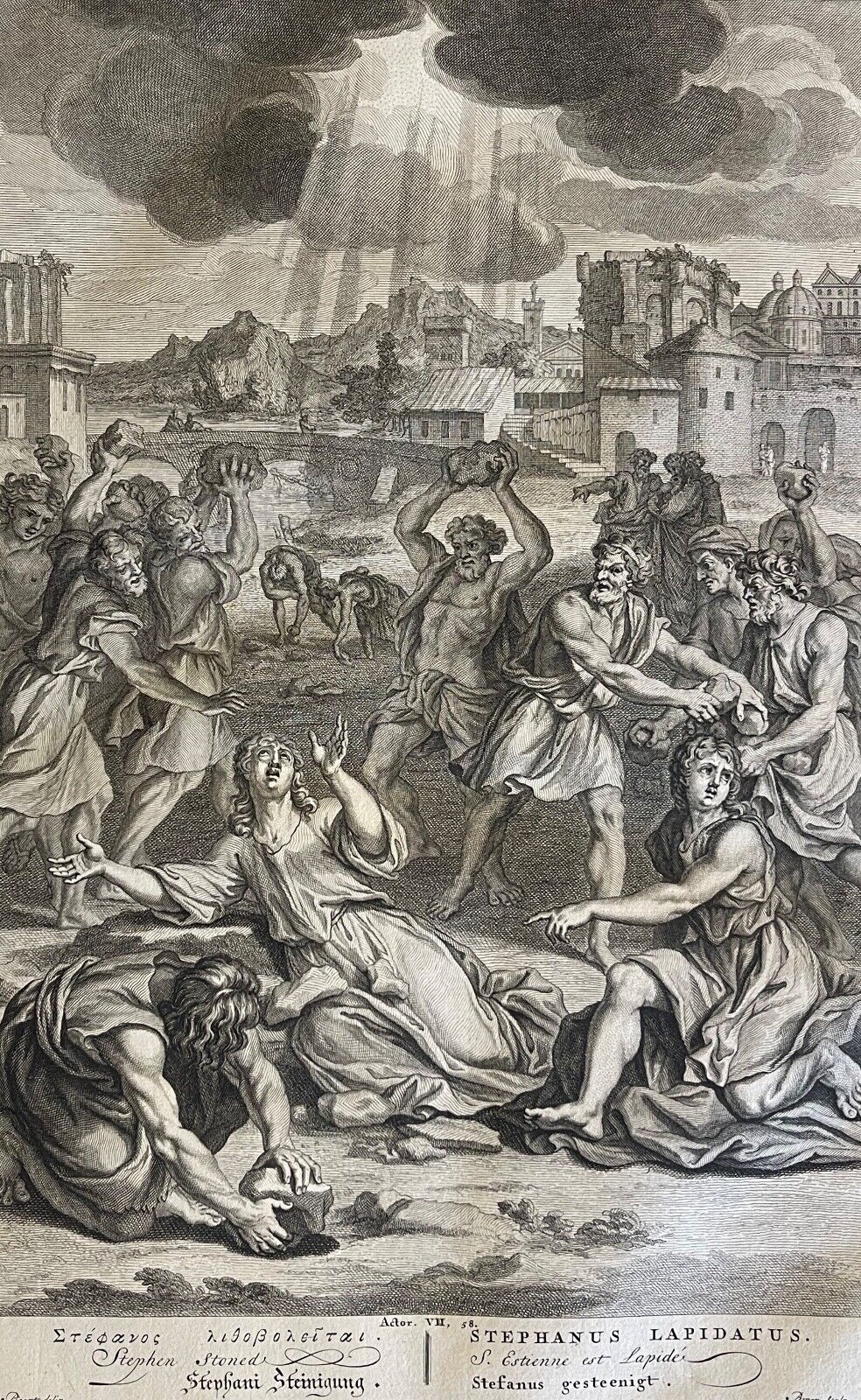
At the centre of the foreground, Stephen kneels upon the ground, his arms raised and his eyes turned towards heaven.
His expression and gestures convey devotion, prayer and spiritual surrender.
Around him, numerous figures prepare to strike him with large stones.
One powerful figure raises a heavy rock above his head, while others bend towards the ground to collect additional stones.
Their vigorous gestures and muscular movements create an extraordinary impression of violence and tension.
Several other figures observe or participate in the event, completing the dramatic composition.
THE FIRST CHRISTIAN MARTYR
Saint Stephen was one of the seven men chosen to assist the early Christian community in Jerusalem.
According to the Acts of the Apostles, he was brought before the Sanhedrin and accused of speaking against established religious traditions.
Following his defence and declaration of faith, an angry crowd drove him outside the city and stoned him.
Christian tradition honours Stephen as the first martyr, often described as the Protomartyr.
His death became an important subject in Christian painting, sculpture and engraving.
Artists frequently represented the dramatic contrast between the violence of his persecutors and the spiritual serenity of the saint.
A DRAMATIC ARCHITECTURAL LANDSCAPE
Behind the figures, the engraving presents an extensive ancient cityscape.
Ruined buildings, towers, gateways and monumental structures extend across the background.
The architecture creates a powerful sense of depth and contributes to the historical atmosphere of the scene.
Above the city, enormous dark clouds dominate the sky.
Bright rays of heavenly light descend through the clouds, contrasting with the violent action below.
The combination of dramatic landscape, expressive figures and celestial illumination gives the composition a distinctly Baroque character.
BERNARD PICART (1673–1733)
Bernard Picart was one of the most distinguished French draughtsmen and engravers of the late seventeenth and early eighteenth centuries.
Born in Paris in 1673, he trained in the artistic tradition of his father, Étienne Picart, who was also an accomplished engraver.
Bernard Picart later settled in Amsterdam, where he developed an extensive career.
His work included religious compositions, classical mythology, historical illustrations and allegorical subjects.
He became especially admired for the precision of his drawing, the complexity of his compositions and his considerable technical skill.
His engravings remain important examples of early eighteenth-century European graphic art.
A FINE EIGHTEENTH-CENTURY ENGRAVING
The present engraving is distinguished by its detailed intaglio linework and carefully balanced composition.
Numerous closely arranged engraved lines reproduce the musculature of the figures, the folds of their garments and the architectural features of the city.
The atmospheric sky is rendered through subtle contrasts between dark clouds and luminous openings.
The original inscriptions include the Latin title Stephanus Lapidatus and the French title S. Estienne est Lapidé.
The biblical reference to Acts 7:58 is also included.
A COLLECTABLE RELIGIOUS PRINT
This original eighteenth-century engraving is particularly attractive to collectors of Bernard Picart, Biblical art, Christian iconography and historic European prints.
Its substantial dimensions, detailed composition and important religious subject give it considerable artistic and decorative interest.
DETAILS
Subject: The Stoning of Saint Stephen.
Latin title: Stephanus Lapidatus.
Artist: After Bernard Picart (1673–1733).
Original composition: 1720.
Engraving date: 1728.
Period: Early 18th century.
Technique: Antique intaglio engraving.
Paper: Antique laid paper.
Sheet dimensions: 40.4 × 27.6 cm.
Engraved composition including caption: 34.5 × 21.6 cm.
Biblical reference: Acts of the Apostles 7:58.
Subject category: Christian martyrdom, religious history and Biblical art.
CONDITION
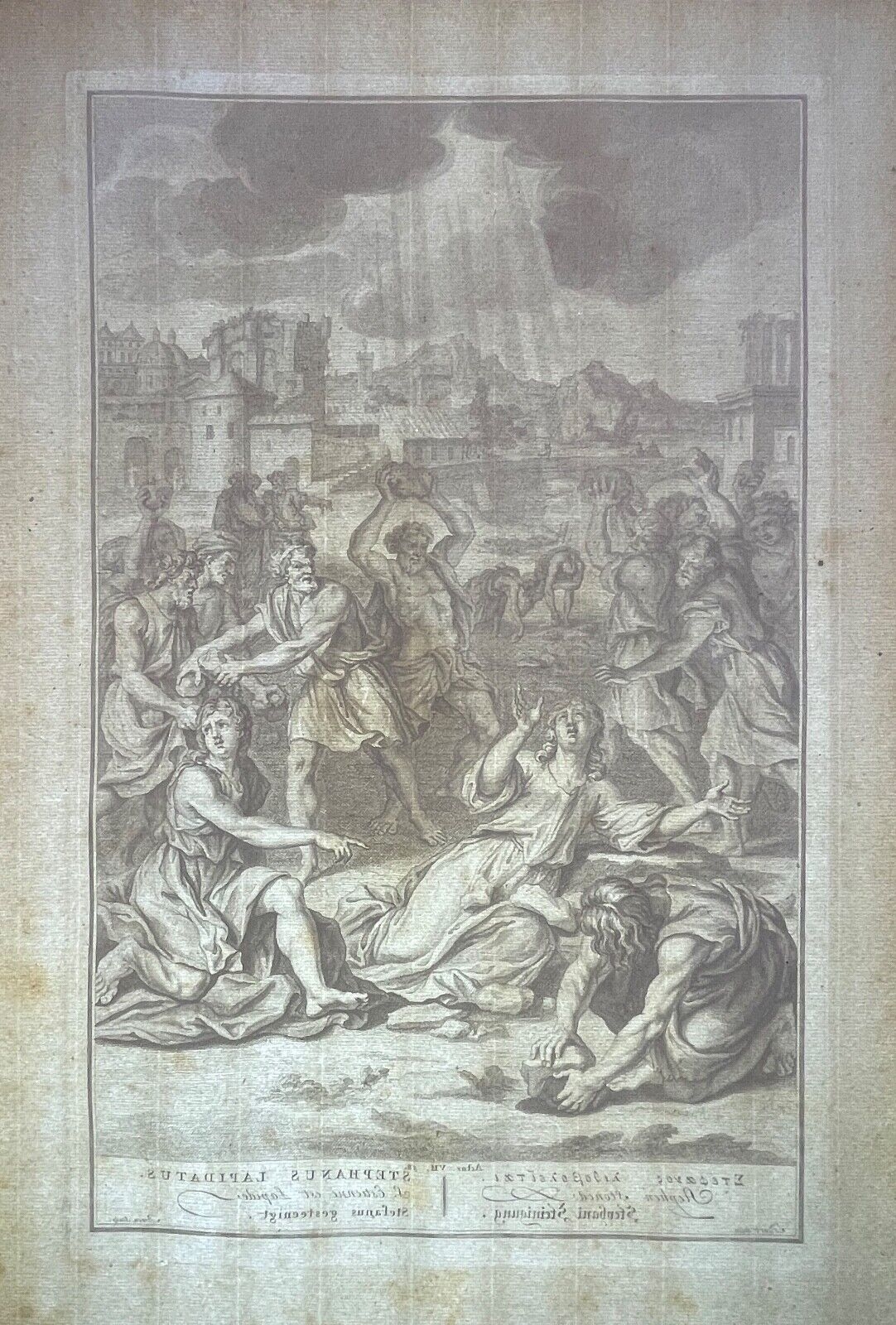
Antique impression showing the natural patina of aged paper.
The engraved figures, architectural details and original inscriptions remain well preserved.
The sheet retains generous margins around the composition.
A remarkable eighteenth-century Biblical engraving depicting the martyrdom of Saint Stephen after Bernard Picart.
Reference: 5215-136R667



Avis
Il n’y a pas encore d’avis.