
Description
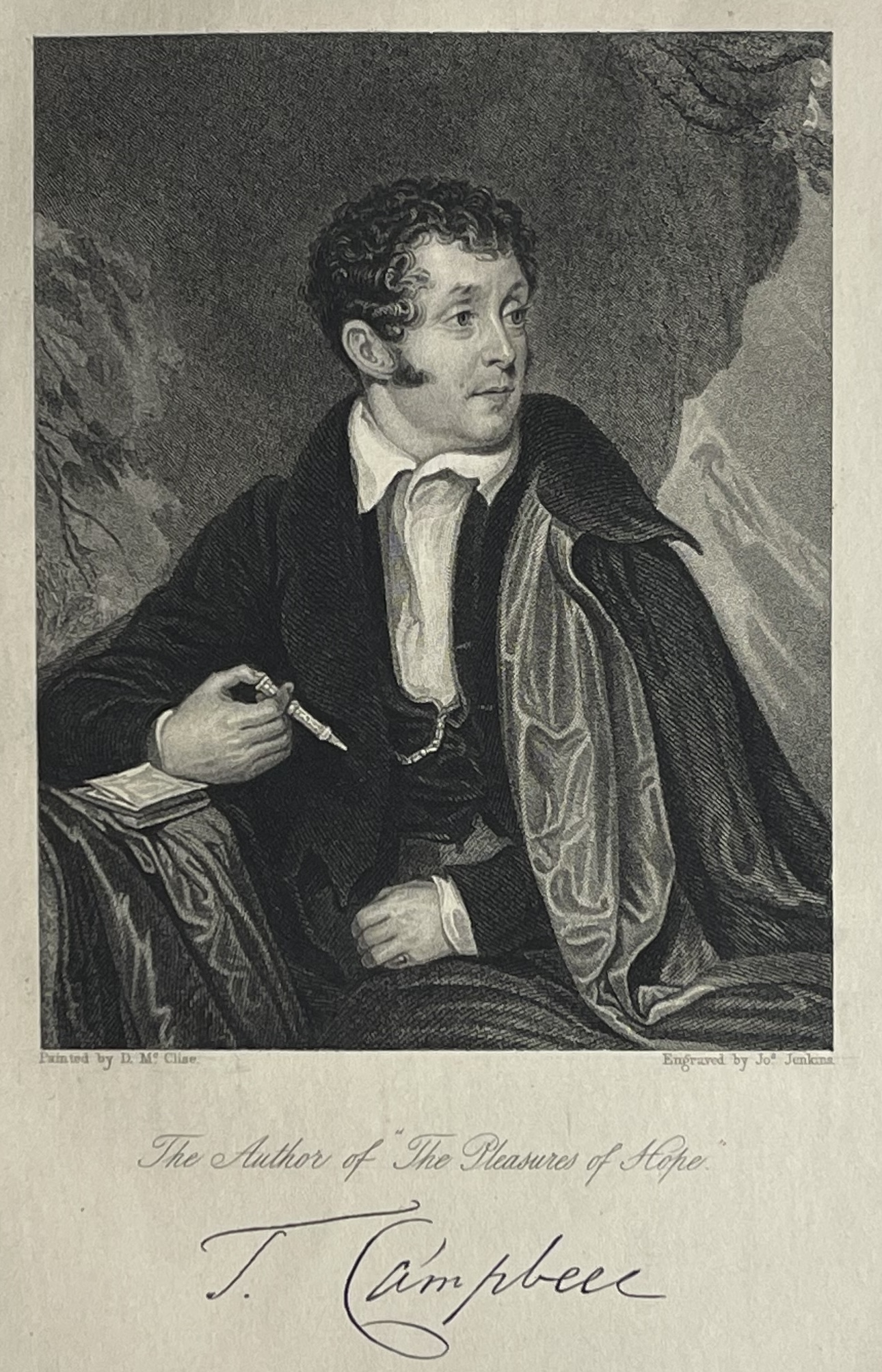
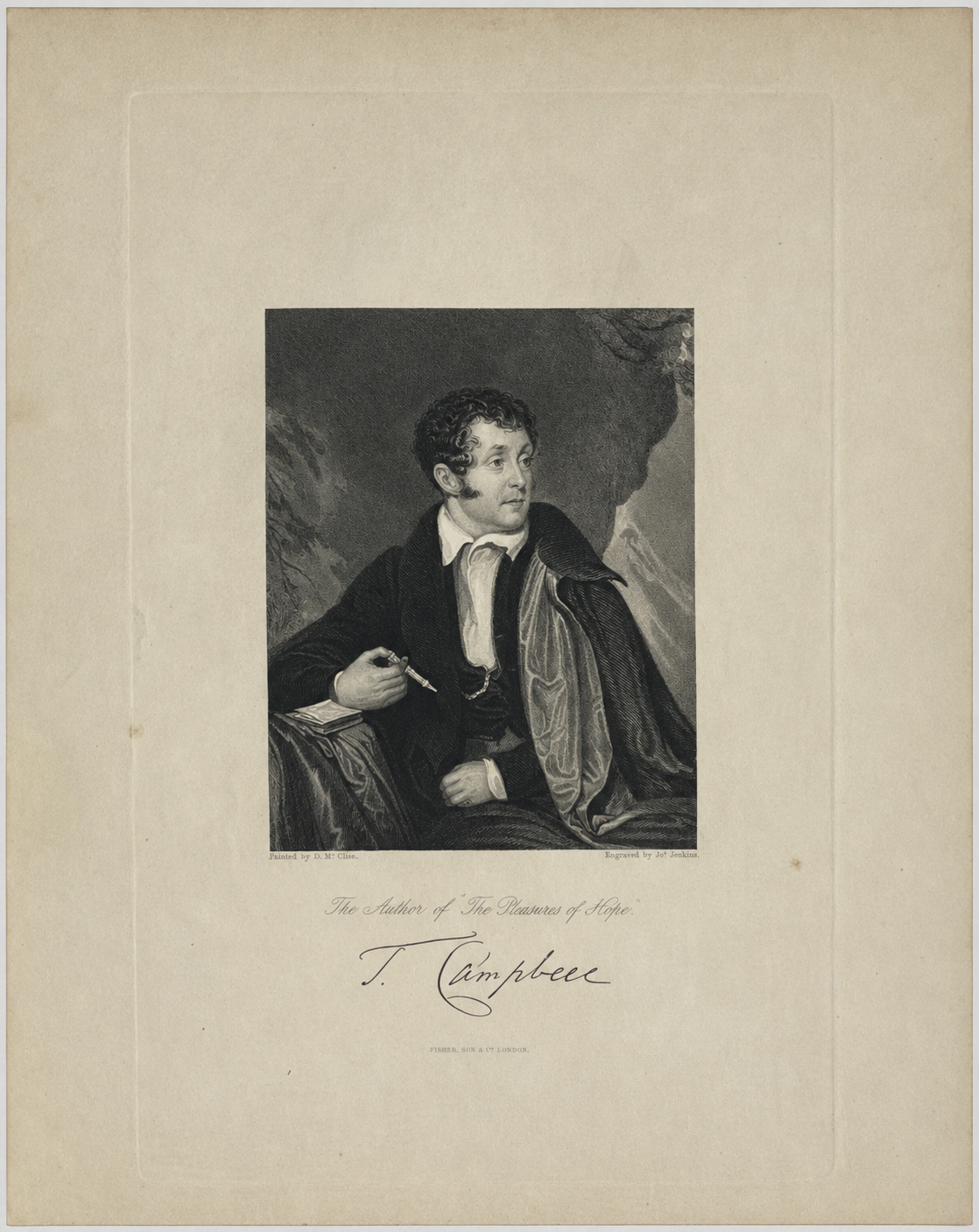
Thomas Campbell Scottish poet engraving, a beautiful original 1844 stipple portrait depicting Thomas Campbell (1777–1844), one of the most celebrated Scottish Romantic poets, literary critics and advocates of political liberty during the early 19th century.
Campbell became internationally famous for his poem The Pleasures of Hope (1799), his patriotic poetry associated with the Napoleonic Wars, his support for Polish independence and his contribution to the foundation of University College London.
Painted by Daniel Maclise (1806–1870), engraved by Joseph John Jenkins (1812–1885) and published in London by Fisher, Son & Co. in 1844.
Thomas Campbell – A Distinguished Scottish Romantic Poet
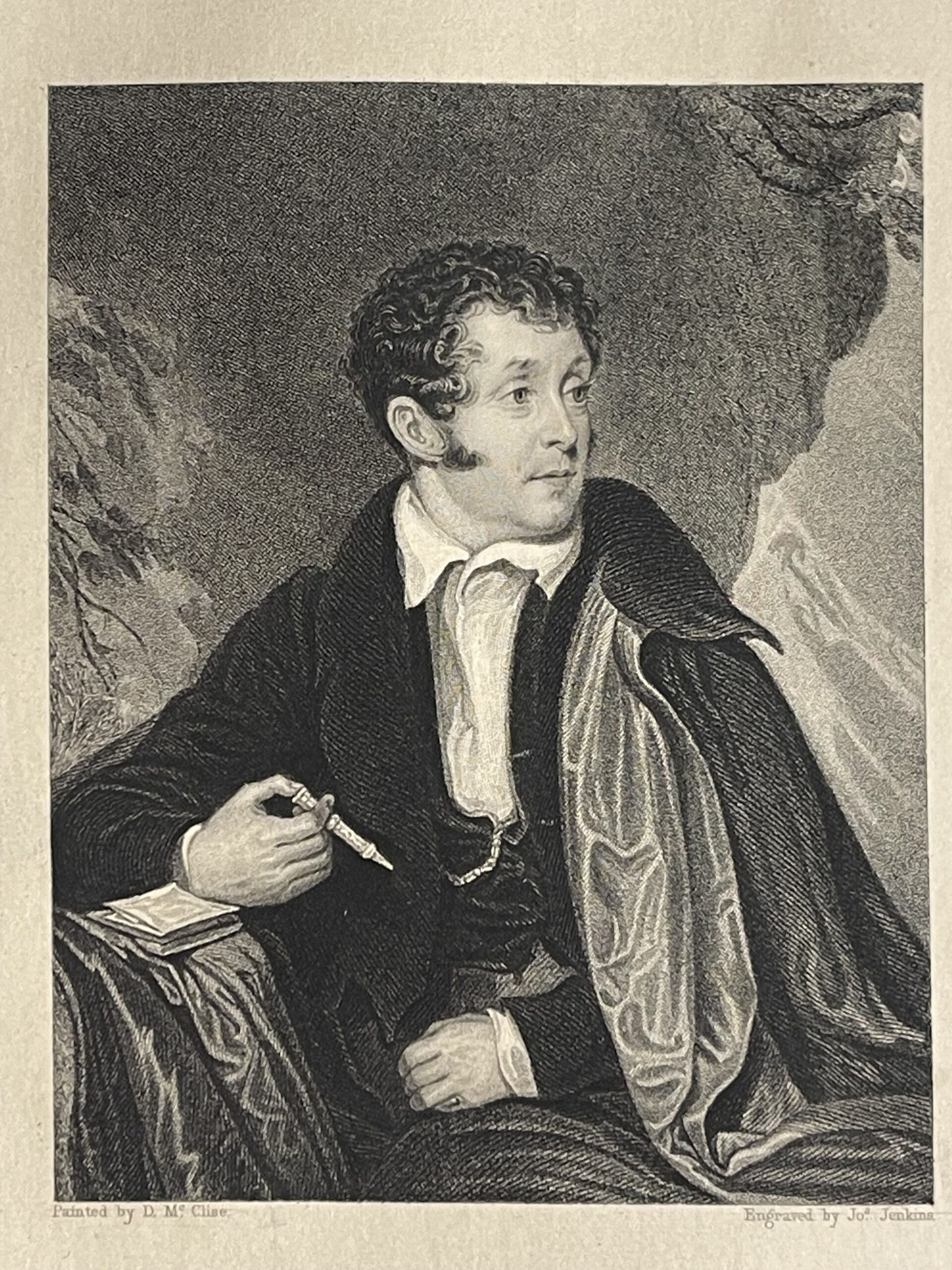
This finely executed portrait presents Thomas Campbell seated in an elegant dark coat, white shirt and carefully arranged neckcloth.
A richly folded cloak falls over his shoulders and across the side of his chair.
The poet holds a writing instrument in his right hand, while several sheets of paper rest on a table beside him.
His expressive face, slightly turned towards the right, conveys the thoughtful and intellectual character of the celebrated writer.
The finely engraved curls of his hair, delicate facial modelling and intricate folds of his clothing demonstrate the remarkable technical skill of the engraver.
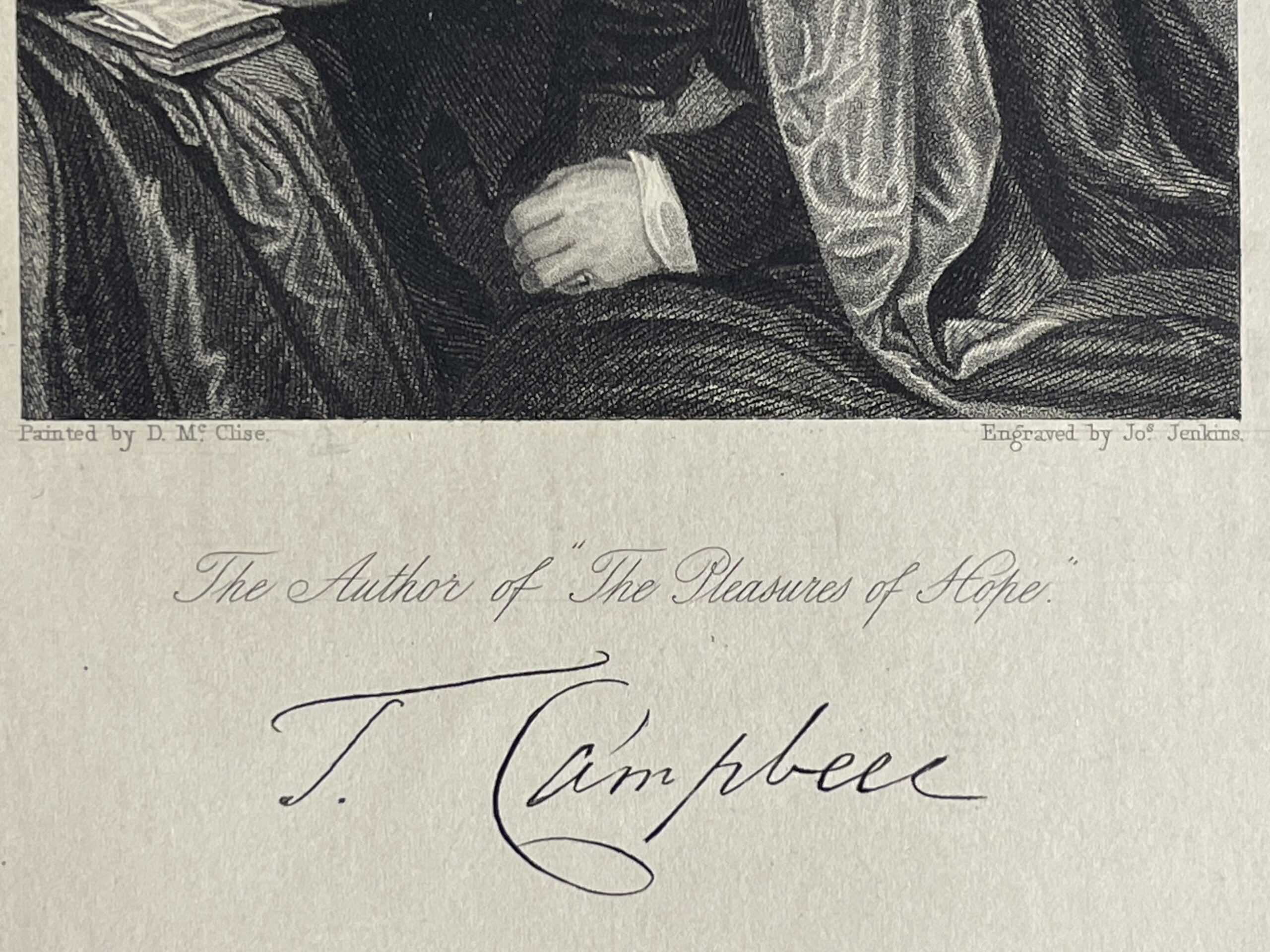
Beneath the portrait appears the original inscription:
The Author of « The Pleasures of Hope ».
An elegant facsimile signature reading T. Campbell is reproduced below the title.
The signature is printed as part of the engraving and is not handwritten.
Thomas Campbell (1777–1844) – The Pleasures of Hope
Thomas Campbell was born in Glasgow, Scotland, on July 27, 1777.
He studied at the University of Glasgow, where he distinguished himself through his literary talents and knowledge of classical languages.
In 1799, at the age of only 21, he published his celebrated poem The Pleasures of Hope.
The work achieved immediate success and established Campbell as one of the most promising British poets of his generation.
The poem explores human aspirations, liberty, hope and the moral strength of individuals confronted with suffering and adversity.
Its success brought Campbell widespread recognition throughout Britain and established his reputation within the Romantic literary movement.
The Napoleonic Wars and Campbell’s Patriotic Poetry
Thomas Campbell lived during one of the most turbulent periods in modern European history.
The French Revolutionary and Napoleonic Wars profoundly influenced British political and literary culture.
During a journey through Germany in 1800, Campbell witnessed the atmosphere of continental Europe during the conflict.
These experiences contributed to his celebrated military and patriotic poetry.
Hohenlinden, one of his best-known poems, was associated with the Battle of Hohenlinden on December 3, 1800, when French forces defeated an Austrian army in Bavaria.
The poem became famous for its dramatic representation of battle and human suffering.
Campbell also wrote Ye Mariners of England, a patriotic naval song celebrating British seafaring courage.
Another celebrated composition, The Battle of the Baltic, commemorated the naval Battle of Copenhagen fought on April 2, 1801, involving British naval forces under the command of Admiral Sir Hyde Parker and Vice-Admiral Horatio Nelson.
These compositions made Campbell one of the most important literary voices associated with Britain’s Napoleonic era.
Thomas Campbell and the Struggle for Polish Independence
Campbell was also deeply committed to political liberty and the rights of European peoples.
Following the defeat of the Polish uprising of 1830–1831 against Russian domination, he became an outspoken supporter of the Polish national cause.
He helped establish an association in London dedicated to promoting Polish interests and assisting political refugees.
Through public appeals, correspondence and literary activities, Campbell sought to increase British awareness of the situation in Poland.
His humanitarian involvement made him an important supporter of Polish political exiles in Britain.
A Pioneer of University College London
Campbell also played an important role in the development of modern higher education.
During the 1820s, he advocated the establishment of a university in London that would offer educational opportunities beyond the traditional religious restrictions associated with older English universities.
His public campaign contributed to the creation of the institution founded in 1826 that later became University College London (UCL).
Campbell was also elected Lord Rector of the University of Glasgow, serving from 1826 to 1829.
His commitment to education reflected his wider interest in intellectual progress and social reform.
Literary Works and Influence
In addition to The Pleasures of Hope, Campbell produced several important literary works, including:
- Gertrude of Wyoming (1809), a narrative poem set in North America.
- Specimens of the British Poets (1819), an influential collection of British poetry accompanied by literary criticism.
- Theodric (1824), a narrative poem.
- The Pilgrim of Glencoe (1842), one of his later poetic works.
Campbell was also active as a literary editor, notably directing the New Monthly Magazine during the 1820s.
His work contributed significantly to the popularity of Romantic poetry throughout the English-speaking world.
Death and Burial in Westminster Abbey
Thomas Campbell died on June 15, 1844, in Boulogne-sur-Mer, France.
His remains were returned to Britain, where he was buried in Poets’ Corner at Westminster Abbey, one of the most prestigious burial places associated with British literary history.
A marble memorial was erected in his honour near the monument to William Shakespeare.
His burial at Westminster Abbey reflected the considerable esteem in which he was held by his contemporaries.
Daniel Maclise (1806–1870)
Daniel Maclise was an Irish painter celebrated for his portraits, historical paintings and literary compositions.
His work frequently depicted important personalities from the intellectual, theatrical and artistic circles of the 19th century.
The portrait of Thomas Campbell captures the thoughtful expression and literary identity of the celebrated Scottish poet.
Joseph John Jenkins (1812–1885)
Joseph John Jenkins was a British engraver and watercolour painter.
His finely executed stipple engraving reproduces Maclise’s portrait with remarkable precision.
The delicate tonal transitions of the face, dark clothing and flowing drapery demonstrate the refined possibilities of 19th-century portrait engraving.
A Historic Portrait of a Major Romantic Literary Figure
This original 1844 engraving represents an important personality in British literary, educational and political history.
Campbell’s literary association with the Napoleonic Wars, his advocacy for Polish independence, his contribution to University College London and his burial in Westminster Abbey give this portrait considerable historical interest.
It is particularly appealing to collectors of Scottish Romantic poetry, Napoleonic-era literature, Polish history, British intellectual history and antique literary portraits.
Dimensions
- Sheet: 25.5 × 20 cm
- Engraved portrait: 11.4 × 9 cm
Condition
An antique impression displaying the natural patina of the paper.
Beautiful preservation of the engraved portrait and original inscriptions.
The facsimile signature beneath the portrait is printed and not handwritten.


Avis
Il n’y a pas encore d’avis.