



Description
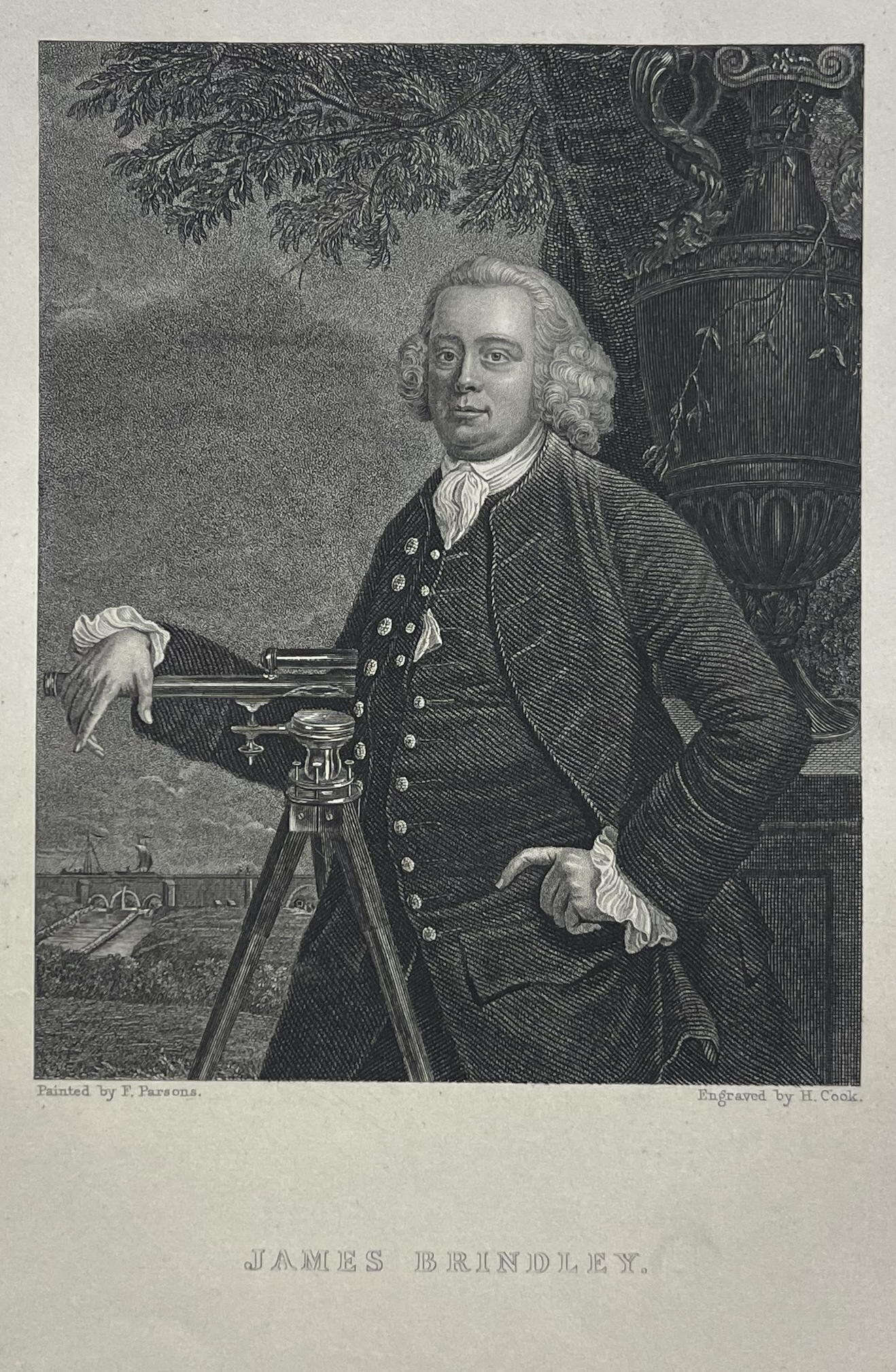
James Brindley antique engraving, a beautiful original 1833 portrait depicting James Brindley (1716–1772), the celebrated British civil engineer and one of the most influential pioneers of canal construction during the early Industrial Revolution.
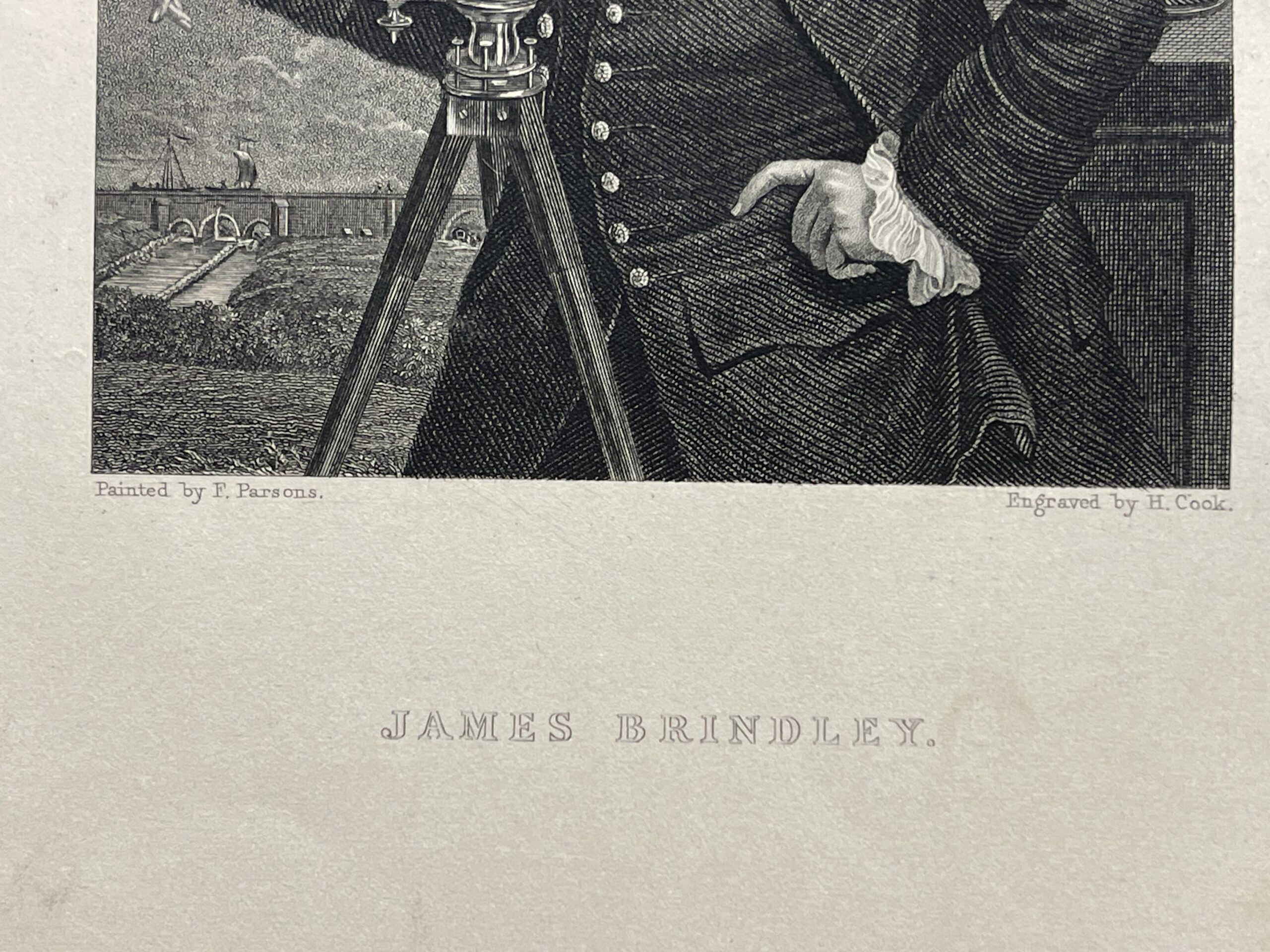
Engraved by Henry Richard Cook, after the original portrait painted by Francis Parsons in 1770.
Published in London by Fisher, Son & Co.
The original painting is preserved in the National Portrait Gallery, London.
James Brindley – A Pioneer of the Industrial Revolution
James Brindley was one of the most important British engineers of the 18th century.
His remarkable achievements in canal construction, hydraulic engineering and inland navigation helped transform Britain’s transportation system and contributed significantly to the development of the Industrial Revolution.
Born in Derbyshire in 1716, Brindley began his professional career as a millwright, designing and repairing watermills and mechanical equipment.
Although he received little formal education, his extraordinary practical intelligence and intuitive understanding of engineering problems soon established his reputation.
His ability to design and construct complex hydraulic systems made him one of the most sought-after engineers of his generation.
The Bridgewater Canal – A Revolution in British Transportation
In 1759, Francis Egerton, the 3rd Duke of Bridgewater, commissioned James Brindley to assist with the construction of a canal connecting his coal mines at Worsley with Manchester.
The Bridgewater Canal opened in 1761 and became one of the most important engineering achievements of the 18th century.
It enabled large quantities of coal to be transported efficiently and economically, helping to supply the rapidly expanding industrial city of Manchester.
One of Brindley’s most remarkable achievements was the construction of the Barton Aqueduct, which carried the canal across the River Irwell.
Completed in 1761, this extraordinary structure demonstrated that artificial waterways could cross natural rivers without interrupting navigation.
The aqueduct became one of the engineering wonders of its age and an important symbol of Britain’s developing industrial infrastructure.
The Grand Cross – Connecting Britain’s Major Rivers
Following the success of the Bridgewater Canal, Brindley became involved in an ambitious programme of inland navigation.
He played an essential role in the development of the Trent and Mersey Canal, linking the industrial districts of Staffordshire with important commercial waterways.
His work also included the Staffordshire and Worcestershire Canal, the Coventry Canal and the Oxford Canal.
Brindley envisaged a system of interconnected canals linking four major English rivers:
- The Mersey
- The Trent
- The Severn
- The Thames
This ambitious network became known as the Grand Cross.
The canals enabled coal, iron, pottery, textiles and manufactured goods to move between industrial centres, inland towns and major ports.
These developments profoundly influenced British economic history, creating transportation infrastructure that preceded the expansion of the railway system.
Brindley also contributed to important engineering developments involving locks, tunnels, aqueducts and the management of water supplies.
His work helped establish the technical principles of Britain’s narrow canal system.
He died in 1772, leaving a lasting legacy in the history of civil engineering.
A Remarkable Historical Portrait
The engraving depicts James Brindley standing beside a surveying instrument mounted on a tripod.
He wears an elegant 18th-century coat, a buttoned waistcoat, lace cuffs and a powdered wig.
His right hand rests upon the surveying instrument, while his left hand is placed against his waist.
The scientific instrument provides an important visual reference to his achievements as a civil engineer.
In the background, a bridge or aqueduct crossing a river recalls his pioneering work on the Bridgewater Canal.
A magnificent architectural urn and decorative foliage complete the composition.
The finely executed engraving reproduces the delicate modelling of Brindley’s face, the texture of his clothing and the intricate details of the surveying equipment.
Francis Parsons – Portrait Painter
Francis Parsons was a British portrait painter active during the second half of the 18th century.
In 1770, he painted the celebrated portrait of James Brindley that served as the model for this engraving.
The original painting is held by the National Portrait Gallery in London.
Henry Richard Cook – Engraver
Henry Richard Cook was a British engraver active during the early 19th century.
His engraved portraits are distinguished by their delicate tonal treatment and carefully rendered details.
The present composition combines stipple engraving with finely controlled lines to reproduce the original portrait’s subtle variations of light and shadow.
A Historical Portrait of the Canal Age
This original 1833 engraving is particularly interesting for collectors of British industrial history, civil engineering, early canal construction, historical portraits and Georgian scientific achievements.
James Brindley’s contribution to the development of the British canal network makes him one of the major figures associated with the early Industrial Revolution.
Dimensions
- Sheet: 26 × 20 cm
- Engraved portrait: 11.6 × 9.2 cm
Condition
An antique impression displaying the natural patina of the paper. Beautiful preservation of the engraved portrait and original inscriptions.

Avis
Il n’y a pas encore d’avis.