Description
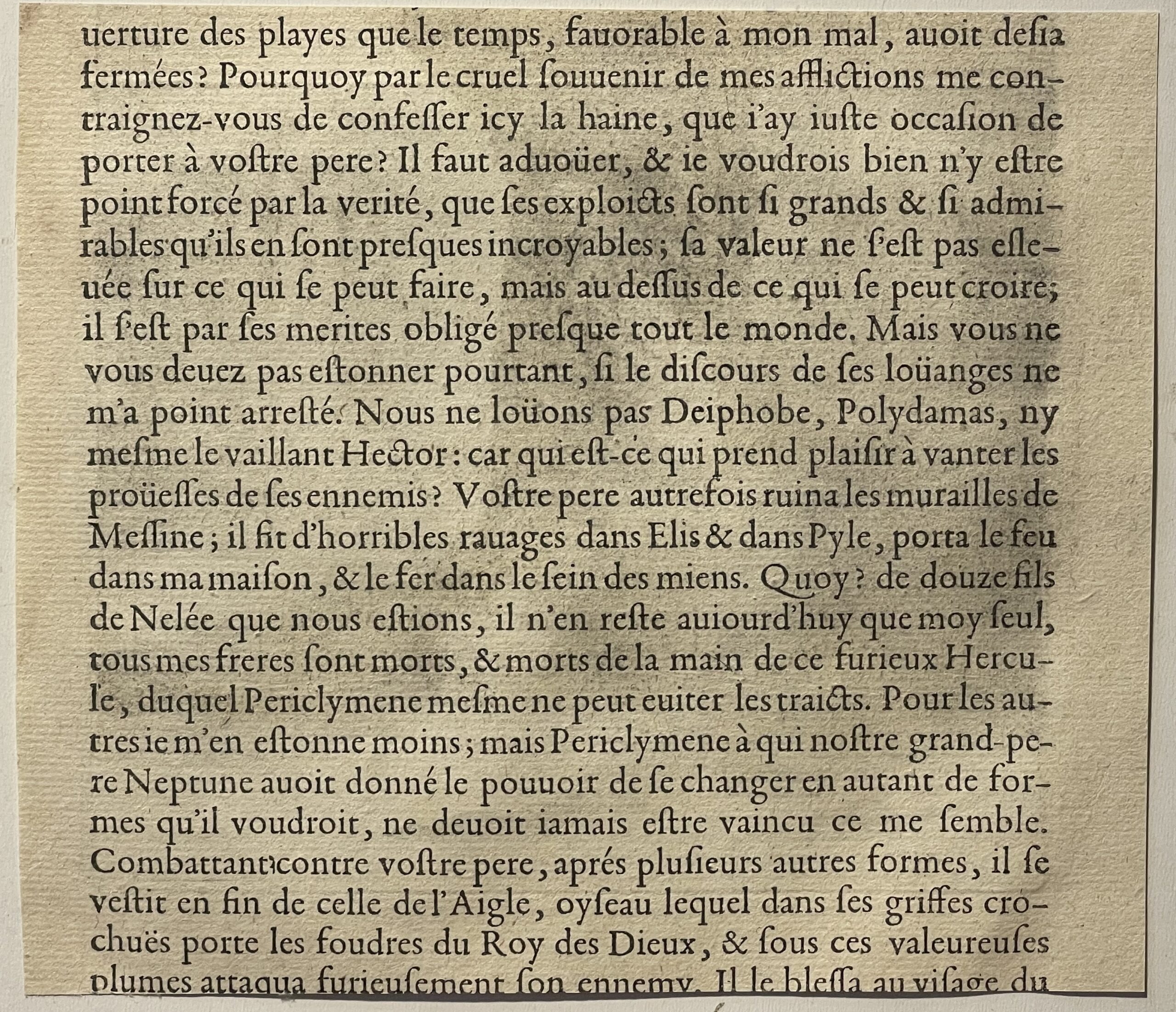
Periclymenus Transformed into an Eagle – Original 1619 French Engraving by Isaac Briot – Hercules and Ovid’s Metamorphoses
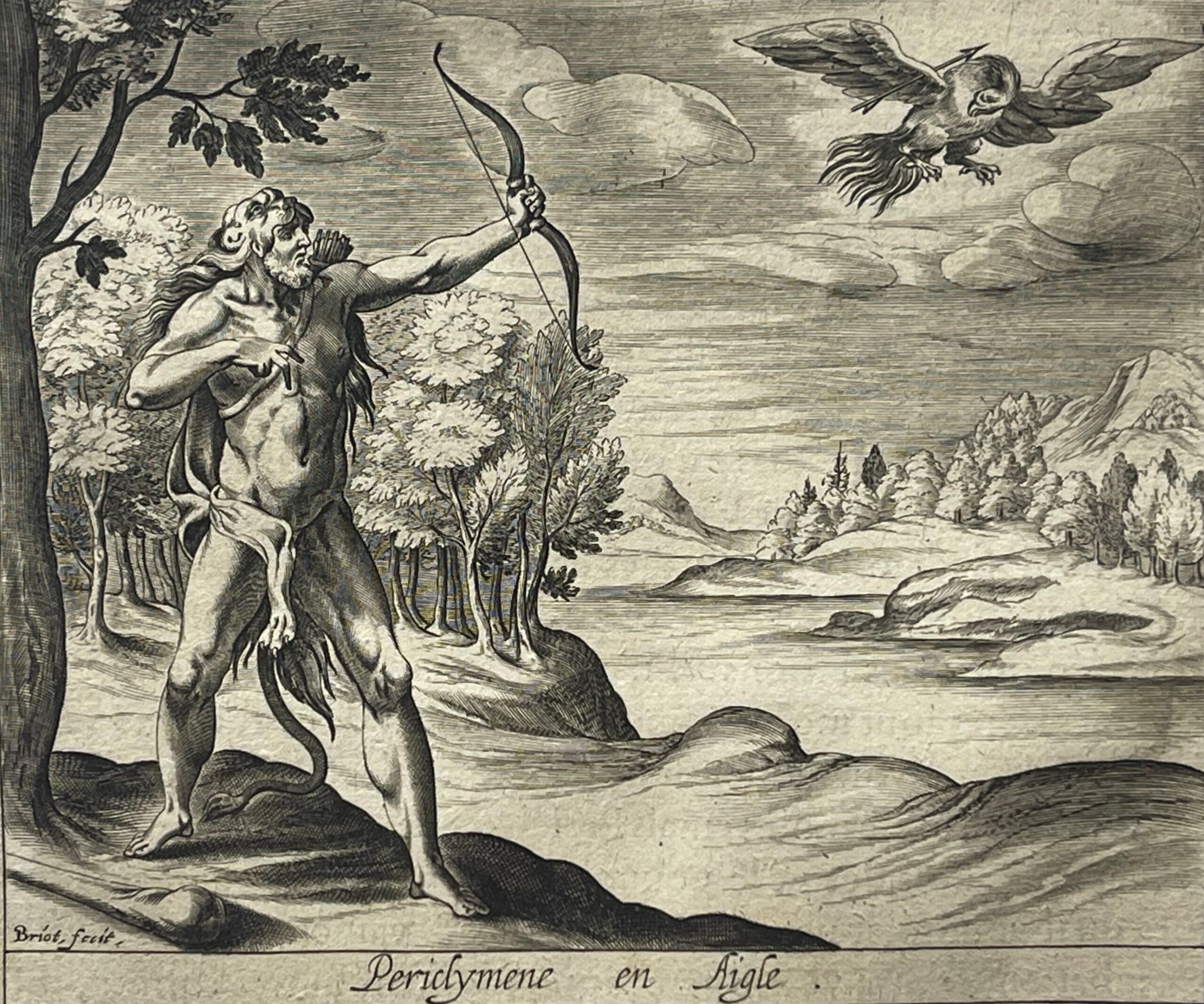
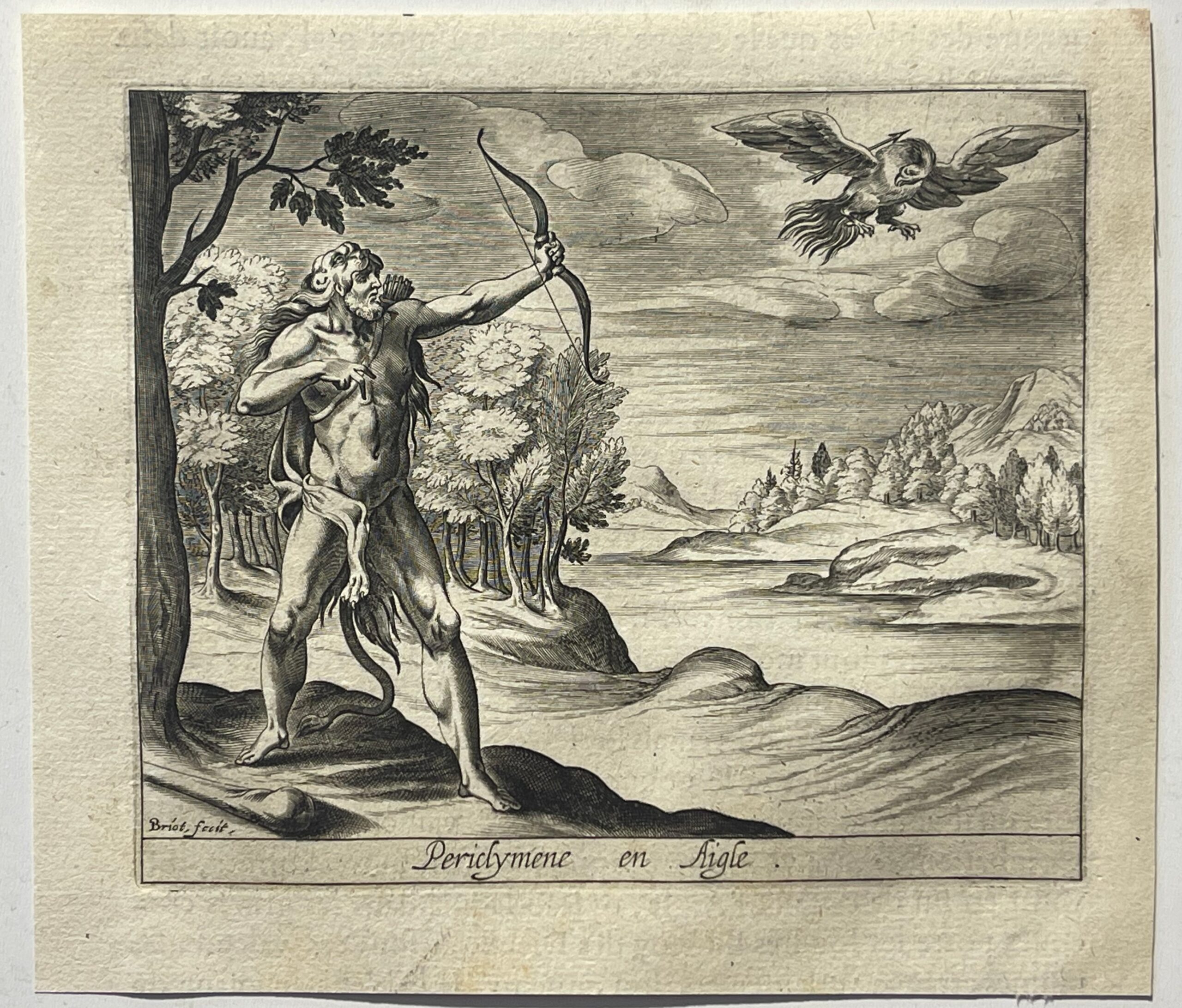
An impressive original French copperplate engraving from 1619, depicting Hercules shooting Periclymenus after the latter has transformed himself into an eagle.
Engraved by Isaac Briot (1585–1670), this early 17th-century composition illustrates a dramatic episode from Book XII of Ovid’s Metamorphoses.
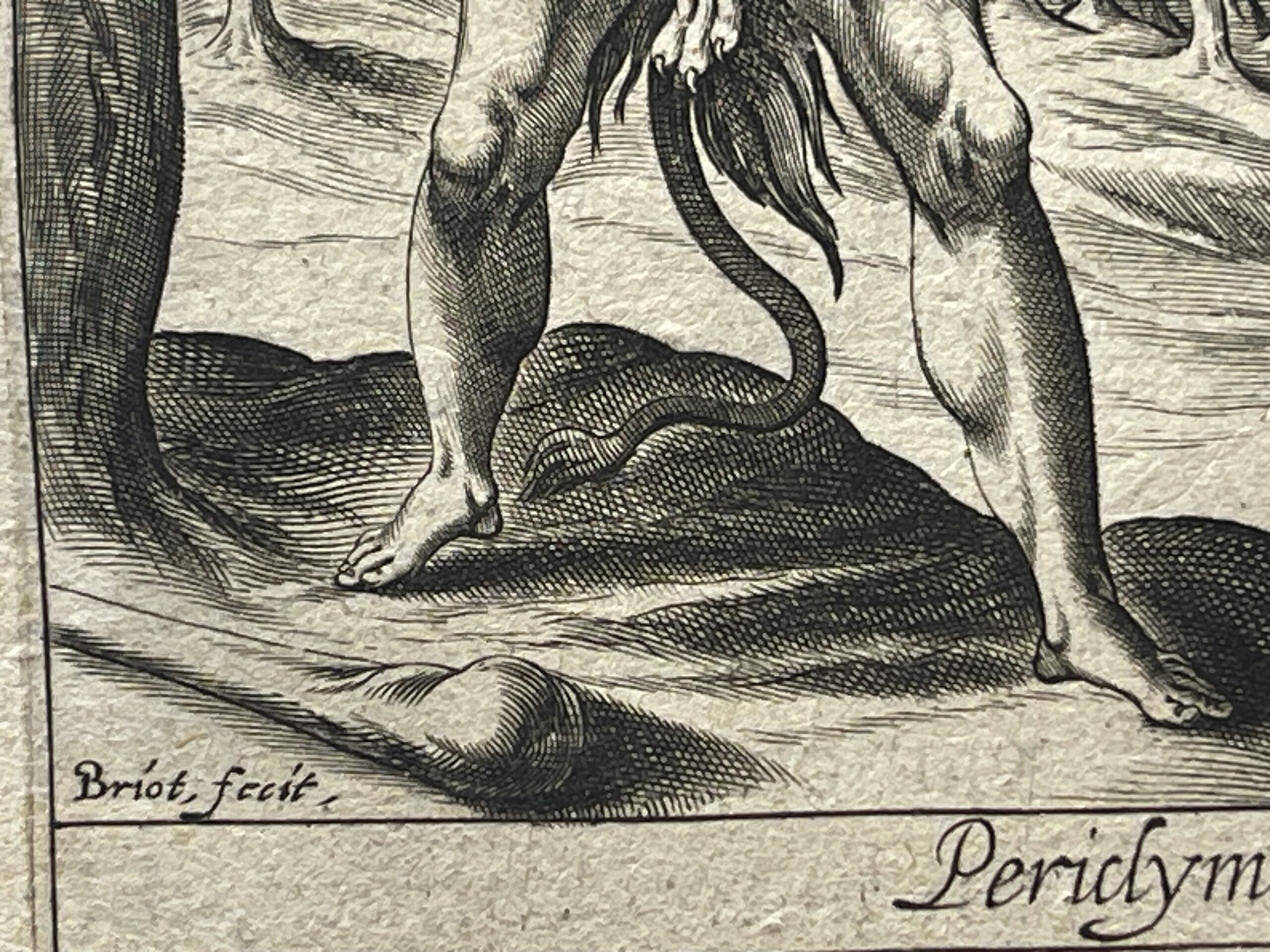
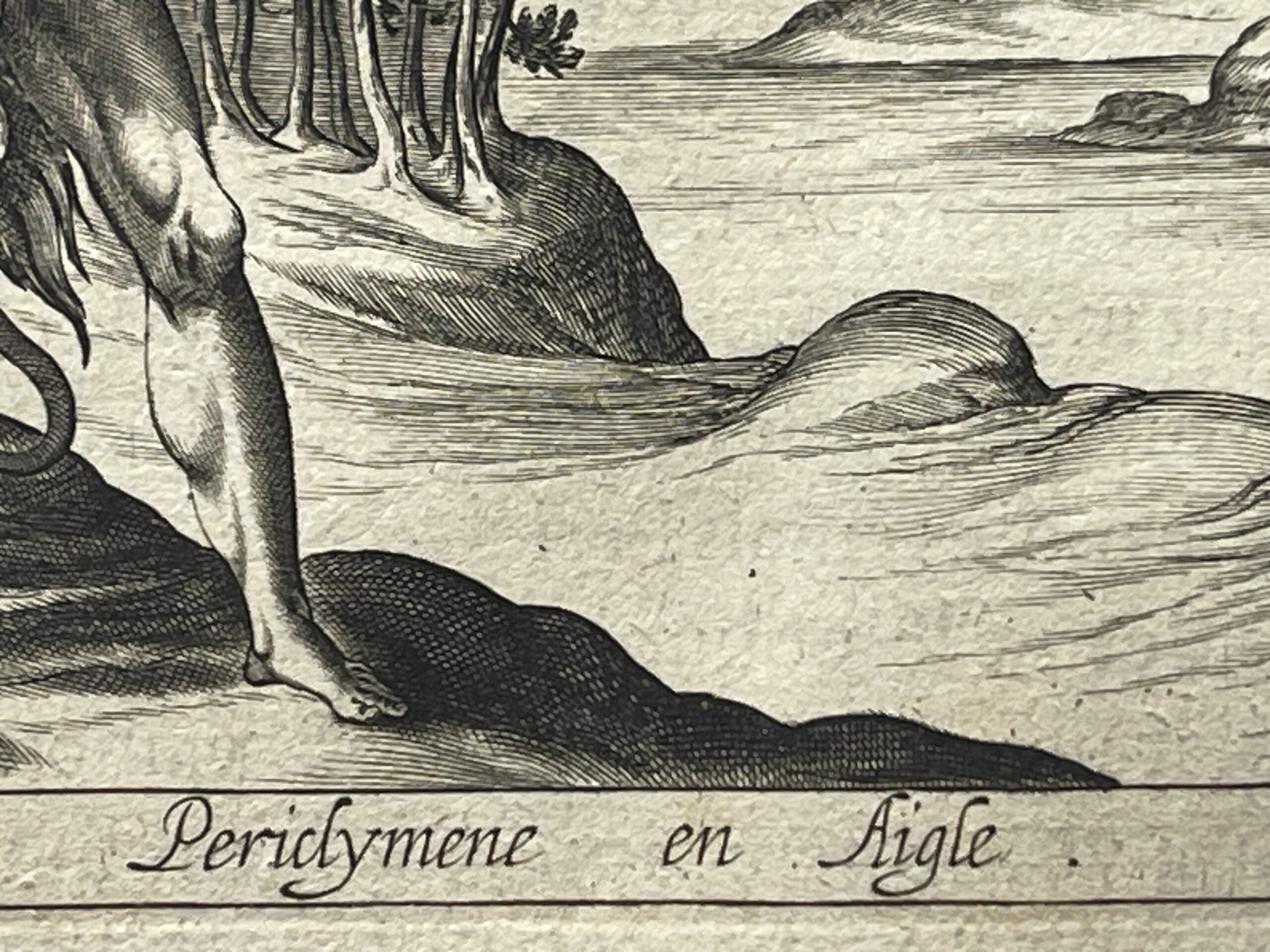
The engraved inscription “Periclymene en Aigle” appears beneath the image, together with the signature “Briot fecit” in the lower left corner.
Periclymenus and Hercules – A Remarkable Greek Myth
Periclymenus was a Greek prince, the son of Neleus, King of Pylos, and brother of the famous Nestor.
According to classical mythology, Neptune, the divine ancestor of his family, had granted him the extraordinary ability to assume different forms at will.
When Hercules attacked Pylos, Periclymenus used this supernatural power in an attempt to escape his formidable enemy.
After transforming himself into several different creatures, he finally assumed the appearance of a magnificent eagle, the sacred bird of Jupiter.
In this form, Periclymenus attacked Hercules with his sharp talons and powerful beak.
However, Hercules, renowned for his exceptional strength and skill with the bow, aimed an arrow at the flying eagle.
The arrow struck Periclymenus near his wing, causing him to fall from the sky and meet his death.
This episode is one of the dramatic transformations described in Ovid’s celebrated mythological masterpiece.
An Outstanding Mythological Composition
The engraving captures the decisive confrontation between Hercules and the transformed Periclymenus.
On the left, Hercules stands in a commanding position, holding his bow and preparing to release an arrow towards the eagle.
His muscular figure, flowing hair, quiver and draped garment are rendered with great attention to anatomical detail.
In the upper right corner, Periclymenus appears as a large eagle with outstretched wings, flying through the clouds.
The scene is set within an elaborate landscape featuring tall trees, wooded hills, a peaceful stretch of water and distant mountains.
The contrast between the powerful figure of Hercules and the dramatic movement of the eagle creates a particularly expressive composition.
Isaac Briot and French Engraving in 1619
Isaac Briot was an accomplished French engraver active during the first half of the 17th century.
His work includes mythological illustrations, portraits and decorative compositions.
This engraving demonstrates the quality of French copperplate engraving during the reign of Louis XIII.
The precise cross-hatching, delicate landscape details and carefully rendered anatomy give the composition depth and movement.
An Authentic Antique Engraving
This print comes from the Parisian edition of Ovid’s Metamorphoses, published in 1619.
The composition is documented in the collections of the Bibliothèque nationale de France, where it is identified as the illustration accompanying Book XII, page 349.
The original engraved signature “Briot fecit” and the French title are preserved.
Characteristics
- Artist: Isaac Briot (1585–1670)
- Original title: Periclymene en Aigle
- Date: 1619
- Period: Early 17th century
- Country: France
- Technique: Original copperplate engraving
- Subject: Hercules and Periclymenus
- Literary source: Ovid’s Metamorphoses, Book XII
- Sheet dimensions: 16.3 × 14 cm
- Engraved image: 13.5 × 11.4 cm
Condition
Antique impression displaying a natural patina of the paper. Beautiful preservation of the engraved composition and original inscriptions. Please examine the photographs.
A remarkable original mythological engraving from 1619, more than four centuries old, particularly appealing to collectors of French Old Master prints, classical mythology and early illustrated editions of Ovid.

Avis
Il n’y a pas encore d’avis.