
Description
Saint Tiron Watercolor – Circa 1918–1919 – Signed Swedish Painting after Nicholas Roerich
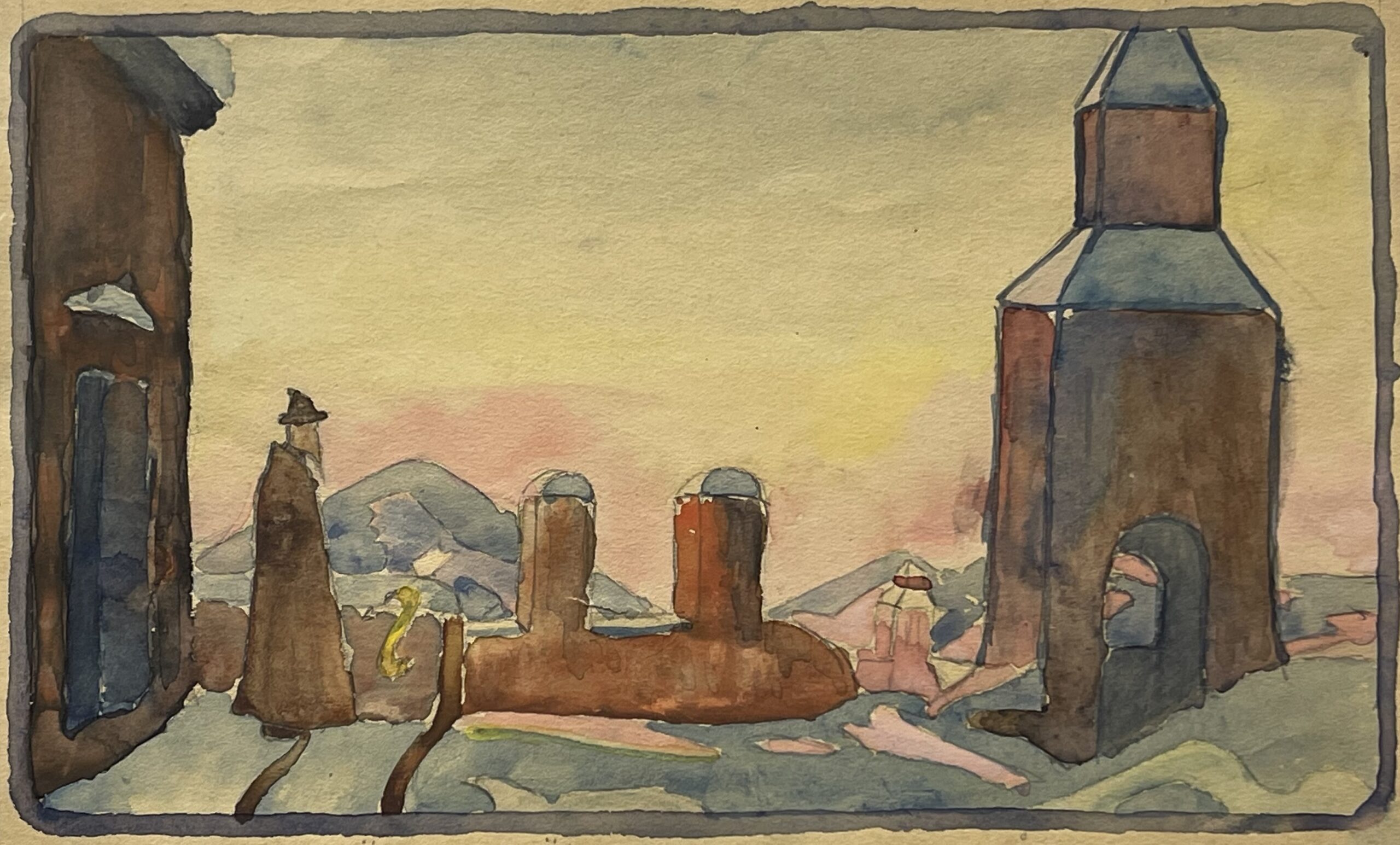
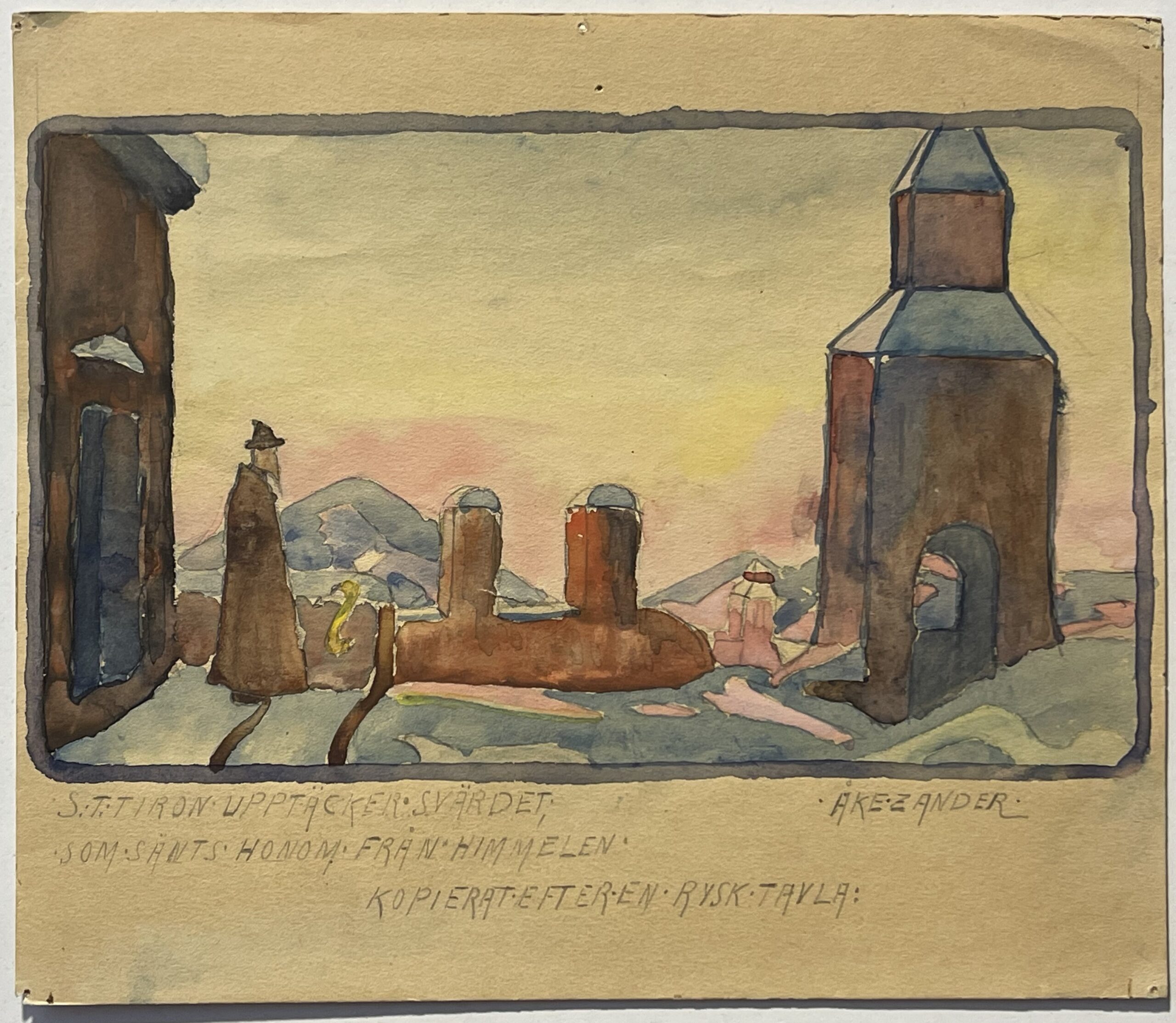
An unusual and attractive original hand-painted watercolor depicting Saint Theodore Tiron receiving a heavenly sword, after a composition by the celebrated Russian Symbolist painter Nicholas Roerich (1874–1947).
Bearing handwritten Swedish inscriptions and a signature reading « Åke Zander », this work may have been painted in Sweden around 1918–1919, during the period of Roerich’s important Scandinavian exhibitions.
Its distinctive palette, medieval Russian architecture and expressive simplified forms make it a particularly interesting example of the early Scandinavian reception of Russian Symbolist painting.
Saint Theodore Tiron and the Heavenly Message
The composition represents Saint Theodore Tiron standing before the walls of an ancient fortified city.
A solitary figure wearing a long dark robe appears among the architectural structures, surrounded by towers, crenellated walls and distant mountains.
The composition features a luminous sky with warm yellow, pink and ochre tones, contrasting with the reddish-brown buildings and blue-grey landscape.
The monumental forms, dark outlines and simplified architectural details recall the distinctive Symbolist language of Nicholas Roerich.
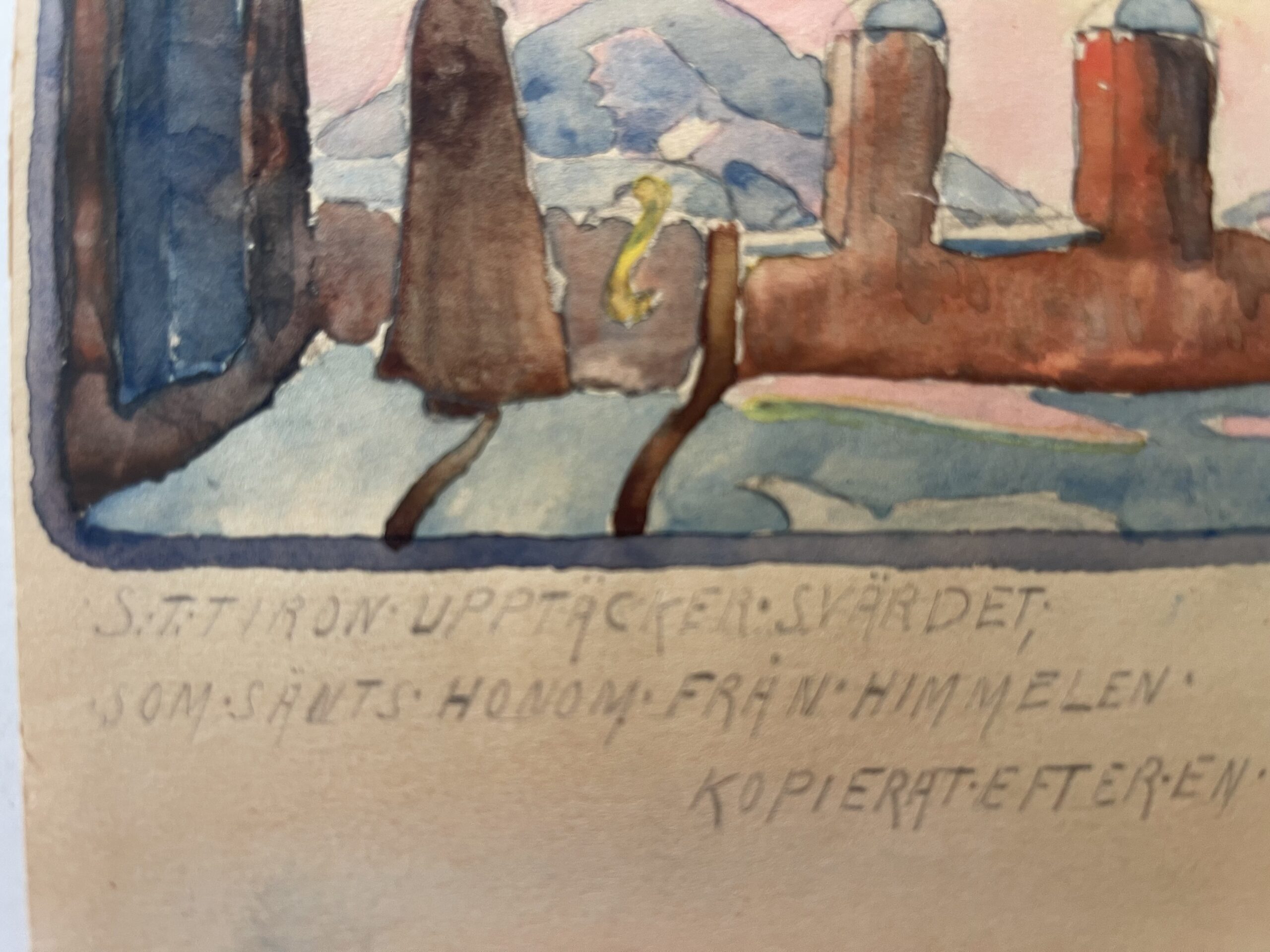
The accompanying handwritten inscription identifies the subject as Saint Tiron receiving a sword sent from heaven.
The original Russian composition is also associated with the theme of a heavenly message, traditionally carried by an arrow.
Nicholas Roerich (1874–1947)
Nicholas Roerich was an important Russian painter, archaeologist, writer and cultural figure whose artistic work was deeply influenced by medieval Russian history, spirituality, legends and ancient architecture.
His paintings are celebrated for their monumental compositions, extraordinary colors and mysterious symbolic atmosphere.
During the early 20th century, Roerich developed a distinctive artistic language combining Russian historical subjects with simplified architectural forms and powerful contrasts of color.
His paintings attracted considerable attention throughout Europe, particularly during his travels and exhibitions in Scandinavia.
The Original Painting of 1917
In 1917, Nicholas Roerich painted a composition entitled Message to Theodore Tiron.
Two versions of this subject are recorded in historical catalogues of the artist’s work.
One of these was formerly associated with a private collection in Stockholm.
A version of the composition was exhibited during Roerich’s Scandinavian exhibitions of 1918–1919.
Roerich subsequently returned to the subject in 1940, producing another version associated with the State Museum of Oriental Art in Moscow.
The Scandinavian Exhibitions of 1918–1919
Nicholas Roerich held an important exhibition at Gummesons Art Gallery in Stockholm from 10 to 30 November 1918.
Further exhibitions followed in Copenhagen and Helsinki during 1919.
These exhibitions introduced Scandinavian audiences to his distinctive representations of Russian legends, medieval architecture and spiritual subjects.
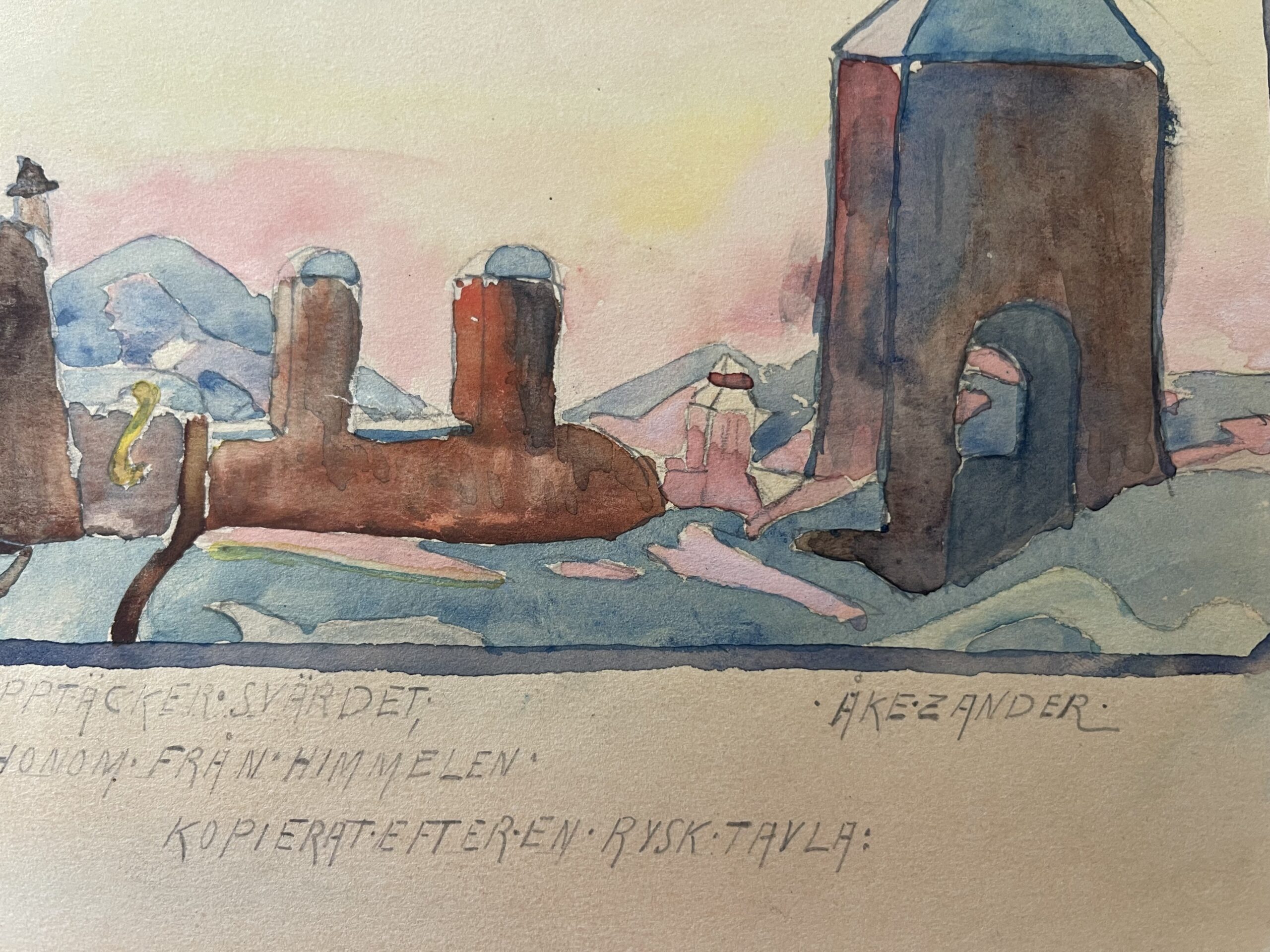
The present watercolor bears handwritten Swedish inscriptions identifying the subject and stating that it was copied after a Russian painting.
Its original paper, handwritten lettering, pictorial technique and the existence of a version of this composition in the Scandinavian exhibition context make a date around 1918–1919 a plausible historical hypothesis.
Although a direct connection with the Stockholm exhibition has not been established, the painting provides an interesting example of the reception and interpretation of Russian Symbolism in Scandinavia.
An Original Hand-Painted Watercolor
This is an individually executed watercolor painting, not a printed reproduction.
The image is characterized by freely drawn architectural outlines, transparent areas of color and a harmonious palette of warm and cool tones.
The simplified treatment of the towers, walls, mountains and solitary figure preserves the symbolic atmosphere of Roerich’s original composition.
A painted border surrounds the image, while handwritten inscriptions and a signature occupy the lower margin.
The work reflects the individual interpretation of its painter rather than a mechanically reproduced image.
Original Swedish Inscriptions
The handwritten inscription beneath the composition reads:
« S TIRON UPPTAGER SVÄRDET, SOM SÄNTS HONOM FRÅN HIMMELEN »
English translation:
« Saint Tiron receives the sword sent to him from heaven. »
A second inscription reads:
« KOPIERAT EFTER EN RYSK TAVLA »
English translation:
« Copied after a Russian painting. »
The work bears a signature reading « Åke Zander » on the lower right.
The identity of the signatory has not yet been independently established.
Historical and Artistic Interest
This watercolor presents a particularly interesting connection between Russian Symbolist painting and Scandinavian artistic culture during the early decades of the 20th century.
The historical exhibition context, Swedish inscriptions, signed composition and distinctive pictorial treatment make the work worthy of attention.
Its small format and atmospheric colors also provide considerable decorative appeal.
Details and Dimensions
- Subject: Saint Theodore Tiron and the heavenly sword
- Original composition: After Nicholas Roerich (1874–1947)
- Original painting: 1917
- Handwritten signature: Åke Zander (reading of signature)
- Proposed date of this watercolor: Circa 1918–1919
- Historical context: Roerich’s Scandinavian exhibitions
- Technique: Original hand-painted watercolor
- Material: Antique paper
- Artistic style: Russian Symbolist influence
- Inscriptions: Swedish, handwritten
- Sheet dimensions: 20 × 17.2 cm (7.87 × 6.77 inches)
- Painted image dimensions: 19.6 × 11.7 cm (7.72 × 4.61 inches)
- Reference: 4252-4R221
Condition
Old watercolor retaining its attractive original colors, painted border and handwritten inscriptions.
The paper presents natural age-related toning, minor surface marks and several old mounting pinholes along the margins.
The painted composition remains well preserved.
Collectors’ Interest
An unusual signed watercolor after Nicholas Roerich, potentially dating from the period of his Scandinavian exhibitions in 1918–1919.
An interesting work for collectors of Russian Symbolism, Scandinavian paintings, Nicholas Roerich, early 20th-century watercolors and historical religious subjects.

Avis
Il n’y a pas encore d’avis.