Description
Waigeo Island Engraving – Pagoda Idols, 1836 4943-70R503-303
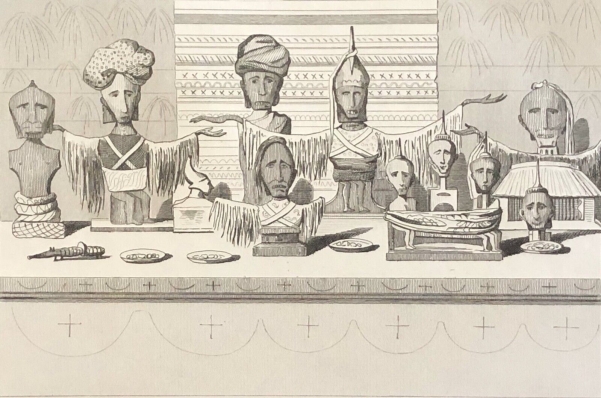
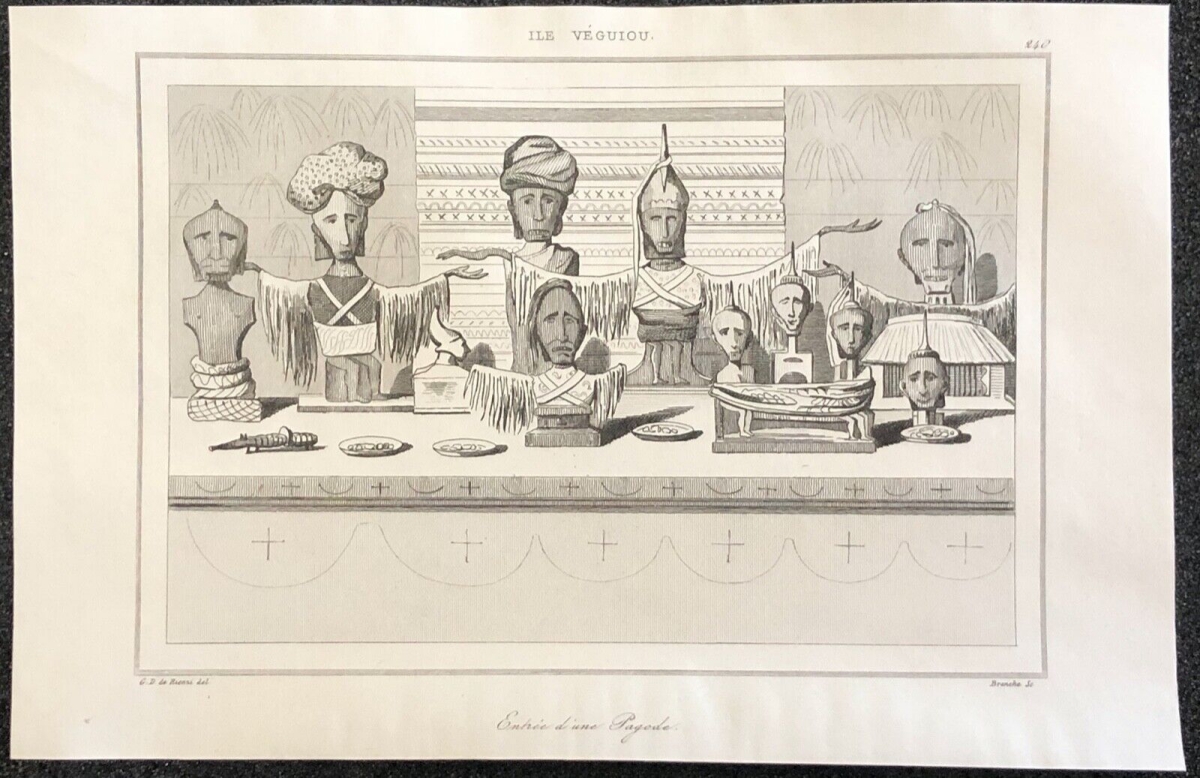
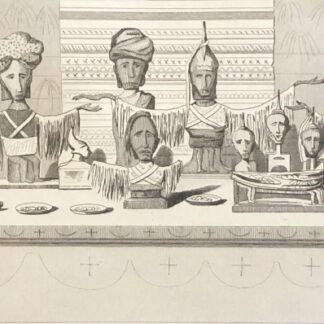
This original Waigeo Island engraving depicts a group of anthropomorphic figures or idols arranged at the entrance of a ceremonial structure described in the original French caption as a “pagoda”.
The plate bears the titles “Île Véguiou” and “Entrée d’une Pagode”. Véguiou is an early French spelling of Waigeo, the largest island in the Raja Ampat archipelago. Waigeo lies west of New Guinea and is now part of Southwest Papua Province, Indonesia.
A 19th-Century Ethnographic Image
The composition shows several carved human figures displayed on a decorated platform. Small objects and apparent offerings are placed before them. The image reflects the terminology and ethnographic interpretation used by European authors during the first half of the 19th century.
It provides an unusual early visual record relating to the religious and material culture of the communities of Waigeo and western New Guinea.
Domeny de Rienzi and Branche
The plate was produced for Grégoire Louis Domeny de Rienzi’s important publication “Océanie ou Cinquième partie du monde”, issued in Paris by Firmin Didot frères in 1836-1837.
The image is attributed to G. L. Domeny de Rienzi and was engraved by Branche. The fine, closely spaced lines and delicate tonal effects are characteristic of steel engraving, a technique widely employed for illustrated geographical and ethnographic publications during this period.
Details
Original title: Île Véguiou – Entrée d’une Pagode
Modern location: Waigeo Island, Raja Ampat, Indonesia
Region: Southwest Papua
Author and artist: G. L. Domeny de Rienzi
Engraver: Branche
Publisher: Firmin Didot frères, Paris
Date: 1836-1837
Technique: steel engraving
Sheet dimensions: 19 × 12.4 cm
Engraved image: 14.8 × 10.2 cm
Period: 19th century
Avis
Il n’y a pas encore d’avis.