
Description
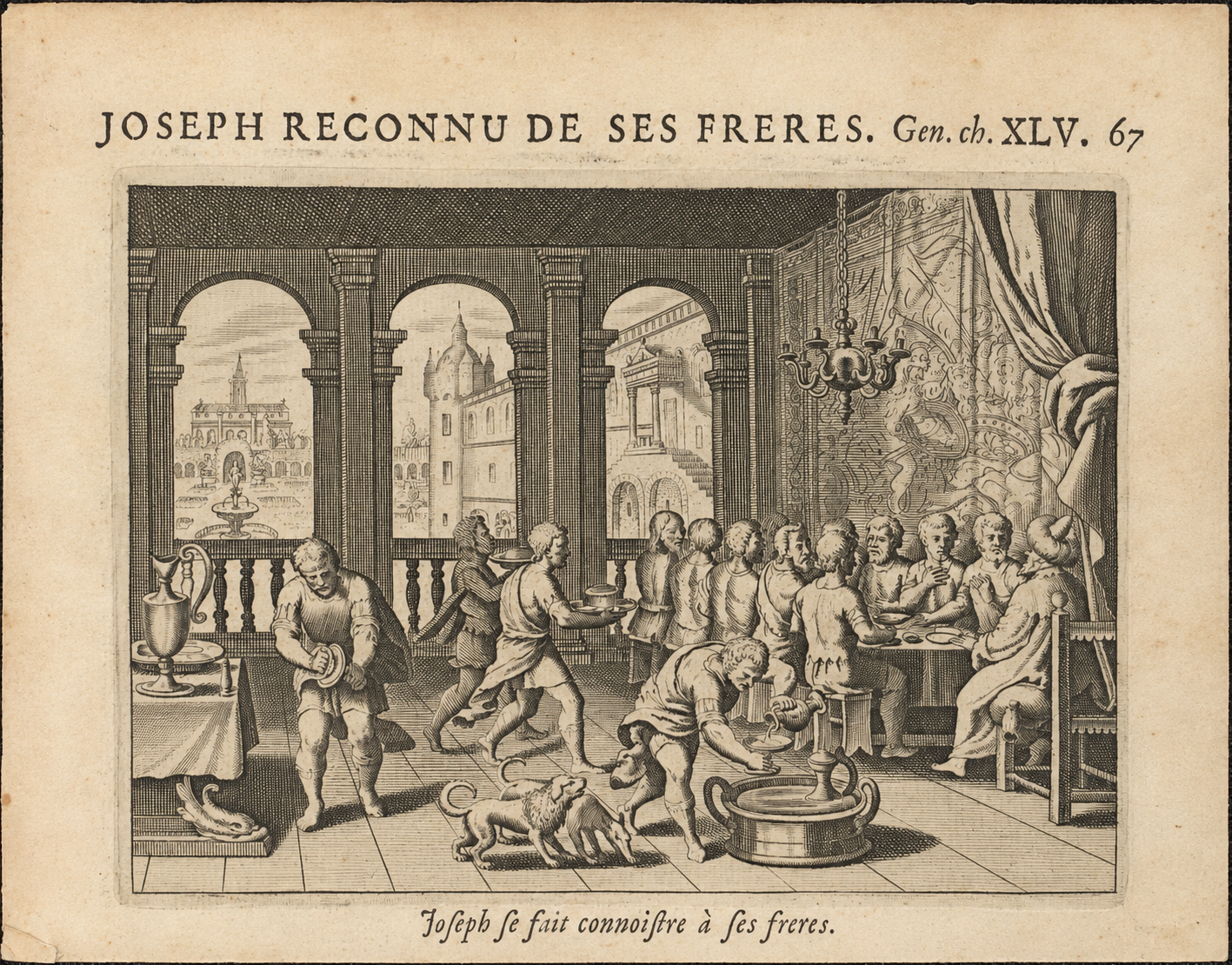
Egypt circa 1672 – Joseph Reveals His Identity to His Brothers – Original Seventeenth-Century French Biblical Copper Engraving after Matthäus Merian the Elder (1593–1650).
Artculture6 presents this beautiful seventeenth-century biblical engraving, produced in Paris between 1671 and 1674, depicting one of the most moving episodes of the Old Testament.
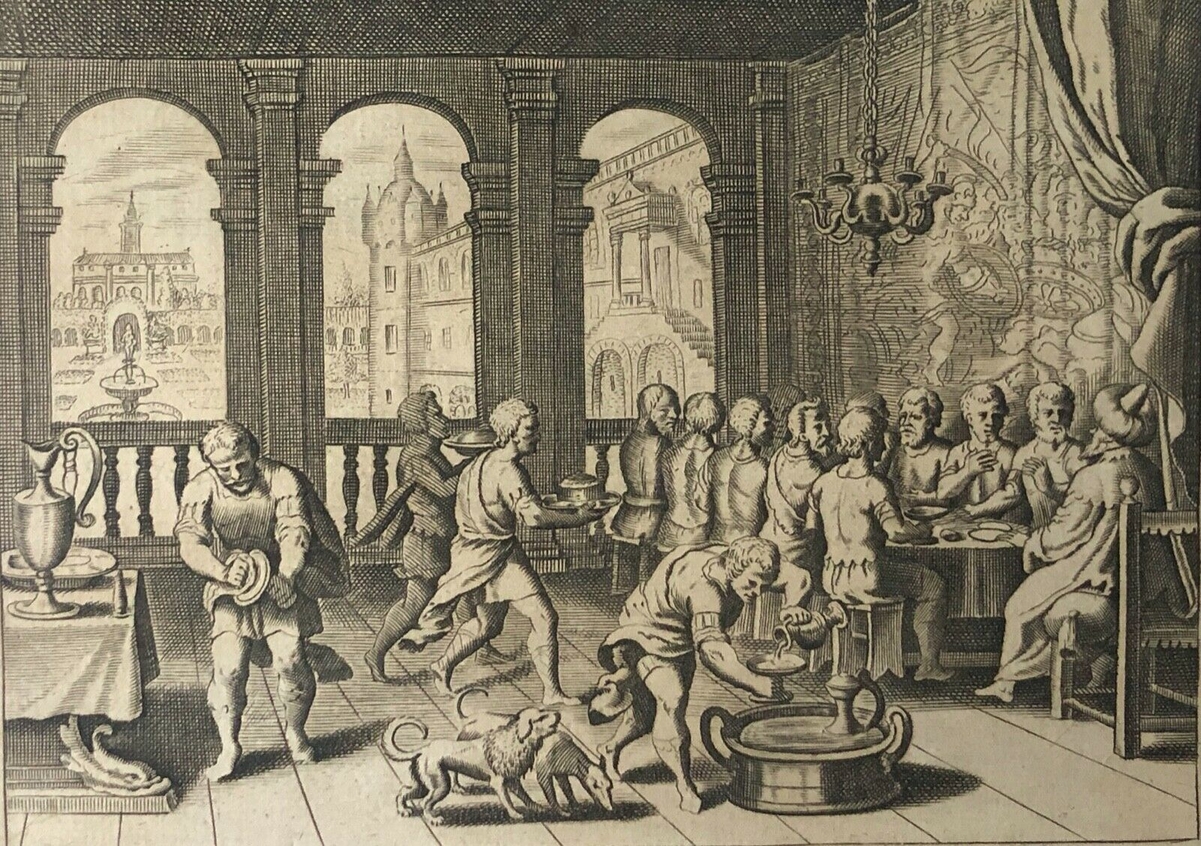
Entitled “Joseph Recognised by His Brothers”, the composition illustrates the moment when Joseph finally reveals his identity to the brothers who had sold him into slavery many years earlier.
The original French inscription reads:
“JOSEPH RECONNU DE SES FRERES. Gen. ch. XLV.”
Below the image appears a second inscription:
“Joseph se fait connoître à ses frères.”
The scene is associated with the compositions of Matthäus Merian the Elder (1593–1650), the celebrated Swiss-born German engraver and publisher.
The engraving was printed on seventeenth-century laid paper, with chain lines spaced approximately 2.7 cm apart.
Its richly detailed architecture, numerous figures and elaborate interior setting make this an attractive example of early European biblical printmaking.
JOSEPH AND HIS BROTHERS – A GREAT STORY FROM THE BOOK OF GENESIS
The story of Joseph is one of the most celebrated narratives of the Old Testament.
Joseph was one of the twelve sons of Jacob and the first son of Rachel.
According to the biblical account, Jacob showed particular affection towards Joseph.
This preference provoked jealousy among his brothers.
Their resentment increased when Joseph described dreams that seemed to suggest that his family would one day bow before him.
Eventually, his brothers decided to get rid of him.
Joseph was sold into slavery and taken to Egypt.
There, he endured many difficulties before achieving an extraordinary rise to power.
Through his ability to interpret dreams, Joseph came to the attention of Pharaoh.
He correctly interpreted the ruler’s dreams as predicting seven years of abundance followed by seven years of famine.
Joseph was entrusted with organising the country’s food reserves in preparation for the coming crisis.
He eventually became one of the most powerful officials in Egypt.
THE FAMINE AND THE JOURNEY TO EGYPT
When famine affected the surrounding territories, Jacob sent his sons to Egypt to purchase grain.
The brothers appeared before Joseph without recognising him.
Many years had passed since they had sold him into slavery.
Joseph had become a powerful Egyptian official, dressed and positioned very differently from the young man they remembered.
He recognised his brothers immediately.
However, he initially concealed his identity.
Through a series of meetings and tests, Joseph gradually discovered the changes that had taken place within his family.
The dramatic climax occurs in Genesis, chapter 45, when Joseph finally reveals who he is.
JOSEPH REVEALS HIS IDENTITY – GENESIS CHAPTER 45
The engraving illustrates the famous moment of recognition and reconciliation.
Joseph’s brothers discover that the powerful Egyptian official standing before them is their own brother.
The revelation is particularly dramatic because they had believed Joseph was lost to them.
The biblical narrative describes their astonishment and fear.
Joseph, however, does not seek revenge.
Instead, he explains that his presence in Egypt has enabled him to preserve many lives during the famine.
He forgives his brothers and invites them to bring their father Jacob and the rest of the family to Egypt.
This episode became an important symbol of forgiveness, reconciliation and divine providence.
It has inspired numerous painters, engravers and illustrators throughout European art history.
A BEAUTIFUL SEVENTEENTH-CENTURY PALACE INTERIOR
The engraving presents the biblical event within an elaborate architectural setting.
The scene unfolds inside a large palace hall.
On the right, a group of figures is gathered around a table.
Several men are seated, while others stand nearby.
Their gestures and expressions suggest conversation and the unfolding of an important encounter.
The figures wear long garments and draped clothing characteristic of seventeenth-century interpretations of biblical antiquity.
On the left, servants move through the interior.
One figure carries dishes or other objects.
Another attendant is occupied near a large vessel.
Two dogs appear in the foreground.
These small details contribute to the liveliness and narrative richness of the composition.
THREE MONUMENTAL ARCHES OPENING TOWARDS THE CITY
One of the most remarkable aspects of the engraving is its architectural perspective.
Three large arches open from the palace towards an imaginary city.
Beyond the arches, the viewer can distinguish a variety of buildings.
Towers, domes, façades and a courtyard fountain create a complex urban landscape.
The architecture combines elements familiar from European Renaissance and Baroque design.
Rather than providing an archaeologically accurate reconstruction of ancient Egypt, the artist presents an imaginative historical setting.
This approach was characteristic of biblical illustration during the seventeenth century.
The architecture gives considerable depth to the scene and creates an impressive contrast with the figures in the foreground.
A RICHLY DECORATED INTERIOR
The palace contains numerous decorative details.
On the right, a large hanging textile or tapestry occupies much of the wall.
Its surface is covered with ornamental patterns and figurative decoration.
An elaborate chandelier hangs above the gathering.
The floor is represented by carefully arranged perspective lines.
On the left, a table covered with a cloth supports a large ewer and other objects.
Near the foreground, a servant works beside an ornamental basin.
These objects demonstrate the artist’s interest in the domestic and ceremonial aspects of the biblical narrative.
The variety of textures and architectural forms makes the composition particularly attractive.
MATTHÄUS MERIAN THE ELDER (1593–1650)
Matthäus Merian the Elder was born in Basel, Switzerland, in 1593.
He became one of the most important engravers and publishers working in German-speaking Europe during the first half of the seventeenth century.
He trained in Zurich and later travelled to Strasbourg and France, where he developed his skills in drawing and copper engraving.
Merian became particularly celebrated for his remarkable topographical views of European cities.
He also produced religious, historical and biblical illustrations.
His works are characterised by carefully constructed architectural perspectives, detailed landscapes and precise engraved linework.
Merian’s compositions circulated widely throughout Europe.
His artistic influence continued long after his death in 1650.
He was also the father of Maria Sibylla Merian (1647–1717), the celebrated naturalist and artist known for her studies of insects and plants.
A FRENCH BIBLICAL ENGRAVING OF THE SEVENTEENTH CENTURY
During the seventeenth century, copper engraving played an essential role in the dissemination of religious imagery.
Biblical stories were illustrated by accomplished artists who combined historical narrative with elaborate architectural settings.
Prints provided a means of making important religious compositions available to a wider public.
The present engraving belongs to this tradition.
Its French inscriptions identify the biblical episode and the relevant chapter of Genesis.
The composition is based on the artistic tradition associated with Matthäus Merian.
The Parisian edition is dated between 1671 and 1674.
The engraving therefore belongs to a period when Merian’s artistic compositions continued to circulate after his death.
THE ART OF COPPER ENGRAVING
The engraving was produced using the traditional technique of copper intaglio printing.
Fine lines cut into a copper plate retain the printing ink.
The plate is then printed under pressure onto a sheet of paper.
This process allows the engraver to create a remarkable variety of tonal values and intricate details.
In the present composition, the architectural structures are represented through carefully organised parallel lines.
The darker areas are obtained by closely spaced engraving and cross-hatching.
The figures are rendered through delicate contours and subtle shading.
The hanging textile, chandelier and palace furnishings demonstrate the technical precision of the engraving.
The perspective of the three arches provides depth, while the distant buildings are treated with lighter strokes.
The result is an attractive and finely detailed biblical image.
ORIGINAL SEVENTEENTH-CENTURY LAID PAPER
The engraving is printed on antique laid paper.
The paper presents visible chain lines spaced approximately 2.7 cm apart.
These lines are a characteristic feature of traditional handmade European paper.
They reflect the structure of the papermaking mould used during manufacture.
The sheet possesses the natural patina and tonal variations associated with historical paper.
The paper itself adds considerable material interest to the engraving.
For collectors and historians of early printmaking, the combination of printed image and original paper characteristics provides an attractive object of study.
THE SYMBOLISM OF FORGIVENESS AND RECONCILIATION
The biblical story of Joseph has a particularly powerful moral significance.
After suffering betrayal and separation, Joseph rises to an important position in Egypt.
When his brothers finally return, he possesses the authority to punish them.
Instead, he chooses forgiveness.
He recognises the importance of preserving his family and providing food during the famine.
The story therefore combines several major biblical themes: betrayal, providence, compassion, reconciliation and family unity.
Its emotional significance explains why the episode became a popular subject in European religious art.
The present engraving offers a visually rich seventeenth-century interpretation of this important narrative.
A BEAUTIFUL WORK OF EARLY EUROPEAN RELIGIOUS ART
The engraving combines a memorable biblical subject with an elaborate architectural composition.
The three monumental arches create a distinctive setting.
The figures are distributed throughout the palace interior, producing an animated narrative scene.
The richly decorated hanging textile, chandelier, domestic objects and small animals provide additional visual interest.
The engraver’s precise linework enhances the architectural and figurative details.
Its association with Matthäus Merian and its seventeenth-century French printing make the sheet particularly interesting for collectors of antique religious engravings.
DIMENSIONS AND TECHNICAL DETAILS
Subject: Joseph reveals himself to his brothers.
Biblical reference: Genesis, chapter 45.
Historical setting represented: Ancient Egypt.
Original composition: After Matthäus Merian the Elder (1593–1650).
Place of edition: Paris, France.
Edition period: 1671–1674.
Historical period: Seventeenth century.
Technique: Copper intaglio engraving, burin.
Support: Antique laid paper.
Chain-line spacing: Approximately 2.7 cm.
Sheet dimensions: 18 × 14.2 cm.
Engraved image dimensions: 14.7 × 10.5 cm.
Printed title: “JOSEPH RECONNU DE SES FRERES”.
Additional inscription: “Joseph se fait connoître à ses frères”.

Avis
Il n’y a pas encore d’avis.