Goumois ? Swiss Jura France Doubs River Village Original 19th Century Drawing
69,00 €
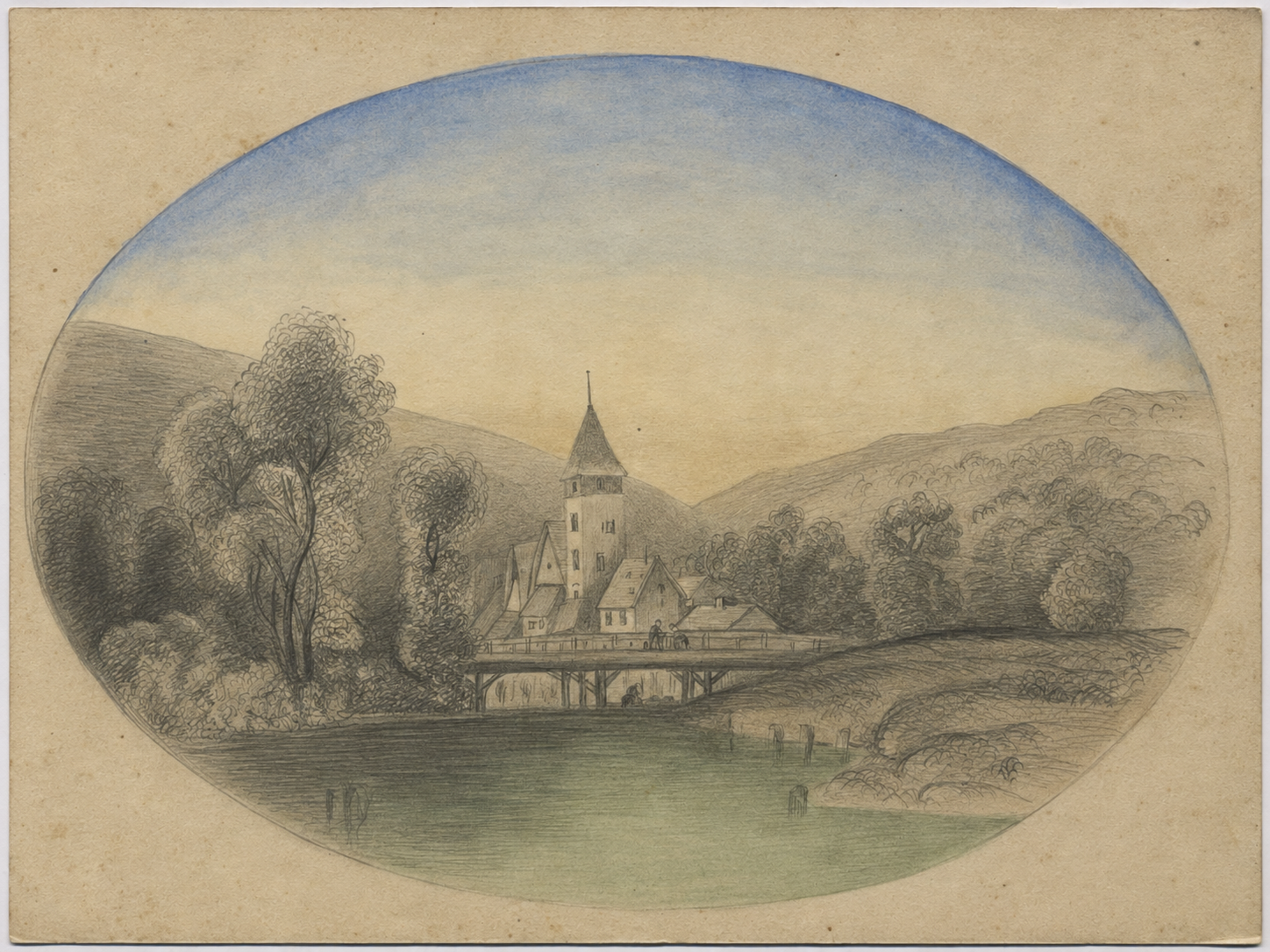
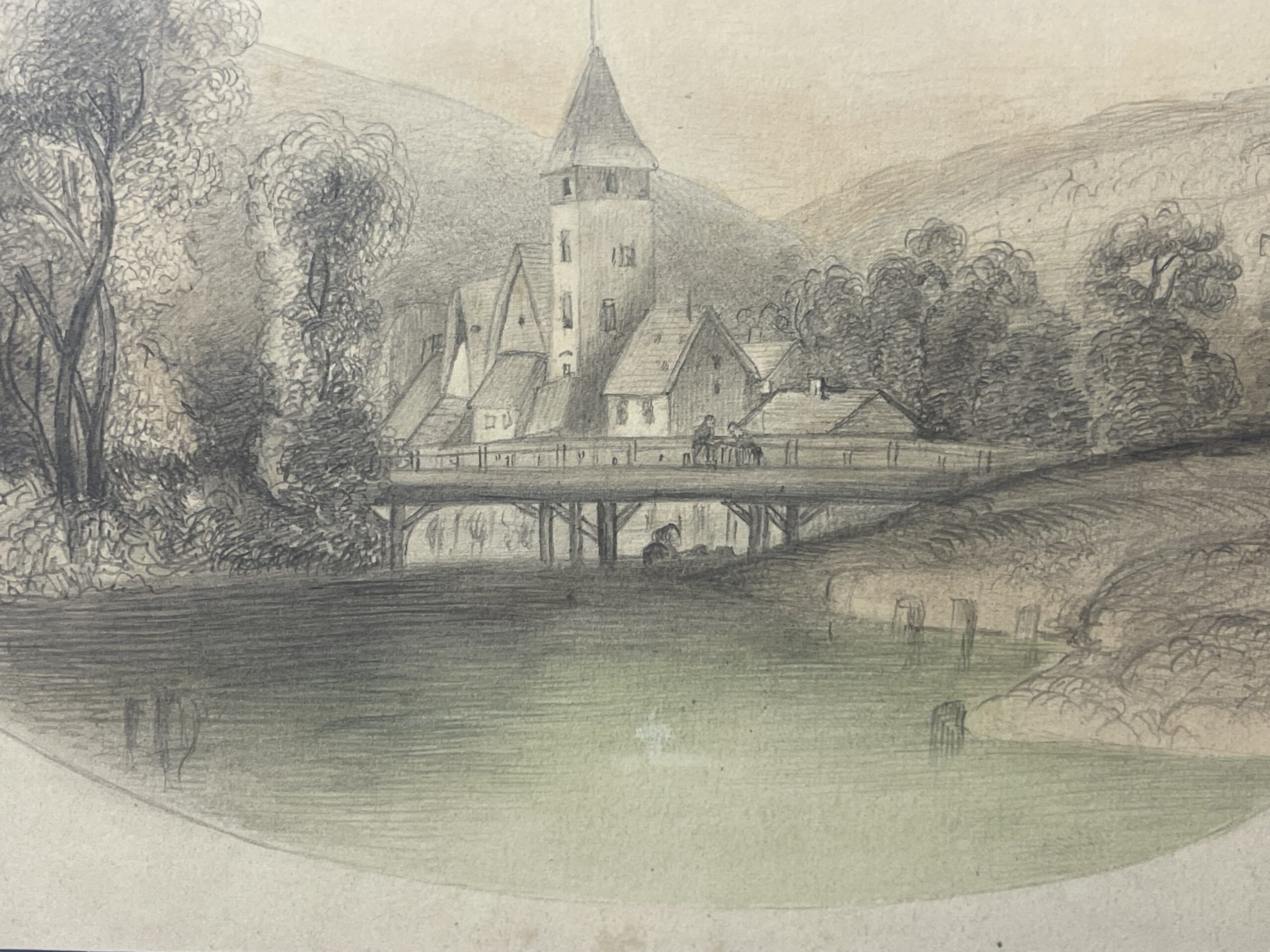
Original nineteenth-century graphite landscape drawing with delicate blue and green colour highlights, possibly depicting Goumois in the French-Swiss Jura, on the Doubs River.
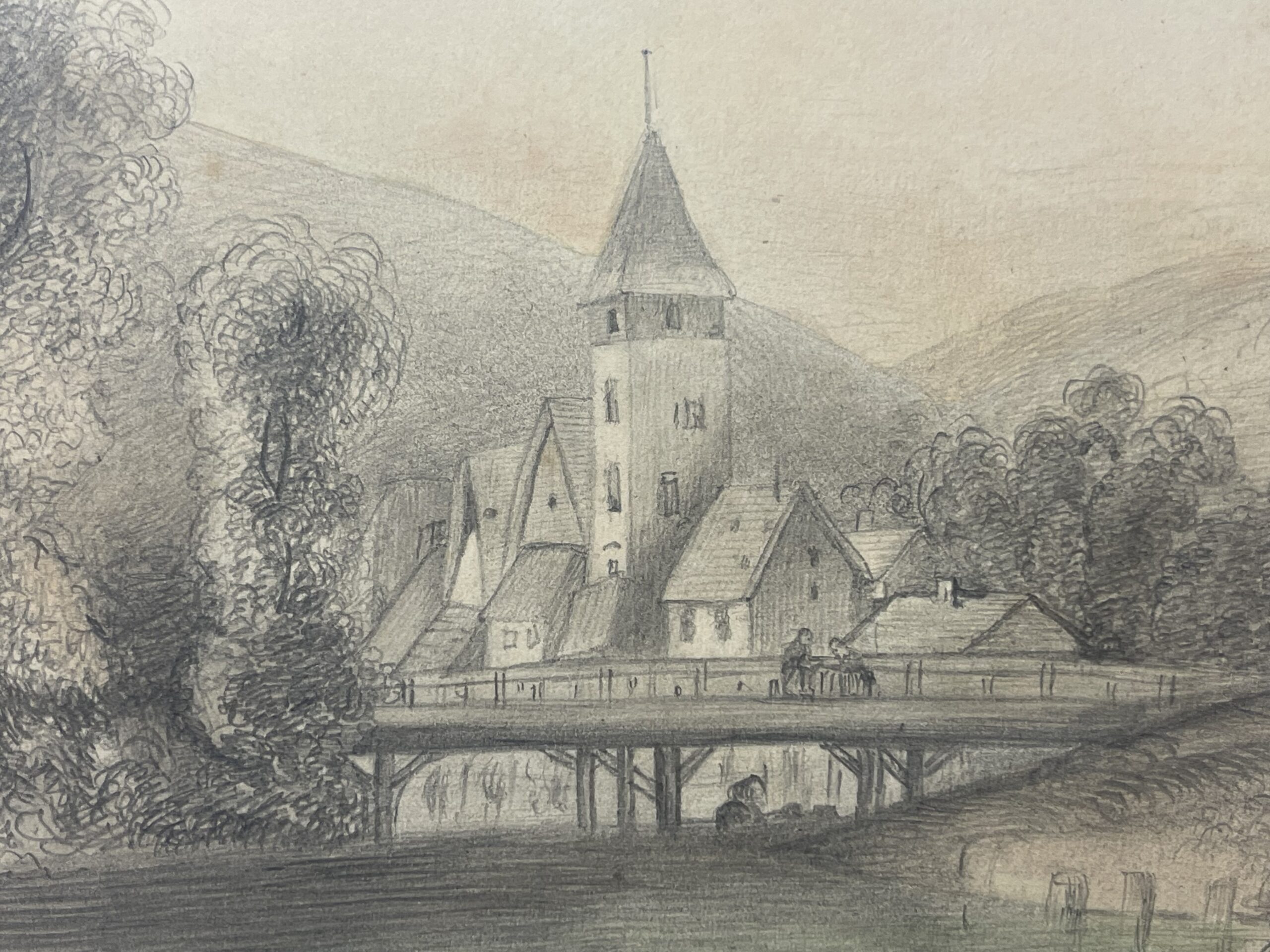
A picturesque village dominated by a square tower with a steep pyramidal roof, traditional houses, wooded hills and a wooden bridge supported by timber structures.
An almost identical composition has been identified in another drawing advertised as dated 1886.
Location: Goumois, Jura, France–Switzerland (proposed identification).
Technique: Graphite with colour highlights on paper.
Period: Probably 19th century.
Sheet: 27 × 20 cm.
Reference: 4821R488.
Description
Goumois ? Swiss Jura – Doubs River Village – Original 19th Century Graphite Landscape Drawing
Beautiful nineteenth-century original hand-drawn landscape, possibly representing Goumois, a historic village situated on the Doubs River at the border between France and Switzerland.
Artculture6 presents this attractive antique drawing executed in graphite with delicate blue and green colour highlights, depicting a picturesque riverside village surrounded by wooded hills.
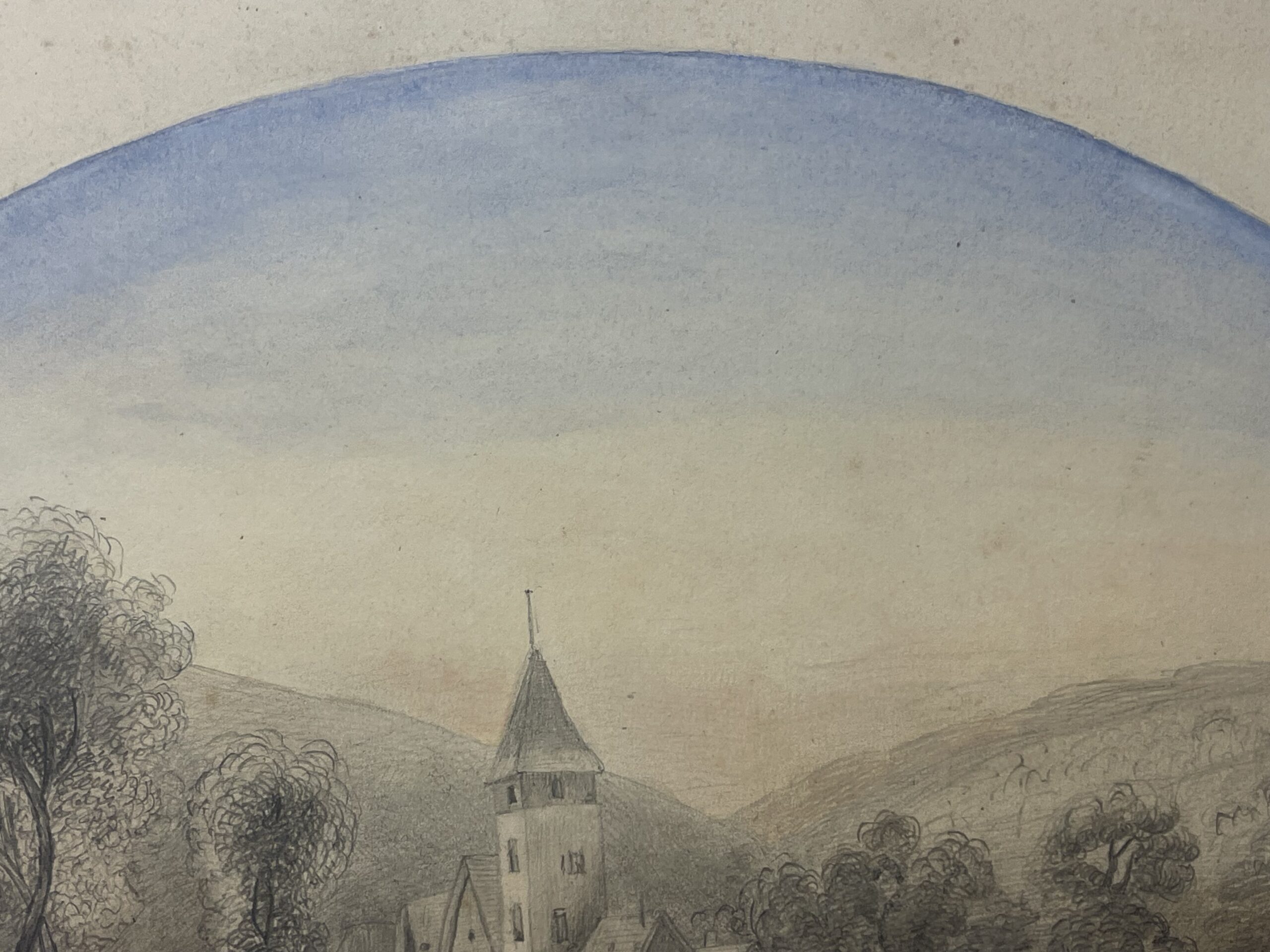
The composition is arranged within an elegant oval frame and features a group of traditional houses, a tall square tower with a pyramidal roof, and a wooden bridge crossing the river.
The detailed architecture, distinctive bridge construction and peaceful mountainous setting make this an especially interesting example of nineteenth-century European landscape drawing.
A HISTORIC VILLAGE IN THE JURA REGION
The village occupies the centre of the composition, standing on the bank of a broad river.
A tall rectangular tower rises above the surrounding buildings. Its steep pyramidal roof, narrow openings and prominent silhouette give the village a distinctive architectural character.
Several traditional houses are grouped closely around the tower. Their steeply pitched roofs and compact arrangement evoke the rural architecture of the Jura Mountains and neighbouring regions of eastern France and Switzerland.
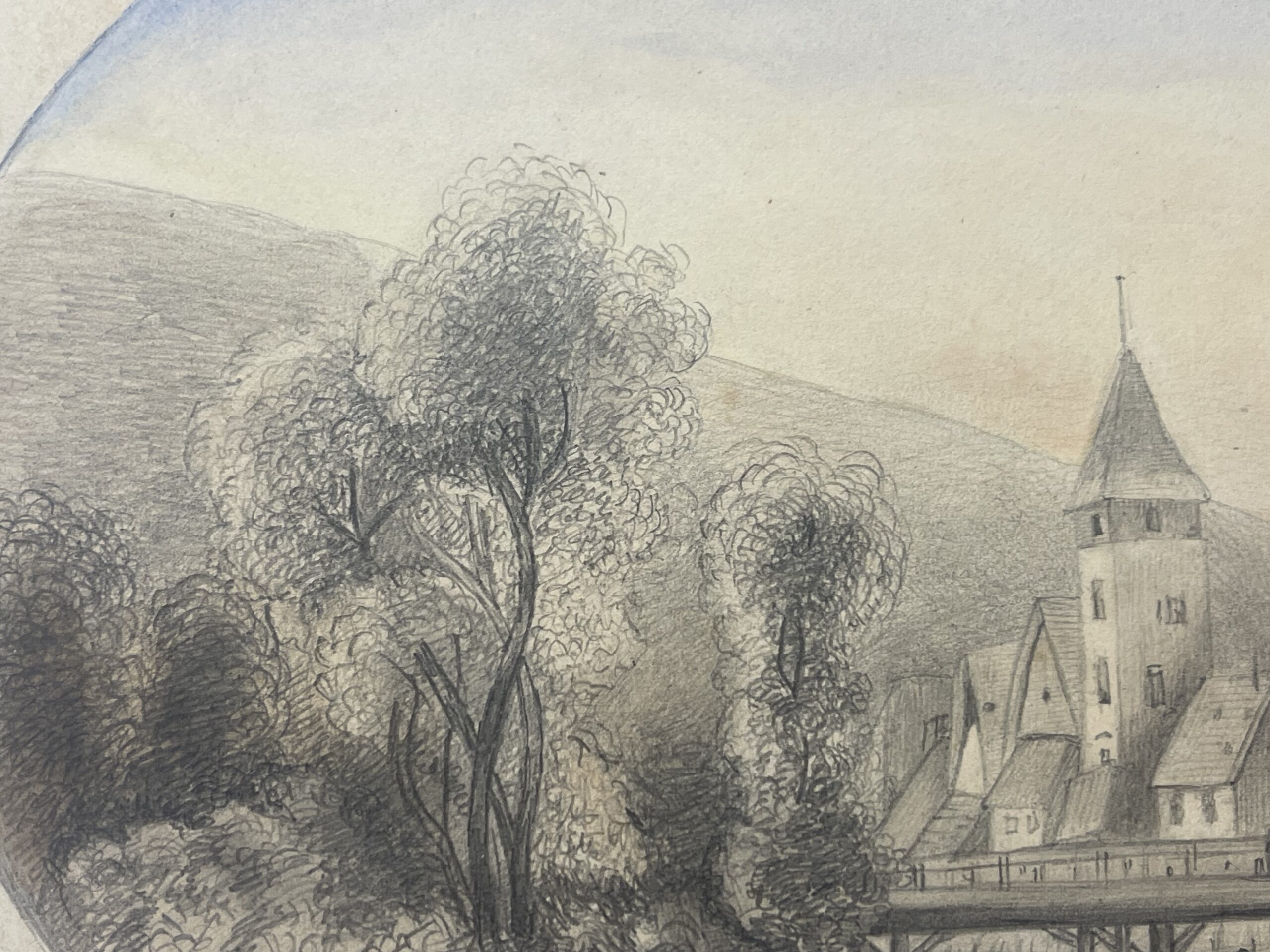
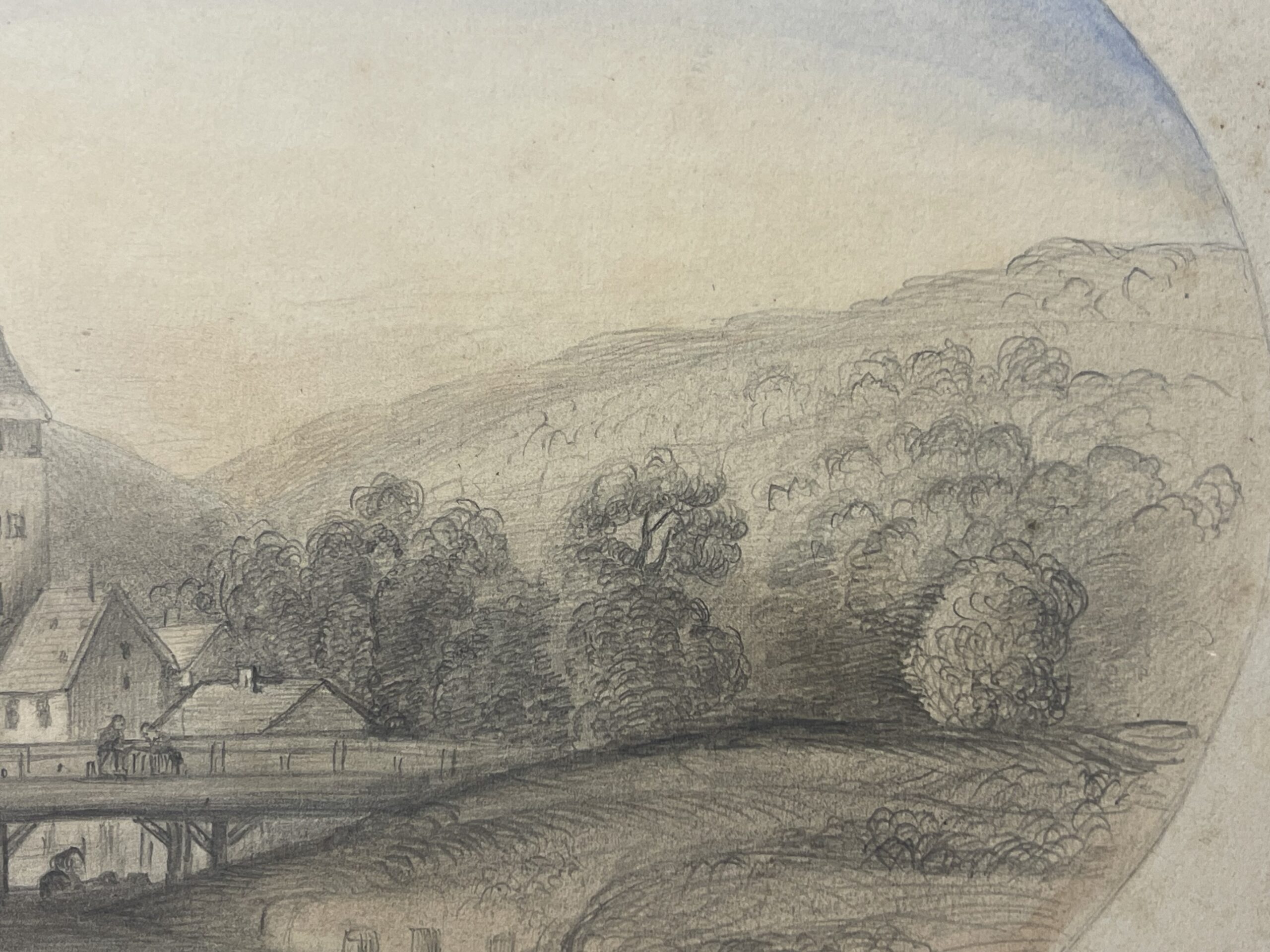
The buildings stand beneath wooded hills, creating a harmonious contrast between the geometric architecture and the surrounding natural landscape.
The artist has carefully rendered the houses, rooflines and architectural details using delicate graphite strokes.
THE WOODEN BRIDGE AND RIVER
One of the most interesting elements of the drawing is the wooden bridge extending across the foreground.
The bridge is supported by a series of slender vertical timber structures with diagonal braces.
The individual supports and the construction of the bridge are clearly distinguished, suggesting an attentive observation of traditional bridge architecture.
Beneath the bridge, the river is represented by fine horizontal graphite lines, enhanced with subtle green colouring.
The gently flowing water occupies the foreground, leading the viewer’s eye towards the village and its prominent tower.
The wooden structure is particularly significant in the context of historic river crossings in the Jura region.
GOUMOIS AND THE DOUBS VALLEY — POSSIBLE IDENTIFICATION
The geographical characteristics of the drawing suggest a location in the Jura region, between eastern France and western Switzerland.
One particularly interesting possibility is Goumois, a historic border village situated on the Doubs River.
Goumois extends across the French and Swiss banks of the river, with its historic buildings set within a wooded valley.
The French side contains an old church with a square bell tower, while the surrounding landscape is characterised by steep wooded slopes and traditional village architecture.
Historic records also document successive bridges across the Doubs at Goumois during the nineteenth century.
Earlier wooden structures preceded later bridge constructions, making the representation of timber supports in this drawing particularly interesting.
The architectural arrangement, river setting and mountainous surroundings offer several points of comparison with Goumois.
However, the precise identity of the village has not been established, and the proposed location must be considered tentative.
A COMPOSITION ALSO KNOWN FROM ANOTHER NINETEENTH-CENTURY DRAWING
Research into this landscape has revealed another drawing with an almost identical composition, advertised as signed Marie Croizet and dated 1886.
The arrangement of the square tower, houses, wooden bridge, trees and surrounding hills closely resembles the present example.
This striking similarity suggests that both drawings may have been based on a common earlier model, possibly a printed landscape study, lithograph or drawing used for artistic instruction.
Such models were widely circulated among artists and amateur draughtsmen during the nineteenth century.
The present drawing is distinguished by its restrained colour highlights and carefully balanced oval composition.
The original source of the composition has not yet been identified.
GRAPHITE TECHNIQUE AND DELICATE COLOUR HIGHLIGHTS
The drawing displays careful pencil work throughout the landscape.
The architectural details are represented through precise linear strokes, while the trees and wooded hills are rendered with softer shading and finely layered marks.
The artist has used light blue colouring in the sky and delicate green tones in the river.
These subtle additions enhance the atmospheric quality of the landscape without obscuring the graphite drawing.
The large oval surrounding the composition lends the work an elegant decorative character associated with traditional landscape studies.
THE LANDSCAPE AND ITS ARCHITECTURE
The composition is particularly attractive for the relationship between its architectural and natural elements.
The tall central tower dominates the small group of houses, while the bridge introduces a strong horizontal element across the river.
Trees on either side frame the village and direct attention towards the central buildings.
The softly shaded hills create depth and establish the setting of a quiet mountain valley.
The result is a charming nineteenth-century European landscape, combining architectural interest with a peaceful rural atmosphere.
TECHNICAL DETAILS
Subject: Historic European riverside village with square tower, wooden bridge and wooded hills.
Possible location: Goumois, Doubs Valley, French-Swiss Jura.
Region: Jura Mountains, France–Switzerland border.
Period: Probably nineteenth century.
Technique: Original hand-drawn graphite with blue and green colour highlights.
Artist: Unidentified.
Composition: Oval landscape.
Support: Paper.
Sheet dimensions: 27 × 20 cm.
Reference: 4821R488.
CONDITION
Antique sheet displaying the natural patina of aged paper.
The graphite drawing and delicate colour highlights remain well preserved.
Photographs of the front, reverse and architectural details are provided.
COLLECTOR’S INTEREST
An appealing antique European landscape drawing of particular interest to collectors of Swiss and French regional views, Jura landscapes, historic river crossings and traditional village architecture.
The possibility of identifying the village as Goumois, together with the existence of a closely related nineteenth-century drawing, adds an interesting historical and topographical dimension to this work.
An attractive example of traditional landscape drawing, combining architectural detail, careful graphite technique and subtle colour highlights.
Offered by Artculture6 – Antique Prints, Original Drawings and Works of Art.



Avis
Il n’y a pas encore d’avis.